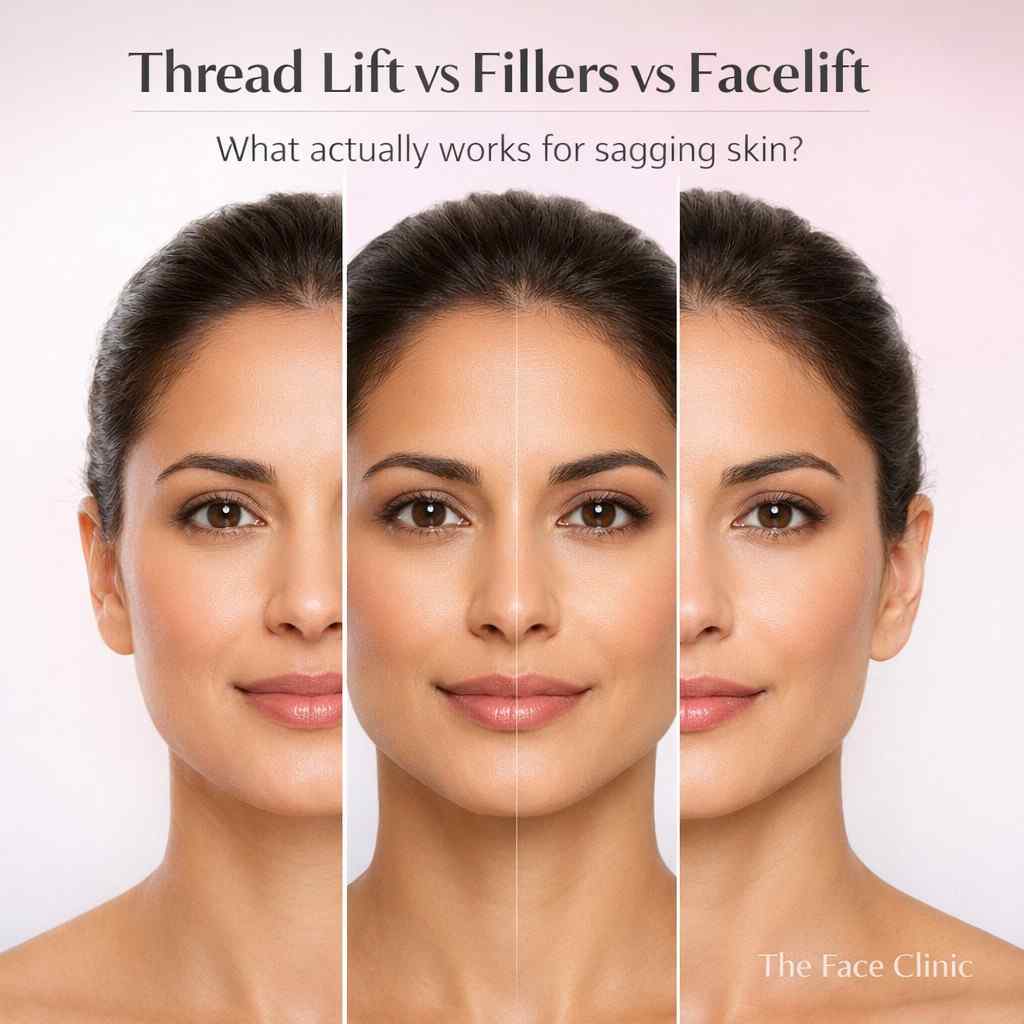
Thread Lift vs Facelift vs Fillers: What Actually Works for Sagging Skin? (Doctor’s Guide 2026)
Choosing between a thread lift, fillers, or surgery is one of the most misunderstood decisions in aesthetic medicine — and often the reason patients end up with suboptimal results.
If you are noticing early jowls, facial heaviness, or loss of definition, this guide explains what actually works — and what doesn’t — based on clinical decision-making, not trends.
Thread Lift Overview (Quick Decision Guide)
- Thread Lift: Best for mild to moderate skin laxity with subtle lifting and collagen support
- Dermal Fillers: Best for volume loss, hollowing, and contour restoration
- Facelift Surgery: Best for advanced sagging requiring structural repositioning
The correct choice depends on what is driving the sagging — skin laxity, volume loss, or structural descentDoctor’s Note
In clinical practice, the decision between thread lift, fillers, or surgery is not based on trends. It is based on structural diagnosis — skin laxity, volume loss, and tissue behaviour.
A personalised, anatomy-based approach consistently delivers the most natural and reliable outcomes.
Why Sagging Skin Happens (Beyond Age Alone)
Facial ageing is multi-layered — not just a surface concern.
Collagen decline → reduced firmness and elasticity
Collagen decline is one of the primary biological drivers of skin ageing and loss of firmness.
Fat redistribution → hollowing in some areas, heaviness in others
Ligament laxity → descent of facial tissues (jowls, folds)
Post-weight loss changes → increased skin laxity, especially after rapid fat loss


What Is a Thread Lift — And How It Actually Works


Facial ageing is driven by collagen decline, shifting fat, and weakening support structures — not just surface skin changes.
What Is a Thread Lift — And How It Actually Works
A thread lift is a minimally invasive, doctor-performed procedure designed to reposition soft tissue and stimulate collagen.
Thread lifts create a temporary lifting scaffold while stimulating collagen production, a process supported by dermatological research on skin regeneration.
Mechanism:
- Threads are placed using precise lifting vectors
They create an immediate mechanical lift
- Over time, they stimulate collagen production, improving skin quality
Thread Types and Vector Placement
Different thread types (such as PDO or PLLA) and vector placement strategies influence both lift quality and longevity.
Key characteristics:
Subtle, natural-looking lift
Minimal downtime
Progressive improvement over time
- Typical longevity: 12–24 months
treatment in Delhi focuses on vector planning, tissue behaviour, and facial balance — not just thread placement.
Thread Lift vs Fillers: Understanding the Real Difference
Factor | Thread Lift | Dermal Fillers |
|---|---|---|
Primary role | Lift sagging tissue | Restore lost volume |
Mechanism | Mechanical lift + collagen | Volume replacement |
Best areas | Jawline, jowls, lower face | Cheeks, under-eyes, temples |
Result | Subtle lifting | Contour and plumping |
Longevity | 12–24 months | 6–18 months |
Downtime | Minimal | Minimal |
Reversibility | Not easily reversible | Reversible |


In many cases, combining lift and volume correction produces the most natural outcome.
Thread Lift vs Surgical Facelift
Factor | Thread Lift | Facelift Surgery |
|---|---|---|
Approach | Non-surgical | Surgical |
Downtime | 1–3 days | 2–3 weeks |
Anaesthesia | Local | General |
Results | Subtle, refined | Dramatic, structural |
Ideal stage | Early ageing | Advanced ageing |
Surgical facelifts reposition deeper structural layers (SMAS), which is why they deliver more dramatic and longer-lasting results, as explained in facelift surgery concepts.
When a Thread Lift Works Best (Ideal Candidates)
Thread lifts deliver the most predictable and natural results when used in carefully selected patients with specific patterns of ageing:
Early Jowls and Loss of Jawline Definition
Patients with early descent along the jawline often benefit from lifting vectors that restore contour without adding volume.
Mild to Moderate Skin Laxity with Preserved Elasticity
Thread lifts are most effective when the skin retains enough elasticity to respond to repositioning and collagen stimulation.
Patients Seeking Subtle, Natural-Looking, Non-Surgical Lifting
This approach is ideal for individuals who prefer gradual, refined improvement rather than dramatic or surgical change.
Early to Moderate Stages of Facial Ageing (Not Strictly Age-Dependent)
Suitability depends more on tissue behaviour and skin quality than chronological age alone.
Facial Sagging Following Weight Loss or Volume Changes
Patients experiencing mild laxity after weight reduction often benefit from structural repositioning without the need for surgery.
In these scenarios, the skin and underlying tissues still have sufficient structural support to respond effectively to lifting vectors and collagen stimulation.
However, not all forms of sagging respond equally to thread lifting.
When a Thread Lift Is NOT the Right Choice (Limitations & Unsuitable Cases)
A thread lift may not deliver satisfactory or predictable results when used beyond its ideal clinical indications:
Severe Skin Laxity and Excess Loose Skin
Patients with significant skin redundancy often require surgical correction, as threads cannot remove or tighten large amounts of excess skin.
Heavy or Markedly Descended Facial Tissues
When facial tissues have advanced descent, lifting with threads alone may not provide sufficient structural repositioning.
Advanced Stages of Facial Ageing
In later stages of ageing, deeper structural changes limit the effectiveness of minimally invasive lifting techniques.
Expectations Similar to Surgical Facelift Outcomes
Thread lifts provide subtle, natural lifting — not the dramatic correction achieved with surgical facelift procedures.
Attempting a thread lift in these scenarios often leads to underwhelming results — not because the treatment fails, but because it is being applied beyond its appropriate indication.
Risks, Limitations & Safety Considerations
Thread lifts are generally safe when performed by experienced practitioners, but like all medical procedures, they have limitations and potential risks that should be clearly understood:
Temporary Nature of Results (Key Limitation)
Thread lifts provide non-permanent lifting, with results typically lasting 12–24 months as the threads gradually dissolve and the lifting effect softens over time.
Common Temporary Effects
Mild swelling, bruising, tenderness, or temporary skin irregularities (such as dimpling) may occur and usually resolve within a few days.
Rare but Possible Complications
In uncommon cases, complications such as asymmetry, infection, or thread-related issues (including migration or visibility) may occur.
Importance of Sterile Technique and Aftercare
Most side effects are temporary and resolve quickly when the procedure is performed under proper sterile conditions and followed by appropriate post-procedure care.
Outcomes Are Highly Technique-Dependent
Results depend significantly on doctor expertise, anatomical understanding, and precise placement techniques, making practitioner experience a critical factor.
Thread Lift Results Timeline: What to Expect
Thread lift results evolve over time, with both immediate mechanical lifting and gradual collagen stimulation contributing to the final outcome.
Immediate Results (Mechanical Lifting Effect)
A visible lift is seen immediately after the procedure due to tissue repositioning along planned vectors.
Early Phase (4–12 Weeks – Collagen Stimulation)
During this phase, collagen production increases, improving skin quality, firmness, and overall texture.
Peak Results (3–6 Months – Natural Integration)
Results become more refined and natural as collagen support stabilises and tissues adapt to their new position.
Maintenance Phase (12–18 Months – Gradual Softening)
As threads dissolve and ageing continues, the lifting effect gradually softens, although some collagen-related improvement may persist.
Thread Lift Cost Comparison Across Countries (Context Only)
Thread lift costs vary widely across countries due to differences in medical expertise, technique, clinic standards, and healthcare systems.
Why Thread Lift Costs Vary
This comparison is provided for general context only. Thread lift treatment planning should always be based on clinical suitability and individual assessment rather than pricing alone. Understanding cost differences is useful — but choosing the right treatment depends far more on diagnosis than geography. | $1,500 – $4,500 |
Why Thread Lift Costs Vary
- Type and number of threads used
- Doctor expertise and experience
- Clinic infrastructure and safety protocols
- Customisation of treatment plan
This comparison is provided for general context only. Thread lift treatment planning should always be based on clinical suitability and individual assessment rather than pricing alone.
Understanding cost differences is useful — but choosing the right treatment depends far more on diagnosis than geography.
The Doctor’s Decision Framework: What Actually Works for You
In clinical practice, the question is not “Which treatment is better?” but “What is the dominant ageing factor driving the concern?”
Mild Skin Laxity → Thread Lift
When skin laxity is the primary issue, lifting and repositioning techniques provide the most effective improvement.
Volume Loss or Hollowing → Dermal Fillers
When facial deflation or contour loss is dominant, restoring volume is more appropriate than lifting alone.
Advanced Sagging → Surgical Options
In cases of significant tissue descent or excess skin, surgical correction provides more predictable and long-lasting results.
Mixed Concerns → Combination Treatments
Most patients present with a combination of laxity, volume loss, and structural changes, requiring a layered treatment approach.
Modern aesthetic outcomes are best achieved through customised, anatomy-based treatment planning rather than a single-procedure approach.
Why Results Depend More on Technique Than Location
The outcome of a thread lift is determined far more by technique, planning, and patient selection than by geography or clinic location.
Anatomical Understanding and Facial Assessment
Accurate knowledge of facial anatomy and ageing patterns is essential to determine where lifting vectors should be applied for natural results.
Precision in Treatment Planning
Customised vector placement and thread selection significantly influence both the quality and longevity of the lift.
Appropriate Patient Selection
Selecting the right candidate is critical, as not all types of sagging respond equally to thread lifting techniques.
Conservative, Balanced Execution
Subtle, well-balanced correction produces more natural and sustainable results compared to aggressive or overcorrected approaches.
Two patients undergoing the same procedure can have completely different outcomes depending on planning and execution.
Final Verdict: Is a Thread Lift Worth It?
A thread lift is an effective, non-surgical option for facial lifting — but only when used in the right clinical context.
Correct Indication (Right Type of Ageing)
The treatment works best when the primary concern is mild to moderate skin laxity rather than advanced structural ageing.
Precise Technique and Planning
Outcomes depend heavily on vector placement, thread selection, and anatomical accuracy.
Realistic Expectations
Thread lifts provide subtle, natural lifting — not the dramatic correction associated with surgical facelift procedures.
It is not a substitute for surgery — but in the right patient, it is a powerful, non-surgical option for facial refinement.
When selected and performed correctly, it offers a refined, natural alternative for patients seeking visible improvement without surgery.
Thread Lift FAQs: Common Questions Answered
Is a thread lift painful?
A thread lift is performed under local anaesthesia, so discomfort is minimal. Most patients experience mild pressure or pulling sensations rather than pain during the procedure.
How long does a thread lift last?
Thread lift results typically last 12–24 months, depending on skin quality, ageing process, and treatment technique. Collagen stimulation can help maintain gradual improvement even as the lift softens.
Is a thread lift better than fillers?
Thread lift and dermal fillers serve different purposes. A thread lift improves skin laxity and lifting, while fillers restore volume and contour. In many cases, combining both treatments provides the most natural result.
What age is best for a thread lift?
Thread lifts are most effective for individuals with early to moderate signs of ageing, typically in their 30s to 50s, when skin still has sufficient elasticity to respond well.
Can a thread lift replace a facelift?
No, a thread lift cannot replace a surgical facelift. It offers subtle, non-surgical lifting, whereas a facelift provides more dramatic and long-lasting structural correction.
Is a thread lift worth it?
A thread lift can be highly effective when used for the right indication. Patients with mild to moderate sagging often see natural-looking improvement without surgery, making it a valuable non-surgical option.
If you are considering a thread lift or exploring non-surgical facial rejuvenation, a structured clinical assessment is the most important first step.
A personalised consultation helps determine whether a thread lift — or an alternative — is truly the right approach for your concerns.