Images are for illustrative purposes only and may not represent actual patients or outcomes. Individual results vary based on anatomy, clinical assessment, and personalised treatment planning.
Botox vs Dermal Fillers (2026): Differences, Cost & Results
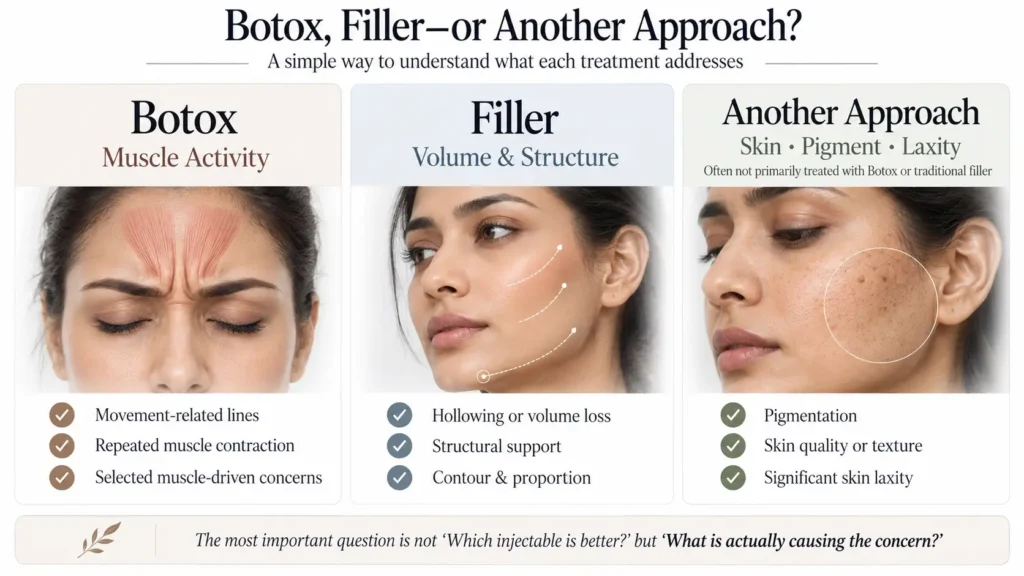
Quick answer: Botox and dermal fillers are both injectable aesthetic treatments, but they solve different problems. Botox temporarily reduces selected muscle activity and is primarily used for movement-related lines. Dermal fillers restore or add volume and structural support. If the concern is mainly skin quality, pigmentation or significant laxity, neither may be the right first treatment.
Neither treatment is inherently “better.” The right choice depends on what is actually causing the concern—muscle movement, volume loss, structural anatomy, skin quality, laxity, or a combination of factors.
This doctor-led guide explains the difference between Botox and fillers, what each treatment can and cannot do, how long results may last, how their risks differ, how pricing works, and when combining treatments may—or may not—be appropriate.
Medically reviewed by Dr. Reema Arora, MBBS, MSc Facial Aesthetics — Founder & Medical Director, The Face Clinic, Hauz Khas, New Delhi.
Last medically reviewed: September 2026.
Botox vs Dermal Fillers at a Glance
Botox / Botulinum Toxin | Dermal Fillers |
|---|
What it acts on | Selected muscles and muscle activity | Volume, structural support and contour |
Often considered for | Movement-related lines and selected muscular concerns | Volume loss, hollowing, contour and proportion |
Common examples | Frown lines, forehead lines, crow’s feet, selected masseter concerns | Cheeks, chin, jawline, lips and selected structural hollows |
When results appear | Gradually over several days | Often visible immediately, although early swelling can affect appearance |
When results settle | Commonly assessed at around 10–14 days | Better assessed once initial swelling has settled |
How long results last | Usually several months; varies by area, dose and individual response | Several months to a year or longer for many HA fillers; varies by product and area |
Can it be immediately reversed? | No. Its effect gradually reduces | Some hyaluronic-acid fillers may be reduced or dissolved with hyaluronidase when clinically appropriate |
How pricing is determined | Units, treatment area and individual plan | Product, quantity, number of syringes, area and treatment plan |
Key planning question | Is muscle activity contributing to the concern? | Is loss of volume or structural support contributing to the concern? |
The most useful question is therefore not simply “Botox or filler?”
It is:
What anatomical change is creating what I see?
What Is Botox?
BOTOX® Cosmetic is a brand containing onabotulinumtoxinA, one formulation of botulinum toxin type A. In aesthetic medicine, botulinum toxin is used to temporarily reduce the activity of selected muscles.
When repeated muscle contraction contributes to visible facial lines, carefully planned treatment can soften those lines while preserving appropriate facial expression and movement.
Botulinum toxin may be considered for concerns such as:
frown lines between the eyebrows;
forehead lines;
crow’s feet around the outer eyes; and
selected muscular concerns elsewhere on the face or neck where clinically appropriate.
For a detailed discussion of treatment areas, suitability, results and the procedure itself, see
Botox treatment in Delhi.
Botox does not “fill” a wrinkle and it does not replace lost facial volume. Its principal aesthetic action is on muscle activity.
For regulatory information on indications, dosing, contraindications and safety, refer to the BOTOX® Cosmetic prescribing information.
What Are Dermal Fillers?
Dermal fillers are injectable materials placed in selected tissue planes to restore volume, provide structural support or refine facial contour.
This guide primarily refers to hyaluronic-acid dermal fillers, which are widely used in facial aesthetics.
Depending on individual anatomy and treatment goals, fillers may be considered for areas including:
Filler treatment is not simply about “adding volume.”
Different facial areas require different product characteristics, quantities, depths and placement strategies. Treatment should therefore be based on facial anatomy and the underlying structural problem, rather than on a predetermined number of syringes.
Traditional volumising fillers should also be distinguished from injectable treatments intended predominantly to improve skin hydration or skin quality. They are not automatically interchangeable.
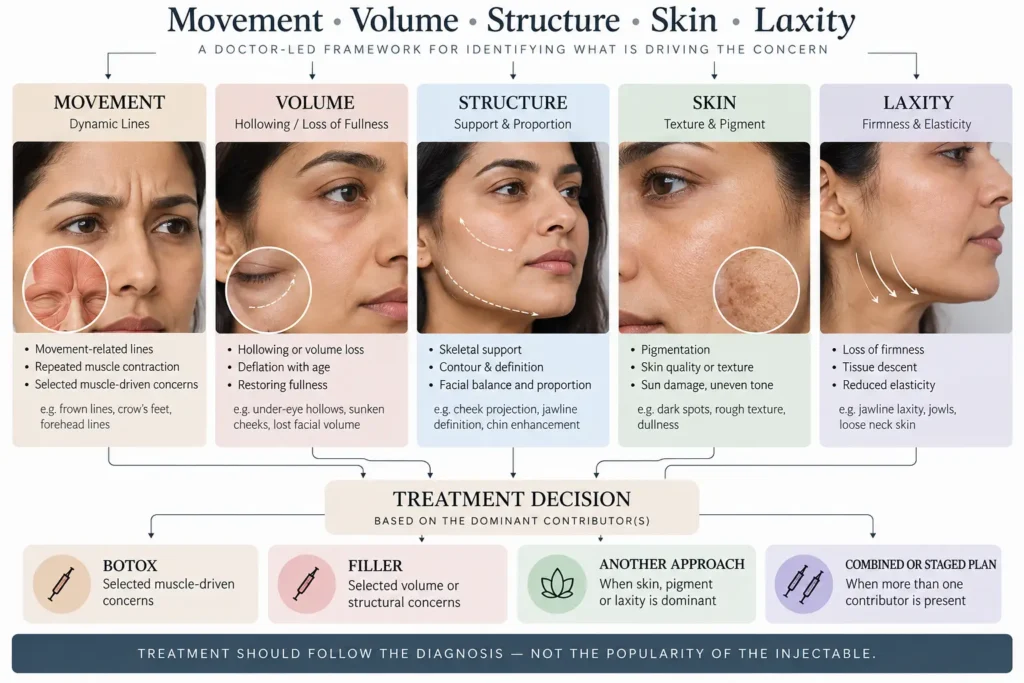
Movement, Volume, Structure, Skin or Laxity? A Better Way to Decide
The usual explanation—“Botox treats wrinkles and filler treats hollows”—is useful but incomplete.
Facial concerns arise from different anatomical causes, and similar-looking concerns may require entirely different approaches.
What is primarily contributing to the concern? | What may be considered? |
|---|
Repeated or excessive muscle activity | Botulinum toxin |
Loss of facial volume or structural support | Dermal filler |
Facial contour or proportion | Filler and/or botulinum toxin depending on the anatomy |
Selected structural under-eye hollowing | Filler may be considered after assessment |
Masseter muscle hypertrophy | Botulinum toxin may be considered |
Skin texture, dehydration or crepiness | Neither may be the primary treatment |
Pigmentation | Neither directly treats the pigment |
Significant skin laxity | Neither may adequately address the concern alone |
Prominent eye bags or fat pads | Filler is not automatically appropriate |
Mixed anatomical changes | A staged or combination plan may sometimes be appropriate |
Treating what is visible without identifying why it is visible is one reason injectable results can sometimes look unnatural or fail to address the patient’s actual concern.
Three Questions to Ask Before Choosing an Injectable
Before thinking about Botox or filler, ask:
Does the concern appear or become more obvious when the face moves?
Is there genuine loss of volume, projection or structural support when the face is at rest?
Could the concern actually be caused mainly by skin quality, pigment, laxity or another anatomical feature?
These questions do not replace a medical assessment, but they illustrate why treatment selection should begin with diagnosis rather than the name of an injectable.
Botox or Fillers: Which Is Used for Different Facial Concerns?
Forehead Lines
Forehead lines are often strongly influenced by movement of the frontalis muscle.
When muscle activity is the principal contributor, botulinum toxin may be appropriate. Treatment planning should also consider brow position, eyelid anatomy, muscle strength and the balance between different upper-face muscles.
Filler is not a routine substitute for appropriate muscle assessment.
Frown Lines Between the Eyebrows
Frown lines commonly develop through repeated activity of the muscles between the eyebrows.
Botulinum toxin may be considered when muscle contraction is the dominant cause.
Deeply established lines can also develop a static skin component, so complete disappearance of a longstanding crease should not automatically be expected from muscle relaxation alone.
Crow’s Feet
Lines at the outer corners of the eyes are frequently associated with orbicularis oculi muscle activity during smiling and squinting.
Botulinum toxin may be considered where appropriate, with treatment tailored to individual anatomy and natural expression.
Cheek and Mid-Face Volume Loss
Loss of mid-face volume and structural support is different from a movement-related wrinkle.
In appropriately selected patients, dermal filler may help restore support or contour while maintaining natural facial proportions.
The objective is not simply to make the cheeks larger. It is to establish whether structural support has actually been lost and whether restoring it is likely to improve the concern.
Chin and Jawline Contour
A concern described as “poor jawline definition” can have several different causes.
When inadequate structural projection or contour is the main issue, dermal filler may sometimes be considered.
When lower-face width is caused predominantly by enlarged masseter muscles, however, the mechanism is different. Selected patients may instead be candidates for
masseter Botox.
Two people asking for a “more defined jawline” may therefore require completely different treatment strategies.
Under-Eye Hollows
Not every dark or tired-looking under-eye area requires filler.
In carefully selected patients with genuine structural hollowing or tear-trough volume loss,
under-eye fillers may be considered following assessment.
However, under-eye darkness can also result from pigmentation, thin skin, vascular visibility, puffiness, prominent eye bags or other anatomical factors.
Filler does not correct all of these causes and may be inappropriate in some patients.
Lips
Dermal fillers can be used to alter selected aspects of lip volume, shape, border definition or proportion.
The objective should be facial balance rather than simply increasing lip size. Product selection and quantity should reflect existing lip anatomy, surrounding facial proportions and the patient’s treatment goals.
Botulinum toxin and filler are not interchangeable treatments for lip structure.
When Neither Botox Nor Dermal Filler Is the Right Treatment
One of the most important parts of injectable treatment planning is recognising when neither treatment addresses the actual problem.
Botox and dermal fillers do not directly correct every sign of facial ageing or every aesthetic concern.
Concerns dominated by:
may require another approach—or sometimes no treatment at all.
A good consultation should therefore answer not only:
“What can be injected?”
but:
“Would an injectable actually improve this concern?”
Botox vs Thread Lift
Botox and threads address different problems. Botox reduces selected muscle activity and is used mainly for movement-related lines. A thread lift uses dissolvable threads to lift and reposition mild-to-moderate sagging tissue—something Botox cannot do.
If the main concern is early jowling or mid-face descent rather than expression lines, a thread lift treatment in Delhi may be considered after assessment. Threads do not replace lost volume or treat dynamic wrinkles, and they are not a substitute for surgery where laxity is significant.
Botox vs Skin Boosters
Botox and skin boosters are both injectables, but they do different jobs. Botox reduces selected muscle activity to soften movement-related lines. Skin boosters are placed superficially to improve hydration, texture and fine crepiness—they do not relax muscles or add structural volume.
If the main concern is dull, dehydrated or crepey skin rather than expression lines, a skin booster treatment in Delhi may be more appropriate. Where both movement lines and skin-quality changes are present, the two may be planned together after assessment.
Can Botox and Dermal Fillers Be Used Together?
Yes. Botox and dermal fillers may sometimes be used within the same broader treatment plan because they address different anatomical components.
For example, a patient could have both:
movement-related upper-face lines, where botulinum toxin may be considered; and
mid-face volume loss, where dermal filler may be appropriate.
That does not mean combination treatment is automatically better.
More treatment is not inherently better treatment.
Botox and filler should be combined only when more than one distinct anatomical problem is present and each treatment has a clear role.
For some patients, one treatment is sufficient. For others, treatments may be staged rather than performed together.
Botox vs Fillers: Results, Onset and Longevity
When Do Botox Results Appear?
Botulinum toxin does not produce its full effect immediately.
Changes commonly begin to become apparent over the first several days, with the result usually better assessed at around 10–14 days, depending on the treatment area and individual response.
The aim is not necessarily to eliminate every visible movement. Appropriate treatment should preserve facial balance and natural expression.
When Do Dermal Filler Results Appear?
Changes from dermal filler are often visible immediately.
However, early swelling can temporarily influence volume and contour, so the appearance immediately after treatment should not always be considered the final result.
Assessment is generally more meaningful once early swelling has settled.
How Long Does Botox Last?
Botulinum-toxin effects commonly persist for several months.
Duration varies with treatment area, dose, muscle strength, individual response and other factors. There is no single repeat-treatment interval that applies to every patient.
Further treatment should be considered according to reassessment and return of relevant muscle activity—not simply because a predetermined number of months has passed.
How Long Do Dermal Fillers Last?
Many hyaluronic-acid fillers can last for several months to a year or longer, but longevity varies considerably.
Factors include:
Maintenance should therefore be based on reassessment rather than an automatic fixed schedule.
Are Botox and Dermal Fillers Reversible?
Botox
Botulinum toxin cannot be immediately “reversed.”
Its effect gradually reduces over time as neuromuscular activity returns.
This makes appropriate dosing, treatment planning and anatomical understanding particularly important.
Hyaluronic-Acid Dermal Fillers
Many commonly used facial fillers are made from hyaluronic acid.
When clinically appropriate, hyaluronic-acid filler can sometimes be reduced or dissolved using hyaluronidase.
This should not be interpreted as meaning filler treatment is casually reversible or risk-free. Dissolving filler is itself a medical intervention, and non-HA filler materials cannot necessarily be removed in the same way.
Safety: How Botox and Dermal Filler Risks Differ
Botox and dermal fillers are medical procedures with different risk profiles.
Appropriate patient selection, anatomical knowledge, product choice, dosing, injection technique and the ability to recognise and manage complications all matter.
Botox: Common and Important Considerations
Temporary treatment-related effects can include local discomfort, bruising, swelling or headache.
Depending on the area treated and muscles affected, unintended weakness or temporary changes in eyelid or brow position can occur.
Medical history, medications, previous treatments and the muscles being treated should therefore form part of the pre-treatment assessment.
Dermal Fillers: Common and Rare Serious Risks
Common temporary effects after dermal filler treatment include swelling, bruising, redness, tenderness and sensitivity.
Other recognised complications include infection, nodules, inflammatory reactions and contour irregularities.
A particularly important but uncommon complication is vascular compromise, which can occur if filler unintentionally enters or affects a blood vessel. Rare vascular complications can result in tissue injury and serious visual or neurological consequences.
Because risks differ between anatomical areas, responsible filler treatment requires detailed knowledge of facial anatomy, appropriate technique and preparedness to recognise and manage complications promptly.
When Urgent Medical Assessment Is Important
Following filler treatment, sudden visual symptoms, unusual severe pain, or concerning whitening, grey or blue discolouration of the skin require urgent medical assessment.
Following botulinum-toxin treatment, significant difficulty swallowing, speaking or breathing requires immediate medical attention.
These complications are uncommon, but patients should know what requires urgent review.
Regulatory resources cited here are provided for patient education. Product approvals and approved indications may differ between countries, including India.
What About Treatment Costs?
Botox and dermal fillers are planned and priced differently, so their treatment costs are not directly comparable.
For a dedicated explanation of how the two pricing structures differ and the factors that can influence overall treatment cost, see our
Botox vs filler cost comparison.
How Does a Doctor Decide Between Botox and Fillers?
A facial-aesthetics consultation should involve more than asking which injectable a patient wants.
Assessment may include:
facial proportions at rest;
facial expression and muscle activity;
existing volume and structural support;
skin quality;
areas of hollowing or shadow;
facial asymmetry;
previous injectable treatment;
relevant medical history and medications;
treatment priorities; and
whether the proposed treatment is actually likely to improve the concern.
One area of the face can also influence how another appears, which is why treatment planning should evaluate the face as a connected anatomical system, rather than treating individual lines or features in isolation.
Natural Results Depend on Diagnosis, Not Simply Dose or Syringes
The amount injected is only one part of treatment quality.
More useful questions are:
Why is this line visible?
Is the lower face broad because of muscle, bone, soft tissue—or a combination?
Is an under-eye shadow caused by a true hollow, pigmentation or an eye bag?
Does a fold itself require treatment, or is loss of support elsewhere contributing to it?
These distinctions are often more important than choosing a popular injectable or a predetermined amount of product.
The aim should be appropriate correction while preserving facial identity, movement and proportion.
Choosing a Practitioner for Botox or Dermal Fillers
Injectable treatment should be approached as a medical procedure rather than simply a beauty service.
Before proceeding, patients should understand:
who will assess and perform the treatment;
the practitioner’s medical qualifications and relevant experience;
which product is being recommended and why;
what anatomical problem is being treated;
what result is realistically achievable;
the relevant risks and limitations;
what follow-up is available; and
how potential complications would be recognised and managed.
An unusually low quotation should prompt questions about the product, amount or dose, practitioner qualifications, treatment setting, consent process and follow-up arrangements, rather than being assessed on price alone.
Frequently Asked Questions About Botox vs Dermal Fillers
1. What is the main difference between Botox and fillers?
Botox primarily changes selected muscle activity, while dermal fillers primarily restore or add volume, structural support and contour.
The correct treatment depends on what is causing the concern.
2. Which is better: Botox or dermal fillers?
Neither is inherently better.
Botox may be appropriate for selected movement-related concerns, while filler may be appropriate for selected volume or structural concerns. Some concerns are better treated with neither.
3. Can Botox and dermal fillers be used together?
Yes, when separate anatomical concerns genuinely justify both treatments.
For example, movement-related upper-face lines and mid-face volume loss represent different problems and may sometimes be addressed within the same overall treatment plan.
Combination treatment should not be recommended simply because two treatments can be performed.
4. Which lasts longer: Botox or fillers?
There is no single answer.
Botulinum-toxin effects usually persist for several months. Many hyaluronic-acid fillers can last for several months to a year or longer, depending on product, treatment area and individual response.
Longevity should not determine treatment choice because Botox and fillers address different problems.
5. Are dermal fillers reversible?
Many hyaluronic-acid fillers can sometimes be reduced or dissolved with hyaluronidase when clinically appropriate.
Other filler materials may not be reversible in the same way.
The ability to dissolve an HA filler does not eliminate the need for appropriate patient selection, product choice and safe technique.
6. Can filler treat under-eye hollows?
Filler may be appropriate for selected structural under-eye hollows or tear troughs, but it is not suitable for everyone with dark or tired-looking eyes.
Pigmentation, thin skin, vascular visibility, puffiness and prominent eye bags can produce similar appearances and require different management.
7. Which costs more: Botox or fillers?
It depends on what is being treated.
Botulinum toxin is commonly priced according to units or treatment areas, whereas filler cost is usually influenced by the product and quantity required.
The lowest quoted session price is therefore not necessarily a useful way to compare the two treatments.
8. How often should Botox or filler be repeated?
Neither treatment should automatically be repeated according to a fixed calendar.
Further treatment should follow reassessment of the remaining effect, return of muscle activity or volume change, individual goals and whether additional treatment remains appropriate.
Key Takeaways: Botox vs Dermal Fillers
Botox and dermal fillers are not interchangeable treatments.
Botox primarily addresses selected concerns related to muscle activity.
Dermal fillers primarily address selected concerns related to volume, structural support, contour and proportion.
Some patients have more than one anatomical contributor and may benefit from a combined or staged approach.
Other concerns—particularly those driven predominantly by pigmentation, skin quality, significant laxity or certain anatomical features—may not be best treated with either.
The central question is therefore not:
“Should I get Botox or filler?”
It is:
“What is actually causing the change I want to improve?”
Once that is established, treatment selection becomes more precise.
Doctor-Led Botox and Dermal Filler Assessment in Delhi
At The Face Clinic, Hauz Khas, New Delhi, injectable treatments are planned following assessment of facial anatomy, muscle activity, volume distribution, structural support, skin characteristics and individual treatment goals.
Dr. Reema Arora, Founder & Medical Director of The Face Clinic, has more than 20 years of focused experience in facial aesthetics and has previously served as Medical Head — Facial Aesthetics at Allergan India.
The purpose of consultation is not to decide how much Botox or filler can be used. It is to determine whether treatment is appropriate, which anatomical component should be addressed, and how to achieve a balanced result while preserving individual facial identity.
If you are considering Botox or dermal fillers—or are unsure which approach is appropriate—a doctor-led facial assessment can help identify the underlying cause of the concern before treatment is recommended.
Medical Disclaimer
This guide is intended for general patient education and does not replace an individual medical consultation. Treatment suitability, product selection, dosage or quantity, outcomes, risks and duration vary between patients and should be determined after clinical assessment.
International regulatory sources cited in this guide are provided for educational reference and should not be interpreted as confirmation that individual products, anatomical indications or techniques have identical regulatory status in India.
All treatments are subject to individual variation. Outcomes are determined following clinical evaluation by a qualified doctor.

 Based on 313 reviews
 Posted on Google
 anjana kaushal
 Ritu Bhardwaj