
- Home
- Services
- BOTOX®
Have Any Question?
Don’t think much, have a query? Call us now!
Connect with us
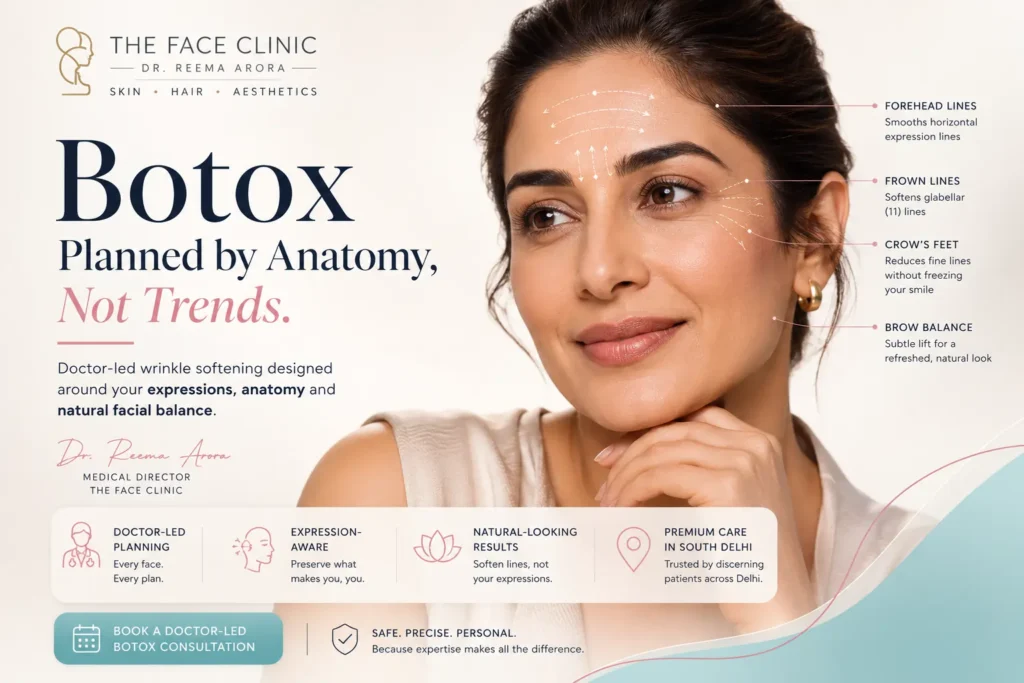
Images are for illustrative purposes only and may not represent actual patients or outcomes. Individual results vary based on anatomy, clinical assessment, and personalised treatment planning.
Best Botox Treatment in Delhi | Natural, Doctor-Led Results
Looking for Botox treatment in Delhi to soften forehead lines, frown lines or crow’s feet without surgery? Botulinum toxin treatment temporarily reduces activity in selected facial muscles, helping soften dynamic expression lines while preserving natural facial movement when treatment is appropriately planned.
At The Face Clinic, every Botox treatment is planned around individual facial anatomy, muscle strength, movement patterns and treatment goals. Dr. Reema Arora uses detailed facial assessment and anatomical mapping to determine which muscles are contributing to the concern and how treatment should be individualised.
Located at C-36, LGF, Hauz Khas, South Delhi, The Face Clinic follows a doctor-led, anatomy-first approach focused on subtle facial rejuvenation and balanced, natural-looking outcomes rather than a standardised injection pattern or an overcorrected appearance.
Botox may be considered for concerns including forehead lines, frown lines and crow’s feet, as well as selected lower-face and neck concerns when clinically appropriate.
Initial effects may become noticeable within the first several days, with the response continuing to develop over approximately one to two weeks. The timing and degree of improvement vary according to the treatment area, dose, muscle activity and individual response.
In 20 Seconds: Quick Treatment Overview
What it is: A doctor-led injectable treatment using botulinum toxin type A to temporarily reduce activity in selected facial muscles.
Common concerns: Forehead lines, frown lines, crow’s feet and selected muscle-related lower-face or neck concerns.
When results appear: Initial effects may become noticeable within several days, with the response continuing to develop over approximately one to two weeks.
How long it lasts: Duration varies according to the treatment area, dose, muscle activity and individual response. For glabellar frown lines, the BOTOX® Cosmetic prescribing information describes an effect lasting approximately 3–4 months; other treatment areas may differ.
Why doctor-led planning matters: Facial balance depends on appropriate muscle selection, anatomical assessment, dosing and injection placement—not simply the number of units used.
Where: The Face Clinic, C-36, LGF, Hauz Khas, South Delhi, New Delhi.
Next step: Medical consultation → facial assessment and mapping → personalised treatment plan → procedure and aftercare.
Botox Treatment in Delhi — What to Expect
Botox treatment is a non-surgical procedure that uses botulinum toxin type A to temporarily reduce activity in selected facial muscles. In facial aesthetics, it is commonly used for dynamic expression lines such as forehead lines, frown lines and crow’s feet.
The treatment itself is usually brief, and most patients can return to routine daily activities soon afterwards, although temporary redness, swelling, tenderness or small areas of bruising may occur.
At The Face Clinic, treatment is planned according to the individual face rather than a fixed injection template. Assessment considers facial movement, muscle strength, brow position, symmetry and the relationship between neighbouring muscle groups before the treatment pattern is determined.
The objective is not simply to remove movement. It is to selectively soften excessive muscular activity while maintaining facial balance and expression.
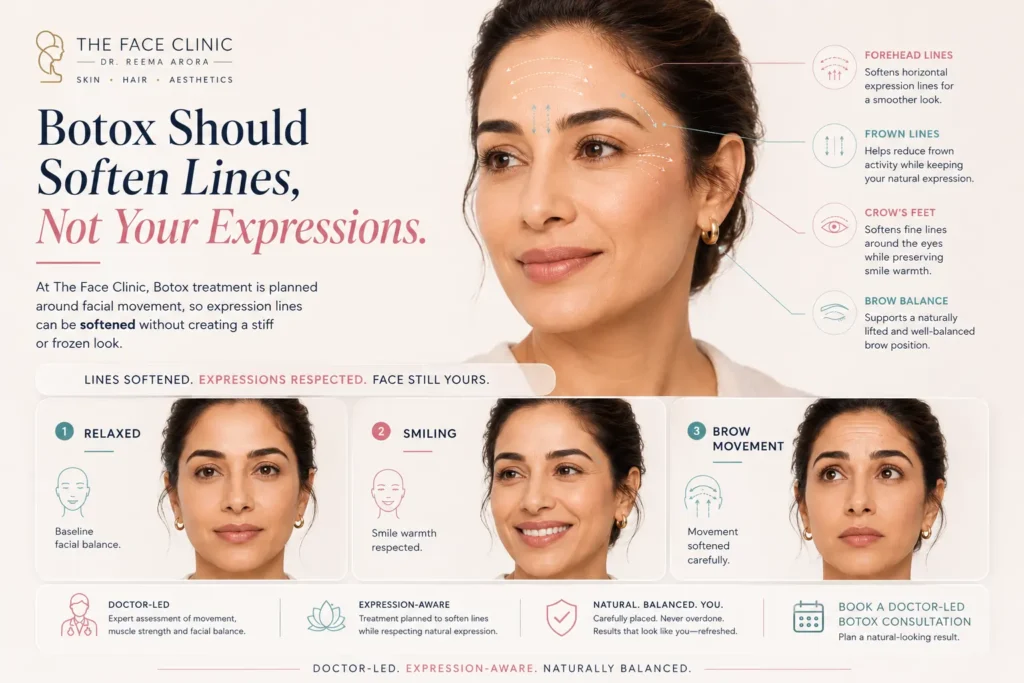
Images are for illustrative purposes only and may not represent actual patients or outcomes. Individual results vary based on anatomy, clinical assessment, and personalised treatment planning.
Why Choose a Doctor-Led Botox Clinic in Delhi?
Botulinum toxin treatment depends on more than placing injections into visible wrinkles. Appropriate planning requires an understanding of facial anatomy, muscle interaction, existing asymmetry, brow and eyelid position and the degree of correction appropriate for the individual.
At The Face Clinic in Hauz Khas, South Delhi, Botox treatment is planned by Dr. Reema Arora using an anatomy-first approach.
Dr. Reema Arora is an MBBS doctor with an MSc in Facial Aesthetics from the UK and more than 20 years of focused experience in facial aesthetics and injectables. She previously served as Medical Head – Facial Aesthetics at Allergan India and has extensive experience training doctors in injectable treatments.
The treatment approach emphasises:
- detailed medical and facial assessment before treatment;
- anatomical mapping and individualised planning;
- authentic, appropriately sourced products;
- conservative dosing where appropriate;
- medical hygiene and treatment protocols;
- realistic expectations;
- balanced, natural-looking outcomes; and
- appropriate clinical follow-up.
For patients comparing broader wrinkle-softening approaches, explore our guide to anti-wrinkle treatment options.
What Is Botox and How Does It Work?
BOTOX® Cosmetic is a branded onabotulinumtoxinA product. In everyday use, the word “Botox” is also commonly used when people are referring more broadly to cosmetic botulinum toxin treatment.
Botulinum toxin type A works by temporarily reducing signalling between nerves and selected muscles, decreasing muscular activity in the treated area.
In facial aesthetics, this can soften dynamic wrinkles—lines that become more visible with repeated expressions such as frowning, squinting or raising the eyebrows.
Common treatment goals may include:
- softening forehead expression lines;
- reducing glabellar or frown-line activity;
- improving crow’s feet;
- modifying selected muscle-related lower-face concerns; and
- preserving facial expression while reducing excessive muscular pull.
Botulinum toxin does not restore lost facial volume. When structural support or volume loss is the principal concern, another approach may be more appropriate.
For a detailed explanation of the difference, see our Botox vs dermal fillers guide.
Botox Treatment Areas
Botulinum toxin may be considered for a number of muscle-related facial concerns depending on individual anatomy, clinical suitability, the product being used and the treatment indication.
Commonly assessed areas include:
- forehead lines;
- glabellar or frown lines between the eyebrows;
- crow’s feet at the outer corners of the eyes;
- selected brow-position concerns;
- selected lower-face muscular concerns;
- masseter-related lower-face width in suitable patients; and
- selected platysma-related neck concerns.
For more specific information about eye-corner lines, see our crow’s feet treatment guide.
Patients considering subtle brow-position improvement can also read our eyebrow lift in Delhi guide.
Not every wrinkle or contour concern should be treated with botulinum toxin. Static wrinkles, volume loss, skin laxity and changes in skin quality may require a different or combined treatment strategy.
Botox for Forehead and Frown Lines
Forehead lines and glabellar frown lines are dynamic wrinkles produced by repeated activity of specific facial muscles.
Although both areas may respond to botulinum toxin, they should not necessarily be assessed in isolation. Forehead movement, brow position and the activity of the muscles between and around the eyebrows interact with one another.
Treatment planning should therefore consider the broader upper-face muscle balance rather than simply injecting an isolated line according to a standard formula.
Assessment may include:
- facial anatomy;
- muscle strength;
- brow position;
- pre-existing asymmetry;
- movement patterns; and
- the degree of correction appropriate for the individual.
This helps treatment remain proportionate to the patient’s anatomy and aesthetic goals.
Is Botox Right for You?
Botox may be considered for adults whose concerns are substantially related to muscle activity—for example, dynamic forehead lines, frown lines or crow’s feet.
Suitability depends on more than the presence of a wrinkle.
A consultation should consider:
- whether the concern is primarily caused by muscle activity;
- facial anatomy and symmetry;
- medical history;
- relevant medications;
- previous injectable treatments;
- individual treatment goals; and
- whether another treatment would better address the underlying concern.
Botulinum toxin treatment is not appropriate for everyone. Known hypersensitivity to botulinum toxin preparations and infection at the proposed injection site are among the contraindications listed in the BOTOX® Cosmetic prescribing information. Certain medical conditions and medications may also require additional consideration.
Pregnancy, breastfeeding, previous treatment reactions and relevant neurological or neuromuscular conditions should be discussed during the medical consultation.
What About Preventative Botox?
Some adults consider treatment when expression lines are becoming increasingly visible with repeated movement, before they become more established at rest.
Age alone, however, is not an indication for treatment.
The more useful question is whether repeated muscular activity is contributing to a concern that is appropriate to treat and whether intervention is proportionate to the patient’s anatomy and goals.
A conservative approach is especially important in younger patients. Treatment should not be performed simply because a person has reached a particular age or because a particular injection pattern is popular.
Does Treatment Planning Differ for Men and Women?
Botox treatment should be based primarily on anatomy rather than gender stereotypes.
Muscle mass, forehead height, brow position, facial proportions and aesthetic preferences vary substantially between individuals and may influence the treatment plan.
The injection pattern and degree of correction should therefore be determined by the individual face rather than by applying a standard “male” or “female” Botox template.
Medical Uses of Botulinum Toxin
Botulinum toxin products are also used in medical practice for selected conditions. Approved indications vary according to the particular product and jurisdiction.
Medical uses may include conditions such as chronic migraine and excessive sweating or hyperhidrosis when the appropriate clinical criteria are met.
Some other uses discussed in clinical practice may be off-label and require appropriate medical assessment and informed consent.
For dedicated information, see our Botox for migraine treatment and hyperhidrosis treatment in Delhi guides.

Images are for illustrative purposes only and may not represent actual patients or outcomes. Individual results vary based on anatomy, clinical assessment, and personalised treatment planning.
Botox, Fillers or Thread Lift — Which Treatment Is Appropriate?
The most appropriate treatment depends on what is creating the visible concern.
Botox primarily modifies selected muscle activity and is therefore most useful when muscular movement is contributing substantially to the problem.
Dermal fillers are primarily used when volume, structural support or contour needs to be restored or modified.
Thread treatments may be considered in selected patients when tissue support or laxity is a more relevant concern.
These treatments are not interchangeable, and combination treatment should not be assumed to be necessary.
If skin laxity rather than muscle activity is the main concern, learn more about thread lift treatment in Delhi.
Botox Treatment Process, Timeline and Aftercare
Consultation and Facial Assessment
Treatment begins with a medical consultation to understand the concern, relevant medical history, medications, previous injectable treatments and treatment goals.
The face is then assessed both at rest and during movement. This helps identify which muscles are contributing to the concern and whether botulinum toxin is the appropriate treatment.
Facial Mapping and Treatment Planning
The injection pattern is planned according to individual anatomy, muscle activity and the relationship between neighbouring muscle groups.
Treatment should not be based simply on copying a standard injection map.
The Procedure
Botulinum toxin is administered using small injections at selected anatomical points.
The number and position of injection sites vary according to the treatment area and the individual treatment plan.
Temporary redness, mild swelling, tenderness or small areas of bruising can occur around injection sites.
Aftercare
Patients should follow the personalised instructions provided after treatment.
General guidance may include avoiding unnecessary rubbing or pressure over treated areas immediately after the procedure. Advice regarding exercise, skincare, other aesthetic procedures and review should be based on the individual treatment performed and the clinician’s instructions.

Images are for illustrative purposes only and may not represent actual patients or outcomes. Individual results vary based on anatomy, clinical assessment, and personalised treatment planning.
Results, Longevity and Maintenance
Botox results develop gradually rather than appearing immediately.
When Will I See Results After Botox?
Some patients begin to notice reduced muscle activity within the first several days.
The response generally continues to develop over approximately one to two weeks, although onset can vary according to the treatment area and the individual patient.
A clinical review may be considered when appropriate after the treatment has had sufficient time to develop.
How Long Do Botox Results Last?
Duration varies according to the treatment area, dose, muscle activity and individual response.
For glabellar frown lines, the BOTOX® Cosmetic prescribing information describes an effect lasting approximately 3–4 months.
Results in other treatment areas may differ, so a single duration should not be assumed for every anatomical area or every patient.
What Happens When Botox Wears Off?
The effect usually diminishes gradually.
As neuromuscular activity returns, movement in the treated muscles progressively increases and the original expression lines may become more visible again.
Botulinum toxin treatment does not permanently remove the underlying muscle activity.
How Often Should Botox Be Repeated?
Repeat treatment should be considered according to individual response, clinical assessment, treatment goals and relevant product guidance rather than an automatic calendar schedule.
Some patients choose ongoing treatment, while others return only when the previous effect has substantially diminished.
What Affects Botox Longevity?
Duration may be influenced by factors including:
- the treatment area;
- muscle strength and movement patterns;
- dose;
- injection pattern;
- individual biological response; and
- previous treatment history.
A higher dose should not be used simply in an attempt to make treatment last longer. Appropriate dosing should be based on anatomy, clinical indication and the desired degree of correction.
What Results Can Botox Achieve?
The visible result of Botox depends on the concern being treated, baseline anatomy, muscular activity and the individual treatment plan.
Potential improvements may include:
- softer forehead expression lines;
- reduced frown-line activity;
- softer crow’s feet;
- selected lower-face refinement in appropriately assessed patients; and
- improvement in selected platysma-related neck concerns.
The objective should be improvement rather than complete elimination of facial movement.
Botox Treatment Cost
Botox treatment cost varies according to the areas treated, individual muscle strength, facial anatomy, treatment goals and the number of units required. Because treatment is personalised, the final cost is confirmed after clinical assessment and development of an individual treatment plan.
For detailed per-unit pricing, area-wise costs and the factors that influence overall treatment cost, see our Botox treatment cost guide.
How Botox Dosing Is Personalised
Botox treatment planning is individualised according to the area being treated and the patient’s facial anatomy and muscle activity.
The number of units required may vary according to movement patterns, muscle strength, treatment area and treatment goals. The appropriate dose and injection plan are determined after clinical assessment and facial mapping.
More units do not automatically produce a better result. Appropriate dosing should aim for the desired clinical effect while preserving facial balance and avoiding unnecessary treatment.
Botulinum toxin units are also product-specific. Units of BOTOX®/onabotulinumtoxinA should not be directly compared with or converted into units of another botulinum toxin preparation.
For general educational information about how dosing varies across treatment areas, see our Botox units by treatment area guide.
Safety, Side Effects and Doctor-Led Care
Botox is a medical treatment and can cause adverse effects even when used appropriately.
Temporary effects around injection sites may include:
- redness;
- swelling;
- tenderness;
- small areas of bruising; or
- headache in some patients.
Other adverse effects vary according to the treatment area and may include unwanted weakness of nearby muscles, asymmetry or changes in eyelid or brow position.
Appropriate patient selection, anatomical knowledge, dosing, injection technique, product handling and clinical follow-up are therefore important parts of treatment.
The BOTOX® Cosmetic prescribing information lists known hypersensitivity to botulinum toxin preparations and infection at the proposed injection site among its contraindications. It also includes warnings and precautions relevant to certain pre-existing neuromuscular disorders and other clinical circumstances.
For detailed product-specific safety and prescribing information, see the BOTOX® Cosmetic prescribing information on DailyMed.
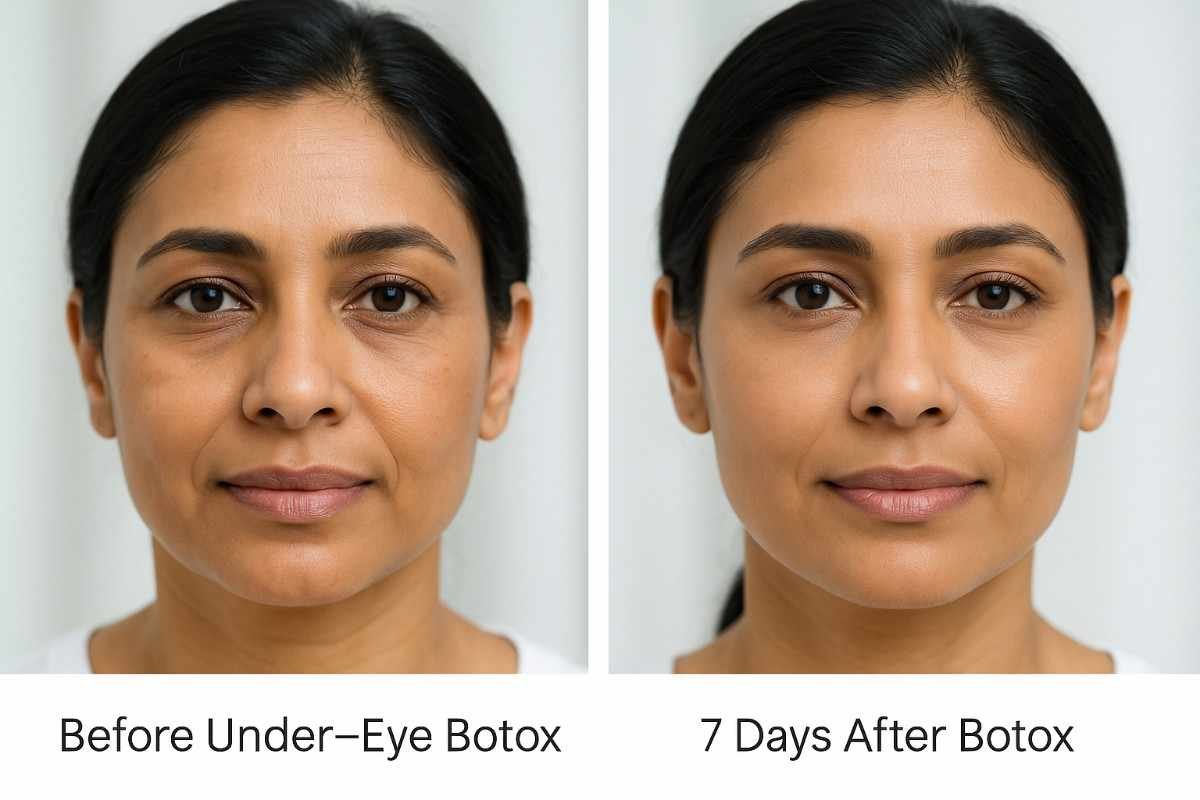
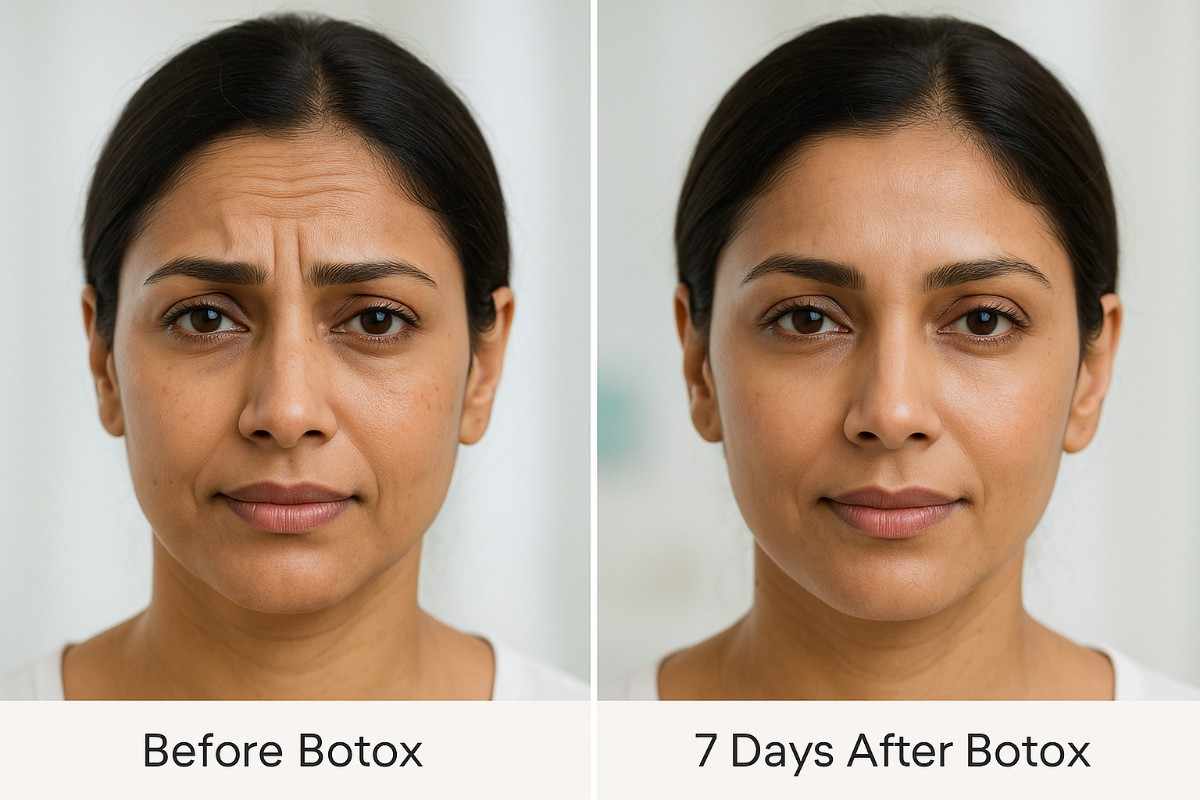
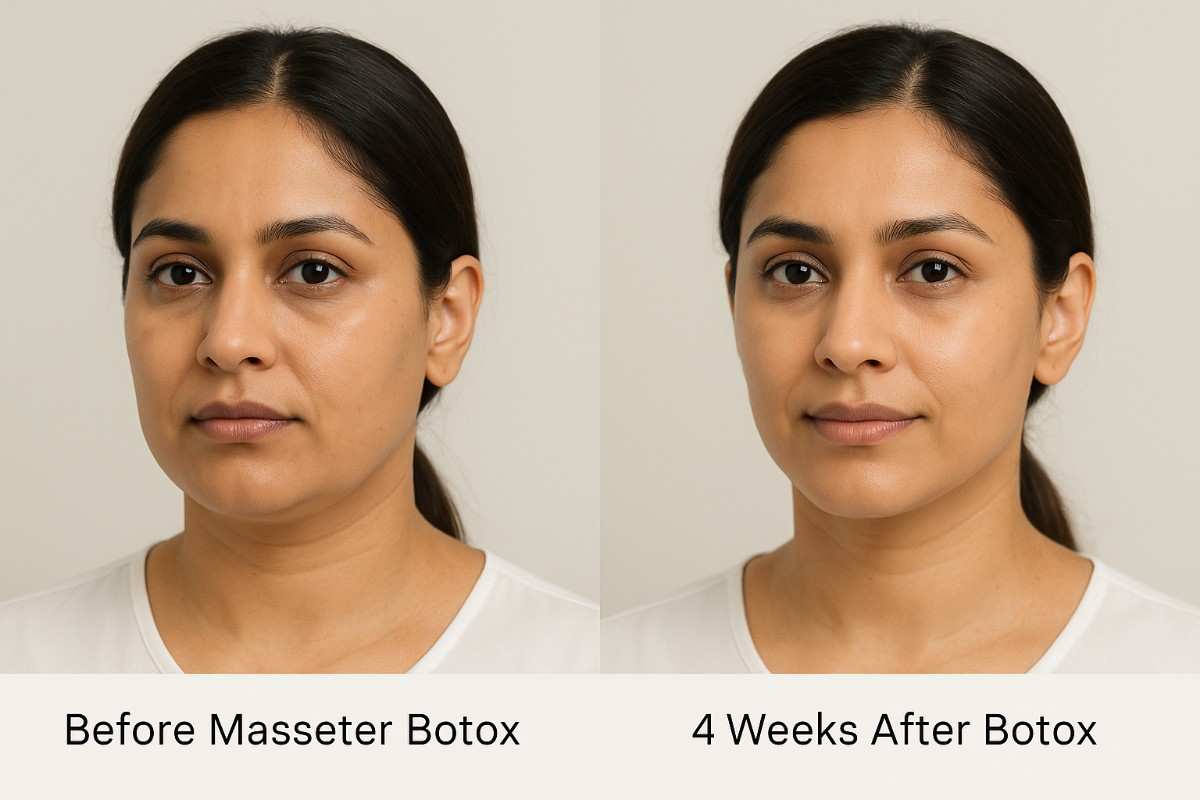
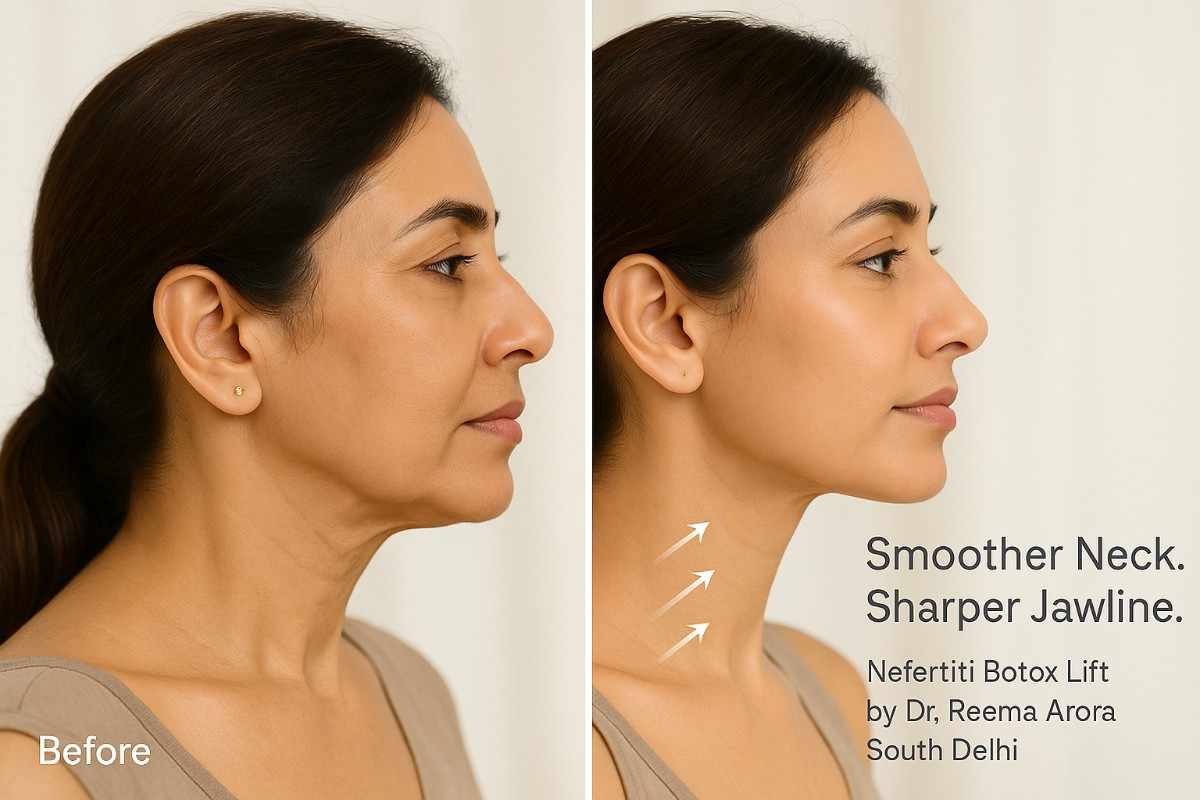
Images are for illustrative purposes only and may not represent actual patients or outcomes. Individual results vary based on anatomy, clinical assessment, and personalised treatment planning.
Frequently Asked Questions About Botox Treatment in Delhi
What is Botox treatment and how does it work?
Botulinum toxin type A temporarily reduces activity in selected muscles.
In facial aesthetics, this can soften dynamic expression lines caused by repeated muscular movement. The injection pattern is planned according to facial anatomy, muscle activity and the area being treated rather than using the same pattern for every patient.
Is Botox treatment safe?
BOTOX® Cosmetic has been studied in clinical trials for approved cosmetic indications, but like any medical treatment, it can cause adverse effects and is not suitable for everyone.
Appropriate treatment requires careful patient selection, knowledge of facial anatomy, appropriate dosing and injection technique, correct product handling and clinical follow-up.
A medical consultation is therefore important to assess suitability, review relevant medical history and medications, discuss potential risks and plan treatment individually.
How long do Botox results last?
The duration of Botox results varies according to the treatment area, dose, muscle activity and individual response.
For glabellar frown lines, the BOTOX® Cosmetic prescribing information describes an effect lasting approximately 3–4 months.
Results in other treatment areas may differ, so the same duration should not automatically be assumed for every patient or anatomical area.
How is the Botox dose determined?
The appropriate dose depends on the treatment area and relevant product-specific guidance, together with facial anatomy, muscle activity and treatment goals.
Treatment is planned after clinical assessment and facial mapping rather than applying the same dose or injection pattern to every patient.
Who may be suitable for Botox treatment?
Botox may be considered for adults with dynamic expression lines or other concerns related to the activity of specific muscles.
Suitability depends on the concern being treated, facial anatomy, medical history and individual goals. A consultation also helps determine whether botulinum toxin is appropriate on its own or whether another treatment would better address the underlying concern.
What areas of the face can Botox treat?
Botulinum toxin is commonly used for muscle-related concerns such as frown lines, forehead lines and crow’s feet.
Depending on individual anatomy, clinical suitability, the product being used and the treatment indication, it may also be considered for selected concerns involving the brow, lower face or neck.
The areas treated and injection pattern should be determined after clinical assessment rather than using a standardised approach for every face.
What should I look for when choosing a Botox doctor in Delhi?
Look for appropriate medical qualifications, detailed knowledge of facial anatomy, experience with injectable treatments, use of authentic regulated products, individualised treatment planning, realistic discussion of risks and benefits and appropriate clinical follow-up.
At The Face Clinic, Botox treatment is planned according to facial anatomy, muscle activity and individual treatment goals, with an emphasis on balanced, natural-looking results rather than a standardised injection pattern.
How does Masseter Botox jawline contouring work?
In appropriately selected patients, botulinum toxin may be used to reduce activity in enlarged or overactive masseter muscles.
Over time, reduced muscle activity may decrease muscular bulk and create a slimmer lower-face appearance.
Suitability depends on whether masseter muscle bulk is genuinely contributing to facial width because botulinum toxin will not correct every cause of a broad or poorly defined jawline.
For dedicated information, see our Masseter Botox and jaw-slimming guide.
What does a Nefertiti neck lift with Botox involve?
The Nefertiti technique refers to targeted botulinum toxin treatment of selected platysma-related muscular activity around the lower face and neck.
It may be considered when downward muscular pull contributes to the appearance of the jawline or neck.
Suitability depends on anatomy, muscle activity and the degree of skin laxity because botulinum toxin cannot correct every cause of lower-face or neck ageing.
Regulatory approval varies according to the particular product, indication, treatment pattern and jurisdiction.
Can Botox and dermal fillers be performed during the same appointment?
Botox and dermal fillers may sometimes be performed during the same appointment when clinically appropriate because they address different aspects of facial ageing.
Botox primarily modifies selected muscle activity, whereas dermal fillers can be used to restore or support volume and facial contour.
Whether one treatment or a combination is appropriate should be determined after assessment rather than routinely combining procedures.
Is Botox suitable for repeated treatment? What if I have an autoimmune condition?
Repeated Botox treatment may be considered in appropriately selected patients, but suitability should be reassessed according to medical history, response to previous treatment, current health, medications and treatment goals.
An autoimmune condition does not automatically determine whether Botox treatment is appropriate. Suitability depends on the specific condition, relevant medications, current health and whether there is any neurological or neuromuscular involvement.
The U.S. BOTOX® Cosmetic prescribing information specifically lists hypersensitivity to botulinum toxin preparations and infection at the proposed injection site among its contraindications and advises particular caution in certain neuromuscular disorders.
Individual suitability should therefore be assessed medically before treatment.
How much does Botox treatment cost in Delhi?
Botox treatment cost varies according to the treatment area, individual muscle activity and the dose required. Your final cost is confirmed after clinical assessment and a personalised treatment plan.
For current per-unit pricing, area-wise costs and the factors that influence overall treatment cost, see our Botox treatment cost guide.
Learn More About Botox Treatment
For patients researching specific aspects of treatment in greater detail:
Botox units by treatment area — educational guidance about how dosing varies across different treatment areas.
Masseter Botox and jaw-slimming guide — dedicated information for patients whose lower-face width may be influenced by masseter muscle bulk.
Considering Botox Treatment in Delhi? Start With a Doctor-Led Consultation
If you are considering Botox treatment, the first step is a medical and facial assessment to determine whether muscle activity is genuinely contributing to the concern and whether treatment is appropriate for your anatomy and goals.
At The Face Clinic in Hauz Khas, South Delhi, Dr. Reema Arora follows a consultation-first approach based on facial assessment, anatomical mapping and individualised treatment planning.
Whether the goal is to soften expression lines, address a selected muscle-related concern or understand which treatment approach may be most appropriate, the consultation is designed to establish realistic expectations before treatment is planned.
The Face Clinic
C-36, LGF, Hauz Khas
South Delhi, New Delhi – 110016
C-36, LGF, Hauz Khas
South Delhi, New Delhi – 110016
All treatments are subject to individual suitability and variation. Outcomes depend on anatomy, clinical assessment, treatment planning and individual response.