Cellulite Removal
- Home
- Services
- Cellulite Removal
Don’t think much, have a query? Call us now!
EXCELLENT Based on 313 reviews
 Posted on Google

 anjana kaushalI had a wonderful experience at The Face Clinic. Dr. Reema is incredibly kind, polite, and professional. She listens to all your concerns very patiently and carefully, making you feel comfortable and well cared for throughout the consultation. The quality of services provided by the clinic is top-notch. The entire team ensures that patients are comfortable Overall, if I ever need any dermatology services in the future, I will definitely visit this clinic again. It has become my go-to place, and I highly recommend it to anyone looking for expert and compassionate skincare treatment.Posted on Google
 Ritu BhardwajA very experienced doctor.
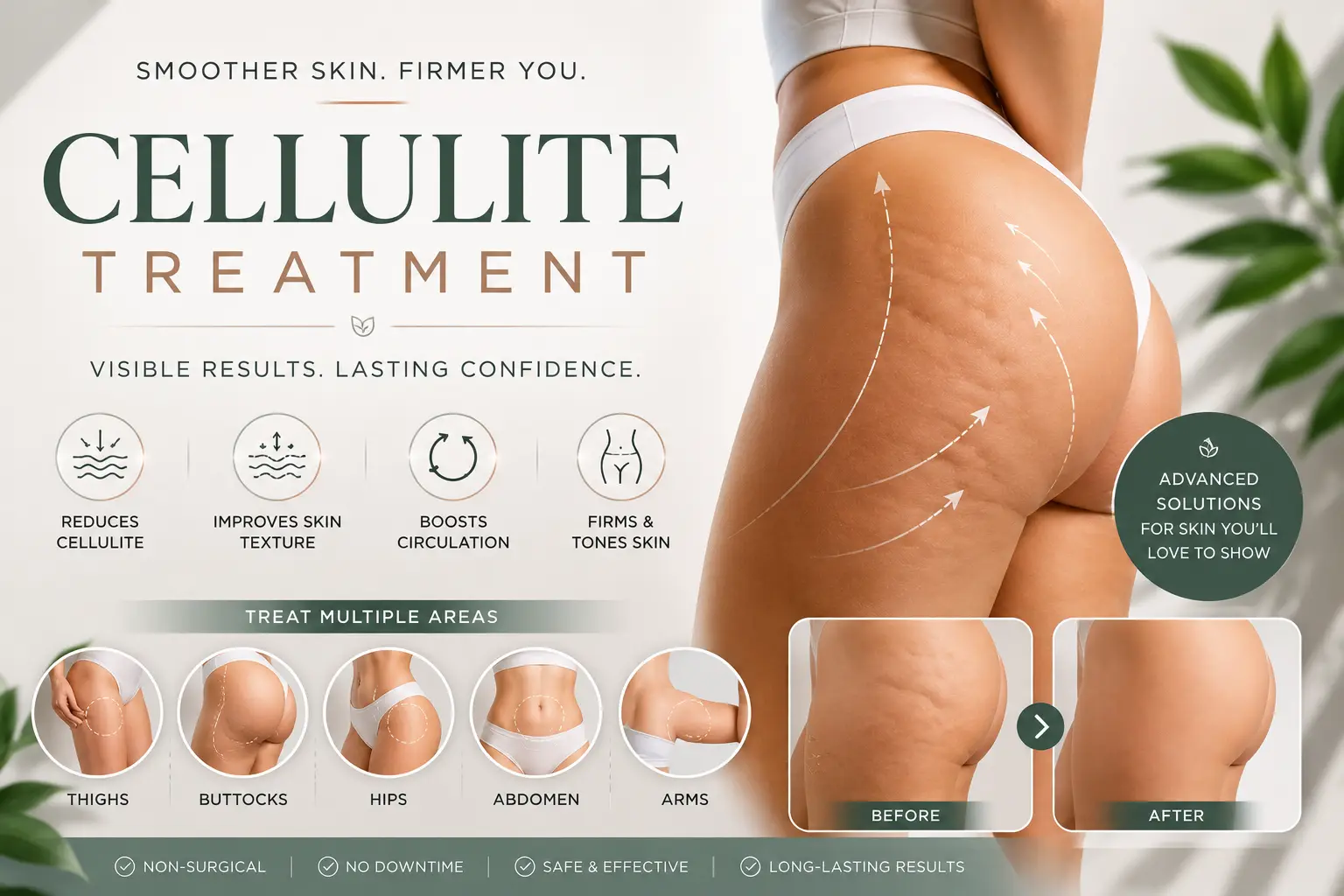
Cellulite treatment in Delhi at The Face Clinic, Hauz Khas, begins with identifying the cause of visible skin dimpling and assessing whether a non-surgical treatment may help.
Cellulite commonly affects the thighs, buttocks, hips and legs. It can occur at different ages and body weights, including in individuals who maintain an active lifestyle.
For patients seeking cellulite treatment in South Delhi, Dr. Reema Arora takes an assessment-led approach, considering the pattern of dimpling, skin firmness, localised fat distribution and individual treatment goals.
Selected non-surgical technologies may help improve skin firmness or the appearance of uneven texture. However, treatments designed to tighten skin, reduce fat or manage temporary swelling do not necessarily correct the fibrous connective-tissue bands responsible for structural cellulite.
The objective of a cellulite reduction treatment is meaningful, realistic improvement where clinically appropriate—not a promise of complete or permanent cellulite removal.
Cellulite-related non-surgical treatments at The Face Clinic start from ₹10,000 for applicable services. Final suitability and cost depend on the individual assessment.
Arrange a cellulite assessment: WhatsApp The Face Clinic | Call +91 99580 73900
At The Face Clinic, treatment planning begins by distinguishing three concerns that may look similar but require different approaches.
This distinction guides whether a treatment is likely to address the patient’s principal concern.
Radiofrequency-based skin tightening
Technologies such as RF may be considered when skin laxity is a meaningful component of the concern.
Radiofrequency delivers controlled energy to tissue and may support skin remodelling and improved firmness. Some RF technologies have demonstrated modest improvements in cellulite appearance, although results vary by device, protocol and individual characteristics.
RF should not be presented as reliably correcting deep structural dimples.
Body Ballancer lymphatic drainage
Body Ballancer uses sequential pneumatic compression and may be considered for selected concerns involving temporary fluid retention or supportive body care.
Its effects on swelling or surface appearance are distinct from structural cellulite correction. There is insufficient evidence that compression-based lymphatic drainage permanently releases fibrous bands or removes cellulite.
Learn more about Body Ballancer in Delhi.
Individualised treatment selection
Additional procedures are considered only where their intended effects match the patient’s concern, relevant clinical evidence and medical suitability.
Combining multiple technologies does not automatically produce better results.
Specialised procedures such as subcision and cellulite-specific lasers are discussed later for educational comparison. Their inclusion does not mean they are routinely provided at The Face Clinic.
The most useful question is not which technology is newest, but which underlying change is responsible for the visible concern.
Main concern | Possible treatment discussion | Important limitation |
Mild dimpling with loose skin | RF-based skin-firming assessment | May not correct deep structural dimples |
Defined, deep depressions | Specialist assessment for fibrous-band-directed procedures | Requires separate procedural suitability |
Uneven thighs with localised fat | Body contouring assessment | Fat reduction does not necessarily improve cellulite |
Temporary swelling or heaviness | Evaluate the cause; selected compression treatments may help | Does not correct fibrous connective-tissue bands |
Extensive cellulite with skin laxity | Assessment of structural and skin-related changes | Non-invasive improvement may be limited |
This is a guide to treatment objectives, not a diagnosis.
When the primary concern is body shape rather than cellulite dimpling, our non-surgical body contouring guide explains the distinction.

Cellulite is a common cosmetic skin condition characterised by an uneven, dimpled or orange-peel-like appearance.
It develops through interactions between fibrous connective-tissue bands, subcutaneous fat and the overlying skin. Fibrous bands can tether areas of skin downward, producing characteristic depressions.
Its visibility may be influenced by:
Cellulite is especially common in women and can occur regardless of fitness level. It is usually harmless and does not necessarily require treatment.
Cellulite refers to visible skin irregularities associated with tissue structure.
Localised fat refers to an accumulation of subcutaneous fat affecting body shape or circumference.
Although these concerns may coexist, they are not interchangeable.
A fat-reduction treatment may improve a localised bulge without correcting cellulite. In some cases, reducing fat volume may make pre-existing skin laxity or dimpling more apparent.
Cellulite severity may be assessed according to the number, depth and visibility of skin depressions. Formal grading systems vary.
Mild cellulite: Subtle irregularities, sometimes more noticeable when the skin is compressed.
Moderate cellulite: Visible dimpling that may be apparent while standing without skin compression.
Severe cellulite: More extensive or pronounced depressions, sometimes accompanied by reduced skin elasticity.
The phrase extreme cellulite is sometimes used to describe particularly noticeable or widespread dimpling, but it is not a separate standardised medical diagnosis.
Treatment decisions depend on the actual tissue changes rather than a descriptive grade alone.
Many people searching for cellulite removal or a cellulite removal treatment want to know whether the skin can become completely smooth.
Although certain procedures can reduce visible dimpling, no treatment reliably guarantees complete or permanent elimination.
The expected benefit depends on the treatment mechanism.
Some minimally invasive procedures directly release selected fibrous bands responsible for defined depressions. Certain non-invasive technologies may provide more modest changes in visible cellulite or skin firmness.
For individuals interested in getting rid of cellulite, realistic improvement is a more useful treatment objective than complete removal.
The American Academy of Dermatology’s cellulite treatment review explains why the evidence and expected results differ across procedures.
Treatments commonly discussed for cellulite do not all target the same anatomical structures.
Some are designed specifically to address visible dimples. Others primarily improve skin firmness, reduce localised fat or affect temporary swelling.
Radiofrequency treatments use controlled tissue heating to support remodelling and changes in skin firmness.
Clinical studies of selected RF technologies have demonstrated improvement in cellulite appearance, but the magnitude and durability of results vary.
RF may be considered at The Face Clinic where reduced skin firmness is relevant to the patient’s concern. Evidence for RF as a general technology category should not automatically be attributed to every applicator or treatment protocol.
Possible adverse effects include temporary redness, swelling or discomfort, with burns, pigmentary changes or other complications possible depending on the device and treatment parameters.
RF should not be considered equivalent to procedures specifically designed to release deep fibrous bands.
Body Ballancer uses rhythmic, sequential compression through specialised garments.
In selected patients, it may help manage temporary fluid-related swelling or provide supportive treatment following certain aesthetic procedures.
The resulting changes in skin appearance may be temporary.
Body Ballancer is not an established treatment for permanent structural cellulite correction. It should be considered separately from procedures that directly address fibrous bands.
Subcision for cellulite is a minimally invasive technique intended to release selected fibrous connective-tissue bands responsible for characteristic skin depressions.
Studies involving specific subcision techniques and devices have shown improvements in selected patients, including results that may persist for extended periods.
Outcomes depend on patient selection, treatment technique and the pattern of dimpling.
Possible complications include bruising, bleeding, swelling, infection, discomfort and contour irregularities.
Subcision is included here for evidence comparison and should not be interpreted as a routinely available treatment at The Face Clinic.
Laser treatment for cellulite includes technologies with different intended effects.
Certain minimally invasive cellulite-specific laser systems are designed to address selected fibrous tissue and associated structural changes.
Published research has demonstrated improvement with particular systems, but this evidence cannot be generalised to all aesthetic lasers.
Potential risks and recovery requirements depend on the exact device and technique.
Routine laser resurfacing and general skin-rejuvenation procedures should not automatically be described as established treatments for structural cellulite.
Specialised cellulite lasers are discussed here for patient education, not as routinely available clinic services.
Acoustic wave therapy delivers mechanical sound-wave energy to the treated area.
Some studies report improvements in the visible appearance of cellulite, although outcomes depend on the technology, treatment protocol and methods used to assess improvement.
Multiple sessions are commonly required, and the durability of results is uncertain.
This treatment is presented as an educational comparison rather than a confirmed clinic offering.
Mesotherapy: Injection-based protocols promoted for cellulite have limited and inconsistent evidence. Formulations vary, and risks depend on the substances and injection technique.
HIFU: Certain ultrasound technologies are used for skin tightening or body contouring, but evidence for direct correction of structural cellulite remains limited.
Cryolipolysis / CoolSculpting: Primarily targets selected localised fat deposits and does not directly release fibrous bands responsible for cellulite dimpling.
Patients researching fat freezing can refer to the separate CoolSculpting treatment guide.
IPL and microdermabrasion are not recommended here as primary cellulite procedures because evidence for meaningful structural cellulite correction is insufficient.

The thighs are among the areas most frequently affected by cellulite, particularly the back and outer thighs.
Cellulite in legs and thighs can occur regardless of body weight and may become more visible with changes in skin elasticity or tissue structure.
A suitable thigh cellulite treatment should distinguish structural dimpling from skin laxity and localised fat.
Patients looking for ways to remove cellulite from thighs may encounter recommendations involving exercise, creams, massage, radiofrequency, lasers and subcision.
These approaches do not have equivalent benefits.
Exercise may support muscle tone and body composition but does not reliably eliminate fibrous bands.
Topical preparations or massage may temporarily improve appearance in some individuals.
Certain RF treatments may improve skin firmness, while selected fibrous-band-release procedures are intended to address defined structural depressions.
No procedure guarantees complete cellulite removal.
Assessment considers the location and depth of dimples, associated skin laxity, previous treatments, relevant medical history and expected degree of improvement.
Where deep structural depressions predominate, non-invasive treatment may provide limited results.
Treatment | Structural cellulite | Skin firmness | Main limitation |
Subcision | Directly targets selected fibrous bands | Not primary purpose | Minimally invasive and technique-dependent |
Cellulite-specific laser | May improve defined dimpling | May improve with certain systems | Device-specific evidence and recovery |
Acoustic wave therapy | Some evidence of visible improvement | Variable | Repeat sessions; uncertain durability |
Radiofrequency | Variable, often modest improvement | Primary relevant benefit | Device and protocol dependent |
Body Ballancer | No established lasting structural correction | Not a primary effect | Supportive fluid-related treatment |
Mesotherapy | Uncertain | Uncertain | Inconsistent evidence and formulations |
HIFU | Limited direct evidence | May support laxity treatment | Not equivalent to band release |
CoolSculpting | Not reliably improved | Not primary purpose | Targets fat rather than structural cellulite |
Clinical interpretation: Improvement in dimpling, increased skin firmness, reduction in fat volume and temporary changes in swelling are different outcomes.
Evidence for one device or technique should not automatically be applied to another.
Treatment response depends on cellulite structure, associated skin laxity, selected technology and individual characteristics.
Appropriate treatment may improve certain aspects of visible dimpling or skin firmness.
However, improvements in skin tightness do not necessarily represent correction of structural cellulite.
Deep or widespread depressions may respond less predictably to non-invasive procedures.
There is no standard session count for every cellulite treatment.
Some minimally invasive procedures are performed as a single intervention in selected patients, while certain non-invasive technologies use multiple sessions.
The appropriate number should be determined by the specific treatment and clinical response rather than a predetermined package.
Selected subcision and cellulite-specific laser techniques have demonstrated longer-lasting improvements in clinical studies.
Some non-invasive and mechanical treatments provide more modest or temporary changes.
The duration of benefit varies, and cellulite may remain or become more visible over time.
Maintenance treatment should be considered only where its expected benefit is justified.
Non-procedural approaches may influence cellulite appearance but do not reliably eliminate the structural causes.
Exercise: Improving muscle tone may make cellulite less noticeable in some individuals.
Weight management: Changes in body composition may affect appearance, but weight loss does not guarantee cellulite reduction. Associated skin laxity can sometimes make dimpling more visible.
Topical products: Some caffeine-based products may have temporary cosmetic effects, while selected retinol formulations may produce modest changes with sustained use. Irritation is possible.
Massage: Temporary changes in fluid distribution and skin appearance may occur, but lasting fibrous-band correction is not established.
No cream, massage technique or exercise programme guarantees cellulite removal.
The cost of cellulite treatment in Delhi depends on the procedure, technology, area and number of clinically appropriate sessions.
Selected non-surgical cellulite-related treatments start from ₹10,000.
This amount applies to the relevant clinic service and is not a universal price for every procedure described on this page.
A treatment-specific estimate is discussed following assessment.
The main factors include:
A higher price does not necessarily mean stronger clinical evidence or better results.
The consultation should clarify the proposed treatment, expected benefits, possible adverse effects, overall cost and whether the anticipated improvement justifies proceeding.
Cellulite is generally harmless, and treatment is an elective cosmetic decision.
A consultation may be appropriate for individuals concerned about visible thigh or buttock dimpling who wish to understand whether an available treatment could offer meaningful improvement.
Suitability depends on the proposed procedure, medical history, tissue characteristics and individual expectations.
Energy-based treatments may cause temporary redness, swelling, discomfort or sensitivity. Burns, pigmentary changes or other tissue injury are possible.
Minimally invasive procedures carry additional risks including bruising, bleeding, infection and contour irregularities.
Compression-based treatments may be unsuitable in certain vascular, cardiovascular or other medical conditions.
Relevant factors may include pregnancy, active infection, implanted devices, previous surgery or conditions affecting healing or circulation. Restrictions vary by treatment.
New, painful or unexplained leg swelling, warmth, redness or significant asymmetry requires medical assessment rather than cosmetic cellulite treatment.
For further information about device-specific risks, see the US FDA’s guidance on non-invasive body-contouring technologies.
Regulatory authorisation for a device or indication in one country should not be assumed to apply automatically in India.
At The Face Clinic, the consultation follows an assessment-first approach.
Dr. Reema Arora assesses the visible changes, their distribution and the relative contribution of dimpling, skin laxity and other tissue characteristics.
Medical history, previous treatments and individual expectations are reviewed.
Where treatment is suitable, the available approaches are explained according to their intended effects, supporting evidence, potential benefits and limitations.
The discussion includes whether the proposed technology addresses the primary concern.
The patient receives an explanation of the proposed protocol, estimated sessions, cost, possible side effects and realistic outcomes.
If meaningful improvement is unlikely with available non-surgical options, that limitation should be discussed before treatment.
The Face Clinic is a doctor-led aesthetic practice in Hauz Khas, New Delhi, founded and directed by Dr. Reema Arora.
Dr. Arora holds an MBBS and an MSc in Facial Aesthetics from the UK. She has more than 20 years of experience in facial aesthetics and previously served as Medical Head – Facial Aesthetics at Allergan India.
Her professional background includes medical education and training in advanced aesthetic procedures.
A key principle of the clinic’s treatment planning is identifying whether a patient’s concern relates predominantly to skin quality, tissue laxity, contour or a combination of changes.
For cellulite, this distinction is particularly important because procedures marketed under the same general treatment category may address different anatomical factors.
Clinical evidence, available technology, individual suitability and treatment limitations are considered before recommending a procedure.
A treatment is not considered appropriate solely because it is popular or technologically advanced.
Patients are informed about the intended benefit, limitations, relevant risks and estimated cost.
Where available treatments are unlikely to provide meaningful improvement, the possibility of not proceeding should remain part of the discussion.
Learn more about Dr. Reema Arora and The Face Clinic.
There is no single best treatment for every patient. The appropriate option depends on whether the concern involves structural dimpling, skin laxity or another tissue change. Evidence and suitability differ between procedures.
Cellulite treatment in India may involve selected radiofrequency, acoustic wave or specialised minimally invasive techniques. Availability, clinical evidence and regulatory status vary by device and clinic.
Non-invasive cellulite treatment may produce modest improvements in appearance or firmness, but it does not reliably correct deep fibrous-band-related depressions.
Radiofrequency may improve skin firmness and reduce the visibility of cellulite in selected patients. Results vary, and permanent removal cannot be guaranteed.
Severe cellulite can be assessed for suitable treatment, but achievable improvement depends on its structure and extent. Non-invasive options may offer limited correction of deep depressions.
Some non-invasive procedures may improve the appearance of thigh cellulite, particularly where skin laxity contributes. Complete or permanent removal cannot be promised.
At The Face Clinic, applicable non-surgical treatments start from ₹10,000. The final cost depends on the selected service and treatment plan.
The Face Clinic is located at C-36, Lower Ground Floor, Hauz Khas, New Delhi – 110016. Patients may arrange a consultation to discuss cellulite-related concerns and suitable available treatments.
Yes. Duration of improvement depends on the procedure and individual tissue characteristics. Some results are temporary, while certain specialised procedures may provide longer-lasting improvement.
Understand Your Cellulite Before Choosing a Treatment
Visible skin dimpling, reduced firmness and localised fat do not necessarily respond to the same procedures.
At The Face Clinic, Hauz Khas, a consultation with Dr. Reema Arora focuses on identifying the main concern, discussing appropriate available treatment options and explaining realistic outcomes.
Understand what treatment may help, what it cannot achieve, the potential risks and the likely cost—before deciding whether to proceed.
The Face Clinic — Dr. Reema Arora
C-36, Lower Ground Floor, Chaudhary Dilip Singh Marg, Hauz Khas Market, New Delhi – 110016
Clinic hours: Monday–Saturday, 10 AM–6 PM
Phone: +91 99580 73900
WhatsApp: Enquire about a cellulite consultation
Medical review: Dr. Reema Arora, MBBS, MSc Facial Aesthetics (UK), Founder & Medical Director, The Face Clinic.
Medical information notice: This content provides general patient education and does not replace an individual medical assessment. Treatment suitability, risks and outcomes vary. Discussion of a procedure does not establish its availability at The Face Clinic.
All treatments are subject to individual variation. Outcomes are determined following clinical evaluation by a qualified doctor.