- Home
- Services
- Eyebrow Lift
Have Any Question?
Don’t think much, have a query? Call us now!
Connect with us

Images are for illustrative purposes only and may not represent actual patients or outcomes. Individual results vary based on anatomy, clinical assessment, and personalised treatment planning.
Non-Surgical Brow Lift Treatment in Delhi
A non-surgical eyebrow lift in Delhi may help selected patients improve mild brow descent, eyebrow asymmetry, or a heavy appearance around the upper eyes—without conventional brow lift surgery.
At The Face Clinic, Hauz Khas, South Delhi, Dr. Reema Arora provides doctor-led assessment and individualised brow lift treatment planning. Depending on your facial anatomy and treatment goals, options may include a Botox eyebrow liftor an eyebrow lift with threads.
These treatments work differently. Botox modifies selected muscle activity, while thread-based procedures aim to provide limited mechanical support or tissue repositioning. Neither is equivalent to surgery, and not every patient with drooping eyebrows or hooded eyes is a suitable candidate.
With over 20 years of experience in facial aesthetics, Dr. Reema Arora focuses on understanding the underlying cause of the concern before recommending treatment.
Non-surgical eyebrow lift cost at The Face Clinic starts from ₹10,000, depending on the procedure selected and individual treatment requirements.
At a glance
Feature | Details |
Treatment | Non-surgical brow lift / eyebrow lift |
Clinic | The Face Clinic, Hauz Khas, South Delhi |
Doctor | Dr. Reema Arora, MBBS, MSc Facial Aesthetics |
Main options | Botox brow lift and selected PDO thread techniques |
Suitable concerns | Mild brow descent, selected asymmetry, some muscle-related brow-position concerns |
Starting price | ₹10,000 |
Expected improvement | Usually subtle and technique-dependent |
Recovery | Varies; swelling, bruising or additional downtime may occur |
Results | Temporary and individually variable |
Consultation | Medical history, facial anatomy and treatment suitability assessment |
Dr. Reema Arora's Approach to Non-Surgical Brow Lifting
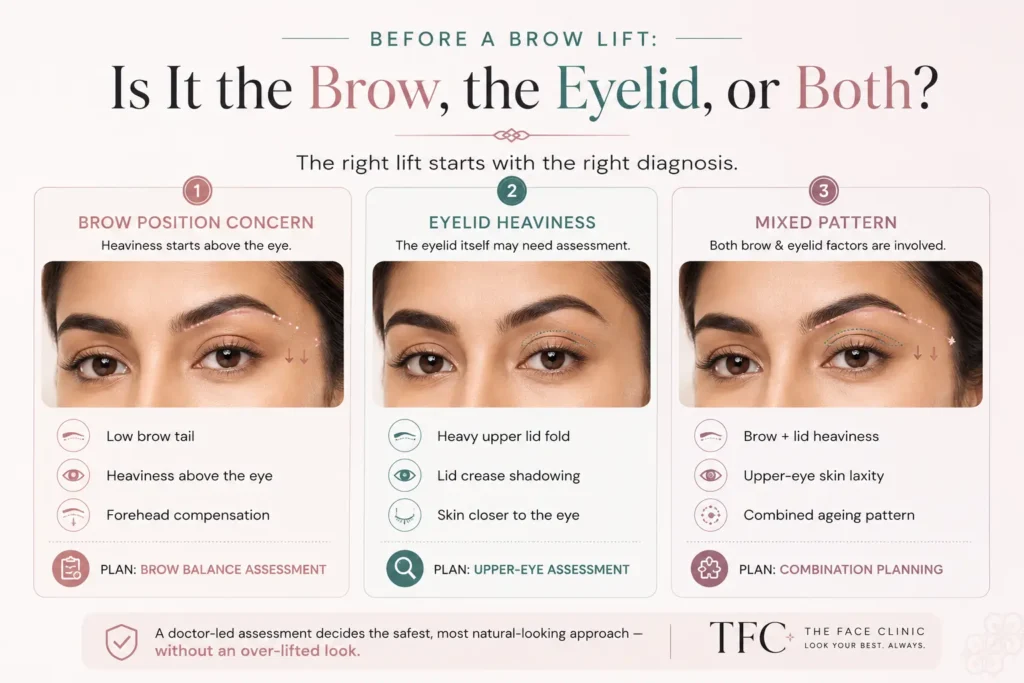
An eyebrow can appear lower or the upper eye area can look heavy for several different reasons. These include natural brow position, changes in muscle activity, age-related tissue descent, excess upper-eyelid skin, or true eyelid ptosis.
Although these concerns may look similar, they do not necessarily require the same treatment.
At The Face Clinic, the assessment considers four important questions:
- Is the eyebrow itself positioned lower than expected?
- Is forehead or brow-depressor muscle activity contributing to the appearance?
- Is excess upper-eyelid skin or eyelid ptosis the main concern?
- Can a non-surgical procedure realistically produce the improvement the patient is seeking?
This distinction is important because an injectable brow lift may provide a modest change in brow position but cannot reliably remove excess upper-eyelid skin or correct true eyelid ptosis.
The goal of the consultation is to identify an appropriate option, explain its likely benefits and limitations, and avoid unnecessary treatment.
What Is a Non-Surgical Eyebrow Lift?
A non surgical eyebrow lift, also called a non surgical brow lift or injectable brow lift depending on the technique, is an aesthetic procedure intended to improve selected aspects of eyebrow position or contour without conventional surgery.
The eyebrow is supported and influenced by skin, underlying soft tissues, and a balance of muscles around the forehead and eyes.
The frontalis muscle contributes to eyebrow elevation, while muscles including the orbicularis oculi, corrugator supercilii and procerus influence downward or inward brow movement.
Changes in this muscular balance can affect the height or shape of the eyebrow.
Some patients are concerned mainly about the outer brow arch. Others notice increasing asymmetry, lower brow position, forehead wrinkles, or heaviness over the upper eyelids.
An appropriate treatment plan begins by distinguishing these concerns rather than assuming they all require eyebrow lifting.
Why Do Eyebrows Become Droopy or Asymmetrical?
Several factors can contribute to sagging or low-positioned eyebrows:
- Age-related tissue changes: Changes in skin elasticity and soft-tissue support may contribute to brow descent.
- Genetics and natural anatomy: Some people naturally have lower-set eyebrows or differences between the two sides.
- Muscle activity: The balance between brow-elevating and brow-depressing muscles influences eyebrow position and expression.
- Previous treatments: Botulinum toxin or other facial procedures may temporarily alter brow height or movement.
- Changes in facial volume: Temple or upper-face volume changes can alter facial contours, although they do not necessarily cause true brow ptosis.
- Underlying eyelid conditions: Excess eyelid skin or true eyelid ptosis may create the appearance of a heavy upper eye even when brow position is normal.
An eyebrow lift treatment should therefore be chosen according to the underlying anatomical cause.
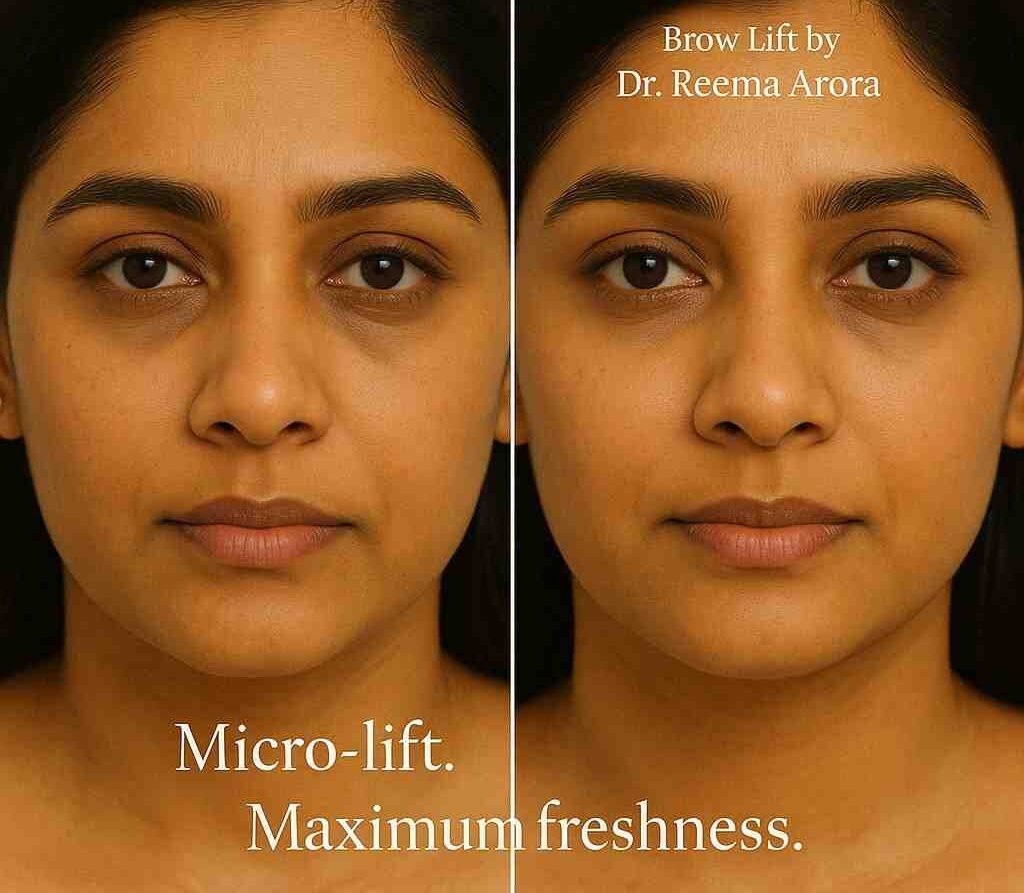
Images are for illustrative purposes only and may not represent actual patients or outcomes. Individual results vary based on anatomy, clinical assessment, and personalised treatment planning.
What Can a Non-Surgical Brow Lift Improve?
A non-surgical brow lift may be considered for selected patients with mild upper-face concerns.
Drooping or Low-Positioned Eyebrows
Mild eyebrow descent can change the relationship between the brow and upper eyelid.
Where muscle activity contributes to this appearance, a carefully planned Botox brow lift may allow limited elevation. In other selected cases, thread lifting may be considered.
The degree of correction depends on individual anatomy and the treatment chosen.
Eyebrow Asymmetry
It is normal for eyebrows to differ slightly in height, arch and movement.
If the difference is influenced by muscle activity, selected treatment may improve balance. Structural asymmetry is less predictable to correct.
Complete symmetry should not be expected or promised.
Loss of Natural Brow Arch Definition
Changes in the lateral brow may affect the definition of the eyebrow arch.
Some patients seek a subtle refinement of the outer eyebrow rather than elevation of the entire brow.
Treatment planning should respect existing facial proportions and the patient’s preferences.
Forehead Wrinkles and Frown Lines
Repeated contraction of forehead and frown muscles contributes to dynamic expression lines.
Botulinum toxin may soften certain facial lines while also influencing eyebrow position. However, forehead wrinkle reduction and brow lifting are separate treatment objectives.
For patients whose main concern is expression lines, anti-wrinkle treatment in Delhi may be more relevant than a brow-lifting procedure.
A Heavy or Tired-Looking Upper Eye Area
A descended outer brow may contribute to upper-eye heaviness in some individuals.
Modest improvement in eyebrow position can sometimes alter the appearance of the eye area, but this does not mean the procedure corrects every cause of hooding or tired-looking eyes.
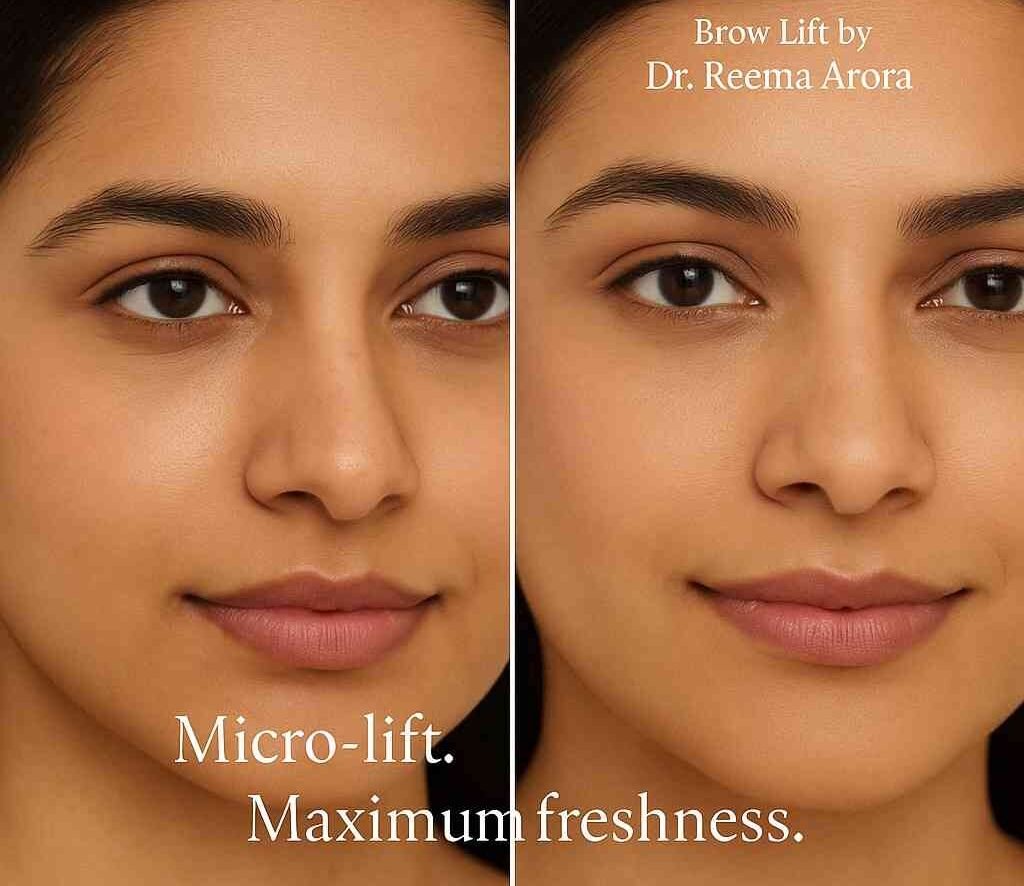
Images are for illustrative purposes only and may not represent actual patients or outcomes. Individual results vary based on anatomy, clinical assessment, and personalised treatment planning.
Eyebrow Lift for Hooded Eyes: Can It Help?
An eyebrow lift for hooded eyes may be useful when a descended eyebrow contributes to heaviness over the upper eyelid.
However, hooded eyes can result from different anatomical conditions.
Concern | What is happening | Treatment consideration |
Brow ptosis | The eyebrow sits lower than its previous or expected anatomical position | Selected non-surgical treatments or surgical brow assessment |
Dermatochalasis | Excess upper-eyelid skin creates folds or hooding | Eyelid assessment; surgery may be more appropriate |
Eyelid ptosis | The upper eyelid margin itself is abnormally low | Medical or oculoplastic assessment |
Naturally low-set brows | Brow position reflects individual anatomy rather than necessarily representing a medical problem | Treatment may not be needed |
Can Botox Help Hooded Eyelids?
A Botox brow lift may help selected patients when muscular forces contribute to mild lateral brow descent.
The improvement is generally subtle. Botox does not remove eyelid skin and is not a reliable treatment for true eyelid ptosis.
When Is Surgery More Appropriate?
If hooding is mainly caused by significant excess eyelid skin or substantial brow descent, non-surgical treatment may provide insufficient correction.
An oculoplastic or plastic surgical consultation may be appropriate.
Sudden eyelid drooping, particularly with double vision, unequal pupils, weakness or other neurological symptoms, requires urgent medical evaluation rather than cosmetic treatment.
For an explanation of surgical brow correction, see the American Society of Plastic Surgeons’ brow lift guidance.
Which Brow Lift Treatment May Be Suitable for Your Concern?
The following table helps distinguish commonly described concerns. It is not a substitute for medical assessment.
Main concern | Possible assessment or treatment direction |
Mild outer brow descent influenced by muscle activity | Botox eyebrow lift may be considered |
Selected mild brow descent with suitable tissue mobility | PDO thread brow lift may be discussed |
Mild muscle-related brow asymmetry | Individualised botulinum toxin assessment |
Forehead wrinkles without significant brow descent | Anti-wrinkle treatment rather than brow lifting |
Heavy eyes caused by excess eyelid skin | Eyelid or surgical assessment |
True eyelid ptosis | Medical or oculoplastic evaluation |
Significant brow descent | Surgical brow lift assessment |
Normal low-set brows without a clinical concern | No treatment may be necessary |
The most appropriate procedure depends on the cause of the concern, not simply the patient’s preferred treatment name.
Images are for illustrative purposes only and may not represent actual patients or outcomes. Individual results vary based on anatomy, clinical assessment, and personalised treatment planning.
Non-Surgical Eyebrow Lift Treatment Options at The Face Clinic
The principal options considered for a non-surgical brow lift include targeted botulinum toxin injections and selected thread-lifting techniques.
These approaches are not interchangeable. They differ in mechanism, suitability, potential complications and expected duration.
Botox Eyebrow Lift: How Does It Work?
A Botox eyebrow lift, also called a Botox brow lift or Botox for brow lift, uses botulinum toxin injections to temporarily alter the activity of selected muscles influencing eyebrow position.
The forehead’s frontalis muscle contributes to lifting the eyebrows. Other muscles around the eyes and frown area contribute to downward or inward brow movement.
In selected patients, reducing the activity of specific brow-depressor muscles may allow a modest relative elevation of part of the eyebrow, particularly the lateral brow.
Who May Benefit From a Botox Brow Lift?
This technique may be considered for patients with:
- Mild lateral brow descent.
- Selected differences in eyebrow position caused partly by muscle activity.
- A preference for limited, temporary improvement.
- Associated dynamic frown lines or other expression-line concerns requiring separate assessment.
Botox is not a substitute for surgical tissue repositioning.
How Much Can Botox Lift the Eyebrows?
A Botox eyebrow lift generally provides a subtle change rather than a dramatic elevation.
In selected patients, the visible difference may be only a few millimetres or less. Some patients experience little measurable lifting, while others may notice an unwanted change in brow position.
The response depends on brow anatomy, the balance between opposing muscle groups, injection technique and individual sensitivity.
A specific amount of brow elevation cannot be guaranteed.
When Will Botox Brow Lift Results Appear?
Changes in muscle activity generally develop over several days, with the treatment response commonly assessed after around two weeks.
The effect is temporary, and the visible brow-position improvement may last a few months. Duration varies according to the individual and treatment technique.
Botox eyebrow lift results should not automatically be assumed to last as long as every other treatment performed with botulinum toxin.
Can Botox Make Eyebrows Droop?
Yes. Inappropriately selected or placed treatment, particularly excessive weakening of the frontalis muscle, can contribute to brow heaviness or brow ptosis.
Unwanted eyebrow asymmetry or eyelid ptosis can also occur.
A proper assessment of muscle activity is therefore particularly important.
Is Botox Eyebrow Lift FDA-Approved?
Specific botulinum toxin products have FDA approval for certain facial expression lines, including glabellar, lateral canthal and forehead lines, according to their product labels.
However, using botulinum toxin specifically to elevate the eyebrow is generally an off-label cosmetic application in the United States.
Regulatory approval for treating forehead or frown lines should not be presented as specific FDA approval for brow lifting.
For a product-specific reference, consult the BOTOX Cosmetic prescribing information on DailyMed.
For related information, read Botox treatment in Delhi and Botox treatment cost in Delhi.
Eyebrow Lift With Threads: PDO Thread Brow Lift
An eyebrow lift with threads, sometimes called a PDO thread brow lift, eyebrow thread lift, or thread lift eyebrow procedure, involves placing selected threads beneath the skin to provide limited mechanical support and tissue repositioning.
PDO stands for polydioxanone, an absorbable material used in certain medical sutures and aesthetic threads.
Different thread designs have different functions. Not every PDO thread is designed to mechanically lift tissue, and the choice of material depends on the procedure and the patient’s anatomy.
How Does a Thread Eyebrow Lift Work?
Selected lifting threads may be used to support limited tissue repositioning.
The effect depends on tissue characteristics, thread design, placement and the direction of support.
Although absorbable threads may stimulate a local tissue response that includes collagen formation, this does not establish a guaranteed or permanent eyebrow lift.
Who May Be Suitable for a PDO Thread Brow Lift?
Thread-based brow treatment may be considered in selected adults with mild brow descent, appropriate tissue mobility and realistic expectations.
It may not be suitable for patients with significant brow ptosis, substantial excess eyelid skin or expectations of surgical-level correction.
How Long Does a PDO Thread Brow Lift Last?
The lifting effect is temporary and its duration varies.
Factors affecting results include thread type, placement, tissue characteristics, healing and continued age-related changes.
There is limited robust long-term evidence defining a predictable duration of eyebrow-specific lifting across different PDO thread techniques.
Therefore, estimates such as 12–18 months should not be treated as assured outcomes.
Is There Downtime After an Eyebrow Thread Lift?
Temporary swelling, bruising, tightness and tenderness may occur. Some patients develop skin puckering or asymmetry during recovery.
Unlike a simple injectable procedure, thread lifting involves introducing material beneath the skin, and the recovery requirements can be more involved.
Possible complications include infection, dimpling, visible or palpable threads, extrusion and unsatisfactory lifting.
For a broader discussion, read thread lift treatment in Delhi and the thread lift cost in India guide.
Dermal Filler Brow Lift: Can Fillers Improve Brow Contour?
Patients researching a dermal filler brow lift may be interested in whether hyaluronic acid fillers can address upper-face volume loss or changes in facial contour.
Volume restoration and eyebrow lifting are different treatment objectives.
Some upper-face volume changes may influence how the temples, forehead and brow region appear, but dermal fillers should not be presented as a routine replacement for a brow-lifting procedure.
There is an important anatomical and regulatory distinction.
The US FDA identifies the forehead, glabella and periorbital regions as areas where dermal filler injection is not approved. Injections into or near blood vessels can cause serious complications, including tissue injury, visual impairment, blindness and stroke.
Approval of a filler for one facial indication does not establish approval for use around the eyebrow.
At The Face Clinic, any separate upper-face volume concern should be evaluated on its own clinical merits. Filler placement should not automatically be recommended as part of an eyebrow-lifting package.
Learn more about dermal fillers in Delhi and the FDA guidance on dermal filler uses and risks.
Can Botox and Thread Lifting Be Combined?
Some patients have more than one concern, such as mild brow descent together with dynamic forehead wrinkles.
A combined plan may sometimes be discussed when each procedure has a clear purpose and acceptable risk profile.
However, combining Botox, threads or fillers does not automatically produce better lifting, more symmetry or longer-lasting results.
Each proposed treatment should be justified independently, with its expected benefits, limitations and risks explained.
Eyebrow Lift Without Surgery vs Surgical Brow Lift
Patients considering an eyebrow lift without surgery often want to understand whether non-surgical treatment can provide an alternative to conventional forehead or brow lift surgery.
The answer depends on the degree of brow descent and the anatomical cause.
A surgical brow lift, also called browplasty or a forehead lift, repositions brow and forehead tissues through an operative procedure.
Non-surgical methods generally aim to produce more limited, temporary changes.
Factor | Non-surgical eyebrow lift | Surgical brow lift |
Technique | Muscle modulation or selected thread support | Surgical tissue repositioning |
Expected change | Usually subtle and variable | May provide more substantial correction |
Incisions | No conventional surgical incisions; threads require skin-entry points | Surgical incisions |
Anaesthesia | Depends on procedure; often minimal or local measures | Depends on surgical technique |
Recovery | Technique-dependent; often shorter but not necessarily zero | Generally longer |
Duration | Temporary | Typically longer-lasting, although ageing continues |
Suitable concerns | Selected mild brow-position changes | More significant brow descent |
Main limitation | Cannot remove substantial excess eyelid skin | Requires surgery with associated risks |
When Is a Surgical Brow Lift More Appropriate?
Surgical evaluation may be more appropriate when:
- The eyebrow has descended significantly.
- Upper-face tissues require substantial repositioning.
- Non-surgical treatment is unlikely to produce a meaningful improvement.
- The patient seeks greater or more durable structural correction.
- Brow descent is contributing substantially to upper-eyelid hooding.
A separate upper-eyelid procedure may also be considered when excess eyelid skin is the primary issue.
Surgical procedures have their own risks and recovery requirements. Avoiding surgery does not make every non-surgical alternative automatically preferable.
For more information, see the American Society of Plastic Surgeons’ brow lift overview.
Non-Surgical Eyebrow Lift Cost in Delhi
The non surgical eyebrow lift cost in Delhi depends on the procedure, treatment complexity, products or materials used, and individual facial anatomy.
At The Face Clinic in Hauz Khas, the published starting price for a non-surgical eyebrow lift is ₹10,000.
Eyebrow Lift Treatment Prices at The Face Clinic
Treatment | Published indicative price |
Botox eyebrow lift | ₹10,000–₹25,000 |
PDO thread brow lift | ₹15,000–₹60,000 |
Individually planned combined treatment | Quoted following assessment |
These price ranges are indicative. The final quotation is confirmed after consultation and treatment planning.
The table intentionally does not list a dermal filler brow lift as a routine, equivalent eyebrow-lifting option.
What Factors Affect Eyebrow Lift Cost?
The final eyebrow lift cost may depend on:
- Treatment technique: Botox injections and thread procedures differ in complexity, materials and follow-up needs.
- Individual anatomy: Brow height, asymmetry, muscle activity and tissue quality affect the treatment plan.
- Extent of correction: A limited outer-brow adjustment is different from a broader upper-face treatment.
- Products and materials: Dose, product selection, thread design and number of threads can influence cost.
- Medical assessment: The quotation should make clear what is included in the treatment and follow-up.
Is Botox Eyebrow Lift Cost the Same as Forehead Botox Cost?
Not necessarily.
A Botox brow lift and Botox treatment for forehead wrinkles may have different clinical objectives, anatomical considerations and injection plans.
Treating forehead lines does not automatically lift the eyebrows. In some patients, inappropriate forehead treatment may actually contribute to brow heaviness.
For broader area-specific pricing, refer to the Botox treatment cost in Delhi guide.
Is a Non-Surgical Eyebrow Lift Less Expensive Than Surgery?
Non-surgical eyebrow lift treatment may have a lower initial procedural cost than surgical brow lifting.
However, direct price comparisons should consider the expected degree of correction, duration, need for repeat treatment, complications and whether the non-surgical procedure can realistically address the concern.
A lower starting price does not make a treatment appropriate for every patient.
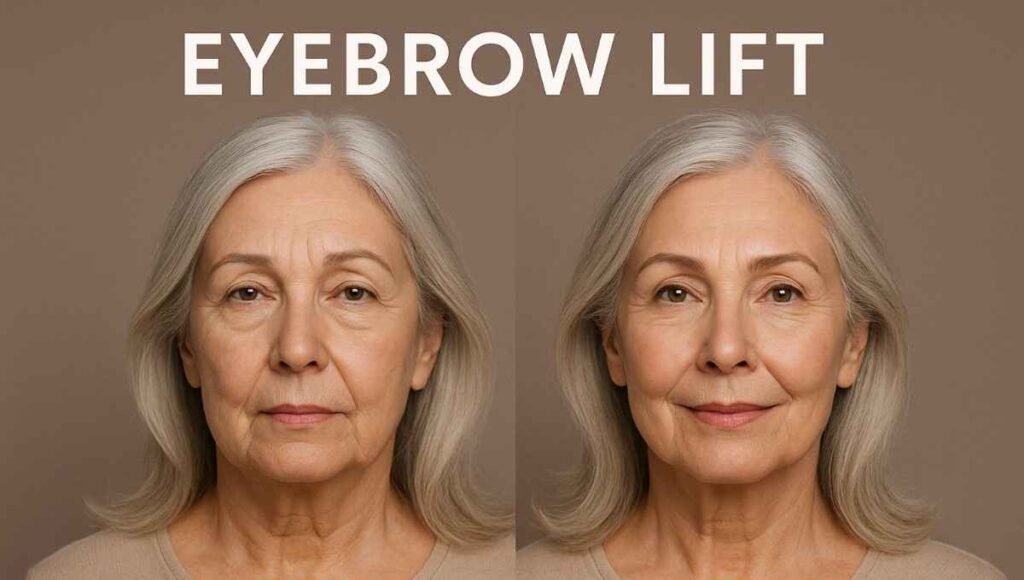
Images are for illustrative purposes only and may not represent actual patients or outcomes. Individual results vary based on anatomy, clinical assessment, and personalised treatment planning.
Who Is a Suitable Candidate for a Non-Surgical Brow Lift?
Suitability depends more on facial anatomy, medical history and treatment goals than age alone.
A non-surgical brow lift may be considered in adults who have:
- Mild brow descent.
- Selected muscle-related eyebrow asymmetry.
- A desire for limited brow arch refinement.
- Mild upper-eye heaviness partly related to brow position.
- Realistic expectations of temporary improvement.
- A preference to consider non-surgical treatment after understanding its limitations.
Who May Not Be Suitable?
A non-surgical brow lift may be inappropriate when:
- Significant brow descent requires surgical repositioning.
- Excess upper-eyelid skin or true ptosis is the main concern.
- A relevant infection or medical condition increases procedural risk.
- There is a contraindication to the proposed injectable product or thread procedure.
- The patient expects dramatic, perfectly symmetrical or permanent results.
- The anticipated benefit does not justify the risks.
Pregnancy, breastfeeding, medication use, allergies, neuromuscular conditions and previous aesthetic procedures should be discussed during consultation, where relevant.
There is no universally appropriate procedure or age range for brow lifting.
What Happens During a Brow Lift Treatment?
Step 1: Facial Assessment
Dr. Reema Arora evaluates brow position, upper-eyelid anatomy, facial proportions, forehead movement and the patient’s treatment goals.
Medical history, previous procedures and potential contraindications are reviewed.
Step 2: Treatment Selection
The doctor explains which concern is being addressed and whether Botox, threads, another approach, or no treatment is appropriate.
Expected benefits, potential complications, alternatives, recovery and cost are discussed before the procedure.
Step 3: Procedure
For Botox, the injection procedure is generally brief.
A thread-based procedure requires additional preparation and placement time. The duration varies with the technique and individual plan.
Not every non-surgical eyebrow lift is a 10–15-minute treatment.
Step 4: Aftercare and Follow-Up
Patients receive instructions appropriate to the selected procedure and information about symptoms requiring medical review.
Follow-up may be recommended to assess the response, recovery or complications.
Brow Lift Recovery, Preparation and Aftercare
Before Your Eyebrow Lift Treatment
Inform the doctor about prescription medicines, anticoagulants, antiplatelet medicines, supplements, allergies, previous facial procedures and relevant medical conditions.
Do not stop prescribed blood-thinning medicines or other essential treatment unless advised by the prescribing clinician.
The clinic will provide preparation instructions according to the selected procedure.
After a Botox Brow Lift
Temporary redness, tenderness, minor swelling or bruising may occur.
Follow the doctor’s instructions regarding pressure or manipulation of the treated area, activity and any necessary review.
After an Eyebrow Thread Lift
Some patients experience swelling, bruising, tenderness, tightness or temporary skin irregularity.
Technique-specific precautions may be recommended to minimise unnecessary pressure or movement while healing.
Seek medical review for worsening pain, significant asymmetry, persistent or increasing swelling, signs of infection or other unexpected symptoms.
Non-Surgical Brow Lift Results: What to Expect
The most important consideration is whether the expected amount of improvement is meaningful for the individual patient.
How Soon Will I See Results?
Botox brow lift: The effect develops gradually over several days. Assessment is commonly undertaken at approximately two weeks.
PDO thread brow lift: Some initial mechanical repositioning may be visible, but swelling and tissue settling can affect the early appearance.
How Long Do Eyebrow Lift Results Last?
Procedure | General expectation |
Botox eyebrow lift | Temporary effect, commonly lasting a few months |
PDO thread brow lift | Temporary and variable; brow-specific longevity is not reliably predictable |
Surgical brow lift | Generally longer-lasting structural correction |
The duration depends on individual anatomy, treatment response, technique and continued tissue changes.
Repeated treatment should be considered only when clinically appropriate.
Will an Eyebrow Lift Look Natural?
Treatment aims to respect individual brow anatomy and facial proportions.
However, a natural-looking result, complete symmetry or a precise amount of lifting cannot be guaranteed.
Unwanted changes in brow shape, expression or symmetry are possible complications and should be included in treatment counselling.
Risks and Side Effects of a Non-Surgical Eyebrow Lift
Non-surgical treatment avoids conventional brow lift surgery but is not risk-free.
Botox Brow Lift Risks
Potential effects include:
- Injection-site discomfort, swelling or bruising.
- Headache.
- Unwanted changes in brow position.
- Brow heaviness or asymmetry.
- Temporary eyelid or eyebrow ptosis.
Botulinum toxin products also carry warnings about rare but potentially serious effects from spread of toxin action, including swallowing, speaking or breathing difficulties. Such symptoms require urgent medical attention.
PDO Thread Brow Lift Risks
Potential complications include:
- Pain, bruising and swelling.
- Infection.
- Skin puckering or dimpling.
- Asymmetry or irregular contours.
- Visible or palpable threads.
- Thread extrusion or other thread-related problems.
- Unsatisfactory or short-lived lifting.
Further medical treatment or intervention may occasionally be required.
Why Dermal Fillers Require Particular Caution
Dermal fillers can cause vascular obstruction, tissue damage and, rarely, serious visual complications.
These risks are especially important when considering injections in the forehead, glabella or around the eyes.
The US FDA does not approve dermal fillers for injection into these anatomical areas. For this reason, a filler-based approach should not be advertised as a routine, FDA-approved brow lift.
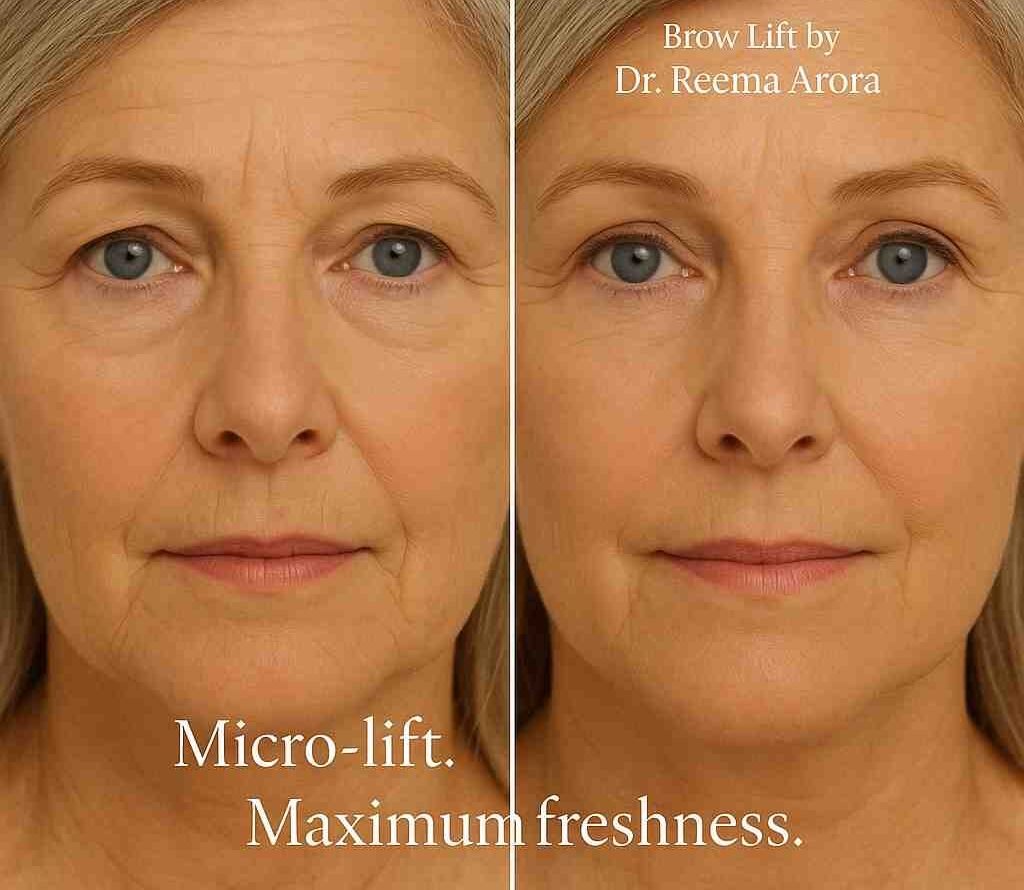
Images are for illustrative purposes only and may not represent actual patients or outcomes. Individual results vary based on anatomy, clinical assessment, and personalised treatment planning.
Are Non-Surgical Brow Lift Treatments FDA-Approved?
The regulatory status of a treatment depends on the specific product, device, intended use and country.
Certain botulinum toxin products have approval for specified facial expression-line indications. This does not necessarily include eyebrow elevation as an approved indication.
PDO thread materials and particular medical devices may have different regulatory statuses. Clearance, approval or other authorisation for a particular product does not establish approval for every aesthetic thread-lifting technique.
Similarly, FDA approval of dermal fillers for certain facial areas does not extend automatically to the forehead, glabella or periorbital region.
At The Face Clinic, treatment suitability and product selection are evaluated individually. Regulatory status should be verified for the specific product and intended use rather than described through blanket claims such as “all treatments are FDA-approved.”
For further reading, refer to:
Non-Surgical Eyebrow Lift for Men
Men may seek treatment for mild brow descent, asymmetry, forehead lines or a heavy appearance around the eyes.
Eyebrow height, shape and facial proportions vary considerably between individuals.
A non-surgical eyebrow lift for men should therefore be planned according to the patient’s natural anatomy and aesthetic preferences rather than following a standardised eyebrow arch.
Selected Botox or thread techniques may be discussed when suitable, but unnecessary elevation or alteration of the natural brow should be avoided.
Why Choose Dr. Reema Arora for an Eyebrow Lift in Delhi?
Dr. Reema Arora is the Founder and Medical Director of The Face Clinic in Hauz Khas, South Delhi.
She has more than 20 years of experience in facial aesthetics and has worked extensively with injectable facial treatments.
Her professional background includes:
- MBBS from St. John’s Medical College, Bengaluru.
- MSc in Facial Aesthetics from the UK.
- Previous experience as Medical Head – Facial Aesthetics at Allergan India.
- Experience in training medical practitioners in botulinum toxin and dermal filler treatments.
- Clinical and academic contributions in non-surgical facial aesthetics.
An Individualised, Doctor-Led Approach
Brow lift treatment planning at The Face Clinic is based on a detailed assessment of facial anatomy and the clinical concern.
The emphasis is on:
- Identifying the cause of brow or eyelid heaviness.
- Selecting a procedure only where the expected benefit is clinically reasonable.
- Considering natural brow shape, movement and facial balance.
- Discussing treatment alternatives, limitations and risks.
- Using appropriately sourced products and procedure-specific medical protocols.
- Providing relevant aftercare and follow-up guidance.
Not every patient needs a brow lift, and more treatment does not necessarily produce a better outcome.
Learn more about Dr. Reema Arora’s qualifications and professional experience.
Frequently Asked Questions About Non-Surgical Eyebrow Lift in Delhi
1. Does a Non-Surgical Eyebrow Lift Really Work?
It may produce a subtle improvement in selected patients. Results depend on whether the treatment addresses the actual cause of brow descent or asymmetry. Significant structural changes generally require surgical evaluation.
2. How Much Does an Eyebrow Lift Cost in Delhi?
The eyebrow lift cost at The Face Clinic starts from ₹10,000. Botox eyebrow lift treatment is indicatively priced at ₹10,000–₹25,000, while PDO thread brow lift treatment is listed at ₹15,000–₹60,000. The final amount is confirmed after medical assessment.
3. Is Botox Eyebrow Lift Better Than Thread Lifting?
Neither is universally better. Botox modifies muscle activity and may be more suitable for selected mild muscle-related brow concerns. Threads aim to provide mechanical support in appropriately selected patients. Their risks, recovery and outcome predictability differ.
4. Can Botox Lift Drooping Eyebrows?
Botox may produce a modest elevation in selected patients by altering the balance of brow-depressor and brow-elevator muscle activity. It does not remove loose skin or provide surgical-level lifting.
5. How Much Brow Elevation Can Botox Achieve?
The visible change is generally subtle and may be only a few millimetres or less. Some patients experience minimal or no measurable lift. No specific amount can be promised.
6. Is an Eyebrow Lift With Threads Permanent?
No. Thread-related lifting is temporary. Results vary with thread design, placement, tissue characteristics and healing. Long-term brow-specific results are not reliably predictable for every technique.
7. Can an Eyebrow Lift Help Hooded Eyes?
An eyebrow lift for hooded eyes may help when brow descent contributes to the hooded appearance. If excess eyelid skin or true eyelid ptosis is responsible, eyelid or surgical assessment may be more appropriate.
8. Can I Get an Eyebrow Lift Without Surgery?
Yes, selected non-surgical techniques may provide limited brow-position improvement. Their suitability depends on anatomy and the correction required. They are not equivalent to a surgical brow lift.
9. What Is the Recovery Time After a Non-Surgical Brow Lift?
Recovery depends on the procedure. Botox injections may involve brief local effects, while thread lifting can cause swelling, bruising, tightness and temporary irregularity requiring additional care.
10. Are Non-Surgical Eyebrow Lifts Safe?
They have recognised risks and potential complications. Medical assessment, appropriate procedure selection, informed consent and aftercare are important. No treatment should be described as completely safe or risk-free.
11. Can Brow Lifting Correct Eyebrow Asymmetry?
Some muscle-related asymmetry may improve with carefully selected treatment. Structural asymmetry or differences in underlying anatomy may persist. Perfect symmetry cannot be guaranteed.
12. Will a Botox Brow Lift Change My Facial Expression?
Botulinum toxin modifies selected muscle activity and can alter brow movement or expression. Treatment planning aims to avoid unnecessary changes, but unwanted changes are possible.
13. Can Men Have a Non-Surgical Eyebrow Lift?
Yes. Suitable adult men may be considered for brow-position treatment. Planning takes account of facial anatomy, natural eyebrow shape and individual goals.
14. Is There an Ideal Age for Non-Surgical Eyebrow Lift Treatment?
There is no single ideal adult age. The need for treatment depends on anatomical findings, medical suitability and patient expectations rather than age alone.
15. Where Can I Find an Eyebrow Lift Near Me in South Delhi?
If you are searching for an eyebrow lift near me, The Face Clinic is located in Hauz Khas, South Delhi. Dr. Reema Arora provides individual consultations to assess Botox brow lift, thread lifting and other appropriate treatment options.
16. How Should I Compare Eyebrow Lift Cost Near Me?
When comparing eyebrow lift cost near me, consider the specific technique, medical assessment, products or materials used, expected outcome, risks, and follow-up arrangements.
At The Face Clinic, treatment starts from ₹10,000, with a final quotation following consultation.
17. Is a Non-Surgical Eyebrow Lift Cost-Effective Compared With Surgery?
The initial cost may be lower, but non-surgical results are usually more limited and temporary. The decision should be based on suitability and realistic outcomes rather than price alone.
18. What Happens if a Non-Surgical Brow Lift Is Not Suitable for Me?
Dr. Reema Arora may recommend no treatment, management of a different concern, or assessment by an appropriately qualified surgical specialist. Non-surgical treatment should not be recommended when it is unlikely to address the underlying problem.
Book a Non-Surgical Brow Lift Consultation in Hauz Khas, South Delhi
If you are considering an eyebrow lift treatment in Delhi, a medical consultation can help determine whether the concern relates to brow position, muscle activity, upper-eyelid anatomy or another facial change.
At The Face Clinic, Dr. Reema Arora evaluates your individual anatomy and explains whether a Botox eyebrow lift, eyebrow lift with threads, or another approach may be appropriate.
You will have the opportunity to discuss expected benefits, possible complications, recovery, alternatives and eyebrow lift cost before deciding whether to proceed.
The Face Clinic — Dr. Reema Arora
C-36, Lower Ground Floor, Chaudhary Dilip Singh Marg, Hauz Khas Market, New Delhi – 110016
Clinic hours: Monday–Saturday, 10:00 AM–6:00 PM
Phone: +91 99580 73900
Email: info@drreemaarora.com
Medical disclaimer: This information is educational and does not replace individual medical advice, examination or informed consent. Treatment suitability, results, recovery and potential complications vary. Regulatory approval or clearance depends on the specific product, device and intended indication.
All treatments are subject to individual variation. Outcomes are determined following clinical evaluation by a qualified doctor.