
Jawline Fillers
- Home
- Services
- Jawline Fillers
Don’t think much, have a query? Call us now!
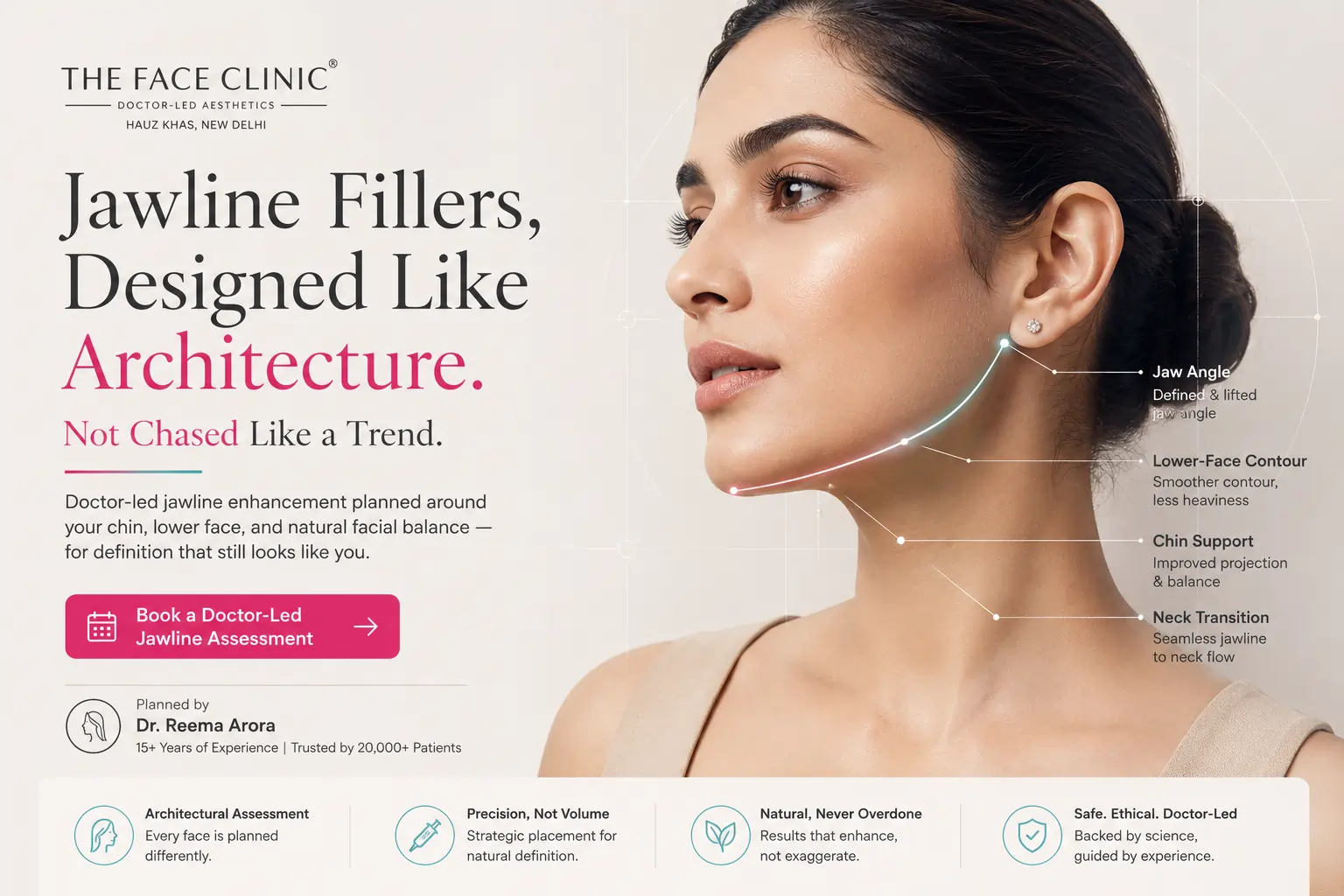
Jawline fillers in Delhi are a non-surgical injectable treatment used to enhance jawline definition, improve facial symmetry, and refine lower-face proportions without surgery. Dermal fillers for jawline contouring can add or restore support in carefully selected areas, helping create a more defined and balanced facial profile while maintaining natural facial movement and expression.
At The Face Clinic, Hauz Khas, South Delhi, jawline filler treatments are planned and performed by Dr. Reema Arora (20+ years’ experience, international trainer) using a doctor-led, anatomy-based approach. Each treatment plan begins with a detailed assessment of the jawline, chin, lower-face proportions, soft tissues and overall facial balance to determine whether filler is appropriate and how much enhancement is required. Expected changes, realistic outcomes, limitations and personalised treatment planning are discussed during consultation, along with relevant jawline filler before-and-after examples where available.
Jawline filler cost in Delhi depends on factors such as the filler selected, quantity required, facial anatomy and individual treatment goals. An in-person medical assessment helps determine suitability, safety and the most appropriate approach for achieving balanced, natural-looking results.
Jawline filler treatment is most appropriate when limited structural definition or projection is an important reason the jawline appears soft or poorly defined. It is not automatically the correct treatment for every unclear jawline; chin projection, prominent masseter muscles, submental fat and skin laxity can also influence lower-face definition and may require a different or combined treatment approach.
Most jawline filler appointments take approximately 30–45 minutes and usually involve limited downtime. With many hyaluronic acid fillers, results may commonly last around 12–18 months, although longevity varies according to the product used, treatment area, facial anatomy, skin quality, metabolism and individual response.
The amount of filler required — and therefore jawline filler cost in Delhi — varies significantly between patients. Treatment planning is based on facial assessment rather than a predetermined number of syringes, with the aim of improving definition and proportion without creating unnecessary width or an overfilled appearance.
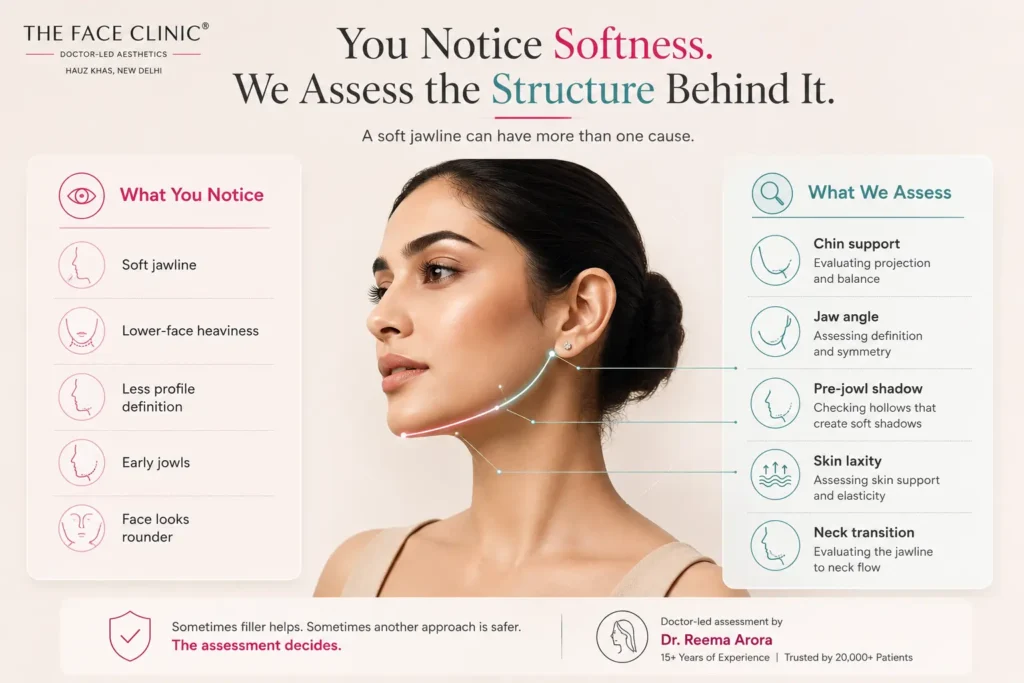
Hyaluronic acid dermal fillers are commonly used for non-surgical jawline contouring, sometimes referred to simply as jaw filler. When clinically appropriate, filler can be placed at selected points along the mandibular border and adjacent lower-face areas according to individual anatomy to improve projection, continuity and definition.
Jawline enhancement is therefore more than surface-level contouring. Effective treatment requires assessment of the underlying facial structure and the relationship between the jawline, chin, soft tissues and overall facial proportions.
In appropriately selected patients, jawline fillers in Delhi can improve the definition of a naturally soft or under-projected jawline, restore some definition affected by age-related change, and help improve mild asymmetry — without surgery or prolonged recovery.
Jawline sculpting may also form part of broader facial-balancing treatment when other areas influence the appearance of the lower face. Explore our complete guide to dermal fillers treatment in Delhi to understand how fillers are used across different facial areas.
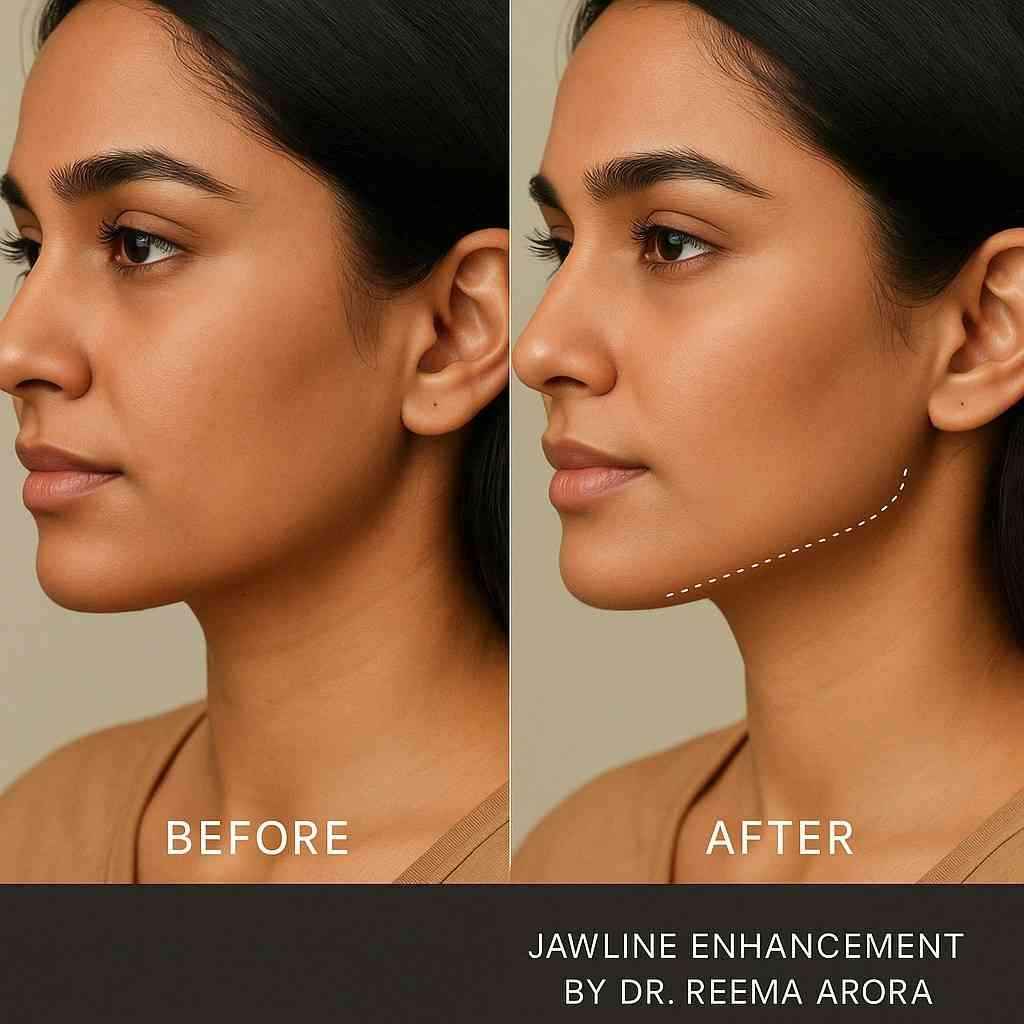
A poorly defined jawline does not always have the same anatomical cause. Before recommending jawline filler, the lower face should be assessed to determine whether reduced definition is primarily related to jaw structure, chin projection, muscle bulk, submental fullness, skin laxity, or a combination of these factors.
When the jawline lacks structural projection or appears naturally soft, carefully placed filler may improve definition along the mandibular border and create a clearer transition between the face and neck.
An under-projected or recessed chin can make the entire lower face appear less defined. In some patients, improving chin projection — alone or together with jawline filler — may create better facial balance than adding more filler along the jawline itself.
Where chin projection is the main concern, treatment may be better directed to chin fillers in Delhi rather than treating the jawline alone.
A broad or heavy lower face can sometimes be related to prominent masseter muscles rather than inadequate jaw structure. In these cases, adding filler may increase lower-face width rather than produce the desired refinement.
When muscle bulk is an important contributor, masseter botox treatment may be considered after clinical assessment.
Jawline filler can improve structural definition, but it does not remove fat beneath the chin. If submental fullness is the principal reason the jawline appears blurred, double chin treatment in Delhi may be more appropriate or may need to be combined with structural treatment.
When reduced jawline definition is mainly caused by skin laxity, tissue descent or more advanced jowling, filler alone may provide limited benefit and can sometimes add unwanted heaviness.
Depending on the degree and cause of laxity, skin tightening treatment — or, in selected cases, a surgical opinion — may be more appropriate.
The aim of assessment is therefore not simply to decide how much filler to use, but to determine whether jawline filler is the right treatment at all and which approach is most likely to improve lower-face balance without overcorrection.
Jawline fillers may be appropriate for adults who:
Both men and women may benefit from jawline fillers, but treatment should be individualised according to facial anatomy, proportions, degree of structural deficiency and personal aesthetic goals.
Where significant skin laxity, submental fullness, masseter prominence or another anatomical factor is the main cause of poor jawline definition, filler alone may not be the most appropriate treatment.
Jawline filler treatment may need to be postponed or avoided in certain circumstances, including:
A medical consultation allows individual risks, previous treatments and treatment expectations to be reviewed before proceeding.
When appropriately indicated and conservatively planned, jawline filler treatment may offer:
At The Face Clinic, jawline filler treatment is planned and performed by Dr. Reema Arora following a detailed assessment of bone structure, chin projection, soft-tissue support, symmetry, masseter prominence and muscle function when relevant, as well as important vascular anatomy.
Filler selection and placement are determined according to the patient’s anatomy, tissue requirements and treatment goals rather than by a fixed product or predetermined number of syringes. Injection planning prioritises anatomical precision, proportion, conservative correction and risk reduction.
The objective is not to create the most prominent jawline possible, but one that appears naturally defined, balanced and appropriate for the individual face — not “done.”
Jawline filler treatment is performed in the clinic and commonly takes approximately 30–45 minutes, depending on the extent of treatment required. Topical anaesthetic and/or a filler containing local anaesthetic may be used to reduce discomfort, and many patients are able to resume routine activities on the same day.
Temporary swelling, tenderness, redness or bruising can occur after treatment. Appropriate patient selection, anatomical knowledge, product choice and injection technique are important for reducing risk, although no injectable treatment is completely risk-free.
When hyaluronic acid filler is used, hyaluronidase may be used to dissolve or reduce the filler when clinically appropriate. Response can vary, and this does not remove the risks associated with injectable treatment or replace careful assessment, appropriate product selection and precise technique.
An improvement in jawline contour may be visible immediately after treatment, although early swelling can temporarily influence the appearance. The result is generally easier to assess as swelling settles over the following 1–2 weeks.
Depending on the patient’s starting anatomy and treatment plan, before-and-after changes may include improved mandibular definition, a clearer transition between the lower face and neck, better lower-face balance and improvement in mild asymmetry.
The aim is not simply to create a sharper jawline. The result should remain proportionate to the chin, cheeks, neck and overall facial structure.
The best results still look like you — more defined and balanced, without unnecessary width or heaviness.
All injectable treatments carry risk. Common temporary effects following jawline filler treatment include swelling, tenderness, redness and bruising.
Less common complications can include infection, inflammatory reactions, persistent lumps or nodules, asymmetry or other filler-related reactions.
Rare but potentially serious complications can also occur, including vascular occlusion, where blood flow becomes obstructed following filler injection. Early recognition and appropriate medical management are therefore essential.
At The Face Clinic, safety is supported through:
Individual suitability, medical history, previous treatments, risk factors and realistic outcome expectations are reviewed during consultation before treatment is undertaken.
Most patients experience limited downtime, but appropriate aftercare can support recovery and help minimise avoidable swelling or bruising.
During the first 24–48 hours, patients are generally advised to:
Aftercare instructions may vary according to the filler used, treatment performed and individual clinical circumstances.
Jawline filler cost in Delhi varies according to the filler selected, amount required, facial anatomy, treatment area and degree of jawline enhancement planned. At The Face Clinic, Hauz Khas, South Delhi, pricing is confirmed after a doctor-led facial assessment rather than being based on a predetermined number of syringes.
| Treatment Approach | Indicative Filler Quantity | Indicative 2026 Price Range | What It May Be Suitable For |
|---|---|---|---|
| Jawline Filler – Limited/Targeted Enhancement | Around 1 syringe in selected patients | ₹25,000–₹45,000 | Limited structural enhancement where only a small amount of correction is required |
| Full Jawline Sculpting with Fillers | Commonly 2–4 syringes | ₹60,000–₹1,60,000 | More extensive jawline definition and lower-face contouring |
| Jawline + Chin Filler Combination | Commonly 3–5 syringes in total | ₹85,000–₹2,00,000 | Selected patients where both chin projection and jawline definition influence facial balance |
Prices are indicative and may vary according to the filler selected, quantity required and individual treatment plan. The final jawline filler price is confirmed after medical assessment.
The number of syringes should not be viewed as a treatment target. Some patients require relatively limited correction, while others need a more comprehensive approach to achieve proportionate lower-face definition without excessive width or projection.
Different injectable products have different structural properties, treatment characteristics and longevity. Product selection should therefore be based on individual anatomy and the type of correction required rather than on brand name alone.
Hyaluronic acid fillers are commonly used for jawline contouring because selected products can provide projection and structural definition while allowing treatment to be adapted to facial anatomy.
When clinically appropriate, hyaluronidase may be used to dissolve or reduce HA filler, although response can vary and this should not be regarded as a guaranteed reversal of treatment or its associated risks.
Other injectable materials, including calcium hydroxylapatite or collagen-stimulating products, may be considered in selected patients where they form part of an appropriate clinical treatment plan.
These products differ from HA fillers in their mechanism, treatment characteristics, longevity and reversibility profile and should not be considered interchangeable.
Jawline fillers are not permanent. With many hyaluronic acid fillers, results may commonly remain visible for around 12–18 months, although duration varies according to the specific product used, quantity injected, facial anatomy, metabolism and individual response. Some products or injectable treatment approaches may have different longevity profiles.
Maintenance treatment, when appropriate, should be based on clinical assessment rather than a fixed treatment schedule.

Jawline fillers and surgical jawline procedures address different levels of structural change.
Jawline filler may be appropriate when the aim is to improve definition, projection or lower-face proportions without surgery. Treatment is performed in the clinic, usually involves limited downtime and requires maintenance because the effects are not permanent.
Surgical treatment may be more appropriate where substantial skeletal correction, significant tissue laxity or a degree of change beyond the capability of injectable treatment is required. Recovery, risks and expected outcomes depend on the specific surgical procedure performed.
The appropriate choice depends on the underlying anatomical concern, degree of correction required and individual treatment goals.
Jawline filler treatment should be based on individual facial anatomy and aesthetic goals rather than a fixed male or female template. However, patients may seek different types of lower-face definition, and treatment planning can be adapted accordingly.
Some men seek greater mandibular definition, stronger posterior jaw angles or increased lower-face projection. Treatment should enhance structure without creating excessive width or an unnatural, overfilled appearance.
Some women prefer more subtle jawline definition with smoother transitions between the chin, jawline and lower face. Treatment may focus on improving contour and proportion while maintaining softness where appropriate.
Facial width, chin projection, mandibular shape, muscle bulk, submental fullness and skin laxity vary considerably between individuals. These anatomical factors — rather than gender alone — determine whether filler is appropriate, where it should be placed and how much correction may be needed.
Jawline fillers are injectable treatments used to improve mandibular definition, projection and lower-face proportions without surgery. Hyaluronic acid dermal fillers are commonly used for this purpose in appropriately selected patients.
Jawline filler pricing at The Face Clinic is approximately ₹25,000–₹45,000 per syringe, while more extensive jawline sculpting may require multiple syringes and a higher total treatment cost. Final pricing depends on the filler selected, quantity required and individual treatment plan.
There is no fixed number. Limited enhancement may sometimes require around one syringe, while more extensive jawline contouring commonly requires multiple syringes. The appropriate amount is determined by facial anatomy and the degree of correction required rather than by a preset treatment package.
No. Jawline fillers are not permanent. With many hyaluronic acid fillers, improvement may remain visible for approximately 12–18 months, although longevity varies according to the specific product, treatment volume, anatomy, metabolism and individual response. Maintenance treatment, where appropriate, is planned according to clinical assessment.
Jawline filler treatment is generally well tolerated. Topical anaesthetic and/or a filler containing local anaesthetic may be used to reduce discomfort. Patients may experience pressure, tenderness or temporary soreness during or after treatment.
Combined chin and jawline filler treatment is individually planned and may require a greater total quantity of filler than treating either area alone. At The Face Clinic, indicative combination-treatment pricing is approximately ₹85,000–₹2,00,000, depending on filler selection, treatment volume and facial anatomy.
Appropriate jawline filler before-and-after examples may be discussed during consultation where patient consent has been provided. These examples can help explain realistic outcomes, although individual results vary according to starting anatomy and treatment plan.
Jawline filler can improve structural definition but does not remove submental fat. If fullness beneath the chin is the main reason the jawline appears poorly defined, treatment directed at the double chin may be more appropriate or may be considered alongside structural jawline treatment.
The answer depends on the anatomy creating the concern. A recessed or under-projected chin may require chin treatment, while limited mandibular definition may respond better to jawline filler. Some patients benefit from treating both areas to improve lower-face balance.
Jawline filler does not reduce facial fat or muscle bulk. Improving structural definition can sometimes make the lower-face outline appear more refined, but filler can also add width if placed or dosed inappropriately. Where lower-face width is primarily related to prominent masseter muscles, treatment directed at muscle bulk may be more relevant than adding jawline filler.
Look for a doctor-led clinic that provides medical assessment, appropriate expertise in facial anatomy and injectable treatment, transparent discussion of risks and limitations, personalised treatment planning and realistic expectations. Treatment should be recommended according to anatomy and clinical suitability rather than simply according to the number of syringes requested.
No — “jaw filler” and “jawline filler” refer to the same injectable treatment used to enhance mandibular definition and lower-face proportions. Jaw filler price in Delhi typically follows the same range as jawline filler pricing — approximately ₹25,000–₹45,000 per syringe for targeted enhancement, with full jawline sculpting costing more depending on the quantity required.
Poor jawline definition can result from different anatomical factors. Where jawline filler is not the only or most appropriate treatment, these related pages provide more specific guidance:
For patients who would like to review authoritative medical information about injectable fillers:
If you are considering jawline fillers, the first step is to determine why the jawline appears poorly defined and whether filler is actually the appropriate treatment.
At The Face Clinic, Hauz Khas, South Delhi, Dr. Reema Arora assesses jaw structure, chin projection, lower-face proportions, muscle prominence, submental fullness and skin laxity before recommending treatment.
During consultation, you can expect:
Book Your Doctor-Led Jawline Filler Consultation
All treatments are subject to individual variation. Outcomes are determined following clinical evaluation by a qualified doctor.