- Home
- Services
- Non-Surgical Face Lift
Have Any Question?
Don’t think much, have a query? Call us now!
Connect with us
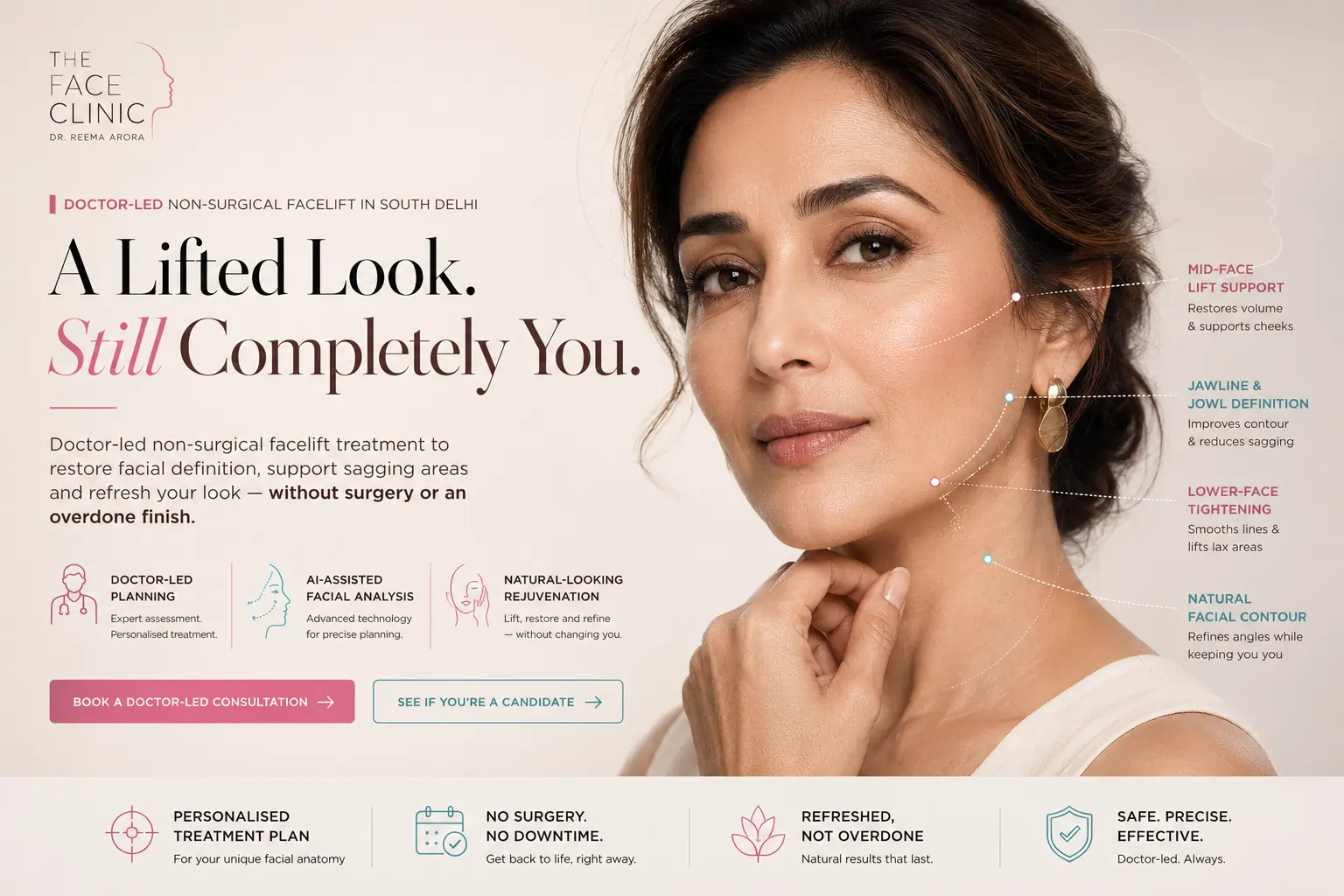
Images are for illustrative purposes only and may not represent actual patients or outcomes. Individual results vary based on anatomy, clinical assessment, and personalised treatment planning.
Non Surgical Face Lift in Delhi – Natural Facial Lifting Without Surgery
A non surgical face lift is a doctor-led facial rejuvenation approach designed to improve early facial sagging, reduced jawline definition and loss of youthful facial contours without traditional facelift surgery. Rather than being one fixed procedure, it is a personalised treatment strategy based on the anatomical changes contributing to facial ageing.
At The Face Clinic in Hauz Khas, South Delhi, every face lifting treatment begins with a detailed facial assessment. The aim is to understand whether the main concern is skin laxity, tissue descent, loss of facial support or volume, changes in skin quality, or a combination of these factors before deciding which treatment may be appropriate. Where the concern is shape and definition rather than laxity alone, the same assessment also guides non-surgical face contouring of the cheeks, chin and jawline.
Depending on the individual assessment, a non-surgical facial lifting plan may involve skin-tightening treatments, restoration of facial support or volume, selected lifting techniques, collagen-stimulating treatments or other appropriately chosen aesthetic procedures. The objective is not simply to “tighten the face,” but to improve facial balance and definition while preserving natural expression.
A non surgical face lift treatment may be suitable for patients noticing early jowls, sagging cheeks, contour loss, reduced jawline definition or mild to moderate facial laxity who want visible improvement without the prolonged recovery associated with facelift surgery. Results and recovery vary according to the treatment or combination selected.
Led by Dr. Reema Arora, with 20+ years of experience in aesthetic medicine, The Face Clinic provides personalised non surgical face lift treatment for patients from South Delhi, including Hauz Khas and Green Park, with an emphasis on detailed facial assessment, appropriate treatment selection and natural-looking results.
What Is a Non-Surgical Face Lift?
A non-surgical face lift is not one procedure, and it does not mean that every patient requires the same combination of treatments. It is better understood as an assessment-led approach to facial lifting and rejuvenation, in which treatment is selected according to the anatomical changes contributing to the visible signs of ageing.
For one patient, the dominant concern may be loose or lax skin. For another, it may be downward tissue movement, loss of cheek or structural support, reduced facial volume, or changes affecting the lower face and jawline. Many patients have more than one of these changes at the same time.
This is why the appropriate treatment can differ considerably from person to person.
Where skin laxity is the main concern, an appropriate skin-tightening treatment may be considered. Where tissue descent, loss of structural support, reduced volume or declining collagen quality contributes to facial ageing, other lifting, restorative or collagen-stimulating approaches may be more appropriate. Some patients may benefit from a carefully planned combination rather than a single treatment.
Treatment should follow the diagnosis—not the other way around.
A non-surgical face lift may therefore involve non-invasive or minimally invasive treatments, depending on what the individual face requires. It should not be viewed as a standard package of HIFU, Botox and fillers applied to every patient.
For patients considering a non surgical face lift in India, the most important first step is not choosing a device, injectable or particular procedure. It is understanding why the face is beginning to look less firm, less defined or more saggy, and which anatomical changes are responsible.
International medical guidance similarly describes a non-surgical facelift (Cleveland Clinic) as an umbrella approach that may include different non-invasive and minimally invasive procedures rather than one single treatment.
Why Does the Face Begin to Sag or Lose Definition?
A face can begin to look saggy, heavier or less defined for different anatomical reasons. Facial ageing is rarely caused by loose skin alone. Changes in skin firmness, facial support, volume, soft-tissue position and lower-face contour can occur together—but not necessarily to the same degree in every person.
This distinction matters because two patients may both describe their concern as a “sagging face”, while the underlying cause—and therefore the most appropriate treatment approach—may be quite different.
Skin Laxity, Collagen Changes and Loss of Firmness
Age-related changes in collagen, elastin and dermal structure gradually reduce skin firmness and resilience. As the skin becomes less supportive, it may begin to appear looser, particularly around the cheeks, jawline and lower face.
Patients may notice:
- softer or less defined facial contours;
- early looseness along the jawline;
- mild lower-face laxity;
- skin that feels less firm or resilient than before;
- fine surface creasing accompanying loss of skin quality.
When skin laxity is the predominant concern, treatment planning may focus more strongly on skin tightening and collagen remodelling rather than simply adding facial volume.
Loss of Facial Volume and Structural Support
Ageing can also change the volume and support of the face. The cheeks may appear flatter, the temples may become more hollow and facial contours that once provided support can become less pronounced.
These changes can sometimes make the lower face appear heavier or more descended, even when loose skin is not the only problem.
This is why loss of facial volume should not automatically be treated as a need for “more filler.” The important question is whether restoring support in selected areas would improve facial balance and contribute meaningfully to the overall lifting plan.
Changes in Soft-Tissue Position and Facial Contours
The soft tissues of the face do not age uniformly. Changes in their position, distribution and support can alter the relationship between the cheeks, lower face and jawline.
Patients may begin to notice:
- sagging cheeks;
- early jowls;
- heaviness beside the mouth or jawline;
- a less distinct lower-face contour;
- an overall impression that the face looks more “droopy” or tired.
This is different from simple skin laxity and helps explain why tightening the skin alone may not address every type of facial sagging.
Early Jowls and Loss of Jawline Definition
Early jowls and loss of jawline definition are common concerns among patients considering a non surgical face lift in Delhi.
Their appearance may reflect more than loose skin alone. Changes in facial support, soft-tissue position, skin laxity, chin or jawline structure and lower-face heaviness can all contribute.
For this reason, the visible jowl should be assessed in the context of the whole face rather than treated as an isolated problem.
A more detailed discussion of non-surgical treatment for jowls follows later on this page.
Submental Fullness and Lower-Face Heaviness
Submental fullness can occur independently of facial ageing and may be influenced by factors such as genetics, facial structure, fat distribution and weight changes. It can nevertheless have a significant effect on how defined the lower face appears.
Even when facial tissues are not markedly lax, fullness beneath the chin can soften the jawline and create the impression of a heavier lower face.
Where this is an important part of the concern, the treatment strategy may need to address the submental area separately rather than treating it as facial laxity alone. Depending on assessment, this may involve fat-reducing approaches such as Kybella (deoxycholic acid injections) or CoolSculpting, alongside or instead of skin-tightening or lifting treatments.
Patients whose primary concern is fullness beneath the chin can read more about double chin treatment in Delhi, which covers these options in detail.
Facial Ageing Is Often a Combination of Changes
For many patients, there is no single cause.
A person may have some skin laxity, modest loss of cheek support, early jowling, changes in skin quality and reduced jawline definition at the same time.
This is why there is no single “best non-surgical facelift” for every face.
A treatment that works well for one type of facial ageing may be less appropriate for another. The aim of a detailed facial assessment is therefore to identify which anatomical changes are contributing most to the appearance of sagging before deciding how they should be treated.
Two people can have the same complaint—”my face is starting to sag”—but require very different treatment plans.
That distinction leads to the next clinical question: Which non-surgical face lift treatment is appropriate for which type of facial ageing?
Which Non-Surgical Face Lift Treatment Is Right for Which Problem?
There is no single non surgical face lift treatment that is right for every face. Treatment selection depends on the predominant anatomical concern—whether this is mainly skin laxity, early jowling or tissue-position change, loss of facial support or volume, declining collagen quality, submental fullness, or a combination of these factors.
At The Face Clinic, the aim is to match treatment to the underlying cause of the visible ageing change, rather than applying a standard combination of procedures.
| If the assessment shows… | Treatment direction that may be considered |
|---|---|
| Predominantly loose or lax skin | HIFU or another appropriate skin-tightening treatment |
| Early jowls or selected tissue-position changes | Thread Lift in suitable patients |
| Loss of facial support or volume | Strategic Dermal Fillers / facial balancing |
| Reduced cheek, chin or jawline support | Area-specific structural contouring where appropriate |
| Progressive collagen and tissue-quality decline | Biostimulator treatment |
| Submental fullness affecting jawline definition | Cause-specific Double Chin treatment |
| More than one ageing mechanism | Carefully planned combination treatment |
This is a decision guide, not a treatment prescription. The appropriate approach depends on individual anatomy, degree of ageing, medical suitability and realistic treatment goals.
When Loose or Lax Skin Is the Main Concern
When skin laxity is the predominant problem, treatment may focus on stimulating collagen and improving skin firmness rather than replacing facial volume.
Depending on the degree and location of laxity, options may include HIFU treatment in Delhi or another appropriately selected skin tightening treatment, such as Ultherapy, Endolift or radiofrequency (RF) skin tightening.
These treatments primarily address skin laxity and firmness rather than replacing lost facial structure or volume. They should therefore not automatically be expected to correct every cause of jowling, facial heaviness or reduced jawline definition.
Specific ultrasound-, radiofrequency- or laser-based approaches are selected according to facial anatomy, skin quality and treatment goals rather than because one technology is universally “best.”
“As a man, I was looking for subtle enhancements. The combination of HIFU and Botox gave me a refreshed, masculine appearance.” — Rahul V., Gurgaon Individual results vary based on anatomy, clinical assessment and personalised treatment planning.
When Early Jowls or Changes in Tissue Position Are the Main Concern
Where early jowling or changes in soft-tissue position contribute to a less defined lower face, a thread lift may be considered in appropriately selected patients.
Thread lifting may be useful where there is mild to moderate tissue descent and a selected degree of physical support or lifting is required. Its role is different from skin tightening or volume restoration, which is why patient selection and realistic expectations are important.
A thread lift cannot reproduce the degree of tissue repositioning achievable with facelift surgery.
For detailed information about suitability, procedure, recovery and expected results, see Thread Lift Treatment in Delhi.
When Facial Support or Volume Has Been Lost
Not every face that appears to sag primarily needs tightening.
Loss of cheek volume, changes in facial support or reduced chin and jawline definition can alter facial proportions and contribute to the impression that the lower face has become heavier or less defined.
In appropriately selected patients, dermal fillers in Delhi may be used strategically to restore support or improve facial balance. The objective is not simply to add volume, but to determine whether carefully placed structural support can improve the overall facial contour.
Where mid-face support has reduced, cheek filler treatment may sometimes be relevant. Where chin or mandibular structure contributes to poor lower-face definition, carefully planned chin filler treatment or jawline filler treatment may be considered.
Importantly, adding filler directly to the visible area of sagging is not automatically the correct solution. Treatment planning should consider the relationship between the cheeks, lower face, chin and jawline rather than treating individual folds or areas in isolation.
When Collagen and Tissue Support Have Gradually Declined
Some patients are less affected by one isolated area of laxity or volume loss and instead show a more gradual decline in collagen, skin quality and tissue support.
In selected patients, biostimulator treatments may form part of the rejuvenation plan. Treatments such as Sculptra are designed to stimulate collagen formation progressively rather than relying only on immediate volumisation.
They may therefore be considered when the aim is to support a gradual improvement in collagen, skin quality and tissue support while maintaining natural facial expression.
For more detailed information about treatment options, suitability and expected timelines, see Sculptra & Biostimulator Treatment in Delhi.
When Submental Fullness Is Affecting the Jawline
A less defined jawline is not always caused by facial laxity.
In some patients, submental fullness or a double chin contributes significantly to lower-face heaviness and obscures the transition between the chin, jawline and neck.
Where this is the predominant concern, tightening facial skin or adding volume elsewhere may not address the underlying problem. The submental area should be assessed separately to determine whether the concern is primarily related to fat, skin laxity, facial structure or a combination of these factors — and whether approaches such as Kybella or CoolSculpting, discussed on the double chin treatment page, are appropriate.
When More Than One Ageing Change Is Present
Many patients have more than one contributing factor—for example, a combination of skin laxity, early jowling, reduced facial support and changes in skin quality.
In these situations, a combination treatment plan may be considered, but only when each component addresses a clearly identified anatomical concern.
More treatments do not necessarily produce a better result.
A carefully planned combination may address skin firmness, tissue support and facial proportions in different ways while avoiding unnecessary treatment or overcorrection.
Muscle activity and expression lines may also be addressed with neuromodulator treatment such as Botox in selected patients, but this is an adjunct to facial rejuvenation rather than a primary treatment for structural facial sagging.
“Dr. Reema’s blend of fillers and thread lift truly transformed my face. It looks naturally lifted—exactly what I hoped for.” — Ankita S., Delhi Individual results vary based on anatomy, clinical assessment and personalised treatment planning.
The objective of a non surgical face lift in Delhi should therefore not be to select as many technologies as possible. It is to identify which changes are making the individual face look older, heavier or less defined—and treat only what is clinically relevant.
The best treatment is not the one with the most technology behind it; it is the one that addresses the right anatomical problem.

Images are for illustrative purposes only and may not represent actual patients or outcomes. Individual results vary based on anatomy, clinical assessment, and personalised treatment planning.
Can Jowls Be Improved Without Surgery?
Early jowls can often be improved without surgery in appropriately selected patients, but the right approach depends on why the jawline is beginning to lose definition.
A jowl is not always simply “loose skin.” Its appearance may reflect a combination of skin laxity, changes in facial support or soft-tissue position, reduced chin or jawline definition and, in some patients, submental heaviness.
This is why the visible jowl should be assessed in the context of the whole face rather than treated as an isolated problem.
What Causes Early Jowls?
Early jowling can become visible as the relationship between the cheeks, lower face and jawline changes with age. For some patients, skin laxity is the main contributor; for others, changes in facial support, tissue position or lower-face structure are more important.
Identifying the predominant cause helps determine whether tightening, lifting, structural support—or no treatment in a particular area—is actually appropriate.
Which Treatments May Help Jowls Without Surgery?
Treatment depends on the predominant cause.
Where skin laxity is contributing, HIFU or another appropriate skin-tightening treatment may be considered. Where selected tissue-position changes or early descent are more relevant, a Thread Lift may be appropriate in suitable patients.
Where loss of facial support contributes to the appearance of jowling, carefully planned structural treatment may sometimes be considered. The objective is not simply to place filler into the jowl itself, but to determine whether restoring support elsewhere would improve facial balance.
For some patients, a combination approach may be appropriate—but only when each treatment addresses a clearly identified cause.
When Are Non-Surgical Treatments Less Likely to Be Enough?
Non-surgical treatment has limitations. Where there is substantial excess skin, more advanced tissue descent or pronounced jowling, non-surgical procedures cannot reproduce the degree of tissue repositioning achievable with facelift surgery.
The goal should therefore be meaningful, proportionate improvement—not an attempt to imitate surgical results with increasingly aggressive combinations of non-surgical treatments.
Non-Surgical Face Lift vs Skin Tightening: What's the Difference?
A skin tightening treatment and a non-surgical face lift are not the same thing.
Skin tightening primarily addresses skin laxity and loss of firmness by stimulating collagen and improving skin support.
A non-surgical face lift is a broader, assessment-led treatment strategy. It may need to consider not only skin laxity, but also facial support, volume, soft-tissue position, jawline definition, submental fullness and the relationship between different areas of the face.
| Skin Tightening | Non-Surgical Face Lift |
|---|---|
| Primarily addresses skin laxity and firmness | Addresses the broader reasons the face appears saggy or less defined |
| Centred on improving lax or less firm skin | Centred on diagnosing and addressing the main causes of facial sagging |
| May use ultrasound, radiofrequency or other appropriate energy-based modalities | May involve tightening, selected lifting, structural support, biostimulation or a combination |
| Does not replace lost facial support or volume | May address support or volume where these contribute to the concern |
| Best understood as one treatment category | Best understood as an overall treatment strategy |
For a patient whose main concern is predominantly loose skin, a dedicated skin tightening treatment in Delhi may be sufficient. Where several anatomical changes are contributing to facial ageing, however, tightening the skin alone may not address the complete problem.
Is HIFU the Same as a Non-Surgical Face Lift?
No. HIFU is one treatment modality; a non-surgical face lift is a broader treatment strategy.
HIFU uses focused ultrasound energy to stimulate collagen at selected tissue depths and may be considered when skin laxity and loss of firmness are important contributors to facial ageing.
It does not, however, restore lost facial volume, replace structural support or address every cause of early jowling and lower-face heaviness.
For this reason, HIFU may be:
- an appropriate stand-alone treatment for selected patients;
- one part of a broader facial rejuvenation plan;
- or unnecessary when the main concern is caused by something other than skin laxity.
The decision should therefore begin with what the face needs, not with whether a patient has heard of or specifically requested HIFU.
Patients considering ultrasound-based tightening can read the dedicated guide to HIFU Treatment in Delhi for detailed information about suitability, treatment areas, procedure, results, recovery and cost.
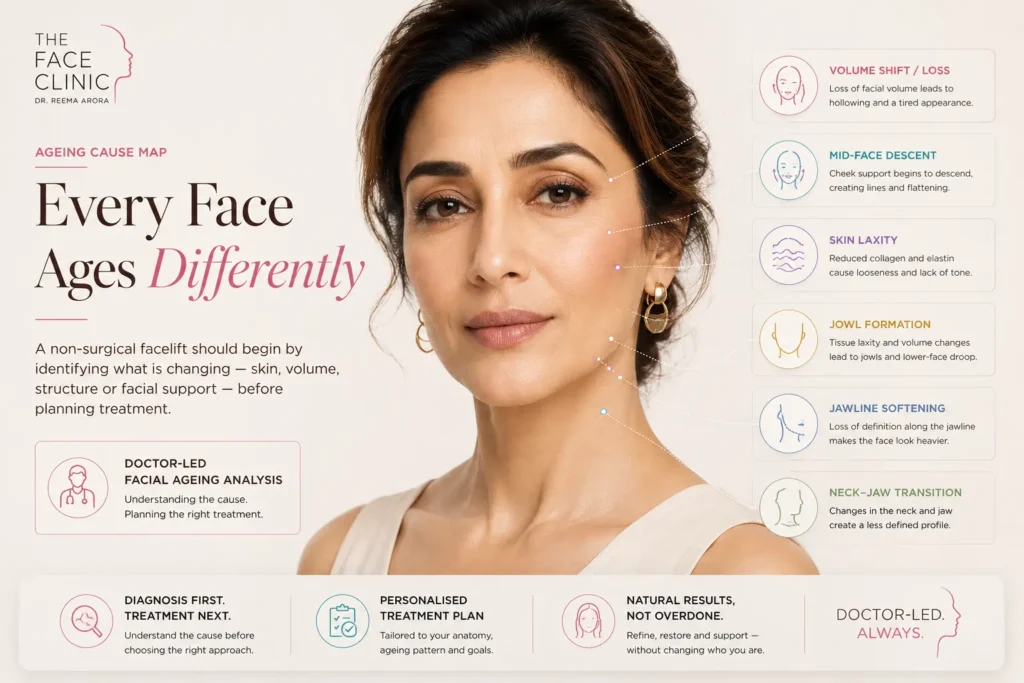
Images are for illustrative purposes only and may not represent actual patients or outcomes. Individual results vary based on anatomy, clinical assessment, and personalised treatment planning.
Who Is a Good Candidate for a Non-Surgical Face Lift?
A non-surgical face lift may be appropriate for patients who are beginning to notice facial ageing but do not require—or do not currently wish to undergo—traditional facelift surgery.
Suitability is determined more by facial anatomy, degree of ageing and treatment goals than by chronological age alone.
You May Be Suitable If You Have:
- mild to moderate facial laxity;
- early jowls or loss of jawline definition;
- sagging or flattening of the cheeks;
- early loss of facial support or volume;
- changes in lower-face contour;
- more than one mild-to-moderate ageing change occurring together;
- realistic expectations about the degree of improvement possible without surgery.
Good treatment planning also means recognising when an area does not require treatment or when intervention is unlikely to add meaningful benefit.
When May Non-Surgical Treatment Be Less Suitable?
Non-surgical treatment may be less appropriate when there is:
- substantial excess or hanging skin;
- more advanced jowling or tissue descent;
- a need for significant surgical-level repositioning;
- an expectation of dramatic or permanent correction;
- a medical or anatomical reason that makes a particular treatment unsuitable.
In these situations, the most appropriate recommendation may be to avoid unnecessary non-surgical treatment and discuss whether a surgical opinion would better address the concern.
What Results Can a Non-Surgical Face Lift Realistically Achieve?
The aim of a non-surgical face lift is to produce appropriate improvement in selected signs of facial ageing while preserving natural expression and facial proportions.
Depending on the underlying concern and treatment selected, patients may notice improvement in early jowling, facial and jawline definition, mild to moderate skin laxity, cheek or structural support, skin firmness and quality, lower-face balance and contour, and the overall impression of looking more refreshed or less tired.
The degree and timing of improvement vary according to the anatomy being treated and whether the chosen approach is intended to tighten skin, provide support, stimulate collagen, reposition selected tissues or address another specific concern.
What a Non-Surgical Face Lift Cannot Do
Non-surgical treatments cannot:
- remove substantial excess skin;
- reproduce the tissue repositioning achieved with facelift surgery;
- guarantee complete correction of advanced jowls or facial laxity;
- stop the natural ageing process;
- produce identical outcomes for every face.
Some treatments also require maintenance, while others develop progressively rather than producing an immediate final result.
The goal is improvement—not surgical imitation. A good treatment plan therefore aims for a result that is noticeable enough to be worthwhile but proportionate enough to remain natural.
Non-Surgical Face Lift vs Surgical Face Lift: When Is Surgery More Appropriate?
Non-surgical and surgical face lifting should not be viewed as competing versions of the same treatment. They address different degrees and patterns of facial ageing and involve different treatment, recovery and risk considerations.
What Is the Main Difference?
A non-surgical face lift may use non-invasive or minimally invasive treatments to improve selected concerns such as skin laxity, early jowling, loss of support or reduced facial definition. Recovery is generally shorter, but the degree of correction is also more limited and treatment may require future maintenance.
A surgical facelift involves incisions and surgical repositioning of facial tissues. It can address more advanced tissue descent and excess skin to a degree that non-surgical treatments cannot reproduce, but it also involves surgical recovery and a different risk profile.
| Non-Surgical Face Lift | Surgical Face Lift |
|---|---|
| Non-invasive or minimally invasive, depending on treatment | Surgical procedure involving incisions and tissue repositioning |
| Better suited to selected early-to-moderate ageing changes | Can address more advanced laxity, tissue descent and excess skin |
| Generally shorter recovery | Longer surgical recovery |
| Degree of correction is more limited | Greater degree of tissue repositioning is possible |
| Maintenance may be required depending on treatment | Results are generally longer-lasting, although ageing continues |
| Treatment-specific risks | Surgical risks and, where applicable, anaesthesia-related risks |
Neither approach is automatically “better.” The appropriate choice depends on the degree of ageing, the result being sought, medical suitability and the patient’s willingness to undergo surgery and recovery.
When May a Surgical Facelift Be More Appropriate?
A surgical opinion may be more appropriate when there is significant excess skin, pronounced jowling or lower-face descent, advanced facial or neck laxity, a desire for a greater degree of tissue repositioning than non-surgical treatment can reasonably provide, or when repeated non-surgical treatment is unlikely to produce a meaningful enough improvement.
Being clear about these limitations is important. Attempting to treat more advanced facial ageing simply by adding further fillers, threads or energy-based procedures can lead to unnecessary treatment without achieving the degree of correction the patient actually wants.
Is a Mini Facelift the Same as a Non-Surgical Face Lift?
No. A mini facelift is still a surgical facelift procedure. It generally uses a more limited surgical approach than a traditional full facelift and commonly focuses on early lower-face and neck ageing, but it still involves surgical incisions and tissue repositioning.
A non-surgical face lift, by contrast, uses non-invasive or minimally invasive aesthetic treatments and does not surgically reposition facial tissues.
The distinction is important because mini facelift, non-surgical facelift and skin tightening describe different treatment concepts and should not be used interchangeably.
The right question is therefore not simply: “Which facelift is best?” It is: “What degree and type of correction does my face actually require?”
Non-Surgical Face Lift Cost in Delhi and India
There is no single fixed cost for a non surgical face lift because it is not one standard procedure. The treatment plan may involve one treatment or a carefully selected combination, depending on the anatomical changes contributing to facial sagging and loss of definition.
For patients researching non surgical face lift cost in Delhi or face lift cost in India, it is more useful to understand the cost of the treatment actually required than to compare a standard “facelift package.”
The table below gives an indicative starting range only — it is not a quote, and it is not a recommendation to have any specific treatment. The actual treatment plan and cost are confirmed only after facial assessment.
| Treatment approach | Indicative cost (starting range) |
|---|---|
| Limited/localised non-surgical lifting treatment | From ~₹10,000 |
| HIFU | ~₹20,000 – ₹60,000 |
| Thread Lift | ~₹15,000 – ₹75,000 |
| Dermal Fillers (per session) | ~₹20,000 – ₹1,00,000 |
| Sculptra / Biostimulators | ~₹25,000 onwards per session |
| Ultherapy | ~₹30,000 – ₹70,000 |
| Endolift | ~₹25,000 – ₹65,000 |
| Botox (per area) | ~₹10,000 – ₹30,000 |
| Kybella / CoolSculpting (submental) | (₹15,000–₹60,000 |
What Affects the Cost of a Non-Surgical Face Lift?
The overall cost may vary according to:
- The treatment selected — skin tightening, tissue lifting, structural support and collagen stimulation involve different treatment approaches and pricing.
- The areas being treated — a limited lower-face concern differs from treatment involving several facial areas.
- The degree and type of facial ageing — mild skin laxity, early jowls, loss of facial support and combination ageing may require different strategies.
- The extent of treatment required — the amount of product, number of threads, treatment area or treatment intensity varies according to the procedure selected.
- Whether one treatment or a combination is appropriate — combination treatment should be used only when more than one clearly identified concern needs to be addressed.
- The number of sessions required — some treatments may be performed as a single procedure, while others may require a planned course or future maintenance.
At The Face Clinic, the recommended plan and its cost are discussed after facial assessment, once the main anatomical concerns and appropriate treatment options have been identified. This helps patients understand what is being treated, why it is being recommended and what it is expected to contribute before proceeding, while avoiding unnecessary procedures.
Dr Reema Arora's Approach to Non-Surgical Facial Lifting
Dr. Reema Arora’s approach begins with assessing why the face looks different, rather than starting with a particular injectable, device or procedure.
The face is considered as a whole—including skin laxity, facial support, volume distribution, lower-face contour, jawline definition and skin quality—before deciding whether non-surgical treatment is appropriate and which approach merits consideration.
The emphasis is on treatment selection, proportion and restraint. A newer or more complex technology is not automatically the better choice, and combining several procedures does not necessarily produce a better result.
At The Face Clinic in Hauz Khas, South Delhi, treatment planning is guided by:
- detailed facial and anatomical assessment;
- the individual pattern and degree of facial ageing;
- realistic treatment goals and expected benefit;
- appropriate product and device selection;
- treatment-specific discussion of risks and recovery;
- preservation of natural facial expression and proportions;
- avoidance of unnecessary treatment or overcorrection.
Where appropriate, alternatives and the limitations of non-surgical treatment are also discussed before a treatment plan is finalised.
The objective is not to make a patient look like someone else. It is to aim for a result that appears more refreshed, balanced and defined while remaining recognisably their own face.
Frequently Asked Questions About Non-Surgical Face Lift
Does a Non-Surgical Face Lift Really Work?
Non-surgical treatment can improve selected signs of early to moderate facial ageing in appropriately selected patients, but the type and degree of improvement depend on the underlying anatomical concern and the treatment used. Skin laxity, loss of facial support and early tissue-position changes are different problems and may respond to different approaches. A non-surgical face lift cannot reproduce the degree of tissue repositioning or removal of excess skin achievable with facelift surgery, particularly where facial ageing is more advanced.
How Long Do Non-Surgical Face Lift Results Last?
There is no single duration because a non-surgical face lift is not one procedure. Longevity depends on the treatment or combination selected, the area treated, individual anatomy and skin quality, the biological response to treatment, continuing facial ageing and lifestyle factors, and whether maintenance treatment is appropriate. Some treatments produce effects that require periodic maintenance, while collagen-stimulating treatments may develop more gradually over time. Treatment-specific timelines should therefore be considered according to the particular procedure recommended rather than applying one longevity estimate to every non-surgical face lift.
Is a Non-Surgical Face Lift Safe?
No aesthetic procedure is completely risk-free. Potential risks depend on the specific treatment selected, treatment area, individual anatomy, medical history, product or device used and the experience of the treating doctor. A detailed consultation is therefore important to assess suitability, discuss treatment-specific risks and determine whether a particular procedure should be performed, modified, postponed or avoided. Where non-surgical treatment is unlikely to provide an appropriate degree of correction, discussing surgical options may sometimes be more appropriate.
What Is the Recovery Time After a Non-Surgical Face Lift?
Recovery varies according to the treatment selected. Some energy-based skin-tightening procedures may involve little visible downtime, while injectable or thread-based treatments can cause temporary swelling, tenderness or bruising. Patients planning treatment before an important event should discuss the expected recovery period for the specific procedure being considered, rather than assuming that every non-surgical facial treatment has no downtime.
How Much Does a Non-Surgical Face Lift Cost in Delhi?
There is no single package price because a non surgical face lift is an individualised treatment strategy. As a general orientation, some limited treatment options currently begin from around ₹10,000, while more comprehensive skin-tightening, thread-lifting, structural-support or combination plans can cost substantially more. The exact cost depends on the anatomical concern, treatment selected, areas treated and extent of treatment required. A detailed facial assessment allows the recommended plan and associated cost to be explained before treatment.
Who Is a Good Candidate for a Non-Surgical Face Lift?
A non-surgical face lift may be considered for patients with concerns such as mild to moderate facial laxity, early jowls, sagging cheeks, reduced jawline definition, loss of facial support or volume, early lower-face ageing, or a preference for facial rejuvenation without traditional facelift surgery. Suitability is based on facial anatomy and degree of ageing rather than age alone. Patients should also have realistic expectations about what non-surgical treatment can and cannot achieve. Where there is substantial excess skin or more advanced tissue descent, a surgical facelift consultation may provide a more appropriate discussion of treatment options.
Book a Non-Surgical Face Lift Consultation in Delhi
If you are searching for a non-surgical face lift near you in Delhi, the first step is to understand what is actually contributing to the change in your facial appearance.
At The Face Clinic in Hauz Khas, Dr. Reema Arora assesses facial structure, skin quality, degree of laxity, facial support and lower-face contour before discussing whether non-surgical treatment is appropriate and which options merit consideration.
The consultation is designed to help you understand what is contributing to facial sagging or loss of definition, which treatment options may be relevant, which treatments are unlikely to add meaningful benefit, what degree of improvement is realistic, likely recovery and maintenance considerations, and the anticipated treatment cost.
Book a Facial Assessment
Understand the cause first. Choose the treatment second.
Related Non-Surgical Facial Treatments
Depending on the concern identified during assessment, you may also wish to explore:
- Skin Tightening Treatments in Delhi — for predominantly loose or lax skin.
- HIFU Treatment in Delhi — for ultrasound-based skin tightening in appropriately selected patients.
- Thread Lift Treatment in Delhi — for selected early tissue descent and lifting requirements.
- Dermal Fillers in Delhi — where loss of facial support or volume contributes to the concern.
- Sculptra & Biostimulator Treatment in Delhi — for selected concerns involving progressive collagen and tissue-support decline.
- Double Chin Treatment in Delhi — where submental fullness contributes to lower-face heaviness or reduced jawline definition.
- Non-Surgical Neck Lift in Delhi — where neck laxity, neck bands or loss of the jawline-neck transition is the predominant concern.
All treatments are subject to individual variation. Outcomes are determined following clinical evaluation by a qualified doctor.