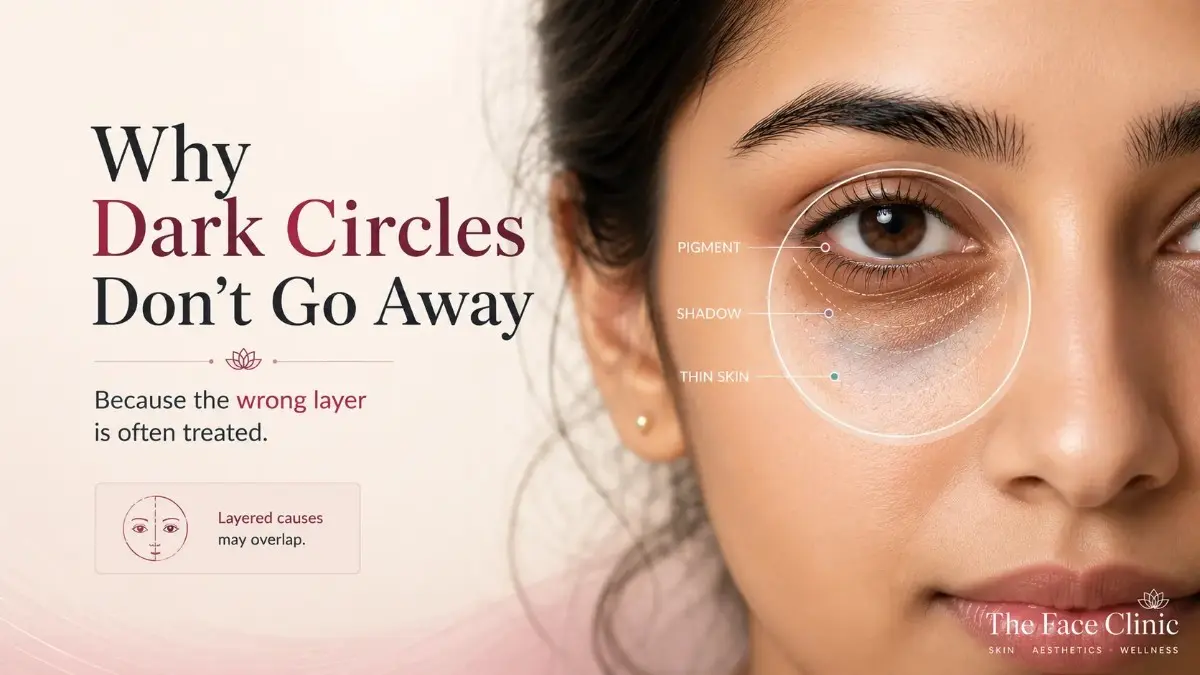
Why Dark Circles Don’t Go Away

Hero image showing layered under-eye assessment for why dark circles do not go away

Why Dark Circles Don’t Go Away: The 5-Layer Misdiagnosis Guide

Medically reviewed by: Dr. Reema Arora, MBBS, MSc Facial Aesthetics, UK — Founder, The Face Clinic, South Delhi
 

Why Your Dark Circles May Not Be “Stubborn” — They May Be Misread

If you have tried better sleep, eye creams, home remedies, facials, peels, lasers, or fillers — and your dark circles are not going away — the problem may not be your effort. It may be the diagnosis. It can be frustrating to look tired even when you feel rested, especially when every new treatment seems to help only briefly or not at all.
 
Many people assume dark circles under eyes are simply a pigmentation issue. In reality, the under-eye area is one of the most complex zones of the face. Darkness can come from pigmentation, tear-trough hollowness, thin skin, vascular visibility, puffiness, structural shadowing, or a mixed pattern.
 
That is why dark circles don’t go away with one standard solution. This 5-layer misdiagnosis guide explains how the cause must be identified before choosing treatment. At The Face Clinic, Dr. Reema Arora begins with a doctor-led under-eye assessment, so the plan is based on the actual layer causing the tired look.
 
Core Insight Box: Dark Circles Are a Pattern-Recognition Problem
 
Dark circles are not just a colour problem — they are a pattern-recognition problem. The same tired-looking under-eye area may be caused by pigment, structural shadowthin skin, visible vessels, puffiness, or a mixed pattern. That is why a cream, laser, filler, or peel may disappoint when it is chosen before the underlying cause is understood. To treat dark circles correctly, the first step is not choosing a procedure — it is identifying the dominant layer first.
 
For patients considering dark circle treatment in Delhi, diagnosis-first planning helps avoid choosing the wrong procedure too early.
 

Doctor’s Summary

Dark circles often persist because the visible concern has been misread. Pigment, hollowness, thin skin, vascular colour, puffiness, and lifestyle or allergy triggers can all create a tired under-eye appearance, but they do not respond to the same treatment.
 
A pigment-led concern may need skin-type-safe pigment control. A hollow-shadow pattern may need structural assessment. Puffy darkness may need allergy, fluid, or eye-bag evaluation before any injectable plan. In many patients, more than one layer is involved.
 
That is why a doctor-led under-eye assessment is important before choosing creams, peels, lasers, fillers, or regenerative treatments.

This Guide Is Especially Useful If Your Dark Circles Are Not Going Away

This guide is especially useful if your dark circles are not going away despite better sleep, skincare, or repeated attempts to “fix” the under-eye area. Many people keep changing products or treatments without realising that the concern may be coming from a different under-eye layer.
 
You may find this guide helpful if:
  • eye creams have not helped much, even after consistent use

  • your under-eyes look different in the mirror, selfies, and harsh lighting

  • dark circles look worse in photos than they do face-to-face

  • laser improved colour, but not the tired or hollow look

  • filler made the under-eye look puffy, heavy, or unnatural
  • your dark circles change with lighting, camera angle, or facial expression

  • you are unsure whether the issue is colour, structure, skin quality, swelling, vascular visibility, or a combination of these
These patterns matter because different layers need different treatment plans. That is the starting point of the 5-layer misdiagnosis guide.

What This Guide Can and Cannot Tell You

This guide is educational. It is not a personal diagnosis, a treatment prescription, or a guarantee that dark circles can be completely removed in every case. The under-eye area is medically and anatomically complex, and the right plan depends on skin quality, pigmentation, facial structure, vascular visibility, puffiness, ageing pattern, and previous treatments.
 
What this guide can do is help you understand why dark circles may look different from person to person, and why the cause should be identified before choosing a cream, peel, laser, filler, or other treatment. A proper under-eye assessmentis still necessary before deciding what is safe, suitable, and realistic for you.

Why “Dark Circles” Is Not a Diagnosis

“Dark circles” is a description of appearance, not a diagnosis. It tells us that the under-eye area looks darker, but not why it is happening. Two patients may both notice dark circles under eyes, yet one may have pigment, another may have hollowing, another may have puffiness, and many may have a mixed pattern.
 
That is why understanding the types of dark circles matters before choosing treatment. The visible darkness may come from pigment within the skin, vascular colour showing through delicate tissue, swelling, tear-trough depression, or shadows created by facial structure. In some patients, under-eye hollows make the area look darker even when the skin colour itself has not changed.
 
Medical references also describe the causes of dark circles as varied rather than single-cause. Cleveland Clinic’s overview of the causes of dark circles under the eyes  explains that ageing, genetics, allergies, and lack of sleep can contribute. Mayo Clinic similarly notes that dermatitis, fatigue, genetics, rubbing or scratching the eyes, ageing-related skin changes, skin colour changes, sun exposure, puffy eyelids, and hollows may all play a role. 
This is why a diagnosis-first approach is important. If pigment is treated as hollowness, or puffiness is treated as pigmentation, results may look incomplete. The goal is not just to label the concern as “dark circles,” but to identify the dominant layer creating the tired appearance.

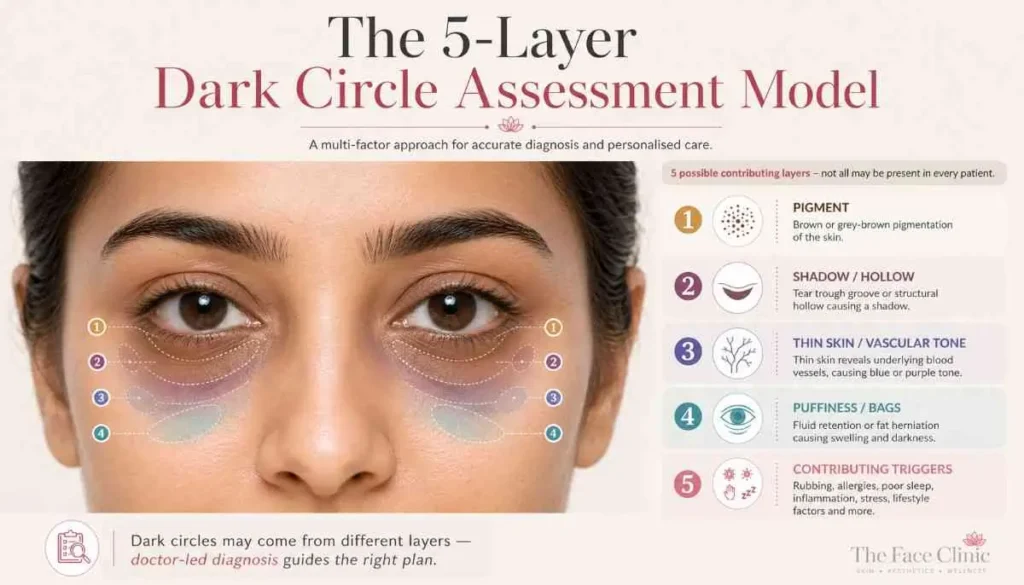
The 5-Layer Dark Circle Assessment Model

This is an educational assessment model, not a formal self-diagnosis. It helps explain why different under-eye patterns may need different treatment plans. The goal is to help you move from “what type of dark circles do I have?” to a more useful question: “Which layer is creating the tired look?”
 
The five layers are colour, shadow, skin quality, puffiness, and triggers. In real patients, dark circles are often mixed. That is why the types of dark circles are better understood as patterns, not fixed labels.
 
Clinical note: At The Face Clinic, the under-eye area is assessed in relation to skin thickness, pigmentation risk, facial structure, puffiness tendency, allergy or swelling history, and previous treatment history before any procedure is recommended.


Layer 1 — Colour: Brown, Blue, Purple, Grey or Mixed

Colour gives important clues, but it should not be read in isolation. Brown dark circles under eyes or grey-brown darkness may suggest pigment, especially when the colour remains visible in most lighting conditions. In these cases, dark circles due to pigmentation may be related to melanin, post-inflammatory change, rubbing, sun exposure, or skin-of-colour pigmentation tendencies.
 
Pigmentation under eyes is especially relevant for Indian and global skin-of-colour patients. Mayo Clinic notes that changes in skin colour from melasma or post-inflammatory hyperpigmentation are more common in people with brown or Black skin, which makes pigment-led assessment important before choosing peels, lasers, or brightening treatments. 
 
By contrast, blue purple dark circles may suggest visible vascular colour, thin skin, or blood vessels showing through the under-eye area. A mixed brown-blue-grey tone may mean more than one layer is active. This is why colour is a clue, not the final diagnosis.
 

Layer 2 — Shadow: Tear Trough Hollows and Facial Structure

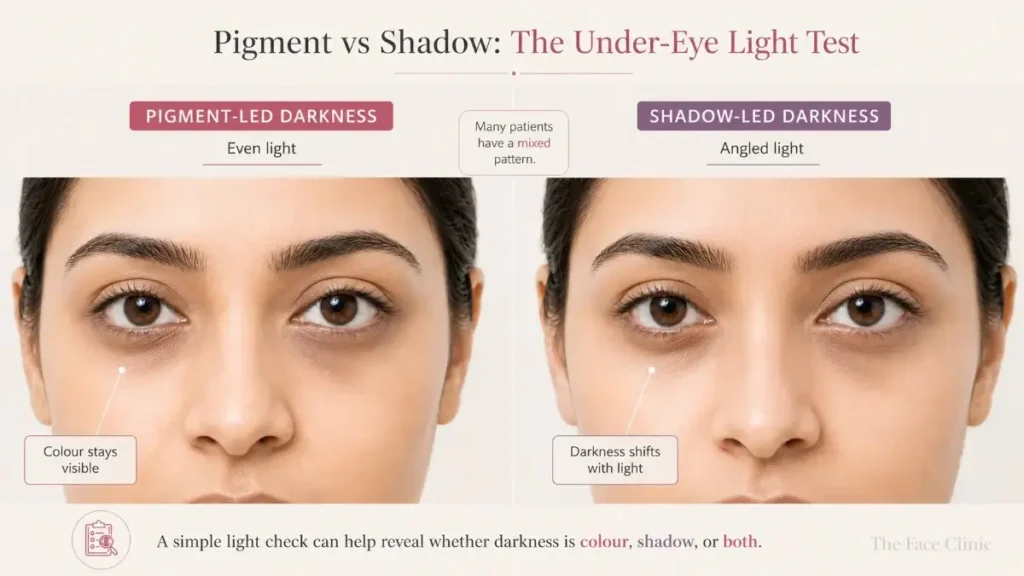
Some dark circles are not mainly pigment. They are shadows. This is the key difference in pigment vs shadow dark circles: pigment is colour within the skin, while shadow is created by depth, contour, lighting, or facial structure.
 
Dark circles due to hollowness often appear worse under overhead lighting, in photographs, or when the face is tired. A deep tear trough, cheek volume loss, orbital anatomy, or facial structure can create under-eye shadows even when the skin itself is not very dark. This is why someone may try brightening creams or pigment lasers and still look tired.
 
Tear trough dark circles need careful assessment because filling every hollow under eyes is not automatically safe or suitable. If hollowness is the dominant concern, an under-eye filler assessment may help determine whether filler is suitable, should be staged, or should be avoided.
 

Layer 3 — Skin Quality: Thin, Crepey or Collagen-Poor Under-Eye Skin

Thin skin under eyes can make the area look darker because underlying vessels, shadows, and textural changes become more visible. This is different from true pigment. The colour may look bluish, grey, or tired, but the issue may be poor support, reduced hydration, collagen-related ageing, or fragile skin quality.
 
Crepey under-eye skin can also catch light unevenly, making fine lines and darkness appear stronger in photos. With ageing, repeated irritation, dryness, or barrier weakness, the under-eye skin may appear thinner, less supported, and more crepey.
 
This is where under-eye skin quality becomes important. Depending on suitability, selected skin-quality treatments may be considered to support hydration, texture, barrier function, and collagen-related skin quality. These may include hydration support, barrier repair, collagen-supportive skincare, carefully selected regenerative options, or skin booster treatment for skin quality after assessment. However, they should not be presented as a universal solution for all thin-skin or vascular dark circles, because visible darkness may also involve translucency, blood-vessel visibility, pigmentation, shadowing, or mixed causes.
 

Layer 4 — Puffiness: Fluid, Allergies and Eye Bags That Create Shadows

Under eye puffiness and dark circles often appear together because swelling can cast a shadow below the lower eyelid. In this pattern, the skin may not be deeply pigmented, but the eye still looks heavy, tired, or dark because the puffiness changes how light falls on the area.
Puffy eyes and dark circles may be influenced by sleep position, salt intake, fluid retention, allergies, sinus congestion, crying, fatigue, or lower eyelid bags. Mayo Clinic notes that what looks like dark circles may sometimes be shadows from puffy eyelids or hollows under the eyes that develop with ageing. 
 
Swelling under eyes can fluctuate through the day, which is one clue that fluid or allergy-related puffiness may be involved. DermNet also mentions head elevation, cold compresses, and massage while applying a cold compress as general measures for temporary eyelid swelling.
 
This is why eye bags and dark circles should not automatically be treated like pigmentation or hollowness.


Layer 5 — Triggers: Rubbing, Sun, Sleep, Genetics and Inflammation

The final layer is triggers. These may not be the only causes of dark circles, but they can worsen almost every other layer. Patients often ask whether rubbing eyes dark circles can become worse over time. Repeated rubbing can irritate delicate eyelid skin, worsen pigmentation, increase inflammation, and make swelling or vascular visibility more noticeable.
 
Allergies and dark circles can overlap because itching often leads to rubbing, and allergy-related swelling can create puffiness and shadowing. Sun exposure dark circles may also become more visible when pigment deepens over time, especially in skin-of-colour patients or those prone to melasma and post-inflammatory hyperpigmentation.
 
Mayo Clinic lists dermatitis, fatigue, genetics, rubbing, pigmentation changes and sun exposure  among factors associated with dark circles. 
 
Triggers matter because even the best treatment plan can underperform if rubbing, inflammation, sun exposure, allergy flares, or poor sleep are repeatedly worsening the under-eye area.
5-layer dark circle assessment model showing pigment, shadow, thin skin, puffiness and contributing triggers around the under-eye area

The 3-Minute Dark Circle Observation Check

This is an observation check, not a diagnosisThis is an observation check, not a diagnosis. It is designed to help you notice visible patterns before seeking a professional under-eye assessment. Do not use it to decide your own treatment, choose an injectable, or start any procedure without medical evaluation. If you have been wondering, “what type of dark circles do I have?”, these simple checks can help you think more clearly about whether colour, structure, skin quality, swelling, or more than one factor may be involved.
 
The goal is not to label yourself, but to understand why the under-eye concern may be persisting despite skincare, sleep, lasers, fillers, or repeated treatment attempts.


The Light Test

Look at your under-eyes in harsh overhead light, then compare them in soft, front-facing daylight. If the darkness looks much better when light falls evenly from the front, shadow or facial structure may be contributing. This is often where under-eye hollows, tear-trough depth, cheek volume changes, or overhead lighting can make the area look darker than the skin actually is.


The Colour Test

Colour can offer clues, but it should not be read alone. Brown or grey-brown darkness may suggest pigment. Blue-purple dark circles may suggest visible vascular colour or thin skin. A grey shadow may point toward hollowness or tear-trough depth. A darker crescent below puffiness may suggest swelling or eye bags. This is the basic difference between colour within the skin and shadow created by structure or lighting.


The Morning-Evening Test

Notice when the darkness looks worse. If it is heavier in the morning, puffiness, fluid retention, sleep position, sinus congestion, or allergies may be contributing. If it looks worse mainly in harsh overhead light, shadowing, tear-trough depth, or structural hollowness may be more visible. Changing patterns often suggest more than one layer is involved.
 

The No-Tug Skin Observation

Observe the under-eye area gently without pulling, stretching, rubbing, or pressing the skin. Look for texture, crepiness, visible vessels, dryness, puffiness, or uneven reflection of light. Do not touch or manipulate the area if your skin is irritated, sensitive, inflamed, sunburnt, recently lasered, recently injected, or recovering from any procedure. The under-eye area is delicate, so this should remain visual only.


The Treatment History Test

Your past treatment response can give useful clues. If eye creams failed, the issue may not be only surface pigmentation or dryness. If laser improved colour but not the tired look, shadow, hollowness, or puffiness may still be present. If filler created puffiness, heaviness, or an unnatural under-eye look, the concern may not have been suitable for filler, or the plan may have needed staging, dose adjustment, or a different approach.
Why Dark Circles Don’t Go Away – Dr Reema Arora

Why Common Dark Circle Treatments May Not Work

If you have tried products or procedures and still feel disappointed, it does not mean you did something wrong. Often, persistent under-eye darkness continues because the treatment selected does not match the layer creating the tired look.
 
This is the main reason why dark circles treatment fails: pigment, structure, skin quality, swelling, vascular visibility, and lifestyle or allergy triggers are different problems, even when they all appear as “dark circles.” The question is not whether a treatment is good or bad. The question is whether it matches the dominant under-eye layer.


Why Eye Creams May Not Be Enough

Eye creams are not useless — they are limited. A well-formulated eye cream may support hydration, barrier repair, mild pigmentation, fine lines, and surface smoothness. Ingredients such as humectants, gentle brighteners, barrier-supporting moisturisers, and carefully selected retinoids may improve the way under-eye skin looks over time.
 
But this also explains why eye creams do not work for dark circles in many people. A cream cannot lift a tear trough, replace lost volume, correct deep structural shadowing, remove significant eye bags, or reverse fat-pad related puffiness. If the tired look is coming from hollowness, visible vessels, swelling, or facial structure, even a good eye cream may only give partial improvement.


Why Lasers May Not Work for Some Dark Circles

Lasers are not ineffective — they are selective. They may help when the concern is suitable: selected pigment patterns, texture changes, collagen support, or surface irregularity may improve with the right device, settings, and skin-type planning.
 
This explains why laser does not work for dark circles when the darkness is structural rather than pigment-led. A laser may improve colour but leave the tired look unchanged if the darkness is being created by tear-trough depth, under-eye hollows, puffiness, or facial anatomy. In skin-of-colour patients, laser selection also needs caution because overly aggressive settings may increase the risk of pigmentation changes rather than improve them. The key is not “laser or no laser,” but whether the visible pattern is actually laser-responsive.


Why Under-Eye Filler May Not Work for Some Dark Circles

Under-eye filler is not wrong — it is anatomy-dependent. It can be helpful in carefully selected hollow-shadow cases, especially when the tired appearance is caused by a tear trough or volume deficit. But filler is not the answer for every under-eye concern.
 
This is why under-eye filler may not work when puffiness, fluid tendency, poor lymphatic drainage, very thin skin, pigment dominance, malar swelling, or unsuitable anatomy is present. In these cases, filler may make the under-eye area look heavier, puffier, bluish, or unnatural instead of fresher.
 
For patients with puffiness or eye bags, Mayo Clinic’s discussion of under-eye filler and puffiness assessment  notes that fillers, laser resurfacing, and chemical peels may improve selected under-eye concerns, while laser resurfacing can carry pigment-change risks in brown or Black skin. This is why under-eye filler should be assessed conservatively, with anatomy, skin thickness, swelling tendency, and treatment history considered before treatment is chosen.


Why Peels or Pigment Treatments May Disappoint

Peels and pigment treatments are not pointless — they are pigment-dependent. They may help when pigmentation is the dominant layer, especially in selected brown or grey-brown discoloration, surface dullness, post-inflammatory pigmentation, or sun-related pigment.
 
But they may disappoint if the main issue is shadow, hollowness, puffiness, thin skin, visible vascular colour, or untreated triggers such as rubbing, allergies, and sun exposure. In skin-of-colour patients, peels and pigment procedures also need careful selection because irritation can sometimes worsen pigmentation rather than improve it.
 
In most cases, the question is not whether a cream, laser, filler, or peel is “good.” The real question is whether it matches the dominant under-eye layer.

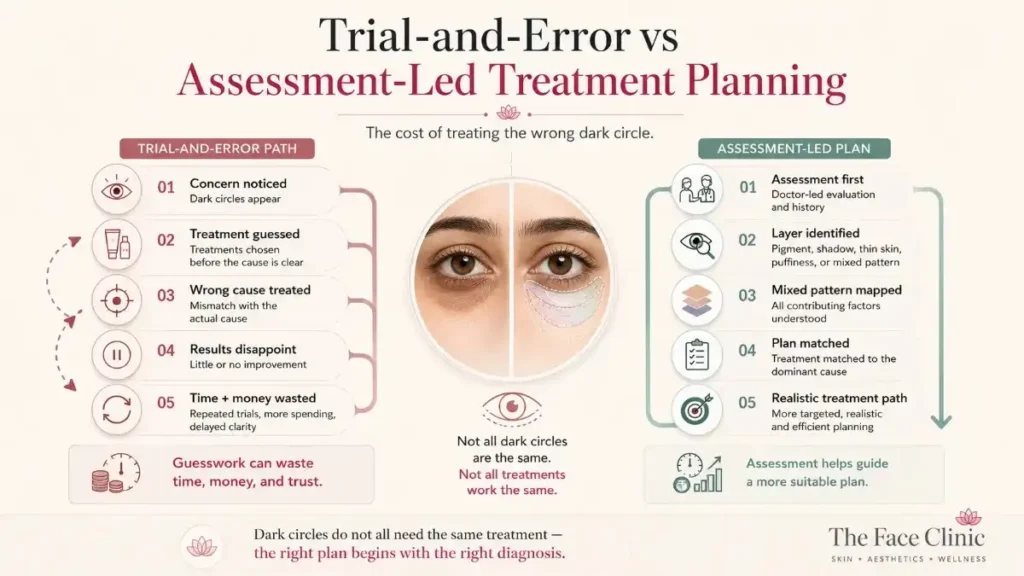
The Cost of Treating the Wrong Dark Circle

The most expensive under-eye treatment is not always the highest-priced one. Often, the more expensive path is repeating the wrong treatment because the actual under-eye layer was never identified. This is also why the cost of treating dark circles varies so much from person to person: pigment, structure, skin quality, swelling, and mixed patterns do not need the same plan.
 
The real cost of treating dark circles wrong is not only financial. It can also mean wasted time, repeated appointments, frustration, heavier-looking under-eyes, or loss of trust in treatments that may have worked better if chosen for the correct reason. The real value of under-eye treatment cost should be understood in the context of diagnosis, suitability, number of sessions, treatment sequencing, and realistic expectations.
 
The most effective dark circles removal treatment is not always the strongest or most expensive option; it is the option that matches the correct under-eye pattern.
Wrong assumption
Common mistake
Why cost increases
“It is only pigmentation”
Repeated creams or peels
Hollow or shadow remains untreated
“I need filler”
Filler despite puffiness
Heaviness or swelling may worsen
“Laser will remove it”
Laser used for structural shadow
Pigment may improve, but the tired look remains
“It is just lack of sleep”
Delaying assessment or trying only lifestyle fixes
Mixed causes continue and treatment is postponed
“One session should solve it”
Unrealistic expectations
Repeated corrections may be needed
This is why dark circles treatment cost should not be judged only by the price of one cream, peel, laser, or filler session. A lower-cost treatment can become expensive if it is repeated for the wrong concern, while a carefully planned approach may reduce unnecessary procedures by identifying the dominant cause first.
Infographic comparing trial-and-error dark circle treatment with assessment-led under-eye treatment planning
If you have tried better sleep, eye creams, home remedies,

What May Help Each Type of Dark Circle? A Treatment-Matching Guide

There is no single best treatment for dark circles for every patient. The correct plan depends on the dominant layer causing the tired look. This is why understanding the underlying pattern matters before choosing creams, peels, lasers, fillers, or regenerative treatments.
 
The goal is not to match one concern to one fixed procedure, but to understand whether the visible darkness is mainly pigment, shadow, thin skin, puffiness, or a mixed pattern. This distinction is especially important: pigment sits within the skin, while shadow is created by depth, hollowness, puffiness, or facial structure.
What you notice
Possible dominant layer
What may be considered
What may be incomplete
When to seek assessment
Brown or grey-brown darkness
Pigment
Sunscreen, pigment skincare, selected pigment procedures after skin-type assessment
Filler alone
If pigment is worsening or recurring
Grey shadow or groove
Hollow/shadow
Tear trough or midface assessment; filler if suitable
Creams alone
If darkness changes with lighting
Blue-purple tone
Thin skin / vascular visibility
Skin-quality support, barrier repair, collagen-focused planning, regenerative options if suitable
Pigment creams alone
If skin looks thin or translucent
Puffy darkness
Fluid, allergies, bags
Trigger control, de-puffing, medical or surgical assessment
Filler if unsuitable
If swelling is frequent, persistent, or one-sided
Mixed pattern
Multiple layers
Staged combination plan
One-session fixes
If several treatments have failed
Common dark circles treatment options may include skincare, sunscreen, pigment correction, selected peels or lasers, hydration and barrier support, collagen-focused planning, regenerative skin-quality treatments, tear-trough or midface assessment, allergy or swelling control, and in selected cases, surgical opinion for significant bags.
 
For thin skin under eyes, pigment creams alone may not be enough because the issue may involve translucency, vascular visibility, texture, and support. In mixed cases, the safest plan is often staged: correct triggers first, identify the dominant layer, then choose the most suitable treatment sequence.

What Not to Do When Dark Circles Don’t Improve

When dark circles do not improve, the answer is not always a stronger cream, a stronger laser, or more filler. The safer next step is to understand why the under-eye area still looks dark. Because this area is delicate, repeated trial-and-error can sometimes increase irritation, pigmentation, swelling, or disappointment.
 
Avoid these common mistakes:
  • Changing eye creams every few weeks without understanding whether the concern is colour, structure, skin quality, swelling, vascular visibility, or a combination of these.

  • Assuming all dark circles are pigmentation. A grey groove, hollow tear trough, or puffy lower eyelid may create darkness even when the skin colour itself is not the main issue.

  • Choosing under-eye filler too early. Puffiness tendency, thin skin, previous filler, facial anatomy, and swelling risk should be assessed before filler is considered.

  • Using lasers or peels without pigment-risk assessment, especially in Indian or skin-of-colour patients.

  • Treating puffiness as hollowness. Swelling, eye bags, allergies, or fluid retention may need medical, lifestyle, or surgical evaluation rather than tear-trough correction.

  • Ignoring irritation, allergy, or sudden changes. Constant rubbing, eczema, redness, pain, sudden swelling, or one-sided changes around the eyes should be assessed before cosmetic treatment is considered.
A safer approach is to pause the trial-and-error cycle and identify the dominant cause first. Once the visible pattern is understood, the plan can be more precise, conservative, and realistic.

When Not to Treat Dark Circles Aggressively

Not every under-eye concern should be treated quickly, deeply, or with injectables. Aggressive treatment may mean correcting too much too soon, using filler where it is not suitable, or treating before the real cause has been diagnosed. In some cases, the safest plan is to pause, stabilise the skin, investigate the trigger, or refer for medical evaluation before considering aesthetic correction. This is where dark circles treatment safety becomes more important than speed.
 
Treatment should usually be delayed when there is active eczema, dermatitis, irritation, infection, redness, pain, sudden swelling, or constant rubbing due to uncontrolled allergies. Treating inflamed or unstable skin may worsen sensitivity, pigmentation, swelling, or barrier damage. Significant puffiness should also not be assumed to be “dark circles” without assessment. Fluid retention, allergy, fat-pad prominence, or true eye bags may need a different plan, and prominent eye bags may require an oculoplastic or surgical opinion rather than filler-first correction.
 
Extra caution is needed in patients with very thin or fragile under-eye skin, recent under-eye complications, previous filler-related swelling, nodules, prolonged bruising, or unrealistic expectations of complete erasure. In such cases, under-eye treatment safety depends on conservative planning, careful product selection, staged correction, or sometimes choosing not to treat.
 
doctor-led assessment is especially important when dark circles are new, worsening, one-sided, associated with swelling, or not explained by pigment, shadow, skin quality, lifestyle, or facial anatomy. Possible medical causes of dark circles should be considered before cosmetic correction. Cleveland Clinic notes that dark circles may be linked to factors such as aging, genetics, fatigue and allergies, while persistent or significant eye swelling should be assessed by an eye-care professional. 
 
The safest result is not always the most aggressive one. Sometimes, the best treatment decision is to first calm the skin, control triggers, investigate the cause, or avoid treatment until the under-eye area is suitable. This is why dark circles correction should begin with diagnosis, not a pre-decided treatment.

How a Doctor-Led Under-Eye Assessment Works

If skincare or repeated treatments have not improved dark circles, the missing step is often diagnosis. A doctor-led dark circles assessment starts by identifying why the under-eye area looks dark, tired, hollow, swollen, or uneven. Dark circles are not a single condition. They may come from colour changes, structural shadowing, skin quality, vascular visibility, swelling, allergies, facial anatomy, or a combination of factors. A proper assessment usually looks at four things: the visual pattern, skin safety, treatment sequencing, and realistic improvement.
 

First, Identify Colour, Shadow or Swelling

The first step is to identify the dominant visual pattern. Brown or grey-brown darkness may suggest pigment. A grey groove may point towards hollowing or shadow. Blue-purple tones may come from thin skin or vascular visibility, while puffy darkness may relate to fluid retention, allergies, or eye bags. This helps avoid treating the wrong layer.
 

Then, Assess Skin Thickness and Under-Eye Safety

A proper under-eye assessment also looks at skin thickness, skin quality, puffiness, allergy tendency, pigmentation risk, previous filler, filler-related swelling, or recent under-eye procedures. Very thin skin, unstable allergies, swelling, or fragile under-eye tissue may change the plan completely. In some patients, the safest recommendation may be to delay, stage, or avoid aggressive correction.
 

Next, Decide Whether Treatment Should Be Staged or Combined

Some patients need one focused approach, such as pigment control, skin-quality support, tear trough correction, or trigger control. Others have mixed patterns and need sequencing. For example, pigment and hollowing may need different steps, while puffiness should be assessed carefully before considering injectables. Staging helps reduce overcorrection and keeps the result more natural.
 

Finally, Define What Improvement Is Realistic

The goal is visible improvement, not forced or unrealistic “permanent removal.” Persistent under-eye darkness may improve when the correct cause is treated, but results depend on anatomy, skin quality, lifestyle triggers, and suitability. A responsible plan should explain what can improve, what may remain, and what should not be overtreated.
 
If your dark circles have not improved despite skincare or repeated treatments, an assessment for under-eye dark circles treatment at The Face Clinic can help identify what is actually causing the darkness and which next step is safest for your under-eye area.

Frequently Asked Questions About Dark Circles That Don’t Go Away

Why are my dark circles not going away even after sleep?

Dark circles can persist after sleep when the cause is not fatigue alone. Better rest may improve tiredness, mild fluid retention, or temporary dullness, but it may not correct pigmentation, under-eye hollowness, thin skin, vascular visibility, puffiness, or inherited facial anatomy. This is why some people still notice dark circles despite sleep and a healthy routine. Understanding why dark circles are not going away starts with identifying which layer is creating the darkness.
 

How do I know if my dark circles are pigmentation or shadow?

Pigment usually looks like a more consistent brown, grey-brown, or uneven colour on the skin itself. Shadow-related darkness often changes with lighting, facial angle, tiredness, or camera position. A hollow tear trough may look darker under overhead light because it creates a shadow, not because the skin is deeply pigmented. Differentiating pigmentation or shadow dark circles is important because pigment vs shadow dark circles need different approaches and should be assessed before treatment is chosen.
 

Can eye creams remove dark circles if the cause is hollowness?

Eye creams can support hydration, barrier repair, mild brightness, and smoother skin texture, especially when dryness or irritation is part of the problem. However, eye creams for dark circles cannot fill a structural hollow or correct a deep tear trough. If the darkness is mainly caused by volume loss, facial anatomy, or shadowing, skincare alone may disappoint. In cases of dark circles due to hollowness, the under-eye area may need a different assessment-led plan.
 

Why do my dark circles look worse in some lighting?

When dark circles look worse in certain lighting, it often points towards a shadow component. Overhead light, harsh bathroom lighting, flash photography, and some camera angles can exaggerate hollows under the eyes. A tear trough groove or midface hollow can cast under-eye shadows, making the area look darker even when the actual skin colour has not changed. This is why the same under-eye area may look better in soft daylight and more tired under downward artificial light.
 

Can puffiness make dark circles look worse?

Yes. Puffiness and dark circles often overlap because swelling or under-eye bags can create a shadow below the lower eyelid. This can make the area look darker, heavier, or more tired. Fluid retention, allergies, rubbing, poor sleep, salt intake, and true fat-pad prominence can all contribute. In some patients, treating skin colour alone may not help if puffiness is the main driver. Understanding the difference between eye bags and dark circles helps prevent the wrong approach.
 

Does treating the wrong cause increase the cost over time?

Yes. The cost of treating dark circles wrong can become higher than starting with proper diagnosis. Repeated creams may not help structural hollows, filler may disappoint if pigmentation is the main issue, and pigment-focused treatments may not correct shadows caused by tear trough hollowness or puffiness. This is why the cost of treating dark circles can vary significantly between patients. The most cost-effective plan is the one that matches the actual cause and avoids repeated, unsuitable treatments.

Final Takeaway — Treat the Pattern, Not Just the Colour

Often, why dark circles don’t go away comes down to the wrong layer being treated — not because the treatment was too mild. Dark circles may come from pigment, shadow, thin skin, puffiness, vascular colour, lifestyle triggers, facial anatomy, or a combination of factors. That is why chasing the strongest cream, laser, filler, or peel may still disappoint if the real cause has not been identified.
 
A better approach is to understand the pattern first: whether the darkness is brown and pigment-led, changes with lighting because of shadow, or is influenced by puffiness, thin skin, or visible vascular colour. Once the cause is clear, the treatment plan can be more precise, conservative, and realistic.
 
For persistent under-eye darkness, the goal is not aggressive erasure. The goal is to treat the right cause, in the right order, with the safest plan for the under-eye area.