
Dark Circle Treatment
- Home
- Services
- Dark Circle Treatment
Don’t think much, have a query? Call us now!

Medical Review: Medically reviewed by Dr. Reema Arora, MBBS, MSc Facial Aesthetics, UK — Founder & Medical Director, The Face Clinic, South Delhi
Dark circles are not always caused by lack of sleep — and they do not all need the same treatment.
Under-eye darkness can result from pigmentation, tear-trough shadowing, under-eye hollowness, thin skin, visible blood vessels, puffiness, allergies, repeated rubbing, ageing-related changes or a combination of these factors. Two people may therefore have similar-looking dark circles but need very different treatment plans. Because the causes vary so much, effective under-eye dark circle treatment starts with identifying which factor is actually responsible.
At The Face Clinic, Hauz Khas, South Delhi, dark circle treatment in Delhi begins with a doctor-led assessment to identify what is contributing most to the tired or shadowed appearance. The aim is to distinguish colour from shadow, hollowness from puffiness and skin-quality concerns from structural changes before deciding whether treatment is appropriate.
Depending on the cause, treatment may include medical skincare, pigmentation-focused treatment, selected peels or laser-based protocols, skin-quality support, structural correction with under-eye fillers in suitable patients, or a staged combination approach. In some cases, medical or surgical evaluation may be more appropriate than cosmetic treatment.
The objective is realistic improvement — not a promise of complete or permanent dark circle removal. Treatment should make the under-eye area look fresher and better rested while preserving a natural appearance.
Book a Doctor-Led Dark Circle Assessment
Doctor-Led Assessment | Cause-Based Treatment Planning | Under-Eye Safety Focus | Natural-Looking Results
“Dark circles” describe an appearance rather than one single diagnosis.
Brown or grey-brown darkness may be predominantly pigment-related. A grey groove beneath the eye may actually be a shadow created by a tear trough or loss of structural support. Blue or purple tones may become more visible through thin under-eye skin, while puffiness and eye bags can create shadows of their own.
Medical literature similarly describes pigmentary, vascular, structural and mixed patterns of periorbital dark circles.
This distinction matters because treatment should match the factor creating the darkness.
For example:
Many patients also have a mixed pattern, where more than one contributor needs to be assessed.
“The important question is not simply, ‘Which dark-circle treatment should I choose?’ It is, ‘What is creating the darkness?’ Pigment, shadow, thin skin, puffiness and anatomy can overlap. Identifying the dominant contributor helps us decide whether treatment should be pigment-focused, structural, skin-quality based, staged — or sometimes avoided altogether.”
A dark-circle assessment should move from the visible concern to the treatment decision — rather than beginning with a predetermined procedure.
The first step is to determine whether the concern is predominantly:
Appearance alone cannot provide a complete diagnosis, but identifying the dominant pattern helps determine which treatment pathway deserves consideration.
A hollow or tear trough can create a dark-looking shadow even when the skin itself is not heavily pigmented.
Assessment therefore considers the depth of the hollow, cheek and midface support, skin thickness, puffiness, fluid tendency and overall anatomy before structural treatment is considered.
Filler is not automatically appropriate simply because a tear trough is visible.
When pigmentation, thin skin, texture or vascular visibility is contributing to the appearance, treatment may need to focus on the skin rather than volume.
The approach may involve pigmentation control, barrier support, selected skin-quality treatment or carefully chosen procedural options depending on skin type and the underlying concern.
Mixed dark circles may be better treated sequentially.
Inflammation, allergies, pigmentation or puffiness may sometimes need attention before structural treatment is considered. In other patients, the safest decision may be to avoid a particular procedure entirely.

Different patterns can point towards different treatment directions, although direct clinical assessment is still required.
| What You Notice | Possible Dominant Contributor | What May Be Considered | What May Be Incomplete or Unsuitable |
|---|---|---|---|
| Brown or grey-brown darkness | Pigmentation, sun exposure, rubbing-related or post-inflammatory pigment, genetic tendency | Sun protection, appropriate skincare, selected peels or pigment-focused procedures | Filler alone when there is no structural hollow |
| Grey groove, hollow or shadow | Tear-trough depth, under-eye hollowness, facial anatomy or loss of support | Structural assessment; conservative volume correction where suitable | Pigment creams alone |
| Blue or purple tone | Thin skin, vascular visibility, reduced tissue support | Skin-quality assessment and selected supportive treatment | Pigmentation treatment alone if pigment is not dominant |
| Puffy or bag-like darkness | Fluid tendency, allergies, swelling, orbital fat prominence or true eye bags | Trigger assessment, conservative planning, medical or surgical opinion where appropriate | Filler when puffiness or bags are dominant |
| Mixed darkness | Two or more contributing factors | Staged, cause-based combination treatment | A one-treatment-fits-all approach |
This is an educational guide rather than a self-diagnosis tool. The under-eye area should be assessed directly before deciding which treatment is appropriate.
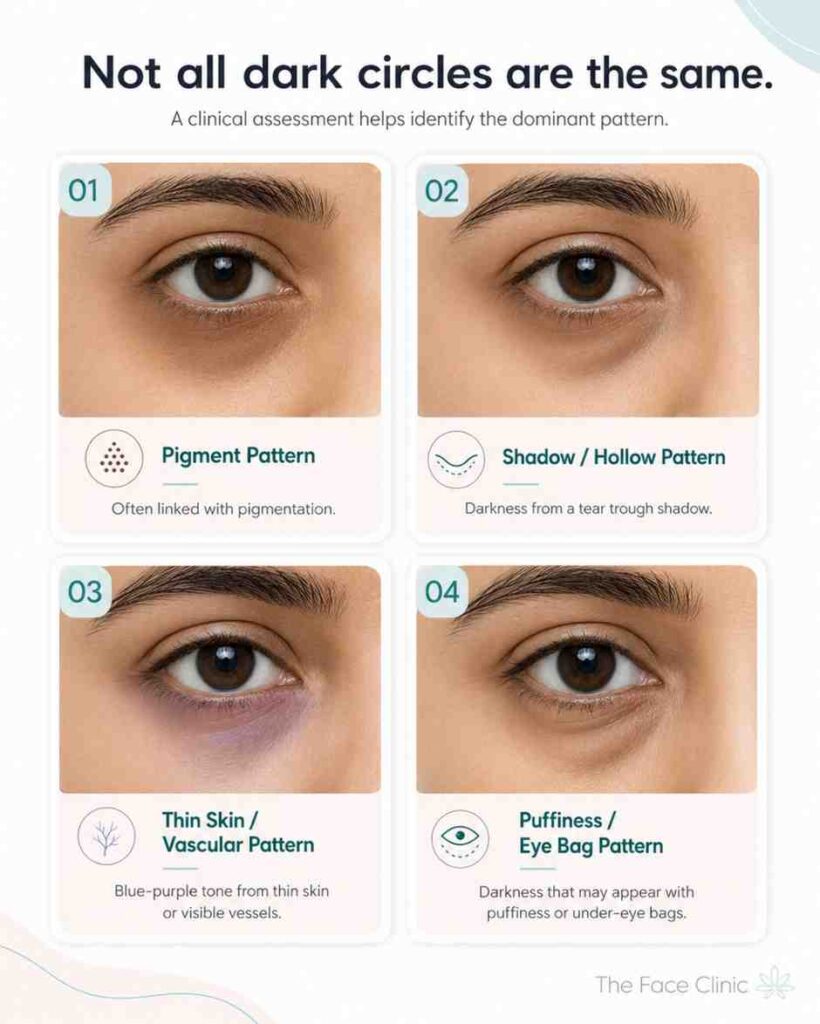
Dark circles can have several contributing causes, and more than one may be present at the same time.
Common factors include:
Sleep, hydration and lifestyle may influence how tired the eyes look in some people, but persistent dark circles should not automatically be attributed to tiredness alone.
A comprehensive medical review of the causes of periorbital dark circles similarly describes pigmentation, vascularity, oedema, tear-trough anatomy and structural shadow among the possible contributors.
If you have already tried creams, peels, lasers or other treatments without understanding why the darkness persists, our guide explaining why dark circles don’t go away explores the diagnostic layers in greater detail.
The appropriate treatment for dark circles under the eyes depends on which factor is contributing most to the visible concern.
Pigment-led dark circles commonly appear brown or grey-brown and may be influenced by genetic tendency, sun exposure, post-inflammatory pigmentation, allergies or repeated rubbing.
Under-eye pigmentation treatment may include:
For selected pigmentation concerns, PicoSure laser treatment may be considered after assessing the type and depth of pigmentation, skin tone and risk of post-inflammatory pigment change.
Treatment around the eyes should remain conservative. Excessive irritation can worsen pigmentation, particularly in pigment-prone skin.
When darkness is primarily created by a groove or hollow beneath the lower eyelid, the concern is structural rather than purely pigmentary.
In carefully selected patients, under-eye fillers may help soften tear-trough shadowing and create a smoother transition between the lower eyelid and cheek.
However, treatment suitability depends on more than the depth of the hollow. Assessment should also consider:
Where pigmentation rather than hollowness is dominant, filler may offer little improvement in the actual colour.
Thin or translucent under-eye skin can make blood vessels and deeper structures more visible, creating a blue, purple or grey appearance.
Treatment may focus on improving skin quality rather than adding volume. Depending on suitability, this may include skincare, hydration and barrier support, collagen-supportive strategies or selected skin booster treatment such as polynucleotide (PDRN) eye treatment.
Improvement is usually gradual. Skin-quality treatments should not be presented as a universal solution because pigment, hollowness and puffiness may coexist.
Puffiness can itself create under-eye shadows.
Assessment should consider whether fullness is related to:
When true bags or significant fat prominence are responsible, repeated filler or pigment treatment may not address the primary concern. Surgical assessment — or, in select cases, a review of non-surgical blepharoplasty options — may be more appropriate.
Many patients have combinations such as:
These cases may benefit from staged treatment, with the dominant or most modifiable concern addressed first and the area reassessed before another treatment is recommended.
The purpose of combining treatments is not to do more. Every step should have a clear indication.
Dark-circle treatment at The Face Clinic is consultation-led rather than procedure-led.
Your consultation may consider:
This helps distinguish colour-related darkness from structural shadow, skin-quality changes, puffiness and mixed concerns.
The under-eye area has thin tissues and complex anatomy.
If the skin is inflamed, puffiness is dominant, filler is unsuitable or another form of evaluation is required, this should be identified before treatment is performed.
Treatment should improve the under-eye area without creating an overfilled or overtreated appearance.
Some concerns are better addressed in stages. Pigmentation, inflammation, puffiness or skin quality may be treated first and structural concerns reassessed later.
Not every under-eye concern should begin with an aesthetic procedure.
Medical assessment or surgical opinion may be recommended when the clinical pattern suggests that another treatment pathway would be more appropriate.
Dark-circle treatment may be considered for adults with persistent under-eye darkness related to a treatable pigment, structural, skin-quality or mixed concern and who have realistic expectations about the degree of improvement possible.
You may benefit from assessment if you notice:
Suitability depends on the underlying cause, anatomy, skin condition, medical history and proposed treatment — not simply on how dark the area appears.
Sometimes the safest plan is not to inject, peel or laser the under-eye area immediately.
Treatment may need to be delayed, modified or avoided in the presence of:
The objective is not simply to determine what can be treated, but what should be treated.
Seek appropriate medical assessment rather than cosmetic treatment first if the change is:
Cosmetic treatment should never delay appropriate medical evaluation.
Results depend on what is creating the darkness.
Pigmentation generally improves gradually rather than disappearing immediately. Response depends on pigment depth, skin type, sun exposure, inflammation, rubbing and adherence to the treatment plan.
When structural hollowness is the dominant cause and filler is appropriate, softening the tear-trough depression may reduce shadowing and improve the transition between the lower eyelid and cheek.
The goal is conservative contour improvement rather than elimination of every natural shadow.
Improvement is usually gradual because the aim is better skin quality rather than instant structural correction. Treatment courses and maintenance depend on the option selected and individual response.
Results depend on why the puffiness is present. Allergy management, trigger control or medical or surgical assessment may be more useful than a standard aesthetic procedure in some patients.
Mixed patterns often improve in stages. One component may respond well while another remains partly visible.
Complete or permanent dark circle removal cannot be guaranteed. Individual results vary according to anatomy, pigmentation, skin quality, treatment suitability and response.

The cost of dark circle treatment in Delhi depends on what is causing the darkness and which treatment pathway is appropriate.
Pigmentation-focused treatment, peels, selected lasers, skin-quality treatment and structural correction have different pricing structures, while mixed concerns may require more than one stage. Depending on the treatment selected, costs may broadly range from approximately ₹5,000 to ₹70,000+ per session.
The final treatment recommendation and cost should be established after assessing the under-eye area.
For detailed treatment-wise price ranges, factors affecting fees and guidance on comparing treatment options, see our complete guide to dark circle treatment cost in India.
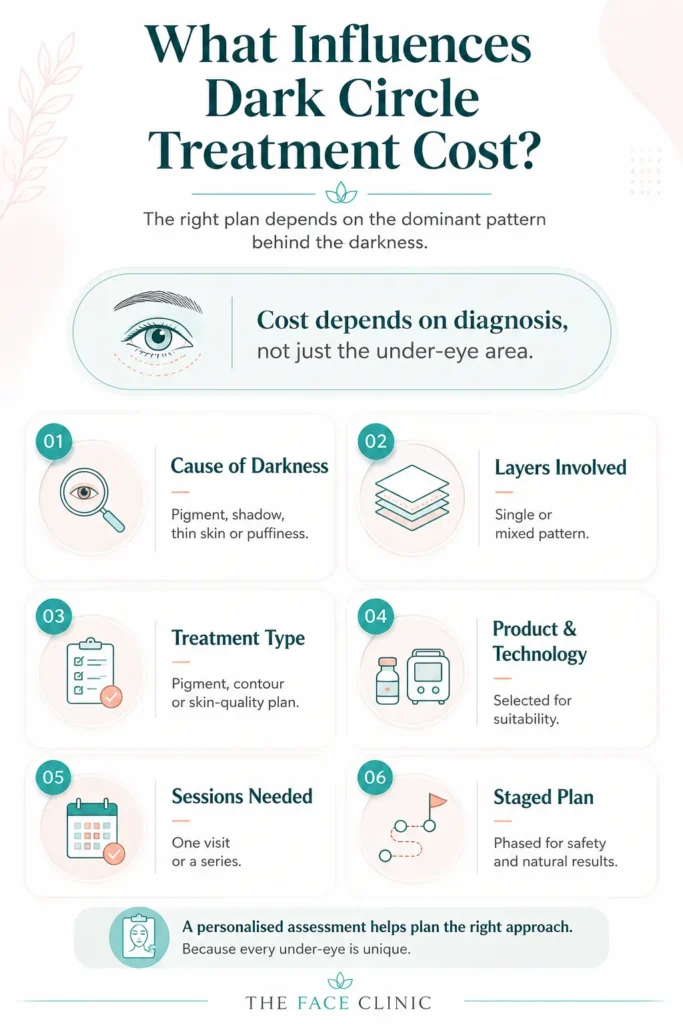
The Face Clinic follows a doctor-led approach in which treatment selection is based on the underlying concern, anatomy and suitability rather than a predetermined procedure.
Treatment planning is led by Dr. Reema Arora, Founder and Medical Director of The Face Clinic, with assessment of pigmentation, structural shadow, under-eye anatomy, skin quality, puffiness and previous treatment history.
Dr. Arora has more than two decades of focused experience in facial aesthetics and has previously served as Medical Head – Facial Aesthetics at Allergan India.
This experience is particularly relevant to treatment selection in anatomically sensitive areas such as the under-eye region.
Treatment selection takes into account pigmentation tendency, post-inflammatory darkening, skin sensitivity and the need for conservative procedural planning in Indian and pigment-prone skin.
The objective is a fresher, better-rested appearance rather than obvious correction.
Patients are also advised when filler is unlikely to help, when treatment should be staged or when cosmetic treatment is not the most appropriate pathway.
The Face Clinic is located in Hauz Khas, South Delhi, and provides consultation-led dark circle treatment for patients from Delhi NCR and beyond.
There is no single best treatment for every type of dark circle. The appropriate option depends on whether the dominant concern is pigmentation, structural shadow, thin skin, vascular visibility, puffiness or a mixed pattern. The treatment choice should therefore follow clinical assessment rather than a predetermined procedure.
Pigmentation creates colour within the skin, while hollowness can create darkness through depth and shadow. The two can also occur together, and lighting can significantly change their appearance. Clinical assessment is more reliable than trying to diagnose the cause from colour alone.
They may help selected patients when darkness is predominantly caused by tear-trough hollowness or structural shadow. Fillers do not directly remove true brown pigmentation and may be unsuitable when significant puffiness, fluid tendency or true eye bags are present.
Yes. Many patients do not need filler. Depending on the cause, treatment may involve skincare, sun protection, selected peels or laser-based procedures, skin-quality support, management of irritation or allergies, or another appropriate treatment pathway.
Selected pigmentation may improve with consistent sun protection, appropriate skincare, control of rubbing or inflammation, and carefully selected pigment-focused procedures. The treatment depends on pigment type, skin tone and whether pigmentation is actually the dominant cause of the darkness.
The under-eye area is delicate, so treatment selection, patient suitability and technique are particularly important. Risks vary according to the procedure. Sometimes the safest choice is to delay treatment, avoid a particular procedure or seek medical or surgical evaluation instead.
This depends on the cause and treatment selected. Pigmentation and skin-quality treatment may require a course of treatment or ongoing care, while structural correction follows a different timeline. Mixed dark circles may require staged treatment.
Not always. Dark circle removal treatment in Delhi can achieve substantial improvement for many patients, while others retain some natural pigmentation, vascular colour, shadow or anatomical features. The realistic goal is meaningful improvement rather than a promise of complete or permanent removal.
Look for a clinic that assesses the underlying cause before recommending a procedure. A good consultation should distinguish pigmentation from structural shadow and puffiness, explain treatment limitations and alternatives, discuss relevant risks and be willing to advise against treatment when a procedure is unlikely to help.
If your under-eyes continue to look dark, hollow, tired or puffy despite skincare or previous treatment, the first step is to understand what is contributing to the appearance.
At The Face Clinic, Hauz Khas, South Delhi, a doctor-led assessment evaluates pigmentation, tear-trough shadowing, under-eye hollowness, skin quality, vascular visibility and puffiness before treatment is recommended.
During consultation, you can understand:
All treatments are subject to individual variation. Outcomes are determined following clinical evaluation by a qualified doctor.