
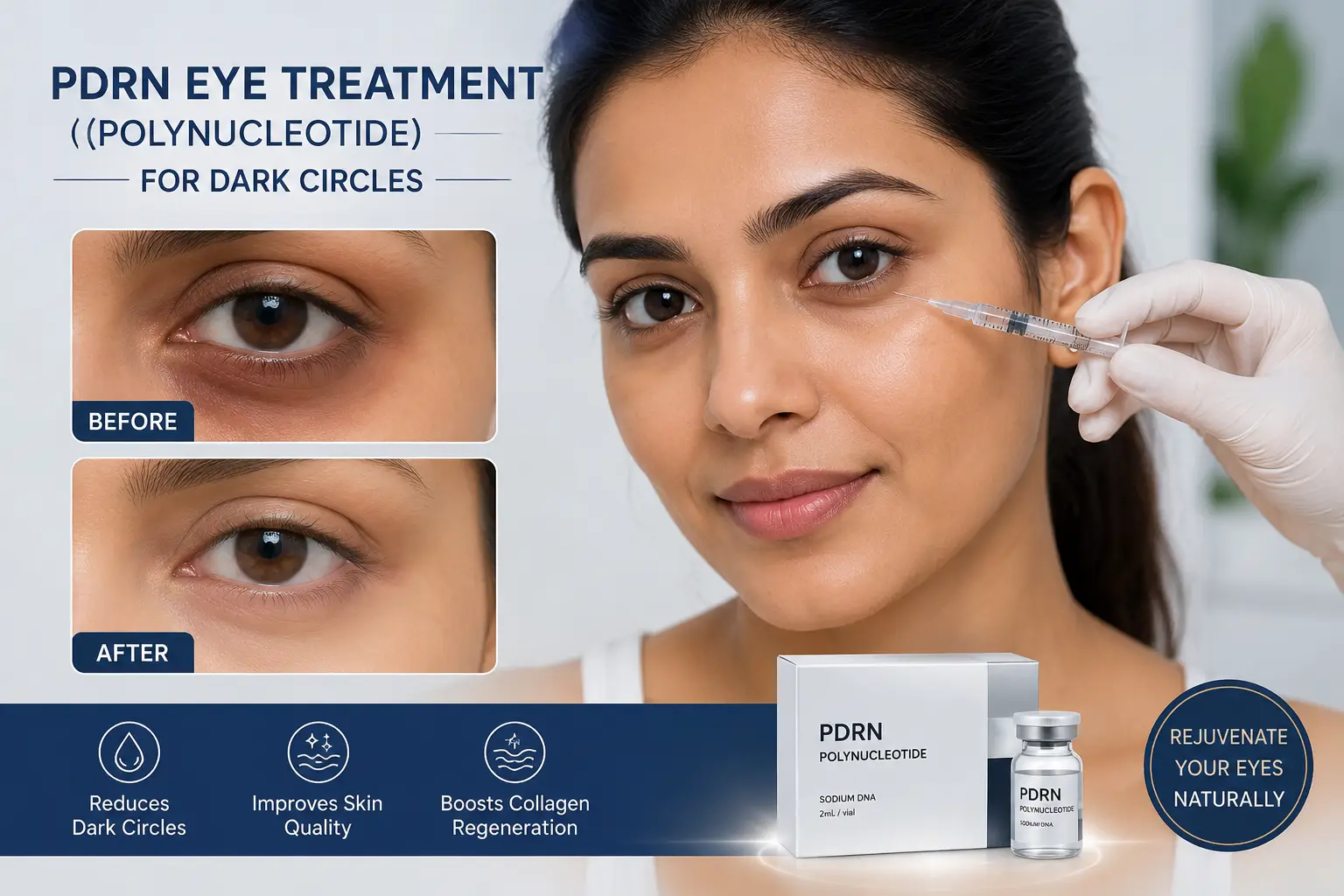
PDRN & Polynucleotide Eye Treatment in Delhi for Under-Eye Skin Quality
PDRN eye treatment and polynucleotide under-eye treatment are regenerative injectable approaches used primarily to support the quality of delicate skin beneath the eyes. Rather than adding volume or changing facial structure, treatment is considered when the main concern involves thin or crepey under-eye skin, fine lines, reduced hydration, early textural ageing or a tired appearance related partly to skin quality.
Patients often search for PDRN eye treatment for dark circles and puffiness, but these concerns do not all have the same cause. Under-eye darkness may result from thin translucent skin, visible vessels, pigmentation, tear-trough shadowing, structural hollowing, puffiness, prominent eye bags or a combination of factors. PDRN or polynucleotide treatment is therefore not a universal dark-circle treatment.
Its role is more specific: improving selected under-eye skin-quality concerns when the skin itself is an important part of the problem.
At The Face Clinic, Hauz Khas, South Delhi, PDRN and polynucleotide eye treatments are planned after a doctor-led under-eye assessment by Dr. Reema Arora. The formulation, technique, number of sessions and expected outcome are individualised according to under-eye anatomy, skin quality and the concern being treated.
PDRN Eye Treatment at a Glance
| Question | Quick Answer |
|---|---|
| What is PDRN eye treatment? | A regenerative injectable approach used to support skin quality in the delicate under-eye area. |
| What may it help improve? | Thin or crepey-looking skin, fine lines, reduced hydration, early textural ageing and selected dark-circle appearances where skin quality contributes. |
| Does it fill under-eye hollows? | No. PDRN and polynucleotides are not substitutes for structural volume correction when a true tear trough or hollow is the main concern. |
| Can it treat every dark circle? | No. Pigmentation, structural shadowing, eye bags, inflammation and significant puffiness may require different treatment pathways. |
| Are results immediate? | Improvement is generally progressive rather than instant and varies between patients and formulations. |
| Is there downtime? | Temporary redness, swelling, tenderness, bruising or small injection-site bumps can occur. |
| How many sessions are needed? | Treatment is commonly planned as a short course, but the number and interval depend on the formulation, under-eye condition and individual response. |
| What determines PDRN eye treatment cost? | Product or formulation, quantity, treatment area, technique, number of sessions, doctor expertise and whether additional treatment is clinically required. |
What Is PDRN / Polynucleotide Eye Treatment?
PDRN and polynucleotides are DNA-derived materials used in regenerative medicine and increasingly in aesthetic practice. They are used with the aim of supporting biological processes involved in tissue repair and skin-quality improvement rather than creating the immediate volume associated with conventional dermal fillers.
PDRN stands for Polydeoxyribonucleotide. Polynucleotide, or PN, is a related term used for DNA-derived polymers. Although the expressions are often used interchangeably in aesthetic marketing, they should not automatically be treated as identical.
Research distinguishes PDRN and PN according to molecular characteristics including DNA-fragment length and molecular weight scientific comparison of PDRN and polynucleotides in dermatology. Different commercial formulations may consequently have different physical properties, concentrations and intended clinical applications.
This distinction matters under the eyes because treatment should be selected according to the formulation, the anatomy and the clinical objective—not simply because a product is marketed as “salmon DNA,” PDRN or polynucleotide treatment.
Many formulations are derived from highly purified salmonid DNA, which is why patients may also encounter the term salmon DNA treatment when researching regenerative injectables.
For a broader explanation of PDRN treatment beyond the eye area, see our PDRN treatment for facial skin quality guide.
How Do PDRN and Polynucleotides Work in Under-Eye Skin?
The skin beneath the eyes is thin and anatomically different from much of the rest of the face. Changes in hydration, collagen support, elasticity and dermal thickness can therefore become visible relatively early as fine lines, crepiness, translucency or a tired appearance.
PDRN and polynucleotide treatments are studied for their regenerative effects within the skin. Depending on the formulation, their biological activity may involve pathways associated with tissue repair, fibroblast activity and extracellular-matrix support.
Research into PDRN has also described mechanisms involving adenosine A2A receptor activity and nucleotide salvage pathways. Polynucleotide formulations may additionally have product-dependent effects related to extracellular-matrix remodelling and tissue hydration.
These biological mechanisms provide a rationale for their use in skin rejuvenation, but they should not be translated into promises of guaranteed collagen production, permanent skin thickening or complete correction of under-eye darkness.
The clinical question is therefore not simply:
“Does PDRN work?”
It is:
“Is poor under-eye skin quality an important part of this patient’s concern, and is this particular formulation appropriate for it?”
What Can PDRN Eye Treatment Help Improve?
PDRN eye treatment is most relevant when the objective is gradual improvement in the quality of the under-eye skin rather than structural correction.
Thin or Crepey Under-Eye Skin
Thin, finely wrinkled or crepey-looking under-eye skin can become more noticeable with ageing, dryness and changes in dermal support.
In appropriately selected patients, PDRN or polynucleotide treatment may be considered to support smoother-looking texture, hydration and skin resilience.
The degree of improvement varies. Significant loose skin or advanced lower-eyelid laxity represents a different concern and may require alternative assessment.
Fine Lines and Early Textural Ageing
Fine lines around the lower eyelid may become more visible as skin hydration and elasticity decline.
A regenerative skin-quality approach may be considered when these changes are relatively early and the goal is subtle improvement without adding volume or changing facial expression.
Deeper wrinkles, significant skin excess or advanced ageing changes may require a different or combined treatment strategy.
Reduced Hydration and Under-Eye Skin Quality
The under-eye area may appear dull, dry or finely textured when skin quality has declined.
Certain PDRN or PN formulations may support hydration and overall skin condition, although the response depends on the specific product, technique, skin condition and treatment course.
Translucent Under-Eye Skin and Visible Vascular Tone
Very thin under-eye skin can allow underlying vascular colour to become more visible, sometimes creating a blue-purple appearance.
Improving the quality of thin skin may soften the overall appearance in selected patients, but PDRN does not directly remove visible blood vessels and should not be described as a vascular treatment.
A Tired-Looking Under-Eye Area
Skin texture, fine crepiness and translucency can contribute to a tired appearance even when significant hollowing is absent.
Where skin quality is a meaningful contributor, regenerative treatment may provide gradual improvement while preserving the natural shape of the lower eyelid.
However, tired-looking eyes can also result from structural hollowness, pigmentation, eye bags or swelling. These need to be distinguished before treatment is selected.
Can PDRN Eye Treatment Help Dark Circles?
Sometimes—but only when the skin-quality component of the dark circles is suitable for this treatment.
Dark circles are a descriptive appearance rather than a single diagnosis. PDRN or polynucleotide eye treatment may be considered when under-eye darkness is influenced partly by:
- thin or translucent under-eye skin;
- reduced dermal quality;
- vascular colour becoming more visible through thin skin;
- early crepiness and fine lines;
- reduced hydration or skin resilience;
- skin-quality-related shadowing or a persistently tired appearance.
In these situations, the objective is not to “remove” pigment or fill a hollow. It is to improve the condition of the under-eye skin so that the area may appear smoother, fresher or less translucent.
PDRN is unlikely to correct dark circles adequately when the dominant cause is:
- significant tear-trough hollowing;
- structural shadowing;
- substantial under-eye volume loss;
- strong melanin-related pigmentation;
- prominent eye bags or fat prolapse;
- allergy-related inflammation or repeated rubbing;
- active dermatitis or eczema;
- significant or unexplained puffiness;
- a medical cause of under-eye swelling.
Many patients have more than one contributor—for example, thin skin plus hollowing, or pigmentation plus vascular visibility. These mixed patterns may require staged or combination treatment rather than expecting one injectable to correct every component.
For a complete cause-based assessment, see our Dark Circle Treatment in Delhi guide.
Can PDRN Eye Treatment Improve Puffiness or Eye Bags?
Puffiness requires particularly careful assessment because puffiness, fluid retention and true eye bags are not the same problem as poor skin quality.
Mild textural heaviness may coexist with thin or crepey skin, but PDRN should not be marketed as a treatment that reliably “removes eye bags.”
Prominent under-eye bags may result from fat-pad prominence, lower-eyelid anatomy, skin laxity or other structural factors. Persistent swelling may be influenced by fluid retention, allergies, inflammation, irritation, rubbing or medical causes.
In these situations, repeatedly injecting the area without establishing why it is swollen may be inappropriate.
Patients with sudden swelling, marked one-sided change, pain, significant redness or other unusual symptoms should seek medical assessment rather than treating the concern initially as a cosmetic problem.
PDRN Eye Treatment vs Under-Eye Fillers — What Is the Difference?
PDRN/polynucleotide treatment and under-eye fillers address different layers of the under-eye problem.
| Concern | PDRN / Polynucleotide Eye Treatment | Under-Eye Filler |
|---|---|---|
| Thin or crepey skin | May be considered | Does not directly treat skin quality |
| Fine textural lines | May be considered | Not its primary role |
| Reduced hydration/skin quality | May be considered | Not its primary role |
| True tear-trough hollow | Does not replace lost volume | May be appropriate in selected patients |
| Structural shadow from volume loss | Limited role | May improve the structural cause when suitable |
| Strong pigmentation | Not a primary pigment treatment | Does not correct pigment |
| Prominent eye bags | Not a corrective treatment | Often unsuitable; specialist assessment is important |
| Significant puffiness | Requires assessment first | May worsen heaviness in unsuitable anatomy |
The distinction is important because a patient can have thin skin without hollowing, hollowing without poor skin quality, or both at the same time.
Where both concerns coexist, treatments may occasionally be staged or combined, but neither modality should automatically be added simply because another treatment has been performed.
When PDRN Eye Treatment May Not Be the Right Treatment
A doctor-led assessment should establish not only when PDRN may help, but also when another approach is more appropriate.
PDRN or polynucleotide eye treatment may not be the right first treatment when the principal concern is:
True Tear-Trough Hollowing or Significant Volume Loss
A pronounced under-eye depression is primarily a structural concern. Improving skin quality alone cannot recreate missing structural support.
If the principal concern is a true hollow or tear-trough shadow, see our under-eye filler treatment for structural hollowness guide.
Pronounced Eye Bags or Fat Prolapse
Prominent fat pads and true eye bags represent a different anatomical concern. Injectable skin-quality treatment does not remove prolapsed fat and may not deliver the correction the patient is seeking.
Dominant Pigmentation
Brown or grey-brown darkness caused predominantly by melanin requires pigment-focused assessment.
PDRN may occasionally be incorporated into a broader skin-quality strategy, but it should not be positioned as a primary treatment for significant under-eye hyperpigmentation.
Active Dermatitis, Irritation or Inflammation
Active eczema, dermatitis, infection, significant redness or an impaired skin barrier should be assessed and controlled before an elective injectable procedure is considered.
Sudden or Unilateral Swelling
New, significant or one-sided swelling should not simply be treated as cosmetic puffiness. Medical evaluation may be appropriate before any aesthetic procedure is planned.
Unrealistic Expectations
PDRN eye treatment is intended to create gradual skin-quality improvement, not erase every dark circle, remove eye bags, replace missing volume or permanently reverse under-eye ageing.
Patients seeking an immediate or dramatic structural transformation may require another approach.
Who May Be a Good Candidate for PDRN Eye Treatment?
PDRN or polynucleotide eye treatment may be considered for adults whose dominant concern involves the quality of the under-eye skin rather than substantial structural volume loss.
Potential candidates may have:
- thin or crepey-looking under-eye skin;
- fine lower-eyelid lines;
- reduced hydration or skin resilience;
- early textural ageing;
- translucent skin contributing to visible vascular tone;
- selected dark-circle appearances in which skin quality is an important contributor;
- a preference for gradual skin-quality improvement without significant volumisation.
Suitability cannot be determined from a photograph or treatment trend alone. Under-eye anatomy, swelling tendency, skin condition, medical history, previous treatments and expectations all need to be considered.
When PDRN Eye Treatment May Need to Be Delayed
Treatment would generally be postponed or reconsidered where there is:
- active infection around the treatment area;
- active dermatitis, eczema or significant inflammation;
- an acutely damaged or poorly healed skin barrier;
- significant unexplained under-eye swelling;
- recent treatment from which the area has not adequately recovered;
- pregnancy or breastfeeding, where elective treatment is generally deferred because safety data are limited.
Additional medical assessment may also be appropriate in patients with significant allergies, previous injectable reactions, relevant medical conditions, medications that influence bruising or healing, or previous complications from aesthetic injections.
The exact formulation should also be reviewed where an allergy or hypersensitivity concern is relevant.
How Is PDRN / Polynucleotide Eye Treatment Performed?
Treatment begins with assessment rather than injection.
1. Under-Eye Assessment
The doctor evaluates:
- skin thickness and texture;
- fine lines and crepiness;
- pigmentation;
- vascular visibility;
- tear-trough depth;
- lower-eyelid and midface anatomy;
- puffiness or swelling tendency;
- previous fillers or injectable treatments;
- relevant medical and skin history.
The purpose is to establish whether skin quality is actually the layer that needs treatment.
2. Product and Formulation Selection
PDRN and polynucleotide formulations differ.
The appropriate product should therefore be selected according to the treatment area, product characteristics, clinical indication and individual patient—not because one formulation is currently fashionable.
3. Preparation and Treatment
After appropriate preparation of the treatment area, the product is usually delivered through multiple small injections using a technique appropriate to the formulation and delicate under-eye anatomy.
Topical anaesthetic may be used to improve comfort where suitable.
Patients can experience brief pinching, stinging or pressure during treatment.
4. Immediate Review and Aftercare
The area is reviewed after treatment and individual aftercare instructions are provided.
Small temporary injection-site bumps, swelling or redness may initially be visible, so patients should not assume that every PDRN eye treatment has literally “zero downtime.”
PDRN Eye Treatment Side Effects and Downtime
PDRN and polynucleotide injections are generally well tolerated in appropriately selected patients, but no injectable treatment should be described as completely risk-free.
Temporary reactions may include:
- redness;
- swelling;
- tenderness;
- bruising;
- small raised injection-site bumps;
- mild itching or sensitivity.
The extent and duration of visible recovery vary according to formulation, technique, individual skin response and under-eye anatomy.
Patients should follow the aftercare instructions provided for the specific procedure. These may include keeping the area clean, avoiding unnecessary rubbing or pressure, modifying irritating skincare temporarily and following advice regarding exercise, heat, makeup or other procedures.
Unexpected, persistent or worsening symptoms should be medically reviewed. Significant pain, increasing redness, marked swelling, signs of infection or visual disturbance require prompt medical attention.
How Many PDRN Eye Treatment Sessions Are Usually Needed?
PDRN and polynucleotide eye treatments are commonly planned as a course rather than a one-session transformation.
Depending on the formulation and treatment objective, a short course such as two to three sessions approximately three to four weeks apart may be used in clinical practice. However, protocols vary and should not be presented as universal.
The appropriate number of sessions depends on:
- the specific PDRN or PN formulation;
- baseline under-eye skin quality;
- the concern being treated;
- the quantity used;
- individual response;
- whether other treatment is being staged separately.
Maintenance should also be based on the response and ongoing skin changes rather than automatically prescribed on a fixed timetable.
When Will I See Results from PDRN Eye Treatment?
PDRN eye treatment should be understood as a progressive skin-quality treatment rather than an immediate cosmetic correction.
Some patients may notice gradual changes in hydration, texture or the overall appearance of the under-eye skin over the weeks following treatment. Further improvement may develop across a treatment course.
The response varies according to age, baseline skin quality, formulation, treatment technique, lifestyle, anatomy and the actual cause of the concern.
For this reason, fixed claims such as “results last 6–12 months” should not be treated as a guarantee for every patient or every product.
Maintenance, if appropriate, should be decided after observing the individual response.
What Does the Evidence Say About Polynucleotide Under-Eye Treatment?
Scientific interest in PDRN and polynucleotides has increased substantially, but the evidence should be interpreted with appropriate perspective.
A systematic review of polynucleotides in aesthetic medicine reported promising improvements in areas including wrinkles, skin texture and elasticity. However, it also highlighted the limited number of studies, relatively small patient populations and variation between treatment protocols.
More recent reviews of regenerative and under-eye treatments similarly support a potential role for PDRN/PN in skin-quality improvement while emphasising that formulations, techniques and patient selection differ.
This is important because the popularity of PDRN and polynucleotide treatment has grown faster than the quantity of high-quality comparative evidence.
At The Face Clinic, the practical interpretation is therefore conservative:
Use PDRN or PN when the treatment objective matches what the formulation can reasonably improve, and do not use regenerative terminology to promise correction of a structural or pigmentary problem it cannot reliably address.
PDRN Eye Treatment Cost in Delhi
PDRN eye treatment cost in Delhi depends on the treatment actually required rather than on the words “PDRN” or “polynucleotide” alone.
The under-eye area is a small but anatomically delicate treatment zone. Cost therefore reflects not only the quantity injected, but also formulation selection, medical assessment, technique and treatment planning.
The exact fee should be confirmed after consultation once the product, treatment area and expected course are established.
What Determines Polynucleotide Under-Eye Treatment Cost?
The principal factors include:
Exact formulation and product selected PDRN and PN products vary in composition, concentration, physical characteristics, manufacturer and quantity supplied.
PN versus PDRN preparation These are related but not automatically interchangeable categories. The clinically appropriate formulation should guide treatment rather than simply choosing whichever product has the lowest advertised price.
Quantity required The amount used depends on the product, injection pattern and treatment objective.
Treatment area A targeted PDRN under-eye treatment is different from a full-face regenerative protocol and should not automatically be priced or planned in the same way.
Number of sessions Total treatment-course cost depends on how many sessions are clinically appropriate rather than only the price of one appointment.
Doctor expertise and assessment Under-eye treatment requires careful evaluation of lower-eyelid anatomy, skin thickness, swelling tendency, tear-trough structure and previous treatment.
Treatment technique Technique should be matched to the formulation and under-eye anatomy rather than being selected because it is marketed as “advanced.”
Follow-up and medical oversight Sterile technique, appropriate product handling, follow-up and the ability to assess unexpected reactions form part of responsible injectable care.
Whether combination or staged treatment is genuinely required Some patients have more than one concern—for example, skin thinning plus hollowing or pigmentation. Additional treatment should be recommended only when another layer genuinely requires correction.
This page therefore owns PDRN eye treatment cost / polynucleotide under-eye treatment cost, while broader full-face PDRN pricing and treatment considerations are covered separately in our general PDRN treatment guide.
Why Doctor-Led Under-Eye Assessment Matters
The lower eyelid is one of the areas where apparently similar concerns can have very different causes.
Two patients may both say that they have “dark circles,” yet one may primarily have thin translucent skin while another has a deep tear trough, pigment, vascular visibility, swelling or prominent fat pads.
Starting with a product rather than a diagnosis increases the chance of treating the wrong layer.
At The Face Clinic, Dr. Reema Arora assesses:
- what is creating the visible concern;
- whether skin quality is the dominant problem;
- whether PDRN or PN has a clinically appropriate role;
- whether treatment should be staged;
- whether another treatment would be more appropriate;
- and, equally importantly, when not to inject.
The goal is subtle, natural-looking improvement without using a skin-quality treatment as a substitute for structural, pigmentary or medical assessment.
Why Choose The Face Clinic for PDRN Eye Treatment in Delhi?
Doctor-Led Treatment Planning
PDRN eye treatment at The Face Clinic is planned and medically supervised by Dr. Reema Arora, with treatment recommendations based on anatomy and clinical indication rather than a standard package.
Under-Eye Diagnosis Before Product Selection
Thin skin, tear-trough shadowing, pigmentation, puffiness and eye bags are assessed separately before deciding whether a regenerative injectable is appropriate.
Formulation-Specific Planning
PDRN and PN formulations are not treated as interchangeable simply because both are DNA-derived products.
Product selection, treatment quantity and delivery technique are matched to the treatment objective.
Conservative, Natural-Looking Results
The aim is not to create unnecessary volume beneath the eye or promise complete dark-circle removal.
Where treatment is appropriate, the objective is gradual improvement in skin quality while preserving the patient’s natural lower-eyelid anatomy and facial character.
Frequently Asked Questions About PDRN Eye Treatment
Is PDRN eye treatment the same as polynucleotide under-eye treatment?
Not exactly.
PDRN and PN are related DNA-derived regenerative materials, and the terminology is frequently blurred in aesthetic marketing. Scientific literature describes molecular and formulation differences between them.
The specific product being proposed should therefore be identified rather than assuming that every PDRN and polynucleotide injectable is identical.
What does PDRN do for under-eye skin?
PDRN is used with the aim of supporting regenerative processes and improving selected skin-quality parameters.
Under the eyes, it may be considered for concerns such as thin or crepey-looking skin, fine lines, reduced hydration and early textural ageing.
Can PDRN improve crepey under-eye skin?
It may help selected patients where crepiness and declining skin quality are the principal concerns.
Results are gradual and vary according to the formulation, treatment course and baseline skin condition. Significant skin laxity represents a different concern.
Can PDRN eye treatment remove dark circles?
Not all dark circles.
PDRN may be useful when thin skin, crepiness, reduced skin quality or translucency contributes to the appearance. It does not replace treatment for significant tear-trough hollowing, strong pigmentation, prominent eye bags or medical causes of puffiness.
Is PDRN good for under-eye hollows?
PDRN is not a volumising treatment and does not replace lost structural volume.
When a true tear trough or hollow is the dominant problem, structural assessment is needed to determine whether under-eye filler or another approach is more appropriate.
Does PDRN reduce eye bags?
PDRN should not be promoted as a treatment that removes true eye bags.
Prominent fat pads, significant lower-eyelid laxity and persistent puffiness require their own assessment and may need a different treatment pathway.
How many PDRN under-eye sessions will I need?
Many treatment plans involve a short course of sessions, but there is no universal number for every product or patient.
The protocol depends on the formulation used, baseline skin quality, treatment objective and individual response.
How much does PDRN eye treatment cost in Delhi?
PDRN eye treatment cost in Delhi varies according to the exact product or formulation, quantity, treatment technique, number of sessions, doctor expertise and whether any additional treatment is clinically indicated.
An exact quotation is best provided after the under-eye area has been assessed.
Is there downtime after polynucleotide under-eye injections?
Some patients return to normal activities quickly, but temporary redness, swelling, bruising or small injection-site bumps can occur.
For that reason, treatment should not be advertised as universally having “no downtime.”
Is PDRN eye treatment safe?
PDRN and PN treatments are generally well tolerated in appropriately selected patients when suitable products and sterile injection techniques are used.
However, they remain injectable medical procedures. Temporary reactions can occur, individual suitability matters, and no injectable should be described as completely free from risk.
Considering PDRN Eye Treatment in Delhi?
If your under-eye concern is mainly thin or crepey skin, fine lines, reduced hydration or declining skin quality, PDRN or polynucleotide eye treatment may be worth considering.
If the problem is instead caused mainly by a tear-trough hollow, pigmentation, prominent eye bags, significant puffiness or inflammation, another treatment—or no aesthetic procedure at all—may be more appropriate.
At The Face Clinic, Hauz Khas, South Delhi, consultation begins by identifying which layer is actually creating the under-eye concern before deciding whether PDRN belongs in the treatment plan.
Book a doctor-led under-eye consultation with Dr. Reema Arora to discuss suitability, formulation, expected results, session planning and PDRN eye treatment cost.
Individual results vary. Treatment recommendations are made only after clinical assessment, and no specific result can be guaranteed.