
- Home
- Services
- Skin Booster
Have Any Question?
Don’t think much, have a query? Call us now!
Connect with us
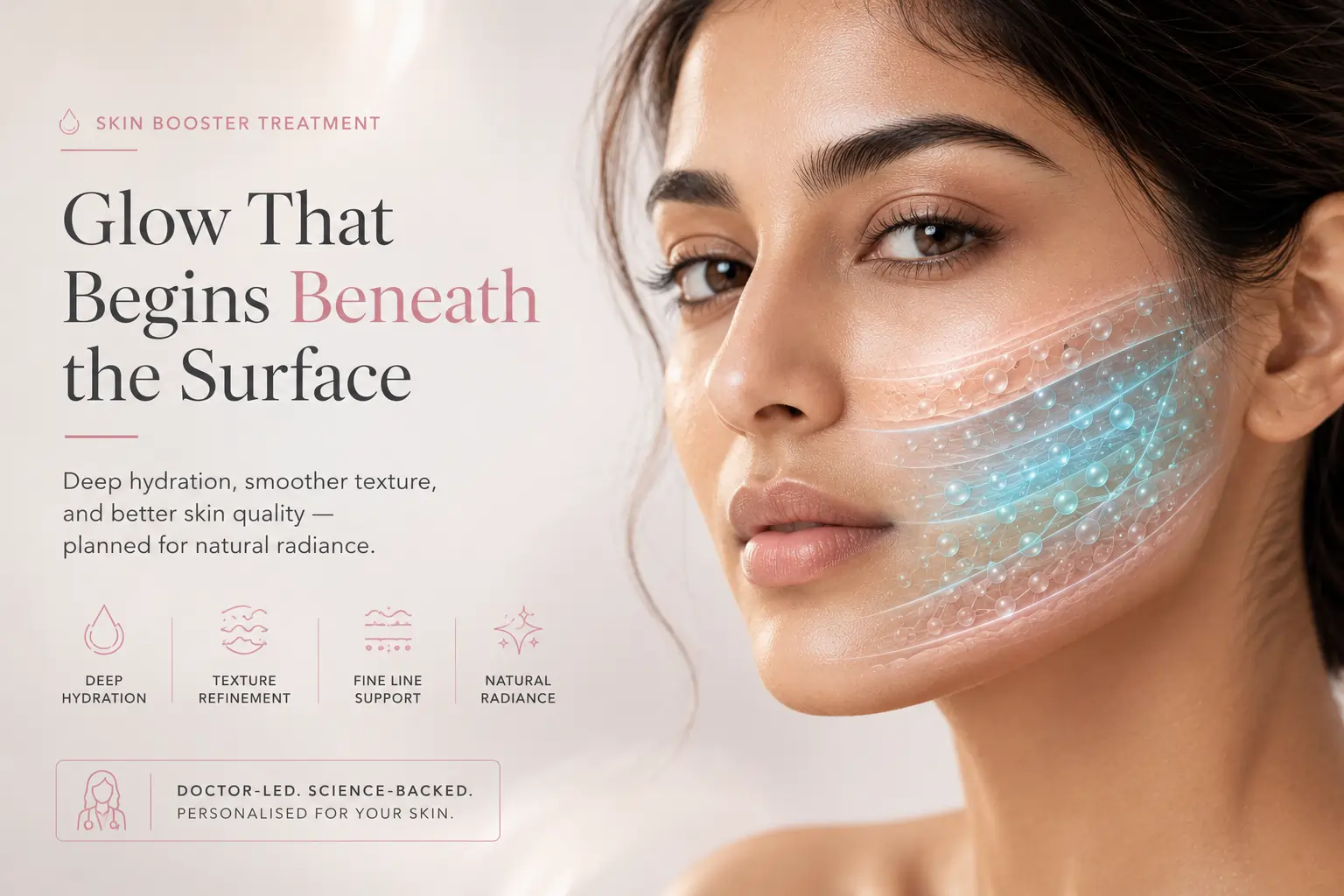
Images are for illustrative purposes only and may not represent actual patients or outcomes. Individual results vary based on anatomy, clinical assessment, and personalised treatment planning.
Skin Booster Treatment in Delhi: Hydration, Texture & Skin Quality
Skin booster treatments are injectable skin-quality treatments designed to improve hydration, texture, luminosity, elasticity and fine lines related to dehydration without intentionally adding facial volume or changing natural facial contours.
Unlike volumising dermal fillers, which are primarily used to restore or enhance facial structure, skin boosters focus on skin quality rather than facial reshaping. Hyaluronic acid-based skin boosters are commonly placed within the skin to improve hydration and smoothness, with treatment selection depending on the formulation, treatment area, skin condition and individual goals.
At The Face Clinic in Hauz Khas, treatment begins with a doctor-led skin assessment by Dr. Reema Arora. The aim is not to select a product simply because it is popular, but to determine whether a skin booster—and which type—is appropriate for the concern being treated.
✔ Doctor-led skin assessment
✔ Indication-based treatment and product selection
✔ Realistic treatment planning and expected outcomes
✔ Gradual improvement without intended facial volumisation
✔ Minimal downtime for most patients
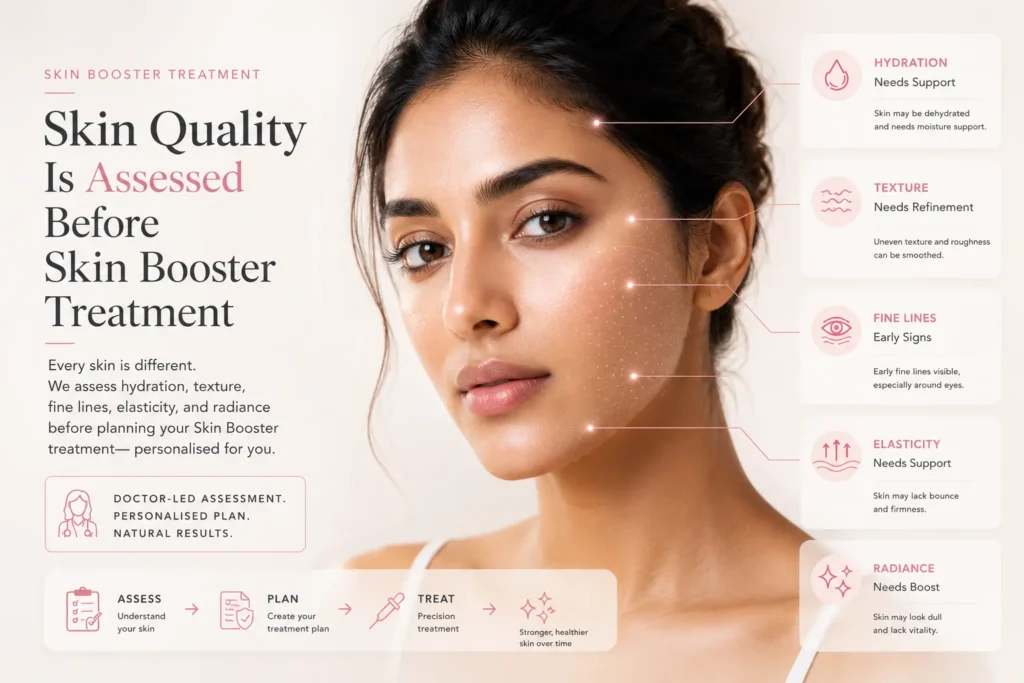
Images are for illustrative purposes only and may not represent actual patients or outcomes. Individual results vary based on anatomy, clinical assessment, and personalised treatment planning.
Skin Booster Treatment at a Glance
What it is: An injectable treatment, commonly using hyaluronic acid-based formulations, designed to improve hydration, texture and overall skin quality. Best suited for: Dehydrated or dull-looking skin, fine lines related to dehydration, early crepey texture and reduced skin smoothness or luminosity. Typical treatment areas: Face, neck, décolletage and hands, depending on the product, indication and individual assessment. What it does not primarily treat: Significant facial volume loss, deep folds or structural sagging. Results: Improvements are usually gradual and depend on the formulation and individual response. Downtime: Usually minimal, although temporary redness, swelling, tenderness or small injection-site marks can occur. Cost: From ₹15,000 per session, depending on the product, treatment area and personalised plan.
What Are Skin Boosters?
Skin boosters are injectable treatments used primarily to improve the quality of the skin rather than its shape or volume. Many established skin boosters use specially formulated hyaluronic acid, a naturally occurring molecule with a strong ability to bind water within the skin.
Rather than creating projection or contour in the way a dermal filler may, appropriately selected skin booster treatments are intended to improve concerns such as dehydration, dullness, fine lines, rough texture and early loss of elasticity.
How Do Skin Booster Injections Work?
Depending on the formulation and treatment indication, small amounts of the selected product are placed within or just beneath the skin at planned injection points. Hyaluronic acid-based formulations attract and retain water within the treated tissue, helping improve hydration and smoothness over time.
Different injectable skin-quality treatments can vary in formulation, treatment depth, biological effect and intended outcome. They should therefore not be considered interchangeable simply because they may address overlapping concerns.
The appropriate approach depends on the skin concern, treatment area, skin characteristics and desired outcome. These factors are assessed before recommending a particular injectable treatment.
What Can Skin Booster Treatment Improve?
Skin booster treatment is best suited to concerns related to hydration and skin quality rather than facial structure. Depending on the formulation, treatment area and baseline skin condition, it may help skin look smoother, better hydrated and more luminous. For patients asking what the best treatment for skin hydration is, or looking specifically for a skin booster for skin quality rather than facial reshaping, an appropriately selected skin booster is often the starting point for assessment.
Common concerns that may respond include: Dehydrated or moisture-depleted skin Dull or tired-looking skin Fine lines related to dehydration Rough or uneven skin texture Early crepey skin changes Reduced skin smoothness and elasticity Declining skin quality with age or environmental exposure
The degree of improvement varies between patients. More pronounced volume loss, laxity or structural facial changes may require a different treatment approach.
Skin Booster for Dull Skin
Hyaluronic acid-based skin boosters can improve the skin’s ability to retain moisture, making them particularly useful when the primary concern is persistent dehydration, dullness or loss of luminosity. A skin booster for dull skin is generally considered when the concern is moisture-related rather than caused by pigmentation or volume loss, which may need a different assessment.
While moisturisers support the skin barrier and surface hydration, injectable skin boosters work through a different route by placing the selected formulation within the skin according to the product and treatment protocol, offering a form of injectable skin hydration that topical products cannot replicate.
Patients with dehydrated or lacklustre skin may notice gradual improvement in smoothness and luminosity as hydration within the treated tissue improves.
Skin Booster for Fine Lines, Crepey Skin and Uneven Texture
A skin booster for fine lines, or a skin booster for texture more broadly, may be considered when early changes appear as fine lines, mild crepiness or rougher texture, particularly when associated with reduced hydration and elasticity.
Treatment is intended to improve the condition of the skin itself rather than fill individual lines. Deeper wrinkles or changes driven predominantly by structural volume loss may require a different or combined approach.
Changes in skin quality and changes in facial structure often require different treatment approaches.
Skin Booster for Ageing Skin
Age alone is not an indication for skin booster treatment. What matters is the type of visible skin change.
In appropriately selected patients, a skin booster for ageing skin may be considered when early changes in hydration, smoothness, elasticity or texture appear before significant sagging or volume loss develops.
Treatment selection should therefore be based on the underlying concern, not simply the patient’s age.
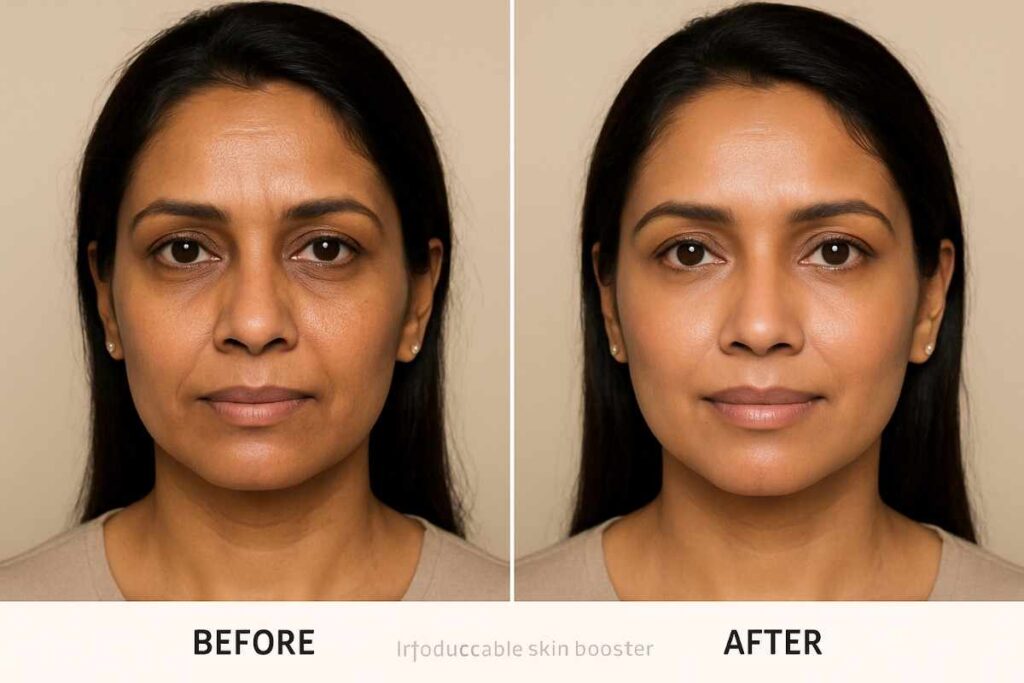
Images are for illustrative purposes only and may not represent actual patients or outcomes. Individual results vary based on anatomy, clinical assessment, and personalised treatment planning.
Skin Booster vs Dermal Filler — What Is the Difference?
Patients comparing a skin booster vs filler are usually trying to work out whether their concern is about skin quality or facial structure — and although both are injectable treatments, and some formulations contain hyaluronic acid, skin boosters and dermal fillers are used for different aesthetic objectives.
Skin boosters primarily target skin hydration, texture and overall skin quality. Dermal fillers are generally used when the treatment goal involves volume restoration, contour, projection or structural support.
Skin Booster Dermal Filler Primary goal Improve skin quality and hydration Restore or enhance facial structure and volume Typical concerns Dehydration, dullness, fine lines and early crepey texture Volume loss, contour deficiency, deeper folds or structural change Effect on facial shape Not intended to significantly alter facial contours May change contour, projection or facial proportions Hydration benefit A central treatment objective May occur, but is not usually the principal objective Volume restoration Not the primary purpose A principal indication for many fillers Treatment planning Based on skin quality, treatment area and formulation Based on anatomy, structural assessment and volume requirements
The two treatments are therefore not interchangeable.
A patient concerned primarily with dull, dehydrated or finely textured skin may benefit from a skin-quality treatment, whereas visible volume loss or structural contour changes may be better addressed with dermal filler or another appropriately selected treatment.
For more information about structural volume restoration and contour correction, see our dermal filler treatment guide.
In some patients, both concerns coexist. In these situations, treatment may be staged or combined, but only when each treatment has a clear indication.
When a Skin Booster May Be More Appropriate
A skin booster may be more appropriate when the principal concern is hydration, luminosity, fine dehydration lines or early texture change rather than loss of facial structure.
When a Dermal Filler May Be More Appropriate
Dermal filler may be considered when the primary concern relates to: Facial volume loss Loss of contour or projection Structural support Selected deeper folds Specific areas requiring shape or proportion correction
The next step is to determine which type of skin booster or skin-quality injectable, if any, best matches the patient’s concern, skin characteristics and treatment goals.

Images are for illustrative purposes only and may not represent actual patients or outcomes. Individual results vary based on anatomy, clinical assessment, and personalised treatment planning.
Skin Booster vs Mesotherapy — What Is the Difference?
Skin booster treatment and mesotherapy may both involve multiple small injections, but they are not interchangeable treatment categories.
Mesotherapy is a technique in which selected formulations are delivered through superficial micro-injections into the skin. The ingredients used, injection depth, objectives and protocols can vary considerably depending on the formulation and indication.
Skin boosters, by comparison, generally use specifically selected injectable skin-quality formulations with defined treatment protocols aimed primarily at improving concerns such as hydration, smoothness, fine lines and overall skin quality.
The appropriate option depends on the skin concern, formulation, treatment area and intended outcome, rather than on the injection technique alone.
Types of Skin Boosters and Skin-Quality Injectables
Not every injectable treatment used to improve skin quality works in the same way. Differences in formulation, tissue interaction, treatment protocol and intended outcome mean that treatments commonly discussed together should not automatically be considered interchangeable.
Treatment selection should therefore begin with the patient’s skin concern and clinical assessment—not the popularity of a particular brand.
Hyaluronic Acid Skin Boosters
Hyaluronic acid (HA) skin boosters are primarily considered when the treatment goal is to improve hydration, smoothness, luminosity and early textural changes without intentionally creating structural facial volume.
Depending on the formulation, HA skin boosters may be delivered through a series of small injections across selected treatment areas. Some are planned as an initial course followed by maintenance, while others use different schedules.
Examples of established HA-based skin-quality treatments may include formulations from ranges such as Restylane Skinboosters and Juvéderm Volite, where clinically appropriate and available.
The number of sessions, treatment intervals and duration of improvement vary according to the selected formulation, treatment area, baseline skin condition and individual response.
SkinVive by Juvéderm
SkinVive is a hyaluronic acid-based injectable skin-quality treatment used to improve skin smoothness and hydration rather than primarily restore facial volume or create structural contour.
It may be considered when the principal concern is skin smoothness, hydration or overall skin quality, but its indications, technique and protocol should not be assumed to be identical to those of every other HA skin booster.
For patients specifically considering SkinVive, the SkinVive treatment guide provides more detailed information about its indications, procedure and expected outcomes.
Profhilo
Profhilo is a hyaluronic acid-based injectable treatment commonly considered when the objective includes hydration and improvement in skin quality, particularly where changes in elasticity are also part of the concern.
Although Profhilo is frequently discussed alongside skin boosters, it has its own formulation and treatment approach. It should therefore be assessed as a distinct injectable skin-quality treatment rather than simply another interchangeable skin booster.
Whether Profhilo or another HA-based treatment is more appropriate depends on the patient’s skin characteristics, treatment area and desired outcome. For patients specifically considering this option, the Profhilo treatment guide covers its indications, procedure and expected results in more detail.
Regenerative Skin-Quality Treatments: PDRN & Polynucleotides
When the treatment objective extends beyond primarily HA-based hydration, PDRN and polynucleotide-based treatments may be considered within a broader regenerative skin-quality strategy.
These belong to a different treatment category and should not be treated as simply another form of generic HA skin booster. Depending on the formulation and clinical indication, they may be considered for selected texture-related or regenerative concerns.
For more detailed information about regenerative options, see our PDRN skin treatment guide.
Patients specifically considering polynucleotide-based treatment can also read about polynucleotide treatment and its doctor-led planning.
Which Skin Booster or Skin-Quality Treatment Is Right for You?
There is no universally “best” skin booster. The most appropriate treatment depends on what is causing the visible change, which area is being treated and what outcome the patient is trying to achieve.
A useful starting point is the primary concern rather than the product name:
Primary concern Treatment family or option that may be considered Dehydration, dullness or reduced luminosity An appropriately selected HA-based skin booster Skin smoothness and injectable hydration A selected HA skin-quality injectable, such as SkinVive where appropriate Hydration with early changes in elasticity Profhilo or another appropriately selected skin-quality treatment Texture-related or regenerative skin-quality concerns PDRN or polynucleotide-based treatment where clinically appropriate Significant facial volume loss Dermal filler rather than a skin booster Pronounced tissue laxity or structural sagging Skin-tightening, lifting or another structural treatment approach
This table is a decision guide, not a treatment prescription. Different concerns can coexist, and two patients who both describe their skin as “dull” or “ageing” may require very different approaches after clinical assessment.
The objective is therefore to identify what needs treatment before deciding what should be injected.

Images are for illustrative purposes only and may not represent actual patients or outcomes. Individual results vary based on anatomy, clinical assessment, and personalised treatment planning.
Who Is Suitable for Skin Booster Treatment?
Suitability depends more on the type of skin concern than on age alone.
A suitable candidate is generally someone whose main objective is to improve skin condition rather than substantially alter facial structure. This may include patients who: Have a hydration, smoothness or early texture concern Prefer subtle, gradual improvement without intended facial volumisation Have concerns appropriate for the selected formulation and treatment area Understand that results vary between products and individuals Have realistic expectations about what treatment can and cannot achieve Are medically suitable for the selected injectable treatment after clinical assessment
A patient’s chronological age alone does not determine whether treatment is appropriate. The decision should instead reflect the skin characteristics, underlying concern, treatment area, medical history and intended outcome.
When Skin Boosters May Not Be the Primary Treatment
Skin boosters may not be the primary treatment when the main concern is: Significant facial volume loss Pronounced structural sagging or tissue laxity Deep folds caused predominantly by volume or structural change A need for facial projection, contouring or repositioning A skin concern better addressed with another dermatological or aesthetic modality
Where substantial laxity or structural ageing is dominant, a different strategy—such as an appropriately selected non-surgical face lift approach—may be more relevant than skin booster treatment alone.
Final suitability should follow clinical assessment rather than choosing a particular injectable treatment or brand simply because it is popular.
Areas That Can Be Treated With Skin Boosters
Skin boosters may be considered across selected areas where the primary concern is dehydration, early textural change or declining skin quality. The appropriate product and treatment approach vary according to the area being treated and individual skin characteristics.
Face
The face—particularly the cheeks and midface—is one of the most commonly treated areas. Treatment may help improve hydration, smoothness and fine texture.
Neck, Décolletage and Hands
Skin boosters may also be considered for: Neck: Early crepey texture, dehydration and selected fine horizontal lines Décolletage: Dehydration and textural changes in sun-exposed skin Hands: Selected cases of dryness or early crepey skin quality
Structural volume loss in the hands or significant neck laxity requires a different assessment.
Selected Under-Eye Indications
The under-eye area requires particularly careful treatment selection because the skin is thin and not every product or concern is suitable for injection.
In appropriately selected patients, certain skin-quality injectables may be considered for fine crepey texture or dehydration-related lines. Structural tear-trough hollowing, significant under-eye bags or other causes of shadowing require a different assessment.
What Happens During Skin Booster Treatment?
Skin booster treatment is performed in a structured clinical setting, with the product, treatment areas and injection approach selected according to the individual indication.
Consultation and Treatment Planning
Treatment begins with a clinical assessment of the: Skin concern and treatment goals Skin thickness and overall skin condition Degree of dehydration or textural change Proposed treatment area Relevant medical history Suitability of the selected formulation
The aim is to determine not only which product may be appropriate, but whether a skin booster is the right treatment at all.
The Injection Procedure
The treatment area is cleansed using appropriate antiseptic skin preparation. A topical numbing cream may be applied where appropriate to improve comfort.
Depending on the selected formulation and treatment area, the product is then placed using a series of small injections or micro-deposits within planned treatment zones. Technique and depth are adapted to the product and anatomy to support appropriate and even placement.
Procedure time: approximately 20–40 minutes, depending on the number and size of areas being treated.
Does Skin Booster Treatment Hurt?
Most patients experience mild, temporary discomfort rather than significant pain, although sensitivity varies between individuals and treatment areas.
Topical anaesthesia may be used where appropriate, and more delicate areas can feel more sensitive during injection.
Downtime and Recovery
Downtime is usually limited. Temporary effects may include: Small raised injection-site bumps Mild swelling Redness or tenderness Minor bruising
Small injection-site elevations often settle within 24–48 hours, although recovery varies according to the product, treatment area and individual response.
Many patients return to their usual routine the same day or the following day.
Skin Booster Results — When Will You See a Difference?
Skin booster results are generally progressive rather than immediate, and the timeline varies according to the formulation, protocol, treatment area and baseline skin condition.
When Do Skin Booster Results Begin?
Early improvements in hydration or luminosity may become noticeable within the first few weeks. Changes in smoothness, texture and overall skin appearance may continue to develop progressively.
Where a treatment course is recommended, results are best assessed after the planned sessions have been completed and sufficient time has passed for the response to develop.
Results vary between patients, and treatment should be planned around realistic improvement rather than an expectation of instant or dramatic change.
How Long Do Skin Booster Results Last?
Longevity varies considerably between products and individuals.
Factors that may influence the duration of improvement include: The formulation used Treatment area Baseline skin condition Number and spacing of sessions Individual metabolism UV exposure and lifestyle factors Skincare and maintenance strategy
Some HA skin-booster protocols may provide improvement lasting for several months, but a single universal duration should not be applied to every product or patient.
Maintenance is therefore planned according to the treatment used and the individual’s response rather than a fixed schedule.
What Skin Boosters Cannot Correct
Skin boosters are not designed to significantly correct: Deep static folds Significant facial volume loss Pronounced skin laxity or sagging Structural facial imbalance Concerns requiring projection or contour enhancement
Where these changes are dominant, another treatment or staged approach may be more appropriate.
How Many Skin Booster Sessions Do You Need?
There is no single treatment schedule that applies to every skin booster.
Some HA skin boosters are planned as an initial course followed by maintenance, while other injectable skin-quality treatments use different protocols.
Where clinically indicated, a treatment plan may involve 2–3 initial sessions, but the number and spacing of treatments depend on: The selected product Treatment area Baseline skin condition Severity of the concern Individual response Intended outcome
Product-specific protocols should take precedence over a generic session schedule. The recommended course is therefore determined after assessment.
Skin Booster Treatment Cost in Delhi
Skin booster treatment in Delhi generally starts from approximately ₹15,000 per session, with the final skin booster treatment price depending on the product selected, treatment area, amount of product required and whether a treatment course is recommended. Skin booster cost is therefore best confirmed after a personalised assessment rather than compared on price alone.
Skin Booster Injection Price — Indicative Range
Treatment / Area | Indicative Sessions | Indicative Price |
|---|---|---|
Face — Single Session | 1 | ₹15,000–₹30,000 |
Multi-Session Treatment Course | Individualised | ₹45,000–₹80,000 |
Selected Under-Eye Skin-Quality Treatment | 1–2, where clinically appropriate | ₹18,000–₹28,000 |
Neck or Hands | 1–2, depending on indication | ₹16,000–₹30,000 |
These figures are indicative rather than a fixed quotation. The final skin booster price varies according to the formulation, product volume, treatment area and individual treatment plan.
Product-specific protocols and pricing may differ for treatments such as SkinVive, Profhilo or other injectable skin-quality options.
Book a doctor consultation for a personalised Skin Booster treatment plan →
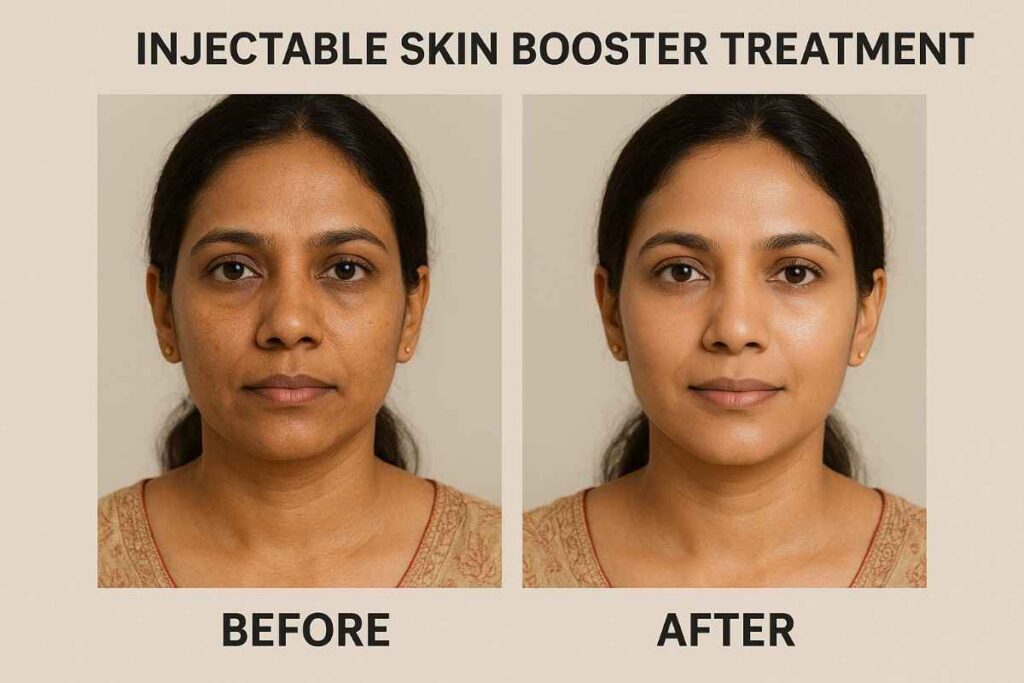
Images are for illustrative purposes only and may not represent actual patients or outcomes. Individual results vary based on anatomy, clinical assessment, and personalised treatment planning.
Skin Booster Before & After Results
Skin booster before-and-after results should demonstrate changes in skin quality rather than changes in facial shape.
In appropriately selected patients, photographs may show gradual improvement in: Skin hydration Cheek smoothness Luminosity Fine dehydration lines Early crepey texture
Results should be assessed using comparable lighting, positioning and timing wherever possible. Where documented, details such as the product used, number of sessions and timing of the after photograph can provide useful context.
Individual results vary, and before-and-after photographs should be viewed as examples of treatment outcomes rather than guarantees of a particular result.
Can Skin Boosters Be Combined With Other Treatments?
Yes, but combination treatment should be indication-led rather than routine.
If a patient has an additional concern—such as pigmentation, structural volume loss, tissue laxity, dynamic wrinkles or a separate regenerative indication—another treatment may be considered as part of a staged plan.
Depending on the clinical concern, this may include: Regenerative skin-quality treatments Selected laser or energy-based procedures Chemical peels or other surface treatments Dermal fillers or structural treatments
The purpose of combining treatments should be to address different, clearly identified concerns, not simply to add more procedures to the same appointment.
Treatment sequencing is particularly important when multiple procedures may increase inflammation. Adequate recovery intervals may therefore be recommended.
Skin Booster Safety, Side Effects & Aftercare
When appropriately selected and performed in a clinical setting, skin booster treatments are generally well tolerated. However, as with all injectable procedures, temporary side effects and less common complications are possible and should be discussed before treatment.
Common Temporary Effects
Recognised temporary effects may include: Mild swelling Small injection-site bumps or papules Redness Tenderness Minor bruising
These effects usually settle over the following days, although recovery varies according to the product, technique, treatment area and individual response.
Less Common Risks
Less common complications may include: Infection Persistent or prolonged swelling Surface irregularity Inflammatory or hypersensitivity reactions Post-inflammatory pigment changes Rare vascular compromise or occlusion with injectable HA products, depending on the product, technique and injection site Other product-specific or injection-related complications
Patients should contact the clinic promptly if they develop severe or increasing pain, progressive swelling, unusual blanching or skin discolouration, or any unexpected worsening after treatment.
Product-specific risks are reviewed during consultation.
When Treatment May Need to Be Deferred or Avoided
Suitability depends on the individual product and medical history. Treatment may need to be deferred or avoided in situations such as: Active infection or significant inflammation in or around the proposed treatment area Known hypersensitivity to relevant product components Medical conditions or medications that may materially alter procedural risk Recent procedures or skin reactions where adequate recovery has not yet occurred Pregnancy or breastfeeding, where elective treatment is not advised according to product information, clinical policy or individual medical assessment
This is not an exhaustive contraindication list. Product-specific precautions and contraindications are reviewed before treatment.
Aftercare Guidance
Typical aftercare may include: Avoiding strenuous exercise for approximately 24 hours Avoiding excessive heat, sauna or steam for the first 24–48 hours Limiting intense sun exposure during early recovery Temporarily avoiding irritating active skincare ingredients where advised Avoiding massage or pressure over treated areas unless specifically instructed
Aftercare may vary by formulation and treatment area, so patients should follow the instructions provided for their individual treatment.
Are Skin Boosters Safe for Indian Skin?
Skin boosters can be considered across a range of Indian skin tones and skin types, but treatment planning should take account of individual pigment response, sensitivity, inflammation history and the treatment area rather than relying on skin tone alone.
In patients prone to post-inflammatory pigmentation, unnecessary inflammation should be minimised through appropriate: Product and indication selection Injection technique Treatment spacing Procedure sequencing Early aftercare and sun protection
This becomes particularly relevant when skin boosters are combined or sequenced with procedures such as lasers, energy-based treatments or chemical peels, where cumulative inflammation may increase post-inflammatory pigmentation risk in susceptible patients.
A history of sensitivity, previous post-inflammatory hyperpigmentation or reactions to aesthetic procedures should therefore be discussed during consultation.
The objective is not simply to perform the injection safely, but to plan the entire treatment sequence with skin behaviour and recovery in mind.
Why Choose The Face Clinic for Skin Booster Treatment in Delhi?
Successful skin booster treatment depends on more than selecting a recognised product. Patient assessment, appropriate formulation selection, injection technique, sterile clinical protocols and realistic treatment planning all contribute to a safe and appropriate treatment approach.
At The Face Clinic, treatment is planned around the individual concern rather than the popularity of a particular injectable brand.
Doctor-Led Skin Assessment & Treatment Planning
Before recommending treatment, Dr. Reema Arora assesses factors including: The primary concern and treatment goals Skin thickness, hydration and texture Degree of laxity or structural change Treatment area and anatomical considerations Previous sensitivity, inflammation or pigment response Relevant medical and aesthetic treatment history Suitability of available formulations
The purpose of assessment is to establish whether a skin booster is appropriate and, if so, which approach best matches the concern.
Precision Injection Technique
Different skin-quality injectables may use different placement techniques, treatment depths and injection patterns.
Treatment planning therefore considers: The formulation being used Anatomy of the treatment area Appropriate injection depth Product volume and distribution Delicate treatment zones where additional caution may be required
The objective is controlled treatment without unnecessary volumisation or over-treatment.
Product Integrity & Sterile Clinical Protocols
Injectable treatment also requires careful attention to product handling and clinical hygiene.
Protocols at The Face Clinic include: Appropriate sourcing and storage of injectable products Product and batch traceability Single-use sterile injection equipment Appropriate antiseptic skin preparation Treatment-specific post-procedure instructions Clinical follow-up where required
Product-specific indications, precautions and contraindications are considered when planning treatment.
Conservative, Natural-Looking Treatment Philosophy
The objective of treatment is not to make the face look filled or noticeably altered.
Treatment is planned to achieve subtle improvement while preserving the patient’s natural facial character.
Where the visible concern is caused primarily by volume loss, significant laxity or another structural change, a skin booster should not be recommended simply because it is a popular injectable treatment.
Frequently Asked Questions About Skin Booster Treatment
How Much Does Skin Booster Treatment Cost in Delhi?
Skin booster treatment at The Face Clinic generally starts from approximately ₹15,000 per session.
The final cost depends on the formulation selected, treatment area, amount of product required and whether an individual session or treatment course is recommended. A personalised quotation is provided after clinical assessment.
Which Skin Booster Is Best for My Face?
There is no universally best skin booster.
The most appropriate option depends on the concern being treated, skin characteristics, treatment area and desired outcome. A patient whose main concern is dehydration may require a different injectable approach from someone seeking improvement in elasticity, texture or regenerative skin support.
Treatment selection should therefore be concern-led rather than brand-led.
How Many Syringes Are Needed for Skin Booster Treatment?
There is no standard number of syringes that applies to every patient or product.
The amount required depends on the formulation, treatment area, recommended protocol and individual treatment plan.
More product does not automatically mean a better result.
Is Skin Booster Treatment Worth It?
Skin booster treatment may be worthwhile when the main concern is hydration, texture, smoothness or early skin-quality change and the patient is looking for gradual improvement without intended facial volumisation.
It is less likely to meet expectations when the principal concern is significant sagging, structural volume loss or facial contour change.
The value of treatment therefore depends on whether a skin booster is the right treatment for the underlying concern.
Is a Skin Booster Good for Dull Skin?
It can be, when the underlying cause is dehydration rather than pigmentation. A skin booster for dull skin works by improving moisture retention within the skin, which can restore some luminosity, but pigment-related dullness may need a different or combined approach.
Is a Skin Booster Good for Fine Lines?
It may help with fine lines that are related to dehydration and early texture change. A skin booster for fine lines is not intended to fill deeper, structural wrinkles, which are usually better addressed with dermal filler or another approach.
Is a Skin Booster the Same as SkinVive or Profhilo?
Not exactly.
“Skin booster” is a broad term commonly used for injectable treatments intended primarily to improve skin quality. SkinVive and Profhilo are specific injectable treatments with their own formulations, indications and protocols.
They may address overlapping concerns, but they should not automatically be considered interchangeable.
Can Skin Boosters Replace Dermal Fillers or Skin-Tightening Treatments?
No. These treatments address different concerns.
Skin boosters primarily target skin quality. Dermal fillers may be used where structural volume or contour is the main concern, while skin-tightening or lifting treatments may be more appropriate when tissue laxity is dominant.
Where more than one type of change is present, treatments may be planned in stages so that each procedure has a clear indication.
How Soon Before an Event Should I Have Skin Booster Treatment?
Skin booster treatment should not ideally be planned for the first time immediately before a wedding, celebration or other important event.
Temporary swelling, small injection-site bumps or bruising can occur, while improvements generally develop progressively. If a treatment course is recommended, additional time may also be required between sessions.
For event-related treatment, consultation several weeks or more in advance allows time to select the appropriate treatment, follow the recommended protocol and allow temporary injection-site effects to settle.
Evidence & Product Information
Different injectable skin-quality treatments have different formulations, indications, protocols and supporting evidence. Product-specific information should therefore be interpreted in relation to the formulation actually being considered, rather than generalised to every treatment described as a “skin booster”.
FDA SKINVIVE by JUVÉDERM — Summary of Safety and Effectiveness Data (P110033/S099): The current FDA record retains the indication for intradermal injection to improve cheek skin smoothness in adults over 21 and, following approval on June 11, 2026, includes an expanded indication for intradermal and/or subdermal treatment to reduce neck lines and improve neck appearance in adults over 21.
Restylane Skinboosters official product information — Galderma: Official manufacturer information describes Restylane Skinboosters within Galderma’s hyaluronic acid treatment portfolio. Product availability and approved indications may vary between countries, and local approved product information should be consulted.