
Natural-Looking PDO Thread Lift for Jawline Definition in Delhi

PDO thread lift result in Delhi showing defined jawline and smoother lower face by expert aesthetic doctor
This comparison graphic explains differences between PDO, PLA and PCL threads, highlighting longevity, lift strength and suitability for various facial aging concerns.

Thread Lift Treatment in Delhi, India — Doctor-Led PDO Thread Lifting for Jawline & Jowls

Thread lift treatment in Delhi is a doctor-led, minimally invasive facial lifting option designed for individuals seeking subtle elevation, improved firmness, and collagen stimulation without surgical incisions or extended downtime. Most effective for early to moderate skin laxity, particularly along the jawline and jowls, thread lift provides immediate structural support while gradually encouraging natural tissue remodeling.

In India, thread lifting is increasingly chosen by patients in their 30s, 40s, and early 50s who prefer refined facial contour improvement rather than dramatic surgical change. When performed in a doctor-led aesthetic clinic using absorbable threads and anatomy-based vector planning, the procedure enhances the mid-face and lower face while preserving natural expression and harmony.

At The Face Clinic, South Delhi, thread lift procedures are approached as structured medical treatments rather than cosmetic shortcuts. Careful patient selection, realistic outcome planning, and adherence to evidence-based protocols form the foundation of each treatment plan. While not a substitute for surgical facelift procedures in advanced ageing, thread lift offers a refined, non-surgical solution for appropriately selected patients seeking facial rejuvenation with minimal disruption to daily life.

Thread Lift Treatment in Delhi, India – Quick Overview

Thread lift treatment in Delhi, India is a doctor-led, minimally invasive facial lifting procedure that uses absorbable threads (PDO, PCL, or PLA) to reposition mild to moderately sagging skin and stimulate collagen production. It is commonly chosen by patients seeking subtle lifting of the jawline, jowls, or mid-face without undergoing surgical facelift.

The procedure is performed under local anaesthesia in a clinical setting, typically requiring 30–45 minutes with minimal downtime (often 1–3 days). Results are subtle and temporary, with longevity influenced by tissue weight, thread type, and anatomical planning.

Thread lift cost in Delhi varies depending on the number and type of threads used, treatment area, and individual facial structure. While not suitable for severe skin laxity, thread lift offers a refined non-surgical option for appropriately selected patients following medical consultation.

Table of Contents

What Is Thread Lift Treatment and How Is It Performed in Delhi?

Thread lift treatment in Delhi is a minimally invasive, doctor-led medical aesthetic procedure designed to lift sagging facial tissues and stimulate collagen production using biocompatible, absorbable threads. These threads — typically composed of PDO (polydioxanone), PCL (polycaprolactone), or PLA (polylactic acid) — are carefully inserted beneath the skin along predetermined anatomical vectors to reposition soft tissue and provide structural support. In addition to the immediate mechanical lift, the threads gradually stimulate collagen remodelling, contributing to progressive skin tightening and improved firmness over the following months.

Unlike a surgical facelift, thread lift treatment does not involve skin excision, general anaesthesia, or extended downtime. The procedure is performed under local anaesthesia in a sterile clinical setting, with precise planning based on facial anatomy, skin thickness, and degree of laxity. It is most suitable for patients with mild to moderate sagging, particularly along the jawline, mid-face, and lower face. When performed by an experienced aesthetic doctor in a controlled medical environment in Delhi, thread lift treatment delivers refined, natural-looking lifting while preserving facial expression and harmony.

For patients considering thread lift treatment in South Delhi, careful anatomical assessment and individualised thread selection are essential to ensure both safety and balanced, long-term results.

Who Is an Ideal Candidate for Thread Lift Treatment in India?

Thread lift treatment in India is most suitable for individuals who are beginning to notice early to moderate facial laxity but are not yet candidates for surgical facelift procedures. Ideal candidates typically fall within the late 30s to early 50s, have relatively good underlying skin quality, and seek subtle lifting and contour refinement rather than dramatic transformation. It is commonly chosen for concerns such as early jowls, jawline softening, and mild mid-face descent.

Patients considering thread lift treatment in Delhi or elsewhere in India should have realistic expectations and understand that results are temporary and progressive. Outcomes vary based on factors such as skin thickness, age, thread type, tissue weight, and lifestyle. A comprehensive medical consultation is essential to determine whether thread lifting alone is appropriate or whether it should be combined with complementary non-surgical treatments — such as dermal fillers or energy-based skin-tightening technologies — for balanced and long-lasting results.

Thread lifts may not be suitable for individuals with significant skin laxity, heavier facial tissues, uncontrolled medical conditions, or unrealistic expectations, where surgical options may provide more appropriate and predictable correction. Careful anatomical assessment at a doctor-led aesthetic clinic ensures that treatment recommendations prioritise safety, facial harmony, and long-term outcomes.

Key Treatment Areas for Thread Lift – Cheeks, Jawline and Neck Contouring
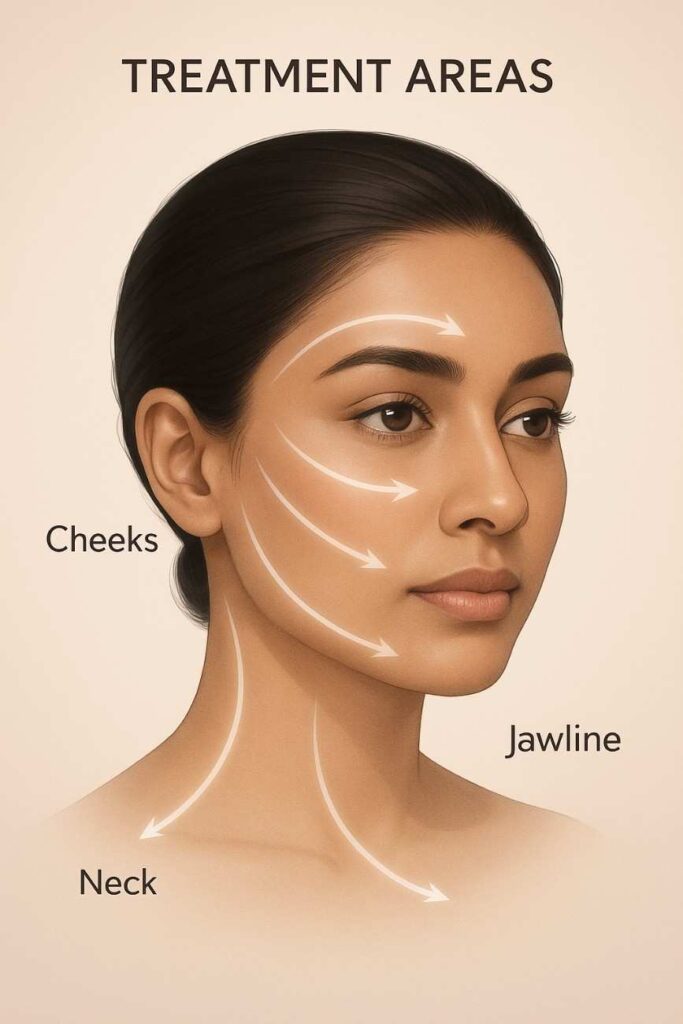
Thread lift treatment areas including cheeks, jawline and neck for facial tightening in India

This illustration displays thread lift treatment areas including cheeks, jawline and neck, showing directional lifting patterns for improved contour and skin tightening.

How Thread Lift Treatment Works: Step-by-Step Procedure in Delhi

Every thread lift performed at our doctor-led aesthetic clinic in South Delhi follows a structured medical protocol designed to prioritise safety, precision, and natural-looking lifting outcomes.
1. Personalised Consultation
Dr. Reema Arora conducts a detailed facial assessment, evaluating skin thickness, degree of laxity, tissue weight, and vector planning to determine whether thread lift treatment is appropriate and which thread type will provide optimal support.

2. Marking & Local Anaesthesia
Precise vector markings are made on the skin to guide thread placement. The treatment area is then numbed using local anaesthesia to ensure patient comfort throughout the procedure.

3. Thread Placement
PDO, cog, cone, or specialised lifting threads are inserted beneath the skin using fine cannulas. The threads are positioned strategically to reposition soft tissues and provide controlled lifting while minimising trauma to surrounding structures.

4. Adjustment & Immediate Lift Refinement
Once placed, threads are gently adjusted to achieve balanced elevation and symmetry. Excess thread ends are trimmed, and lifting effect is assessed in real time.

5. Aftercare & Recovery Guidance
Post-procedure instructions are provided, including sleeping position guidance, activity modification, and facial movement precautions to support optimal healing and longevity of results.

⏱ Procedure time: Approximately 30–45 minutes
🩺 Typical downtime: 1–3 days, with most patients resuming routine activities shortly thereafter

Thread lift treatment at our Delhi clinic is performed in a sterile clinical environment, with careful anatomical planning to preserve natural expression while enhancing facial contours.

Pre-Treatment Checklist & Doctor-Led Medical Safety Screening in Delhi

Thread lift treatment at our doctor-led aesthetic clinic in South Delhi is not performed as a same-day cosmetic walk-in procedure. Every patient undergoes structured medical screening and anatomical evaluation before treatment is recommended.

Comprehensive Assessment Includes:
  • Detailed medical history and medication review

  • Evaluation of anticoagulant use or bleeding risk

  • Assessment of previous facial procedures or prior thread placement

  • Skin examination for active acne, infection, or inflammation

  • Review of autoimmune or uncontrolled systemic conditions

  • Tissue weight analysis and ligament laxity evaluation

  • Anatomical vector mapping for safe lifting direction
Thread lift treatment may be postponed if active skin infection, inflammatory acne, or systemic instability is present.

Where medically appropriate, patients may be advised to:

  • Avoid alcohol 48 hours before treatment

  • Avoid certain supplements that may increase bruising (as advised by the treating doctor)

  • Arrive without makeup

  • Schedule major social events 5–7 days after the procedure
Pre-procedure photography, written informed consent, and realistic outcome discussion are mandatory components of consultation.

Thread lift treatment in Delhi should be approached as a medical procedure requiring anatomical planning — not as a casual aesthetic trend.

Aftercare & Recovery Timeline Following Thread Lift Treatment

Proper aftercare significantly influences both comfort and longevity of thread lift results.

Immediate Phase (Day 1–3)

  • Mild swelling, tenderness, or tightness is expected
  • Sleep on your back with head elevated
  • Avoid wide facial movements and heavy chewing
  • Avoid strenuous exercise or gym activity for approximately 7–10 days

Early Settling Phase (Week 1–2)

  • Minor bruising typically resolves within 7–10 days
  • Subtle tightness gradually softens
  • Makeup may be resumed gently as advised
  • Avoid facial massage, dental work, or aggressive skincare for 2–3 weeks

Collagen Stimulation Phase (Weeks 2–8)

  • Progressive firmness develops
  • Lift effect refines as swelling resolves
  • Collagen deposition along the thread tract contributes to structural support

Collagen maturation typically peaks around 2–3 months following thread placement, contributing to improved firmness and structural support beyond the initial mechanical lift.

Final aesthetic assessment is typically performed at 4–6 weeks once swelling has fully subsided.

Most patients in Delhi resume professional activities within 1–3 days. However, mild swelling may persist subtly for up to 2 weeks in some individuals.

While thread lift swelling duration varies, proper adherence to aftercare instructions reduces risk of dimpling, asymmetry, or thread displacement.

The lifting effect gradually softens over time, but collagen stimulation may help maintain improved firmness beyond the initial mechanical lift.

What Results Can You Expect After Thread Lift Treatment?

Thread lift treatment produces two phases of visible improvement: an immediate lifting effect and gradual skin tightening over time. Immediately after the procedure, patients often notice subtle elevation of areas such as the jawline, lower face, or mid-face, depending on the treatment plan. This initial lift occurs as the threads mechanically reposition soft tissues into a more supported position.

Over the following weeks, collagen stimulation enhances firmness and skin texture as the absorbable threads encourage natural tissue remodelling. Results typically continue to refine over 2–4 weeks and may last between 12 and 24 months, depending on age, skin thickness, tissue weight, thread type, and lifestyle factors.

Thread lift treatment in Delhi and across India is designed to deliver refined, natural-looking improvement rather than dramatic surgical transformation. Realistic expectations, careful anatomical planning, and appropriate candidate selection are essential for achieving balanced and harmonious outcomes.

Thread lift treatment is designed to provide subtle elevation and structural support. It does not replace surgical facelift procedures in cases of advanced skin laxity or significant tissue descent.

Patient satisfaction varies depending on tissue weight, skin quality, age, and expectation alignment. Subtle improvement is typical; dramatic structural transformation should not be expected from thread lift treatment alone.

Doctor’s Evidence — What Medical Literature & Professional Bodies Say About Thread Lift Treatment

Thread lift treatment is recognised in aesthetic medicine as a minimally invasive suspension technique suitable for selected patients with mild to moderate facial laxity.

Absorbable materials such as polydioxanone (PDO), polycaprolactone (PCL), and polylactic acid (PLA) have long-standing medical use as surgical suture materials and may be cleared by regulatory authorities for that purpose. Regulatory clearance applies to the suture material itself and does not constitute approval of cosmetic lifting outcomes. Thread lift results depend on technique, anatomical planning, and patient selection rather than regulatory status alone.

Professional medical guidance includes:

 Cleveland Clinic describes thread lifting as a temporary facial suspension procedure that provides modest lifting and collagen stimulation, best suited for early sagging rather than advanced ageing.

• The American Society of Plastic Surgeons (ASPS) notes that thread lifts produce less dramatic results compared to surgical facelift but may benefit patients seeking subtle improvement with shorter downtime.

• Published reviews in the Aesthetic Surgery Journal report that absorbable PDO, PLA, and PCL threads stimulate collagen deposition along the thread tract while providing mechanical support when placed using appropriate vectors and tension.

• FDA clearance applies to absorbable suture materials such as polydioxanone (PDO) used in surgical settings. The FDA does not approve aesthetic outcomes; clearance pertains to the suture material itself rather than cosmetic lifting results.

Medical consensus emphasises:
  • Careful patient selection

  • Realistic expectations

  • Performance in sterile clinical settings

  • Understanding that thread lift results are temporary
    and modest compared to surgical facelift procedures
At The Face Clinic, South Delhi, thread lift treatment is aligned with these evidence-based principles, prioritising anatomical precision and conservative enhancement over aggressive lifting.

Types of Threads Used in Thread Lift Treatment (PDO, PCL & PLA)

Thread lift treatment utilises different types of absorbable threads, each with distinct properties in terms of strength, longevity, and collagen stimulation. The choice of thread depends on facial anatomy, degree of laxity, desired lift intensity, and long-term treatment planning.
 

PDO (Polydioxanone) Threads

PDO threads are widely used for early to moderate facial sagging. They provide immediate mechanical support and stimulate collagen production as they gradually dissolve over approximately 6–9 months. PDO threads are commonly selected for jawline refinement, mild lifting, and collagen induction.
 

PLA (Polylactic Acid) Threads

PLA threads offer stronger lifting capacity and prolonged collagen stimulation compared to PDO. They typically dissolve over 12–18 months and are often chosen for patients requiring moderate structural support and longer-lasting tissue repositioning.
 

PCL (Polycaprolactone) Threads

PCL threads are designed for extended durability and sustained collagen stimulation, with effects that may last up to 18–24 months in selected patients. They are generally reserved for cases where firmer support and longer-term tightening are desired.
 
In addition to material composition, thread design also varies. Barbed or cog threads provide lifting by anchoring tissue, while mono or smooth threads are primarily used for collagen stimulation and skin quality improvement. Thread selection at a doctor-led clinic in Delhi is individualised based on anatomical assessment, safety considerations, and aesthetic goals.
 
It is important to note that thread dissolution time does not directly equal the duration of visible lift in every patient. Mechanical support gradually softens before complete absorption. Longevity depends on tissue weight, collagen response, vector planning, and thread design as much as material composition.
 
In clinical practice, thread design (cones vs barbs vs mono) influences lifting capacity as significantly as the base material itself.
 

Thread Systems Used Globally (Examples)

Internationally, different thread systems are selected based on lifting objectives and anatomical requirements rather than brand preference alone.
Examples include:
  • Cone-based systems (e.g., Silhouette Soft) — utilise bi-directional cones for deeper soft-tissue suspension.

  • Barbed or cog threads — provide mechanical anchoring for controlled lifting and repositioning.

  • Mono or smooth (regen) threads — primarily stimulate collagen production without significant tissue repositioning.
At our doctor-led aesthetic clinic in South Delhi, thread system selection is determined by tissue weight, ligament laxity, vector design, and desired lift intensity following anatomical assessment.

PDO vs PLA vs PCL Threads – Choosing the Right Non-Surgical Facelift Option

"PDO vs PLA vs PCL threads comparison chart – non-surgical facelift, collagen stimulation, skin tightening, thread lift South Delhi at The Face Clinic"

This comparison graphic explains differences between PDO, PLA and PCL threads, highlighting longevity, lift strength and suitability for various facial aging concerns.

Benefits and Risks of Thread Lift Treatment

Thread lift treatment offers carefully selected patients a minimally invasive option for facial lifting and contour refinement. As with any medical aesthetic procedure, understanding both the benefits and potential risks is essential before proceeding.

Benefits

  • Immediate, subtle lifting of sagging facial tissues

  • Progressive collagen stimulation for improved firmness and skin texture

  • Minimal downtime compared to surgical facelift procedures

  • No surgical incisions or visible scars

  • Office-based procedure performed under local anaesthesia

  • Particularly effective for early jowls, jawline softening, and mild neck laxity

  • Can complement treatments such as jawline fillers, cheek fillers, chin fillers, non-surgical neck lift, and energy-based skin tightening technologies

Potential Risks (Uncommon When Performed by Experienced Doctors)

  • Temporary swelling or bruising

  • Mild asymmetry (usually correctable)

  • Temporary dimpling or contour irregularity

  • Short-term tenderness or tightness

  • Infection (rare)

  • Thread visibility or extrusion (rare)
While thread lift treatment in Delhi and across India provides subtle lifting and skin tightening benefits, results vary depending on individual anatomy, tissue weight, and technique. Ethical practice requires recognising that not every patient is an ideal candidate. Careful medical assessment and doctor-led execution significantly reduce complication risks and help ensure balanced, natural-looking outcomes.

Who May Not Benefit From Thread Lift Treatment?

Thread lift treatment is not designed for all patterns of facial ageing.

Patients with the following concerns may not achieve meaningful improvement with threads alone:
  • Significant skin excess

  • Advanced jowls with deep structural descent

  • Very heavy or thick facial tissues

  • Severe neck laxity

  • Expectation of dramatic reshaping or surgical-level correction
In such cases, surgical facelift or combination strategies may provide more predictable outcomes.

Thread lift treatment is designed to provide subtle elevation and structural support. Patients seeking dramatic or surgical-level repositioning may achieve more predictable outcomes with facelift surgery, as thread lift alone cannot replicate surgical correction. Careful expectation alignment is essential to avoid dissatisfaction.Ethical aesthetic practice in Delhi requires recognising when thread lift treatment is unlikely to deliver satisfactory results. Consultation prioritises long-term facial harmony and medical suitability over short-term cosmetic trends.

When to Contact the Clinic After a Thread Lift

Although uncommon, patients should seek prompt medical review if they experience:
  • Increasing redness, warmth, or swelling beyond 3–4 days

  • Severe pain not controlled with prescribed guidance

  • Persistent or worsening asymmetry

  • Signs of infection such as fever or discharge

  • Feeling a thread end beneath the skin or noticing protrusion at the entry point
Early assessment ensures timely management and protects long-term outcomes.

Thread lift complications are uncommon when performed in a doctor-led clinical setting, but clear communication and early review are essential for optimal safety.

Thread Lift Treatment Cost in Delhi, India

The cost of thread lift treatment in Delhi depends on several factors, including the number and type of threads used, treatment area, facial anatomy, degree of laxity, and the expertise of the treating doctor. A personalised consultation is essential to determine the most appropriate lifting strategy and provide accurate pricing tailored to individual goals.

Thread lift cost typically varies based on:
  • Number and type of threads required

  • Areas treated (jawline, mid-face, neck, or full face)

  • Complexity of tissue repositioning

  • Degree of personalisation and anatomical planning

  • Doctor expertise and clinical setting
In India, basic thread lift procedures may begin at approximately ₹25,000 for limited treatment areas. However, in a doctor-led aesthetic clinic in Delhi, pricing commonly reflects the number of threads used and the level of structural support required.

At The Face Clinic, typical ranges include:
  • Jawline thread lift: ₹45,000 – ₹65,000

  • Full face thread lift: ₹75,000 – ₹1,00,000

  • Neck thread lift: Personalised pricing following consultation
Most patients in Delhi can expect thread lift treatment costs to fall within this range depending on treatment goals and anatomical considerations. When compared with non-surgical facelift cost or dermal filler cost for early sagging, thread lifting is often considered a cost-effective option for appropriate candidates.
 

What Influences Thread Lift Cost?

Factor
Impact on Cost
Number of threads required
Greater thread count increases structural support and material usage
Thread system selected
Cone-based systems may differ in cost compared to standard PDO threads
Treatment area
Jawline vs mid-face vs full face vs neck
Tissue complexity
Heavier or thicker tissues require more strategic vector support
Anatomical vector plan
Personalised lifting design determines final thread distribution
Final cost is determined only after detailed anatomical vector planning during consultation to ensure safe, proportionate, and balanced lifting outcomes.

Male vs Female Thread Lift: Does the Approach Differ?

Yes. Facial anatomy, tissue density, and aesthetic goals often differ between men and women, which influences thread placement strategy and vector planning.
 
For Women
 
In female patients, thread lift treatment typically focuses on:
  • Gentle cheek elevation and mid-face support

  • Soft refinement of the jawline

  • Subtle brow and lower-face lifting

  • Preservation of natural feminine contours
The goal is to restore youthful structure while maintaining softness and facial harmony, avoiding over-tightening or excessive projection.
 
For Men
 
In male patients, thread lift treatment is planned more conservatively to maintain masculine proportions. The focus often includes:
  • Sharper jawline definition

  • Controlled lifting without over-elevating the cheeks

  • Preservation of a flatter brow contour

  • Avoiding feminisation of facial features
Men generally have thicker skin and heavier soft tissue, requiring careful vector selection to achieve subtle rejuvenation that does not appear artificial or overdone.

Individualised planning at a doctor-led aesthetic clinic ensures that lifting strategy respects gender-specific anatomical differences while preserving natural facial identity.

Thread Lift vs Fillers vs Surgical Facelift: Which Is Right for You?

Thread lift treatment, dermal fillers, and surgical facelift procedures address different aspects of facial ageing and are suitable for different stages of tissue laxity and volume loss.
 

Thread Lift

Thread lift primarily targets mild to moderate skin laxity by repositioning sagging soft tissues and stimulating collagen production. It is minimally invasive, performed under local anaesthesia, and typically involves short downtime. It is most suitable for patients in earlier stages of ageing who desire subtle lifting without surgery.
 

Dermal Fillers

Fillers restore lost volume rather than repositioning tissue. They are ideal for hollow cheeks, under-eye concerns, or contour enhancement but do not correct significant skin laxity on their own. In many cases, fillers and thread lift may be combined to address both volume loss and tissue descent.
 

Surgical Facelift

Surgical facelift procedures are generally reserved for advanced ageing changes involving significant skin redundancy and deeper structural descent. They provide more dramatic correction but involve general anaesthesia, surgical incisions, and longer recovery periods.
 

Thread Lift vs HIFU / RF Skin Tightening

Energy-based treatments such as HIFU or radiofrequency microneedling improve skin quality and stimulate collagen tightening but do not reposition sagging tissues. Thread lift provides mechanical suspension in addition to collagen stimulation, making it more suitable for early tissue descent rather than isolated skin laxity alone.
 

Thread Lift vs Mini Facelift

Mini facelift procedures involve surgical repositioning of deeper facial structures through smaller incisions and generally provide longer-lasting correction compared to thread lift. However, they require anaesthesia, surgical recovery, and greater downtime. Thread lift remains an option for patients seeking subtle improvement without surgical intervention.

For many patients in Delhi and across India, combination approaches — such as thread lift with Botox, dermal fillers, or energy-based skin tightening technologies — provide balanced, natural-looking outcomes without immediate surgical intervention. The most appropriate option depends on anatomical assessment, degree of laxity, aesthetic goals, and recovery expectations.

Why Choose Dr. Reema Arora for Thread Lift Treatment in Delhi?

Thread lift treatment requires advanced anatomical knowledge, precise vector planning, and conservative aesthetic judgement. Dr. Reema Arora combines international academic training with extensive clinical experience to deliver refined, natural-looking lifting outcomes tailored to individual facial structure.

She holds an MSc in Facial Aesthetics (UK) and previously served as Medical Head – Allergan India, a global leader in aesthetic medicine. This background reflects advanced expertise in facial anatomy, injectable therapies, and evidence-based lifting protocols.

With over 20 years of experience in facial aesthetics, Dr. Reema approaches thread lift treatment as a structured medical procedure rather than a cosmetic trend. Each plan is individualised based on tissue quality, skin thickness, and long-term harmony — ensuring results remain subtle and proportionate.

All thread lift procedures are performed in a sterile medical setting with structured pre- and post-procedure protocols designed to optimise safety, precision, and longevity of results.

Anatomy-based vector planning and conservative lift intensity are prioritised to preserve natural facial expression and avoid overcorrection, ensuring balanced, proportionate, and aesthetically harmonious outcomes.

At her doctor-led aesthetic clinic in Hauz Khas, South Delhi, thread lift procedures are conducted in a controlled clinical environment prioritising safety, precision, and realistic expectations. Patients travel from across Delhi, NCR, and internationally seeking balanced rejuvenation without an overdone appearance.

Thread Lift Treatment FAQs – Safety, Results, Cost & Recovery in Delhi

These FAQs reflect common questions discussed during doctor-led thread lift consultations at our South Delhi clinic.
 

Q1. Is thread lift treatment safe?

When performed by an experienced aesthetic doctor using regulated, biocompatible threads in a sterile clinical setting, thread lift treatment is considered safe for appropriately selected patients. Temporary swelling, bruising, mild asymmetry, or tenderness may occur. Less common complications — such as infection or thread visibility — are uncommon and are discussed during consultation along with management protocols.
 

Q2. Does thread lift really work?

Thread lift provides immediate mechanical lifting along with progressive tightening through collagen stimulation. It is most effective for early to moderate facial laxity. Results are subtle and vary depending on tissue weight, anatomy, and expectation alignment. Thread lift does not replace surgical facelift in cases of advanced ageing.
 

Q3. How long does a thread lift last?

Results typically last between 12 and 24 months, depending on thread type, tissue weight, skin quality, and lifestyle factors. Thread dissolution time does not directly equal visible lift duration, as mechanical support gradually softens over time. Collagen stimulation may help maintain improved firmness beyond the initial lifting phase.
 

Q4. Is thread lift painful?

The procedure is performed under local anaesthesia. Most patients report mild to moderate discomfort during placement and temporary tightness or soreness for a few days afterward. Pain is generally manageable and subsides as tissues settle.
 

Q5. What is the recovery time after a thread lift?

Most patients resume routine daily activities within 1–3 days. Mild swelling or bruising may occur and typically improves within 7–10 days. Strenuous exercise is usually avoided for approximately 7–10 days. Final aesthetic assessment is typically performed at 4–6 weeks once swelling has resolved.
 

Q6. Who is not a suitable candidate for thread lift?

Thread lift may not be appropriate for individuals with significant skin excess, very heavy facial tissues, uncontrolled medical conditions, or expectations of dramatic surgical-level correction. A structured medical consultation determines suitability and alternative options where appropriate.

Book Your Thread Lift Consultation in Delhi, India

If you are considering thread lift treatment in Delhi, a structured medical consultation is the first step in determining whether this procedure is appropriate for your facial anatomy and degree of skin laxity.

During consultation, Dr. Reema Arora assesses:
  • Facial structure and tissue descent

  • Skin thickness and collagen quality

  • Suitability for thread lift vs alternative treatments

  • Realistic outcome expectations and longevity

This ensures that thread lift treatment is recommended only when clinically appropriate and aligned with long-term facial harmony.

📍 The Face Clinic
C-36, LGF, Chaudhary Dilip Singh Marg
Hauz Khas, South Delhi – 110016

Consultations are conducted at our doctor-led aesthetic clinic in South Delhi and are by prior appointment only. A personalised assessment prioritises safety, precision, and natural-looking results over temporary trends.

Book Your Thread Lift Consultation in Delhi, India

Thread lift treatment is one component of a broader, structured non-surgical face lift strategy. Depending on anatomical assessment and treatment goals, patients may explore the following doctor-led procedures:
Each treatment is recommended only after personalised medical consultation to ensure suitability, safety, and long-term facial balance.

Evidence-Based Reading on Thread Lift Procedures

For independent, medically reviewed information on thread lifting and minimally invasive facial rejuvenation:
These resources provide balanced medical perspectives on indications, techniques, collagen stimulation, and limitations of thread lifting and related procedures.