Ozempic Face: Facial Changes After GLP-1 Weight Loss
Significant weight loss can change more than body shape. Some people who lose substantial weight while using Ozempic, Mounjaro or other weight-management treatments notice hollow cheeks, deeper under-eye shadows, loose facial skin or reduced facial definition.
These changes are commonly described as Ozempic face or Mounjaro face. They are not formal medical diagnoses, and similar facial changes can occur following substantial weight loss through other methods.
For some people, the main concern is facial volume loss. For others, it is skin laxity, more noticeable jowls or changes in skin quality. These concerns do not necessarily require the same treatment.
The important question is not simply how to treat Ozempic face, but what has actually changed in your face after weight loss.
At The Face Clinic in Hauz Khas, South Delhi, Dr Reema Arora provides doctor-led facial assessment to identify the dominant concern, explain suitable treatment options and determine whether aesthetic intervention is appropriate.
The objective is individualised facial restoration, where needed, rather than a standardised makeover or an attempt to reverse every visible effect of weight loss.
What Is Ozempic Face?
Ozempic face is an informal term describing facial hollowing, reduced fullness and more noticeable skin laxity that may accompany significant weight reduction. The same changes are sometimes described as Mounjaro face.
Ozempic contains semaglutide, a GLP-1 receptor agonist. Substantial weight loss associated with semaglutide or other weight-management medications may reduce facial fat as well as body fat.
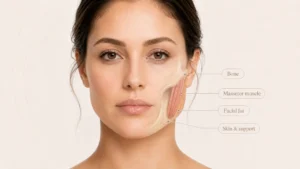
Facial fat contributes to fullness and soft-tissue support in areas such as the cheeks and temples. When that volume decreases, previously less-visible hollows, folds and skin laxity may become more apparent.
However, there is no single appearance that defines Ozempic face.
Its presentation varies according to baseline facial anatomy, age, skin elasticity, the amount of weight lost and other individual factors.
These changes are commonly associated with substantial weight reduction itself rather than being established as a unique facial disorder caused by Ozempic. Research into possible additional medication-related tissue effects is continuing.
Why Does Your Face Change After Significant Weight Loss?
The appearance of the face depends on the relationship between facial fat, skin, underlying structures and soft-tissue support.
Significant weight loss can alter that relationship in several ways.
Loss of Facial Fat and Volume
The face contains superficial and deep fat compartments that contribute to its contours.
When facial fat decreases, the cheeks may appear flatter, the temples more hollow and the transition between the lower eyelids and mid-face more pronounced.
The changes are not necessarily uniform. One person may develop noticeable cheek hollowing while another retains relatively good mid-face fullness.
This provides objective evidence of facial-volume changes in the studied group, but the small retrospective study cannot predict how much volume an individual patient will lose.
Skin Elasticity and Tissue Descent
Skin does not always adapt fully to a reduction in underlying volume.
Age-related changes, baseline skin elasticity, existing tissue laxity and the extent of weight loss influence how the face responds.
As a result, jowls, lower-face laxity and neck skin may become more noticeable.
However, reduced underlying support, tissue descent and genuine excess skin are not identical concerns. Distinguishing them is important when considering treatment.
The Amount and Pace of Weight Loss
Substantial weight reduction may produce more visible facial changes, particularly in people with relatively little baseline facial fullness.
Rapid weight loss can make these changes appear more sudden.
Age, individual anatomy, skin quality and further anticipated weight loss also influence the final appearance.
Research into GLP-1-associated facial changes increasingly considers the interaction between fat compartments, skin and other tissues. Nevertheless, the exact contribution of each mechanism varies, and there is no universally validated method of predicting how a particular person’s face will change.
What Can Ozempic Face Look Like?
People describe facial changes following significant weight loss in different ways. Recognising the dominant concern helps clarify which, if any, treatment may be appropriate.
Facial Volume Loss and Hollow Cheeks After Weight Loss
Hollow cheeks are among the more recognisable changes.
Some people describe this as sunken cheeks or a gaunt face after weight loss.
Reduced mid-face fullness may make the cheekbones appear more prominent while the areas beneath them look flatter or less supported.
Some people also notice hollow temples, altered facial proportions or more visible folds.
However, a thinner-looking face does not automatically require filler. The location and extent of volume loss should be considered in relation to the person’s natural facial structure and preferences.
Under-Eye Hollows and Shadows After Weight Loss
After weight loss, reduced mid-face fullness may make the tear troughs and under-eye shadows more noticeable.
This can create a tired appearance even when the person feels well rested.
Not every under-eye shadow is caused by volume loss. Pigmentation, natural anatomy, puffiness, oedema and skin-quality changes may contribute.
These distinctions matter because an under-eye concern should be assessed before deciding whether injectable correction is suitable.
Sagging Face, Loose Skin and Jowls After Weight Loss
A sagging face after weight loss may show as more visible jowls, softer lower-face contours or a less-defined jawline.
This may result from reduced underlying volume, more visible tissue descent, skin laxity or a combination.
Patients may also describe this as loose facial skin or reduced facial definition.
The appropriate approach depends on the underlying cause rather than appearance alone.
More Visible Folds and Changes in Skin Quality
Loss of facial fullness may make existing lines and folds appear deeper.
Fine lines, crepey skin or changes in texture may also become more noticeable.
These concerns should be distinguished from structural volume loss because treatments intended to improve the skin surface cannot necessarily replace deeper facial support.
For some people, the overall impression is simply that their face looks older after weight loss, even when they are pleased with their weight-management progress.
Images are for illustrative purposes only and may not represent actual patients or outcomes. Individual results vary based on anatomy, clinical assessment, and personalised treatment planning.
What Has Actually Changed in Your Face After Weight Loss?
Two people may lose a similar amount of weight yet notice very different facial changes.
One may develop hollow cheeks while retaining relatively good skin elasticity. Another may have less obvious volume loss but more prominent jowls, under-eye changes or skin laxity.
At The Face Clinic, assessment begins by identifying the dominant anatomical concern. Treatment planning then considers the patient’s medical circumstances, stage of weight loss and personal goals.
Understanding the Anatomical Changes
Assessment area | What needs to be understood |
|---|
Facial volume | Where fullness has decreased, which areas are affected and whether selective restoration would improve facial balance |
Skin laxity and tissue descent | Whether the concern is reduced support, loose skin, tissue descent or a combination |
Under-eyes and skin quality | Whether hollowing, pigmentation, oedema, texture or other factors contribute to the appearance |
These distinctions matter because adding volume cannot reliably correct significant excess skin, while improving skin quality cannot necessarily resolve structural hollowing.
Understanding Treatment Suitability and Timing
An anatomical assessment is only part of the decision.
Dr Reema also considers relevant medical history, previous aesthetic treatments, ongoing or anticipated weight changes and the patient’s expectations.
A person may want to soften a hollow-looking cheek without returning to their previous degree of facial fullness. Another may be concerned predominantly about loose skin rather than volume.
These preferences influence whether treatment should focus on selective volume restoration, skin quality, suitable lifting or tightening procedures, or another approach.
Not every concern requires aesthetic intervention. Continued observation, delayed reassessment or surgical referral may sometimes be more appropriate.
This assessment framework is a simplified patient-education guide, not a validated diagnostic algorithm or predetermined treatment protocol.
Can Ozempic Face Be Prevented or Minimised?
Facial changes associated with significant weight loss cannot always be prevented.
There is currently no established skincare routine, injectable procedure or supplement that guarantees preservation of facial fat or prevents all post-weight-loss laxity.
Maintaining overall health during weight management remains important. Depending on the individual’s medical circumstances, this may include adequate nutrition and protein intake, appropriate resistance exercise, hydration, sun protection and a consistent skincare routine.
However, these measures should not be presented as proven ways to prevent all facial changes.
Patients using prescription weight-management medication should discuss their rate of weight loss and any concerns about their treatment with their prescribing clinician. Medication should not be discontinued or altered solely for cosmetic reasons without medical guidance.
For individuals concerned about their appearance while losing weight, early facial assessment may help document changes and establish realistic expectations.
Emerging research has proposed anatomy-based risk assessment and anticipatory treatment planning. However, the
2026 anatomy-driven prevention model remains a conceptual, hypothesis-generating framework. It does not establish that preventive aesthetic procedures are necessary or effective for everyone.
Does Ozempic Face Go Away Naturally?
There is no single predictable course.
Some facial changes may appear different after weight stabilises. However, established facial volume loss and significant skin laxity may persist.
The extent of improvement depends on baseline anatomy, skin elasticity, age, the amount of weight lost and subsequent weight changes.
Regaining weight may restore some facial fullness, but intentional weight regain should not be pursued as an aesthetic treatment strategy.
For people who are satisfied with their appearance, no aesthetic intervention is necessary.
Where persistent changes are a concern, clinical assessment can help determine whether treatment is appropriate and what improvement may be realistic.
When Is the Right Time to Consider Ozempic Face Treatment?
There is no universal treatment timeline.
Some selected non-surgical procedures may be considered while weight loss is continuing. In other circumstances, waiting until weight and facial contours have become more stable may provide a clearer basis for treatment planning.
The decision depends on the expected amount of further weight loss, the dominant facial concern, overall medical suitability, the procedure being considered and the patient’s expectations.
Ongoing weight reduction may continue to alter facial contours after an initial treatment. Consequently, a conservative or staged approach may be preferable for selected patients.
Where significant excess skin or advanced tissue descent is present, the timing of surgical assessment should be considered separately.
The appropriate treatment stage should be determined by the patient’s anatomy and weight-loss journey—not simply by how long they have been taking Ozempic or Mounjaro.
Which Treatments May Be Considered for Ozempic Face?
There is no single standard approach to facial rejuvenation after weight loss.
Depending on the dominant concern, treatment may focus on selected volume restoration, gradual collagen stimulation, skin quality, suitable lifting or tightening procedures, or a combination.
The following guide summarises the different treatment objectives. It does not represent a standard protocol.
Dominant concern | Possible treatment direction | Important limitation |
|---|
Selected cheek or temple volume loss | HA dermal fillers | Cannot reliably correct significant skin excess |
Suitable diffuse volume or contour concerns | PLLA collagen biostimulation | Gradual effects; does not directly replace lost facial fat |
Genuine under-eye volume deficit | Carefully selected filler treatment | Not appropriate for every shadow, pigmentation concern or puffy under-eye |
Mild-to-moderate laxity or tissue descent | Selected tightening or lifting treatment | Cannot replace surgery where changes are advanced |
Skin texture, hydration or fine lines | Appropriate skin-quality treatment | Does not restore deeper structural support |
Treatment selection and sequencing depend on individual clinical assessment. No particular procedure or combination is necessary for every patient.
Dermal Fillers for Facial Volume Restoration
Where facial volume loss after weight loss is the principal concern, carefully selected hyaluronic acid (HA) dermal fillers may be considered.
Treatment may involve the cheeks, temples or other suitable areas, depending on individual anatomy.
The objective is not simply to make the face fuller. A carefully planned approach considers where volume has been lost, whether restoring it is appropriate and how much correction is required.
Adding volume indiscriminately can alter natural facial proportions without adequately addressing the original concern.
Collagen Biostimulators for Gradual Facial Support
In selected patients, collagen-stimulating injectables may be considered as part of facial restoration after major weight loss.
Poly-L-lactic acid (PLLA) treatments such as Sculptra stimulate a gradual collagen response that may contribute to progressive improvement in suitable volume and contour concerns.
Unlike HA fillers, which provide more immediate volume correction, PLLA-based treatment develops its effects over time and may require multiple sessions.
The choice between a collagen biostimulator, HA filler or another treatment depends on the area involved, degree of volume loss, tissue characteristics, medical history and expected further weight change.
PLLA does not directly replace lost facial fat. It also cannot reliably correct significant excess skin or advanced tissue descent.
Treatment for Under-Eye Hollows and Shadows
Under-eye changes require particularly careful assessment.
A hollow-looking tear trough may reflect local volume loss, changes in mid-face support or natural anatomical characteristics.
Pigmentation, puffiness, oedema and skin-quality changes may produce similar concerns but require different approaches.
In selected patients, HA fillers may be considered for a genuine volume deficit. In others, treatment of the surrounding mid-face, a suitable skin-quality procedure or no injectable correction may be more appropriate.
Direct tear-trough filler is not a universal solution for dark circles following weight loss.
Thread Lift and HIFU for Selected Skin-Laxity Concerns
When loose skin or tissue descent is more prominent than volume loss, selected lifting or tightening procedures may be considered.
Thread lift treatment in Delhi may be suitable for certain patients with mild-to-moderate tissue descent. Its effects, limitations and duration depend on individual anatomy and treatment factors.
HIFU skin tightening uses focused ultrasound energy to produce controlled tissue effects and may be considered for selected patients with suitable laxity.
However, the two procedures work differently and are not interchangeable.
Energy-based treatment should be planned carefully in a volume-depleted face, taking tissue thickness, treatment depth, anatomical area and potential unwanted tissue effects into account.
Neither procedure reliably replaces surgery when excess skin or tissue descent is significant.
Skin Boosters and RF Microneedling for Skin Quality
Changes in hydration, fine lines, texture and skin quality should be distinguished from structural volume loss.
Where appropriate,
skin booster treatment may help improve selected aspects of hydration and skin quality without intentionally adding structural facial volume.
Treatment selection should take account of tissue thickness, the degree of existing volume loss and individual suitability.
These procedures are not substitutes for restoring deeper volume or correcting significant tissue descent.
What Can Ozempic Face Treatment Realistically Improve?
Selected non-surgical treatments may improve facial hollowing, restore volume where appropriate, soften certain shadows or folds, and address suitable skin-laxity or skin-quality concerns.
However, treatment effectiveness depends on the underlying anatomical problem.
Restoring volume cannot reliably correct significant excess skin. Skin-quality treatments cannot replace lost facial fat, and non-surgical lifting procedures have limitations where tissue descent is advanced.
In selected cases, surgical assessment may be more appropriate.
Fat grafting and facial lifting have different objectives: the former may address suitable volume deficits, while the latter may address tissue descent or excess skin. Neither is automatically indicated following weight loss.
For patients with several concerns, a staged treatment plan may allow the dominant issue to be addressed first, followed by reassessment of the remaining changes.
This can be particularly relevant while further weight loss is expected.
The aim of facial rejuvenation after weight loss should be realistic improvement while respecting the patient’s natural proportions and preferences—not attempting to recreate an exact pre-weight-loss appearance.
Are Ozempic Face Treatments Safe?
The safety and suitability of aesthetic treatment depend on the procedure selected, individual anatomy, medical history, current health, product or device used, treatment technique and practitioner experience.
Taking Ozempic or another weight-management medication does not automatically make someone suitable for every aesthetic procedure.
Risks Associated With Injectable Treatments
Dermal fillers may cause temporary swelling, redness, tenderness or bruising. Other possible complications include infection, persistent swelling and nodules.
Rare but serious vascular complications can occur if filler enters or obstructs a blood vessel. These may result in tissue injury or visual impairment.
Under-eye fillers require particularly careful patient selection because of the anatomical complexity of the region and the possibility of persistent oedema or other complications.
Collagen biostimulators have different characteristics, risks and complication-management considerations from HA fillers.
Risks Associated With Thread Lifts and Energy-Based Treatments
Thread lifting may involve discomfort, bruising, asymmetry, skin irregularities, infection or other procedure-specific complications.
Energy-based procedures may cause temporary redness, swelling or tenderness. Depending on the treatment and parameters, additional risks may include burns, pigmentation changes or unwanted tissue effects.
The suitability of these procedures requires careful assessment, particularly where underlying facial volume has already decreased.
Why Medical Assessment Matters
Before treatment, the proposed procedure, expected benefit, realistic limitations, relevant risks and recovery requirements should be explained.
Assessment should also take account of the patient’s weight-management history, previous aesthetic treatments and overall health.
If there are concerns about nutritional status, significant unexplained weight change or medical suitability, further evaluation may be necessary before an elective aesthetic procedure.
Patients should not alter or discontinue prescribed weight-management medication for cosmetic reasons without consulting their prescribing clinician.
Clinical Experience: Why Post-Weight-Loss Facial Treatment Must Be Individualised
In our clinical experience at The Face Clinic, patients concerned about facial changes following substantial weight loss do not all present with the same problem.
Some seek assessment for hollow cheeks or more pronounced under-eye shadows. Others are more concerned about loose skin, altered facial definition or a combination of changes.
These differences matter because the most noticeable feature is not always the only anatomical concern contributing to the appearance.
For example, a person concerned about a tired-looking under-eye may also have changes in mid-face support. Another may describe sagging cheeks when reduced volume and existing tissue laxity are both contributing factors.
Such presentations illustrate why assessing the face as a whole can be more useful than selecting a procedure solely from the patient’s initial description.
Dr Reema Arora’s approach begins by identifying the dominant changes and understanding the patient’s expectations before determining whether treatment is appropriate.
The decision may involve selective volume restoration, a suitable skin-quality procedure, a conservative staged approach, referral for surgical assessment or no aesthetic intervention.
The purpose is not to restore every area of lost fullness. It is to determine whether addressing a particular concern would improve facial balance in a way that is appropriate for the individual.
Understanding Ozempic Face Before-and-After Results
Before-and-after photographs are most meaningful when they document a genuine clinical case under comparable conditions.
They should identify the treatments actually performed and, where relevant, the stage of weight loss and timing of the photographs.
Results from one person cannot predict another person’s response.
An improvement in cheek fullness following a selected volume-restoration procedure, for example, does not establish that the same treatment will correct significant loose skin in a different patient.
Individual treatment plans, recovery and outcomes vary.
Ozempic Face Treatment Cost in Delhi
There is no single fixed price for Ozempic Face treatment because the term describes a range of facial concerns rather than one procedure.
The overall cost depends on the areas involved, the dominant anatomical concern, the treatment selected, the amount of injectable product required where relevant, and whether treatment is planned across multiple sessions.
Current treatment-specific pricing is available on the relevant clinic service pages, including the dermal filler, under-eye filler and Sculptra treatment resources linked above.
A personalised estimate is provided after clinical assessment, once suitable treatment options, expected sessions and priorities have been discussed.
The objective is to recommend treatment according to the identified concern rather than assemble a predetermined makeover package.
Why Choose Dr Reema Arora for Post-Weight-Loss Facial Assessment?
Facial changes following significant weight loss may involve several interacting anatomical concerns.
Distinguishing volume loss, tissue descent, skin laxity and under-eye changes requires an assessment that considers the face as a whole rather than treating individual areas in isolation.
Dr Reema Arora is the Founder and Medical Director of The Face Clinic in Hauz Khas, South Delhi.
She holds an MBBS and MSc in Facial Aesthetics (UK), has over 20 years of experience in facial aesthetics and previously served as Medical Head – Facial Aesthetics at Allergan India.
Her clinical approach emphasises individual anatomy, appropriate treatment selection and natural facial balance.
For patients concerned about post-weight-loss facial changes, assessment focuses on understanding what has changed, whether treatment is necessary, which options may be suitable and when intervention or reassessment is appropriate.
The objective is a personalised treatment plan rather than a standardised Ozempic Face protocol.
Frequently Asked Questions About Ozempic Face
Is Mounjaro Face the Same as Ozempic Face?
Ozempic face and Mounjaro face are informal terms describing similar facial changes that may become noticeable with substantial weight loss.
Ozempic contains semaglutide, which acts through the GLP-1 receptor. Mounjaro contains tirzepatide, which acts through both GIP and GLP-1 receptors.
Despite these pharmacological differences, significant weight reduction with either medication may be accompanied by facial volume loss or more noticeable laxity.
Assessment should focus on the individual’s anatomical changes rather than the medication name.
Can You Develop Ozempic Face Without Taking Ozempic?
Yes. Similar facial changes may occur following substantial weight loss through dietary changes, other medications, bariatric surgery or other methods.
The term Ozempic face has become popular, but facial hollowing and skin laxity after weight reduction are not unique to one medicine.
Can Hollow Cheeks After Weight Loss Be Restored?
Selected cases of cheek hollowing may be suitable for volume restoration.
The appropriate treatment depends on the location and extent of volume loss, facial proportions, tissue characteristics and expected further weight change.
Treatment is not automatically necessary, and restoring volume in every hollow area is not always appropriate.
Why Does My Face Look Older After Weight Loss?
Reduced facial fat can make hollows, folds and shadows more visible, while the skin may not fully adapt to the lower underlying volume. Together, these changes can make the face look older after weight loss.
Whether treatment is appropriate depends on which change is dominant, such as volume loss, skin laxity or skin quality, and on your own preferences.
How Can I Tighten Loose Facial Skin After Weight Loss?
The first step is to determine whether the concern is genuine skin laxity, reduced underlying support, tissue descent or a combination.
Selected non-surgical lifting or tightening procedures may be considered for appropriate patients.
Significant excess skin or advanced tissue descent may require surgical assessment for a more suitable result.
How Long Do Ozempic Face Treatment Results Last?
There is no universal duration.
Longevity depends on the treatment selected, product or device used, treatment area, individual response, ageing and subsequent weight changes.
Treatment-specific expectations and any maintenance requirements should be discussed before proceeding.
Can Men Develop Ozempic Face?
Yes. Facial hollowing, volume loss and skin laxity following substantial weight reduction can affect both men and women.
Assessment should reflect the individual’s anatomy, natural facial proportions and preferences.
The objective is not to apply a standard facial shape or volume target to every patient.
Is Facial Restoration Necessary After Major Weight Loss?
No.
Many people are satisfied with their appearance following significant weight loss and require no aesthetic treatment.
For those who are concerned, individual assessment can help establish whether treatment is appropriate, which options may be suitable and what improvement can realistically be expected.
Medical Review & Selected References
Medical reviewer: Dr Reema Arora, MBBS, MSc Facial Aesthetics (UK) Founder & Medical Director: The Face Clinic, Hauz Khas, South Delhi
Medical Review Date: 26 October 2026
The clinical content is informed by the following publications and safety resources.
These references provide scientific and educational context. They do not establish a universal Ozempic Face treatment protocol or guarantee results from an individual procedure.
Considering Treatment for Facial Changes After Weight Loss?
Hollow cheeks, under-eye changes and loose facial skin following significant weight loss do not all require the same approach.
An individual facial assessment can help establish whether the concern is primarily related to volume loss, skin laxity, tissue descent, under-eye changes or a combination.
During your consultation, Dr Reema Arora reviews your weight-loss history, current concerns, facial volume distribution, tissue laxity and skin quality. Previous aesthetic treatments, further anticipated weight changes and your individual preferences are also considered.
The assessment helps determine whether treatment is appropriate now, whether a staged approach or later reassessment would be preferable, and which options may reasonably address your concerns.
At The Face Clinic in Hauz Khas, South Delhi, the focus is on doctor-led assessment, realistic expectations and individualised treatment planning.
If you have noticed facial changes following Ozempic, Mounjaro or other forms of substantial weight loss, you can arrange a consultation to discuss suitable options, limitations and expected costs.
All treatments are subject to individual suitability and variation. Outcomes depend on clinical assessment, the procedure selected and the patient’s individual response.
All treatments are subject to individual variation. Outcomes are determined following clinical evaluation by a qualified doctor.