- Home
- Services
- Skin Tightening
Have Any Question?
Don’t think much, have a query? Call us now!
Connect with us
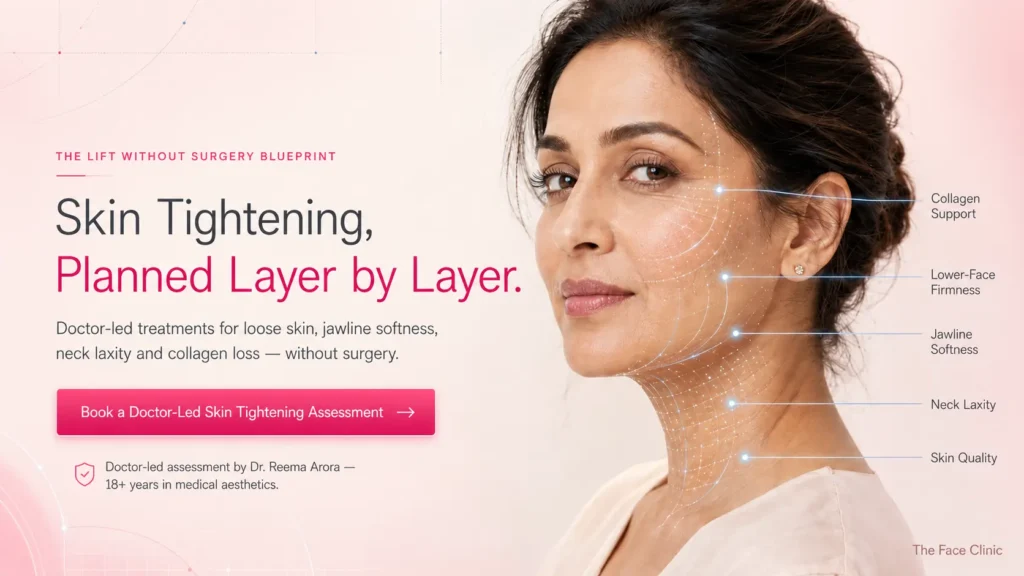
Images are for illustrative purposes only and may not represent actual patients or outcomes. Individual results vary based on anatomy, clinical assessment, and personalised treatment planning.
Skin Tightening Treatment in Delhi for Loose or Sagging Facial Skin
Facial skin can gradually lose firmness and elasticity with age, cumulative sun exposure, weight changes and declining collagen and elastin support. Skin tightening treatment in Delhi may help improve selected degrees of loose or sagging facial skin without surgery, but the right treatment depends on what is actually causing the visible change.
At The Face Clinic in Hauz Khas, South Delhi, Dr. Reema Arora follows an assessment-led approach to facial skin tightening. Rather than choosing a treatment or technology first, the face is evaluated for skin laxity, tissue descent, volume loss and overall skin quality. This helps determine whether non-invasive skin tightening, a minimally invasive procedure, restoration of structural support—or a different approach altogether—is likely to provide the most appropriate and natural-looking result.
Treatments that stimulate collagen remodelling can improve facial skin firmness and selected degrees of laxity, but skin tightening is not the answer to every ageing change. A softer jawline or sagging appearance may result from loose skin, deeper tissue descent, loss of facial volume, or a combination of these changes. Identifying the dominant cause is therefore an important first step before deciding on treatment.
On this page: Why skin becomes loose · Skin laxity vs tissue descent vs volume loss · Treatment options · Compare treatments · Treatment areas · Cost · Candidacy · Results & downtime · Safety · Dr. Reema Arora · FAQs
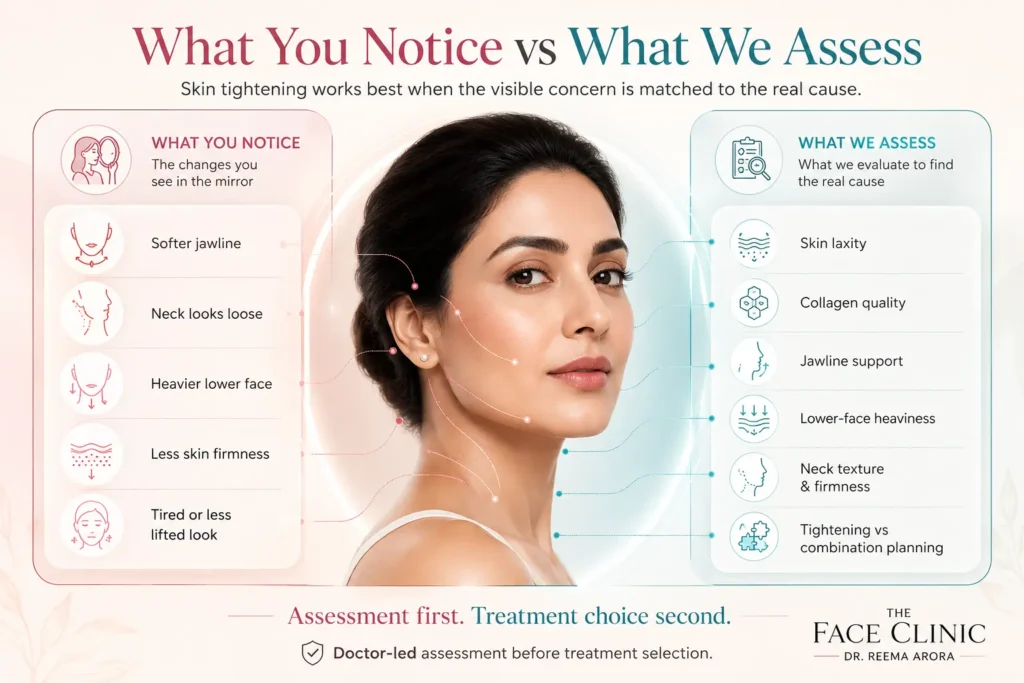
Images are for illustrative purposes only and may not represent actual patients or outcomes. Individual results vary based on anatomy, clinical assessment, and personalised treatment planning.
Why Does Facial Skin Become Loose or Sagging?
Facial skin gradually changes with age as its structural support, elasticity and ability to recover from stretching decline. Several factors can contribute to loss of skin firmness, facial laxity and a looser appearance:
Collagen and elastin decline: Collagen provides structural support, while elastin helps the skin retain resilience. Their gradual reduction can make the skin feel thinner, less firm and less able to maintain its previous contours.
Cumulative sun exposure: Repeated ultraviolet exposure can accelerate visible skin ageing and contribute to reduced firmness, fine lines and changes in skin quality.
Changes in skin quality and hydration: Age-related changes in the skin’s structure and ability to retain moisture can make it appear thinner, drier and less resilient.
Smoking: Smoking can accelerate visible skin ageing and contribute to reduced skin quality over time.
Weight fluctuations or significant weight loss: Stretching followed by loss of underlying volume can leave the skin with reduced recoil. On the face, this may become noticeable around the cheeks, jawline, lower face and neck, particularly when skin elasticity has already declined. Patients who have undergone medical weight loss treatment in Delhi may also require a separate assessment of skin laxity and facial volume after substantial weight change.
Genetics and individual ageing patterns: Skin thickness, collagen quality, facial anatomy and the way different facial layers age vary considerably between individuals. Two people of the same age may therefore have very different degrees and patterns of facial laxity.
These changes can make the face appear less firm, soften the jawline and create the impression of sagging. However, visible sagging does not always mean that loose skin is the main problem. Understanding which of these factors applies to you is the first step before deciding how to tighten loose facial skin safely and appropriately.
Is It Skin Laxity, Tissue Descent or Volume Loss?
Before selecting a face tightening treatment, it is important to establish which facial layer is contributing most to the visible change.
Skin Laxity
The skin itself has lost firmness and elasticity. Selected non-invasive energy-based skin tightening treatments may be appropriate for some patients with mild to moderate laxity when the deeper facial tissues remain reasonably well supported.
Tissue Descent
The deeper facial tissues have shifted downward, often contributing to jowls, a less defined jawline or heaviness in the lower face. Skin tightening alone may not provide sufficient correction when tissue descent is the dominant issue.
Volume Loss
Loss of support in areas such as the cheeks, temples or mid-face can make the overlying skin appear looser. In these cases, simply tightening the skin may not address the underlying structural change.
Many patients have more than one ageing change present. Treatment selection should therefore be based on facial anatomy and the dominant anatomical problem rather than choosing a procedure purely by name — since the right facial laxity treatment for one patient may not suit another with a different anatomical pattern.
The next step is to understand which treatments can improve true skin laxity—and when lifting, restoration of structural support or surgical assessment may be more appropriate.
Which Skin Tightening Treatment May Be Right for You?
There is no single skin tightening treatment that is right for every type of facial laxity. The most appropriate option depends on the degree of skin looseness, facial anatomy, skin quality, tissue position and whether volume loss is also contributing to the appearance of sagging. Because face skin tightening needs vary so widely between patients, there is no single treatment that suits every case.
Non-invasive facial skin tightening treatments and minimally invasive procedures work in different ways and at different tissue depths. Some primarily support collagen remodelling, while others may be more appropriate when the concern includes skin texture changes, tissue descent or loss of structural support.
Treatment selection should therefore follow clinical assessment rather than choosing a technology simply because it is popular or widely advertised.
HIFU / Ultrasound Skin Tightening
High-Intensity Focused Ultrasound (HIFU) is a non-invasive treatment that delivers focused ultrasound energy to selected tissue depths, creating controlled thermal stimulation that supports gradual collagen remodelling.
For appropriately selected patients, HIFU treatment in Delhi may help improve mild to moderate facial laxity and firmness, particularly around areas such as the lower face, jawline and neck. Changes develop progressively as collagen remodeling occurs rather than producing the immediate mechanical repositioning associated with procedures such as thread lifting.
HIFU is therefore best considered as one option within a broader facial assessment—not as a universal treatment for every form of sagging.
Radiofrequency (RF) Skin Tightening
Radio frequency skin tightening, more formally known as Radiofrequency (RF) Skin Tightening, uses controlled RF energy to generate heat within targeted tissue layers, creating thermal stimulation that supports collagen remodelling over time.
In selected patients, RF skin tightening may help improve facial firmness, skin quality and mild laxity without surgery.
Treatment parameters and expected outcomes depend on the RF system being used, the area treated and the degree of laxity present. Non-invasive RF may be particularly useful when the principal concern is early loss of firmness rather than significant tissue descent or excess skin.
RF Microneedling / MNRF for Mild Laxity and Skin Texture
RF microneedling, also known as MNRF, differs from non-invasive RF because fine microneedles deliver radiofrequency energy at controlled depths within the skin. It is therefore a minimally invasive treatment rather than a non-invasive procedure.
MNRF treatment in Delhi may be considered when mild skin laxity occurs alongside concerns such as uneven texture, enlarged pores, acne scarring or reduced dermal quality. Its primary role is controlled dermal remodelling rather than mechanical tissue lifting or repositioning.
When facial sagging is mainly caused by deeper tissue descent rather than skin quality or mild laxity, another treatment approach may be more appropriate.
Laser Skin Tightening
Selected laser skin tightening treatments use controlled laser energy to support collagen remodelling and may help improve firmness and overall skin quality in appropriately selected patients.
Their role depends on the specific laser system, treatment depth, skin type and clinical concern. Laser-based treatment may be useful when reduced firmness occurs alongside changes in skin texture or quality, but it should not be expected to provide the same degree of tissue repositioning as a lifting procedure.
When Can Threads Help With Facial Sagging?
When the main concern is not simply loose skin but downward movement of facial tissues, skin tightening alone may not provide sufficient correction.
A thread lift treatment in Delhi is a minimally invasive procedure in which absorbable threads are positioned beneath the skin to provide mechanical support and selected tissue repositioning. It may be useful in appropriately selected patients with early or selected moderate degrees of tissue descent affecting areas such as the cheeks, jawline or jowls.
Threads can also stimulate a subsequent collagen response, but their primary role differs from energy-based skin tightening. They provide tissue support and repositioning, whereas treatments such as HIFU or RF primarily rely on controlled collagen remodelling.
Where ageing changes involve several facial layers rather than isolated skin laxity, a broader assessment of non-surgical facial lifting options may be more appropriate than relying on a single tightening modality.
Can Biostimulation Improve Skin Firmness?
Biostimulatory treatments are designed to encourage the skin’s own collagen response over time and may help improve skin quality, firmness and dermal support in selected patients.
They may form part of a skin firming treatment plan when ageing changes include progressive collagen loss and reduced skin resilience, particularly when the goal is gradual improvement in overall skin quality rather than immediate lifting.
However, biostimulation should not be considered equivalent to mechanical tissue lifting or surgical correction. If facial sagging is primarily caused by significant tissue descent or excess skin, collagen stimulation alone is unlikely to address the full problem.
When Is Filler More Appropriate Than Skin Tightening?
Sometimes skin appears loose because the underlying facial support has reduced rather than because the skin itself is significantly lax.
Loss of volume in areas such as the cheeks, temples or mid-face can reduce structural support and make the overlying tissues appear softer or more descended. In such cases, repeatedly tightening the skin may not address the dominant cause of the change.
Carefully planned dermal filler treatment in Delhi may be considered when restoring selected areas of structural support is more appropriate than additional skin tightening. The objective is not to “fill” every area of laxity, but to identify whether volume loss is genuinely contributing to the altered facial contour.
Some patients require one modality, while others may benefit from a carefully selected combination in which each treatment addresses a clearly identified component of the ageing pattern.
The aim is not to combine the greatest number of procedures. It is to use the minimum appropriate treatment needed to address the correct anatomical problem while preserving a natural-looking result.

Images are for illustrative purposes only and may not represent actual patients or outcomes. Individual results vary based on anatomy, clinical assessment, and personalised treatment planning.
Skin Tightening Treatments Compared
Different procedures may all appear under the broad label of “skin tightening”, but their roles are not interchangeable.
| Treatment | Type | Primary Role | More Relevant When |
|---|---|---|---|
| HIFU | Non-invasive | Deeper ultrasound-based collagen remodelling | Selected mild to moderate facial laxity |
| RF Skin Tightening | Non-invasive | Thermal collagen remodelling | Early loss of firmness or mild laxity |
| MNRF / RF Microneedling | Minimally invasive | Dermal remodelling | Mild laxity with texture, pores or acne scars |
| Laser Skin Tightening | Depends on laser/protocol | Skin-quality and collagen remodelling | Firmness loss with selected texture concerns |
| Thread Lift | Minimally invasive | Tissue support and repositioning | Tissue descent, early jowling or contour softening |
| Biostimulation | Treatment-dependent | Progressive collagen support | Reduced skin resilience and firmness |
| Dermal Filler | Injectable | Structural volume support | Volume loss contributing to apparent sagging |
| Surgery | Surgical | Tissue repositioning and excess-skin correction | Advanced laxity, substantial descent or excess skin |
The most appropriate treatment is therefore determined by what has changed anatomically, not by which technology is described as the strongest or newest.
Which Areas Can Facial Skin Tightening Address?
Facial skin tightening may be considered in several areas where loss of firmness or mild laxity is contributing to the visible concern.
Common treatment areas include:
Cheeks and lower face: where early loss of firmness may soften facial contours.
Jawline: where mild skin laxity can reduce definition.
Early jowls: when skin laxity contributes to the concern, although deeper tissue descent must also be assessed.
Under-chin and submental region: in selected patients where laxity contributes to reduced definition.
Neck: where skin quality and laxity are appropriate for the selected technology.
The area a patient notices is not always the layer that needs treatment. A softer jawline, for example, may result from skin laxity, tissue descent, volume change, submental fullness or several factors together.
For this reason, treatment should be planned according to anatomy rather than simply treating the area that appears most visibly changed.
Skin Tightening Treatment Cost in Delhi
The skin tightening treatment cost in Delhi varies according to the treatment modality, treatment area, degree and pattern of facial laxity, and the number of sessions required.
Because HIFU, RF, MNRF and laser treatments use different technologies, treatment depths and protocols, their costs should not be compared on price alone.
At The Face Clinic, treatment is selected after identifying the dominant anatomical concern. This helps ensure that the recommended treatment—and its cost—is based on what actually needs correction rather than on a technology chosen in advance.
| Treatment | Indicative Cost |
|---|---|
| RF Skin Tightening | ₹15,000–₹20,000 per session* |
| HIFU Skin Tightening | ₹22,000 onwards* |
| MNRF / RF Microneedling | ₹12,000–₹25,000 per session* |
| Laser Skin Tightening | ₹15,000–₹60,000 per session* |
*Prices are indicative and may vary according to the treatment area, technology or protocol used, degree of laxity and individual treatment plan. Final pricing is confirmed after clinical assessment.
Where tissue descent rather than skin laxity is the dominant concern, thread lifting may sometimes be considered instead of—or alongside—energy-based tightening. Thread-lift pricing depends on the area treated, degree of repositioning required and individual thread plan; detailed pricing is available on our Thread Lift Treatment in Delhi page.
What Affects the Cost of Skin Tightening Treatment?
Several factors can influence the final skin tightening cost in Delhi:
Treatment modality: HIFU, non-invasive RF, MNRF and laser treatments use different technologies, treatment protocols and session structures.
Treatment area: Cost may vary depending on whether treatment is planned for the cheeks, lower face, jawline, neck or a combination of treatment areas.
Degree and pattern of laxity: Mild laxity may require a different approach from more pronounced laxity or deeper tissue descent. Greater sagging does not automatically mean that more non-surgical treatment is appropriate.
Number of sessions: Some treatments may be performed as a single session in selected patients, while others are commonly planned as a course.
Combination treatment, when clinically appropriate: If a separate issue such as tissue descent or volume loss also requires treatment, overall cost may change. Combination treatment should only be recommended when each procedure has a clearly identified role.
At The Face Clinic, Dr. Reema Arora assesses facial anatomy, skin quality, degree of laxity and the underlying cause of visible sagging before recommending treatment. Patients receive a personalised plan and a clear cost estimate before treatment begins.
The goal is not to select the least or most expensive technology, but to identify the most appropriate treatment for the anatomical problem being treated.
Who Is a Good Candidate for Facial Skin Tightening?
Facial skin tightening may be appropriate for selected patients who have mild to moderate skin laxity, early loss of firmness, softening of the jawline or lower face, or selected facial and neck laxity following weight change.
Suitability depends on more than age alone. Factors such as facial anatomy, skin quality, degree of laxity, tissue position, volume changes and realistic treatment goals are more important when deciding whether a non-invasive or minimally invasive treatment is appropriate.
Good candidates typically understand that non-surgical treatments can improve selected degrees of laxity and firmness, but they do not reproduce the degree of tissue removal or repositioning achievable with surgery.
When Is Non-Surgical Skin Tightening Not Enough?
Non-surgical skin tightening has important limitations.
Patients with significant excess skin, advanced facial laxity, marked jowling or substantial tissue descent may obtain only limited improvement from energy-based or minimally invasive treatments.
In these situations, repeatedly adding non-surgical procedures may not address the underlying anatomical problem. A surgical assessment may sometimes be more appropriate when the degree of correction required exceeds what non-surgical treatment can realistically achieve.
The objective is not to avoid surgery at all costs, but to recommend the treatment approach that best matches the patient’s anatomy, concerns and expectations.
What Results, Sessions and Downtime Can You Expect?
The treatments discussed on this page work in different ways, so results, session requirements and recovery are not identical.
Non-invasive energy-based treatments such as HIFU and RF generally rely on gradual collagen remodelling, so improvements in firmness and contour tend to develop progressively rather than immediately. MNRF and laser-based treatments may also improve skin quality and firmness over time but can involve different treatment schedules and recovery profiles.
Procedures that provide mechanical tissue support, such as thread lifting, have a different result pattern and should not be compared directly with collagen-remodelling treatments.
The number of sessions required depends on the modality, treatment area, degree of laxity and individual response. Some procedures may be performed as a single treatment in selected patients, while others are planned as a course.
Downtime also varies. Some non-invasive treatments may require little interruption to normal routine, whereas minimally invasive procedures and selected laser treatments can involve temporary redness, swelling, tenderness or other treatment-specific effects.
Expected recovery should therefore be discussed according to the procedure being considered rather than treated as one universal “skin tightening” timeline.
Risks, Side Effects and Safety
Skin tightening treatments can be performed safely in appropriately selected patients, but the risks and side effects differ according to the technology and procedure used.
Non-invasive treatments may cause temporary effects such as redness, tenderness, warmth or swelling, depending on the modality and treatment area. Minimally invasive treatments such as MNRF or thread lifting have different risk profiles and may involve additional recovery considerations.
RF microneedling has a distinct risk profile, making correct device use, treatment depth, energy selection and medical supervision particularly important.
Safety depends not only on the technology itself but also on correct patient selection, knowledge of facial anatomy, appropriate treatment parameters and realistic treatment planning.
Patients should be informed about treatment-specific risks, expected recovery, contraindications and limitations before proceeding.
What About Indian and Darker Skin Types?
Indian patients represent a wide range of skin tones and pigment responses. Treatment planning should therefore consider skin type, pigmentation tendency, recent tanning or inflammation, previous procedures and the specific energy device being used.
Published clinical evidence on RF and RF microneedling in skin of colour indicates a generally low risk of scarring or pigment changes across darker Fitzpatrick skin types, though it also notes that transient pigmentary changes can occur in some patients and that overall study quality in this area is still developing.
Laser-based treatments require particularly careful selection of the device, wavelength and treatment parameters in more pigment-rich skin.
Skin colour alone does not determine suitability, but technology choice and settings should be individualised rather than standardised across all skin types.
Why Choose Dr. Reema Arora for Facial Skin Tightening?
Dr. Reema Arora, Founder & Medical Director of The Face Clinic, is an aesthetic physician with an MBBS and MSc in Facial Aesthetics (UK), with over 20 years of experience in non-surgical facial aesthetics and facial rejuvenation.
Her clinical approach focuses on understanding the anatomical cause of the patient’s concern before selecting a treatment.
Rather than recommending a particular device or procedure first, Dr. Reema assesses skin quality, tissue position, volume support, facial proportions and the degree of laxity to determine what is contributing most to the visible change.
This approach helps distinguish patients who may benefit from non-invasive tightening from those who may require tissue support, volume restoration, a carefully selected combination—or, in some cases, surgical assessment.
Dr. Reema’s experience also includes her previous role as Medical Head – Facial Aesthetics at Allergan India, alongside extensive experience as a national and international trainer in aesthetic medicine.
Her treatment philosophy prioritises appropriate treatment selection, facial balance and natural-looking outcomes rather than treating every sign of ageing with the same technology.
The goal is not to perform the greatest number of procedures, but to recommend the minimum appropriate treatment needed to address the correct anatomical problem.
Frequently Asked Questions
How do I know which skin tightening treatment is right for my face?
The appropriate treatment depends on the dominant facial change, including the degree of skin laxity, tissue position, volume support and overall skin quality. HIFU, RF, MNRF, laser treatments, threads and structural volume restoration have different roles, so treatment should be selected after facial assessment rather than by technology name alone.
What is the best sagging skin treatment for the face?
There is no single best sagging skin treatment for every face, because sagging can result from skin laxity, tissue descent, volume loss, or a combination of these. The most effective approach is chosen after assessing which of these is dominant — ranging from non-invasive skin tightening for mild laxity, to thread lifting for tissue descent, to structural volume restoration when volume loss is the primary cause.
Is HIFU or RF better for facial skin tightening?
Neither treatment is universally better. HIFU uses focused ultrasound energy, while RF uses radiofrequency energy, and they differ in how energy is delivered and in their treatment protocols. The more appropriate option depends on the degree and pattern of laxity, treatment area, skin quality and individual clinical goals.
When is a skin firming treatment recommended for early signs of ageing?
A skin firming treatment such as RF or HIFU may be considered when the earliest signs of ageing — mild loss of firmness or slight softening around the jawline — are just becoming noticeable, before deeper tissue descent develops. At this stage, a face firming treatment focused on collagen support can often give a more natural-looking result than waiting until laxity becomes more pronounced. The right timing still depends on individual skin quality and assessment.
Can skin tightening improve jowls?
It may help when jowling is partly caused by mild skin laxity, but jowls often also involve tissue descent, volume changes and individual facial anatomy. When deeper tissue descent is the dominant issue, skin tightening alone may provide limited improvement and another lifting or structural approach may be more appropriate.
Can skin tightening help loose facial skin after weight loss?
Selected treatments may help improve mild to moderate facial laxity after weight loss, particularly when the skin retains sufficient elasticity. However, substantial weight loss can sometimes leave significant excess skin or deeper volume changes. In these cases, non-surgical tightening may provide limited correction and surgical assessment may be more appropriate.
How many skin tightening sessions might I need?
The number of sessions varies according to the treatment used, degree of laxity, treatment area and individual response. Some modalities may be performed as a single treatment in selected patients, while others are commonly planned as a course. A treatment-specific recommendation can be made after assessment.
How long do skin tightening results last?
There is no single duration that applies to every skin tightening treatment. Longevity varies according to the modality used, degree of laxity, individual ageing process, skin quality and other patient-specific factors. HIFU, RF, MNRF, laser and thread treatments should therefore not be expected to have identical result timelines or maintenance schedules.
Is face tightening treatment permanent?
No face tightening treatment — surgical or non-surgical — stops the natural ageing process permanently. Non-surgical options such as HIFU, RF and MNRF rely on collagen remodelling, so results typically last months to a couple of years depending on the modality, treatment area and individual ageing rate, after which maintenance sessions may be considered. Surgical tightening addresses excess skin more directly, but it also does not halt future ageing changes.
Is skin tightening painful, and what downtime should I expect?
Comfort and recovery depend on the procedure. Non-invasive RF may produce warmth during treatment, while HIFU can cause brief deeper sensations in some areas. MNRF, thread lifting and selected laser treatments have different comfort, anaesthesia and recovery profiles. Temporary redness, swelling, tenderness or sensitivity may occur depending on the treatment performed.
Are non-surgical skin tightening treatments safe?
These treatments can be performed safely in appropriately selected patients, but each modality has its own risks, contraindications and treatment considerations. Safety depends on correct diagnosis, appropriate patient selection, suitable treatment parameters and knowledge of facial anatomy. Treatment-specific risks should be discussed before the procedure.
Unsure Which Skin Tightening Treatment Is Right for You?
If your face appears looser, less defined or more sagging than before, the first step is not necessarily choosing HIFU, RF or another procedure.
A consultation can help determine whether the main concern is true skin laxity or whether deeper tissue movement, loss of structural support or several ageing changes are contributing—and whether skin tightening is actually the appropriate treatment.
At The Face Clinic, C-36 LGF, Hauz Khas, South Delhi, Dr. Reema Arora creates treatment plans based on facial anatomy, skin quality and realistic treatment goals, with an emphasis on natural-looking results and the minimum appropriate intervention.
PERSONALISED AESTHETIC CARE
Book a Consultation with Dr. Reema Arora
Get a personalised treatment plan based on your concerns, facial structure and aesthetic goals — with a focus on natural-looking results.
✓ Doctor-led consultation
✓ Personalised treatment planning
✓ Natural-looking results