
Exosome Treatment
- Home
- Services
- Exosome Treatment
Don’t think much, have a query? Call us now!
Hear from Our Happy Patients – Their Stories, Their Words!
EXCELLENT Based on 313 reviews
 Posted on Google
 anjana kaushalI had a wonderful experience at The Face Clinic. Dr. Reema is incredibly kind, polite, and professional. She listens to all your concerns very patiently and carefully, making you feel comfortable and well cared for throughout the consultation. The quality of services provided by the clinic is top-notch. The entire team ensures that patients are comfortable Overall, if I ever need any dermatology services in the future, I will definitely visit this clinic again. It has become my go-to place, and I highly recommend it to anyone looking for expert and compassionate skincare treatment.Posted on Google
 Ritu BhardwajA very experienced doctor.
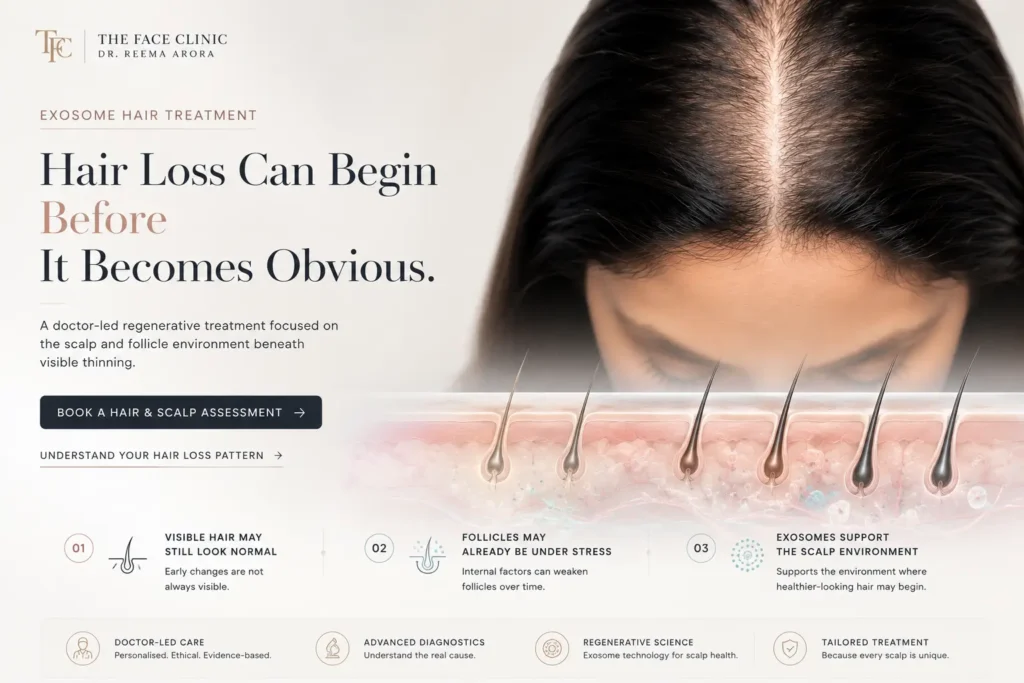
Exosome therapy is an emerging regenerative approach being explored in selected hair-restoration settings for concerns such as early hair thinning and androgenetic alopecia.
Exosomes are microscopic extracellular vesicles involved in cell-to-cell communication. They carry proteins, lipids, messenger RNA, microRNAs and other signalling molecules that are being studied for their potential influence on hair-follicle biology, inflammatory signalling and the scalp microenvironment.
Early clinical studies of exosomes for hair loss have reported encouraging findings in some patients, including changes in hair density or hair-shaft thickness. However, the evidence remains developing. Exosome preparations, concentrations, manufacturing methods and delivery protocols differ considerably between studies, and hair regrowth cannot be guaranteed.
At The Face Clinic in Hauz Khas, South Delhi, patients considering exosome treatment in Delhi first undergo a doctor-led assessment to understand the pattern and possible causes of hair loss. Treatment planning considers medical history, scalp findings, previous treatments, available evidence, product and protocol considerations, potential risks and realistic expectations.
Exosome therapy should therefore be considered within a broader hair-loss management strategy rather than as a substitute for diagnosing the underlying cause of hair thinning.
Treatment focus | Emerging regenerative approach for selected patients with hair thinning |
Evidence status | Encouraging early clinical evidence; larger standardised studies are still needed |
Common research focus | Androgenetic alopecia, male and female pattern hair loss |
Best assessed for | Thinning areas where potentially responsive hair follicles remain |
Treatment plan | Individualised after clinical and scalp assessment; there is no universal course |
Results | Response and timeframe vary; hair regrowth cannot be guaranteed |
Current single-session cost at The Face Clinic | ₹25,000–₹50,000 |
Advanced/combination protocols | ₹30,000–₹60,000 depending on what is included |
Before treatment | Establish the likely cause of hair loss and discuss alternatives, evidence and risks |
Clinic | The Face Clinic, Hauz Khas, South Delhi |
Exosome-based treatment for hair loss remains an emerging area of regenerative medicine. Early clinical studies have reported promising changes in selected hair-growth measures, but exosome source, formulation, concentration, delivery technique and treatment protocols vary substantially.
Larger, controlled studies with standardised treatment methods and longer follow-up remain necessary. Exosome therapy should therefore not be presented as a proven cure or guaranteed exosome hair growth treatment.
Regulatory status can also differ according to the specific product, composition, intended use and jurisdiction and should be considered on a product-specific basis.
Exosomes are nanoscale extracellular vesicles naturally released by cells. They participate in biological communication by transporting molecular cargo—including proteins, lipids and genetic material—from one cell to another.
In hair-restoration research, exosomes are being investigated for their potential influence on pathways involved in:
Exosome therapy for hair loss does not involve transplantation of living stem cells. Instead, the therapeutic concept centres on the biological signals carried by extracellular vesicles.
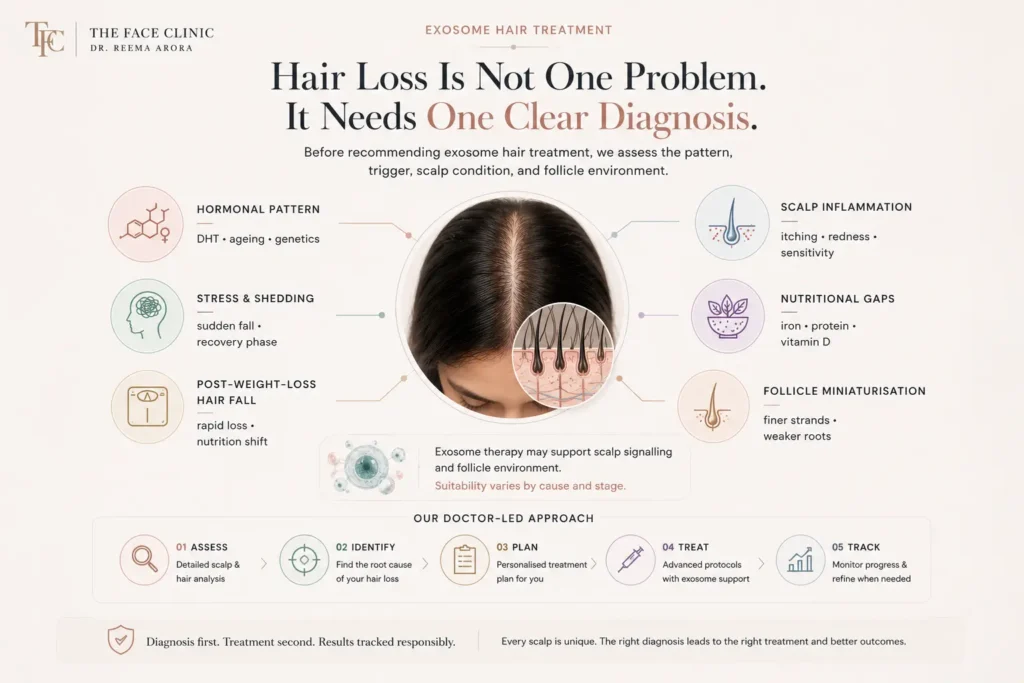
Patients considering exosome treatment for hair loss in Delhi should first undergo assessment because visible thinning can result from several very different conditions. A treatment that may be relevant to one type of hair loss may be inappropriate or insufficient for another.

Hair follicles continuously cycle through growth, transition and resting phases.
In androgenetic alopecia, progressive miniaturisation of susceptible follicles and changes in the hair-growth cycle contribute to reduced density and increasingly fine hairs.
Laboratory and early clinical research suggests that exosomal signalling may interact with several biological pathways relevant to follicular function. Research has examined pathways including Wnt/β-catenin, Sonic Hedgehog and TGF-β/SMAD signalling, among others.
These mechanisms provide a biological rationale for investigating exosome hair restoration, but biological plausibility is not the same as established clinical efficacy.
For patients, this distinction matters:
Exosome hair therapy is scientifically interesting and clinically promising, but the optimal formulation, dose, treatment interval, delivery method and long-term durability have not yet been standardised across products and protocols.
Exosome therapy and stem-cell therapy are distinct approaches.
Exosomes are extracellular vesicles containing molecular cargo involved in cell-to-cell signalling.
Stem-cell therapies involve viable cells capable of proliferation and, depending on the cell type, differentiation.
Because exosome preparations do not involve transplantation of viable stem cells, they have different biological and regulatory considerations.
This distinction should not, however, be interpreted to mean that every exosome product is automatically safer, more effective or more predictable.
Important variables include:
Exosome-based hair treatment may be discussed for selected patients after the cause and pattern of hair loss have been assessed.
Situations in which regenerative approaches may be considered include:
However, not all hair shedding is androgenetic alopecia.
Hair loss may also occur with:
These may require investigation or primary treatment before an elective regenerative procedure is considered.
A regenerative procedure should not substitute for diagnosing the underlying cause of hair loss.
Patients who would like to understand the broader treatment landscape can also read about non-surgical hair restoration treatments in Delhi.
Male pattern hair loss, or male androgenetic alopecia, commonly presents with progressive recession at the frontal hairline, thinning around the temples or reduced density at the crown.
Exosome therapy is being investigated as an adjunctive regenerative approach for androgenetic alopecia. Suitability depends on factors such as:
Established medical treatments and other hair-restoration options should also be considered when appropriate.
Exosome therapy should not be positioned as a replacement for all established hair-loss treatments.
Female pattern hair loss often presents with progressive reduction in density or widening of the central part rather than the frontal recession commonly associated with male pattern hair loss.
Diffuse hair thinning in women may also be related to:
Assessment is therefore particularly important before considering an exosome hair treatment.
Where female pattern hair loss or another potentially suitable condition is identified, regenerative treatment may be discussed within a broader management plan.
You may wish to seek a hair-loss assessment if:
These signs do not establish that exosome therapy is appropriate. The underlying diagnosis and the presence of potentially responsive follicles still need to be assessed.
Exosome-based preparations are also being investigated in aesthetic and regenerative skin applications.
Detailed facial and skin indications are intentionally not covered extensively on this hair-loss page in order to maintain clear search intent and avoid overlap with dedicated exosome skin resources.
Patients interested specifically in skin applications can read about exosome anti-ageing and skin rejuvenation.
For a broader educational discussion of facial applications, read exosome therapy for face and skin.
Early human studies have reported changes in hair-related measures such as density, hair counts or shaft thickness in some participants.
Areas currently being investigated include:
These are potential treatment effects being investigated rather than guaranteed clinical benefits.
A 2026 systematic review of exosome-driven treatment for androgenetic alopecia reported encouraging early clinical findings but identified significant limitations, including small study sizes, retrospective designs, absence of controls in some studies and inconsistent outcome measures.
A separate systematic review of clinical evidence on exosomes and hair regeneration across alopecia types similarly concluded that clinical evidence is promising but remains limited and heterogeneous.
Findings from one exosome preparation should not automatically be assumed to apply to another. Biological source, isolation techniques, concentration, manufacturing methods and delivery protocols can vary considerably.
Exosome treatment may be considered in selected patients after clinical evaluation rather than offered simply because hair shedding or thinning is present.
Assessment should consider:
The consultation should answer a more important question than simply whether exosome treatment can be performed:
Is exosome treatment a reasonable option for this particular pattern of hair loss, or should another treatment take priority?
Where appropriate, standardised scalp photography may be used to establish a baseline and support more objective follow-up.
Treatment may need to be deferred or reconsidered in circumstances such as:
These should not be interpreted as a universal contraindication list for every exosome formulation.
Suitability needs to be considered according to the individual patient, specific product and intended treatment protocol.
Interest in exosome-based hair restoration has grown because extracellular vesicles can carry biologically active signalling molecules, and laboratory research has identified several pathways relevant to hair-follicle biology.
Early clinical studies have reported improvements in one or more hair parameters in some participants, including measurements of density or shaft thickness.
The emerging human evidence is therefore clinically interesting, particularly for androgenetic alopecia.
However, it is not yet equivalent to a large, standardised body of long-term clinical evidence.
Important limitations include:
The 2026 systematic review of exosome-driven treatments for androgenetic alopecia identified encouraging preliminary findings but concluded that broader clinical adoption remains limited by gaps in manufacturing standardisation, regulatory frameworks and robust long-term efficacy data.
Current evidence supports discussing exosome therapy as an emerging or adjunctive regenerative option, rather than as a proven cure for hair loss.
A clinically responsible consultation should explain both sides of the evidence.
What is encouraging:
Early clinical research and biological studies indicate potential.
What remains uncertain:
Which formulation, concentration, delivery method, treatment schedule and patient profile provides the most reliable long-term benefit.
Exosome-based approaches are being investigated internationally across regenerative medicine and hair-restoration research.
However, there is no single globally standardised treatment called “exosome therapy.”
Products and protocols vary, and findings from a particular formulation or research protocol should not automatically be extrapolated to every product marketed under the term “exosomes.”
This distinction is especially important when assessing online claims about treatment efficacy, safety, number of sessions or regulatory approval.

Published clinical hair-loss studies have generally reported limited short-term adverse effects, but the human clinical evidence base remains comparatively small.
Long-term safety information is limited, and findings from individual studies cannot necessarily be generalised across the wide variety of commercially available exosome preparations.
Procedure-related effects may also depend on the method of administration.
Patients should receive information before treatment about:
Medical supervision improves patient assessment and risk management. It should not be described as guaranteeing safety.
“Exosome” does not describe one standardised pharmaceutical product.
Important considerations may include:
Patients may reasonably ask:
What exosome preparation is being proposed? What is its biological source and manufacturer? How is it stored and administered? What is its intended clinical use, and what evidence is available for that specific formulation?
Evidence for one preparation should not automatically be treated as evidence for every product described as an exosome treatment.
Regulatory status depends on the specific product, composition, intended use and jurisdiction.
Patients should not assume that every product marketed as an exosome treatment has the same regulatory status or level of supporting clinical evidence.
For international regulatory context, the US FDA information on exosome products states that there are currently no FDA-approved exosome products in the United States and has cautioned patients about unapproved exosome products marketed with therapeutic claims.
This is specifically a US regulatory position and should not be interpreted as automatically determining the status of a particular product in India.
Patients considering exosome treatment in India should therefore ask about the exact product proposed and its regulatory position under the requirements applicable to that product and intended use.
Exosome treatment at The Face Clinic begins with assessment rather than a predetermined treatment package.
Consultation may review:
Clinical assessment may be supported, where appropriate, by digital or AI-assisted scalp imaging.
These technologies are assessment tools. Clinical interpretation and treatment decisions remain doctor-led.
If the clinical history suggests that investigation or management outside the scope of an aesthetic hair procedure is required, appropriate medical evaluation should take priority.
If a regenerative procedure is considered reasonable, consultation should include discussion of:
Depending on the diagnosis, other regenerative options may include PRF treatment in Delhi.
Patients may also be assessed for GFC hair treatment in Delhi.
The exact method depends on the formulation and treatment protocol selected.
Approaches used in regenerative practice may include direct scalp administration or microneedling-assisted delivery protocols.
Where microneedling is used primarily to facilitate delivery of a formulation, it should be distinguished from a separate combination therapy.
The proposed method, treatment area and what is included in the quoted price should be explained clearly before treatment.
Aftercare varies according to:
Patients should receive procedure-specific instructions rather than relying on generic online aftercare advice.
Where appropriate, follow-up photographs or scalp imaging may help compare findings with baseline documentation.
Exosome hair treatment results can vary substantially between patients.
Some clinical studies have reported changes in measures such as:
over follow-up periods of several months.
This does not establish a universal timeframe in which every patient should expect visible improvement.
Response may be influenced by:
For this reason, fixed promises such as “visible hair regrowth within 3–6 months” should be avoided.
Where improvement occurs, it may develop gradually.
The timing, magnitude and durability of response cannot be reliably predicted for an individual patient before treatment.
Similarly, there is no single universally established treatment course or maintenance schedule applicable to every exosome formulation.

There is no regenerative procedure that is automatically appropriate for every patient experiencing hair thinning.
Regenerative procedures should also be considered alongside—not automatically instead of—established medical management for diagnosed hair-loss conditions where such treatment is appropriate.
PRP is prepared from the patient’s own blood and uses platelet-derived factors.
PRF is another autologous platelet/fibrin-based approach.
Exosome preparations instead contain extracellular vesicles derived from an external biological source or manufacturing process.
PRP has a longer clinical history in androgenetic alopecia, while exosome-based hair treatment remains less standardised in terms of formulation and protocol.
The choice should depend on:
One should not be presented as universally superior to the other.
Read more about PRF treatment in Delhi.
PDRN and exosome therapy are distinct regenerative approaches.
PDRN consists of purified DNA-derived fragments used in regenerative medicine and aesthetic practice.
Exosome preparations contain extracellular vesicles carrying signalling molecules.
They are therefore not interchangeable treatments, and comparative superiority cannot be assumed simply because both are described as regenerative.
Read more about PDRN treatment in Delhi.
GFC, or Growth Factor Concentrate, is prepared from the patient’s blood and concentrates platelet-derived factors using a different processing method.
Exosome treatment does not use the patient’s own platelets and has a different biological and regulatory profile.
The most appropriate option depends on:
Read more about GFC hair treatment in Delhi.
At The Face Clinic, the current exosome hair treatment cost in Delhi is:
Single Session: ₹25,000–₹50,000
Advanced/Combination Protocol: ₹30,000–₹60,000
The final exosome treatment cost may vary according to:
If microneedling is principally being used as the method of delivering the treatment, this should be distinguished from a true combination protocol involving a separate regenerative procedure.
The exact treatment plan and price are provided after consultation.
Prices may change over time and should be confirmed at the time of booking.
Before treatment, patients should:
Patients should not discontinue prescribed medication solely for an elective aesthetic procedure unless advised by the relevant treating clinician.
Aftercare depends on the product, administration protocol and whether another treatment has been performed at the same session.
Patients may be advised to:
Procedure-specific instructions from the treating doctor should take precedence over generic aftercare recommendations found online.
Hair thinning is not one diagnosis.
Choosing a regenerative procedure before understanding why hair loss is occurring can delay more appropriate management.
At The Face Clinic, exosome hair treatment is considered within a doctor-led assessment rather than as a one-size-fits-all treatment package.
Dr Reema Arora is Founder and Medical Director of The Face Clinic and has over 20 years of experience in facial aesthetics and injectable medicine. Her professional background includes serving as Medical Head – Facial Aesthetics at Allergan India and extensive experience in medical education and injectable-aesthetics training.
Read more about Dr Reema Arora.
The clinical approach to exosome treatment emphasises:
Hair loss should be assessed before regenerative procedures are selected.
Pattern hair loss, telogen effluvium, nutritional deficiency, endocrine factors, inflammatory scalp conditions and other causes of shedding may require very different management.
Exosome therapy should therefore not be viewed as a universal first-line treatment or as a substitute for diagnosis.
The useful clinical question is not simply:
“Can exosomes be used?”
It is:
“What is causing the hair loss, and where—if anywhere—does a regenerative procedure fit within the overall treatment plan?”
Exosome therapy for hair loss uses preparations containing extracellular vesicles that carry biological signalling molecules.
These signals are being investigated for their potential influence on hair-follicle biology, hair cycling and the scalp microenvironment.
Clinical evidence is developing, and formulations and protocols are not yet universally standardised.
Early clinical studies have reported improvements in measures such as hair density or shaft thickness in some participants, particularly in research involving androgenetic alopecia.
However, exosome hair regrowth treatment should not be interpreted as guaranteed hair regrowth.
Responses vary, and larger controlled studies are needed to establish reliable protocols and long-term outcomes.
Current research is encouraging but developing.
Recent systematic reviews have identified potential clinical benefit while also highlighting:
Exosome therapy is therefore more appropriately described as an emerging regenerative option than as a proven cure for hair loss.
There is no single worldwide regulatory status covering every product marketed as an exosome treatment.
Regulatory status depends on the particular product, composition, intended use and jurisdiction.
In the United States, the FDA states that there are currently no FDA-approved exosome products.
For treatment in India, regulatory questions should be considered according to the specific product and applicable Indian requirements rather than inferred automatically from US regulation.
Published clinical studies have generally reported limited short-term adverse effects, but the available clinical evidence remains relatively small and individual exosome products are not interchangeable.
Safety considerations may depend on:
Medical assessment and informed consent remain important, and treatment should not be described as risk-free.
Exosome therapy may be discussed for selected patients with hair thinning or androgenetic alopecia after appropriate assessment.
Suitability depends on:
Exosome-based approaches are primarily being investigated in thinning areas where hair follicles remain present and potentially responsive.
Longstanding smooth bald areas, areas where follicles are no longer viable, or scarring hair loss may be unlikely to respond to regenerative signalling alone.
Clinical scalp assessment can help determine whether miniaturised follicles remain and whether medical treatment, regenerative treatment or hair transplantation is more appropriate to discuss.
The current exosome therapy cost in Delhi at The Face Clinic is approximately:
₹25,000–₹50,000 for a single session
Advanced or combination protocols currently range from approximately:
₹30,000–₹60,000
The exact price depends on the product, protocol, treatment area and whether another procedure forms part of the treatment plan.
There is no universally superior regenerative treatment.
PRP/PRF and GFC are derived from the patient’s own blood.
PDRN uses DNA-derived fragments.
Exosome preparations contain extracellular vesicles carrying molecular signals.
These treatments have different mechanisms, evidence bases and practical considerations.
The most appropriate option depends on diagnosis, treatment history, available evidence and clinical assessment.
If you are considering exosome treatment for hair loss in Delhi, the first step is a clinical assessment to understand the pattern and possible cause of your hair loss.
At The Face Clinic, treatment planning is led by Dr Reema Arora and may include discussion of:
The purpose of consultation is to determine which option—if any—is appropriate for the underlying hair-loss condition rather than to assume that one regenerative treatment is suitable for everyone.
The Face Clinic — Dr Reema Arora
LGF, C-36, Chaudhary Dilip Singh Marg
Hauz Khas Market
New Delhi 110016
Clinic Hours: Monday–Saturday, 10:00 AM–6:00 PM
Call / WhatsApp: +91 99580 73900
Treatment suitability, number of sessions and expected outcomes vary between patients and are determined after clinical assessment.
Medical Disclaimer: This page provides general educational information and does not replace an individual medical consultation. Exosome-based hair treatments remain an evolving area of regenerative medicine. Product characteristics, regulatory status, clinical protocols, potential risks and supporting evidence may vary, and individual results cannot be guaranteed.
All treatments are subject to individual variation. Outcomes are determined following clinical evaluation by a qualified doctor.