

Non-Surgical Rhinoplasty (Liquid Nose Job): Cost, Results & Safety Explained
What Is Non-Surgical Rhinoplasty? (Liquid Nose Job Explained)
If you’re looking to improve the shape, symmetry, or profile of your nose without surgery, non-surgical rhinoplasty in Delhi—commonly called a liquid nose job or non-surgical nose job—offers a minimally invasive approach to non-surgical nose reshaping using dermal fillers. For suitable candidates, it functions effectively as a nose job without surgery, avoiding incisions, general anaesthesia and a surgical recovery period.
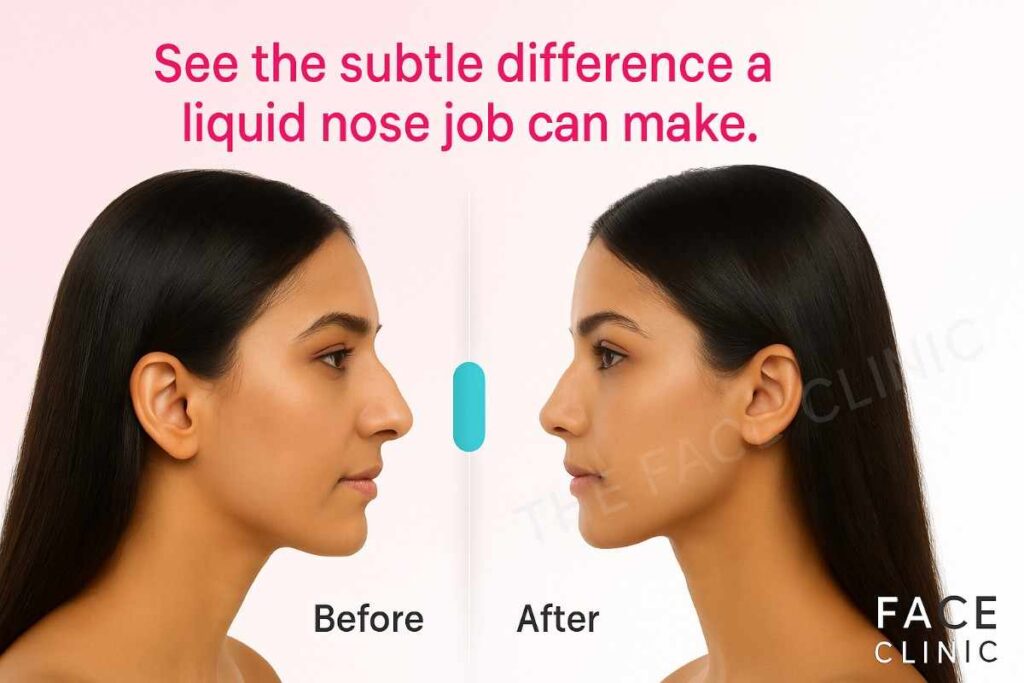
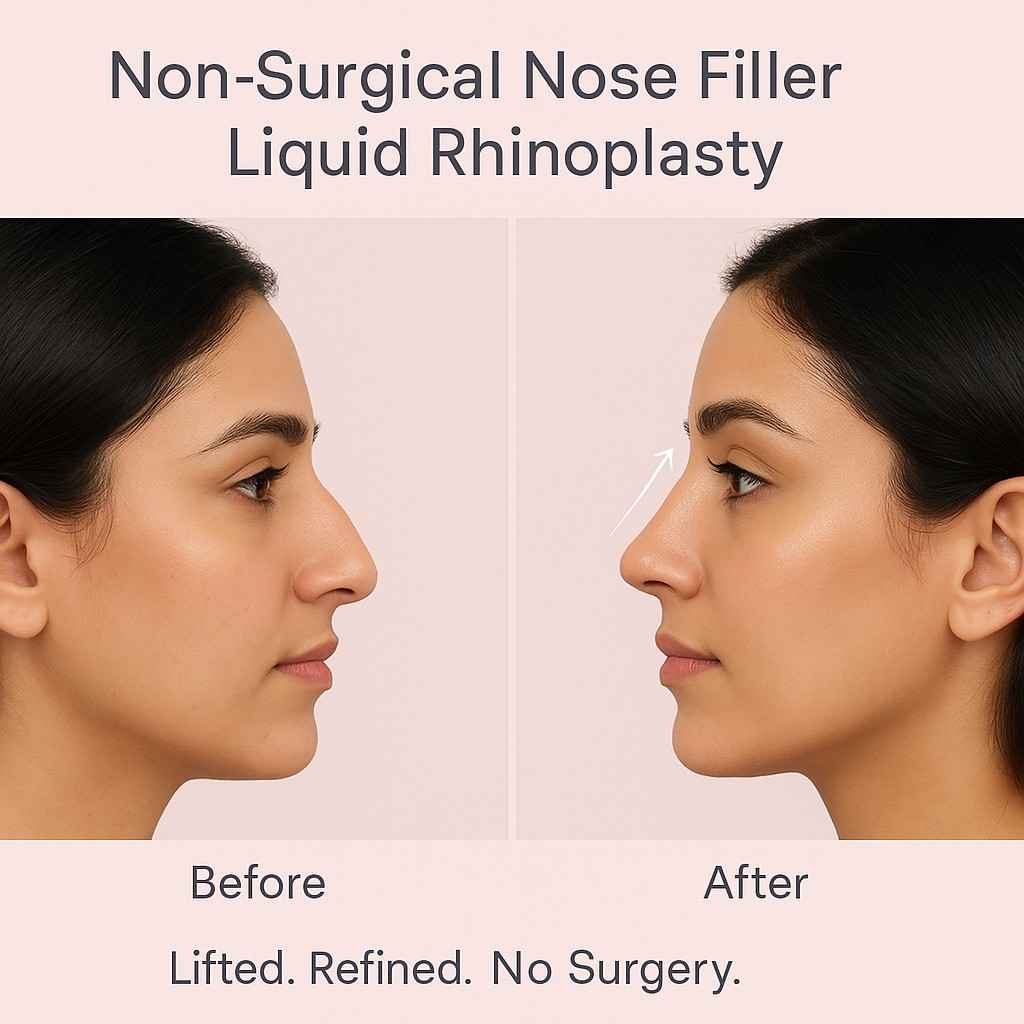
The treatment uses carefully placed hyaluronic acid dermal fillers to improve the appearance of concerns such as a mild dorsal hump, an uneven nasal bridge, asymmetry, or selected concerns involving nasal tip projection. Strategic filler placement can help create a straighter-looking, more defined profile and improve overall facial balance—without incisions, stitches, or general anaesthesia.
At The Face Clinic in Delhi, every non-surgical rhinoplasty is performed by Dr. Reema Arora, who has over 20 years of experience in facial aesthetics. Treatment begins with a detailed clinical assessment and anatomy-based planning to determine whether a liquid nose job is appropriate for the patient’s nasal structure, facial proportions and aesthetic goals.
We use premium, well-established hyaluronic acid dermal fillers, including products such as Juvederm and Restylane, selected according to individual anatomy, the degree of correction required and the treatment plan.
Because the nose has a complex vascular anatomy, non-surgical rhinoplasty requires advanced anatomical knowledge, careful patient selection and precise injection technique. Treatment by an appropriately trained and experienced medical professional helps reduce risk, although—as with any filler procedure—complications remain possible and should be discussed during consultation.
For patients who would like to understand more about the injectable products and techniques used for nasal contouring, see our guide to nose fillers in Delhi.
Quick Answers: Time, Downtime, Results & Cost
Treatment time: Approximately 15–30 minutes Downtime: Usually minimal; many patients return to routine activities the same day Results: Visible immediately, with further refinement as initial swelling settles over the following 1–2 weeks Longevity: Commonly around 8–14 months, although results may last for a shorter or longer period depending on the filler used, individual anatomy, metabolism and treatment technique Typical cost in Delhi: Approximately ₹25,000–₹75,000 for many treatments; more extensive correction may cost more depending on filler volume, product selection and complexity Cost in India: Varies according to city, practitioner expertise, product used and the extent of treatment required
Doctor Summary — Non-Surgical Rhinoplasty (Liquid Nose Job)
A liquid nose job uses strategically placed hyaluronic acid filler to refine selected aspects of nasal contour without surgically altering the underlying nasal framework. It can be useful for appropriately selected patients seeking subtle improvement in concerns such as a mild dorsal hump, bridge irregularity, selected asymmetry or limited tip-projection concerns.
Because filler adds support and contour rather than removing tissue or changing the nasal skeleton, careful patient selection is essential. Patients seeking major structural alteration, significant reduction in nose size or correction of functional breathing problems may require surgical assessment instead.
Results & Longevity
Changes are usually visible immediately, with the result becoming more refined as initial swelling settles. Results commonly last around 8–14 months, although duration varies according to the filler used, individual anatomy, metabolism and treatment technique and may be shorter or longer in some patients.
When hyaluronic acid filler is used, it can usually be dissolved with hyaluronidase if clinically indicated. This provides an important management option but does not eliminate the vascular or other risks associated with nasal filler injections.
What a Liquid Nose Job Cannot Correct
A non-surgical nose job can improve contour and proportion, but it cannot physically reduce the size of the nose, substantially alter the underlying nasal framework or correct functional breathing problems.
Patients requiring major structural change, significant size reduction or correction of breathing difficulties may be better suited to assessment for surgical rhinoplasty.
Safety Considerations
The nose contains a complex network of blood vessels and is an anatomically sensitive area for filler treatment. Non-surgical rhinoplasty should therefore be performed only after appropriate clinical assessment by a medical professional with detailed knowledge of facial anatomy and experience in advanced injectable techniques.
Liquid Nose Job Cost in Delhi
At The Face Clinic, many non-surgical rhinoplasty treatments fall within an approximate liquid nose job price range of ₹25,000–₹75,000 per session.
The final cost may be higher where more extensive contour correction, additional filler volume or a different product strategy is required. A personalised treatment plan and exact cost are therefore determined after clinical assessment.
Liquid Nose Job vs Surgical Rhinoplasty: Cost and Key Differences
Surgical rhinoplasty costs in India vary considerably according to the surgeon, hospital or surgical facility, anaesthesia requirements, complexity of the procedure and whether functional correction is also required. Because these variables can substantially affect the final cost, an accurate surgical quotation requires assessment by the treating surgeon.
Surgical rhinoplasty permanently alters the underlying nasal structures and generally involves anaesthesia, a surgical facility and a longer recovery period.
In comparison, a non-surgical rhinoplasty, or liquid nose job, uses strategically placed dermal fillers to create temporary aesthetic contour changes without surgery.
At The Face Clinic in Delhi, many non-surgical rhinoplasty treatments are approximately ₹25,000–₹75,000, although the final price depends on the filler selected, volume required and complexity of correction. More extensive treatments may therefore cost more.
When weighing a liquid nose job vs surgical rhinoplasty, the two procedures should not be compared on cost alone. Surgical rhinoplasty is designed for permanent structural change and can address concerns that filler cannot, while non-surgical rhinoplasty is more appropriate for selected patients seeking temporary, adjustable contour enhancement with substantially less recovery time.
Who Is an Ideal Candidate for Non-Surgical Rhinoplasty?
You may be a suitable candidate for non-surgical rhinoplasty if you want to make subtle improvements to nasal shape or proportion without undergoing surgery.
Treatment may be considered for patients who wish to:
- Smooth the appearance of a minor dorsal hump
- Improve selected areas of nasal asymmetry
- Refine an uneven or under-defined nasal bridge
- Improve selected concerns involving nasal tip projection or definition
- Enhance overall profile balance and facial proportions
- Address selected minor contour irregularities after previous rhinoplasty, subject to careful specialist assessment
- Explore a temporary contour change before considering permanent surgical rhinoplasty
Because dermal filler adds volume rather than removing tissue or altering the underlying nasal framework, appropriate patient selection is essential.
Who May Not Be a Good Candidate for a Liquid Nose Job?
A liquid nose job may be less suitable when adding filler is unlikely to produce an appropriate or proportionate improvement.
This may include patients who:
- Primarily feel that their nose is already too large or prominent, where adding volume may not achieve the desired result
- Have anatomy in which additional bridge, radix or tip volume could make the nose appear heavier or less balanced
- Have complex post-surgical anatomy that requires more specialised assessment before considering further injectable treatment
- Have medical or anatomical factors that make filler treatment inappropriate
- Have expectations that cannot realistically be achieved through temporary contour enhancement
Patients with previous nasal surgery require particularly careful assessment because surgery may alter tissue planes and vascular anatomy.
Suitability at The Face Clinic is determined through a detailed medical, anatomical and aesthetic assessment rather than by the requested treatment alone.
How Non-Surgical Rhinoplasty Works: Step-by-Step
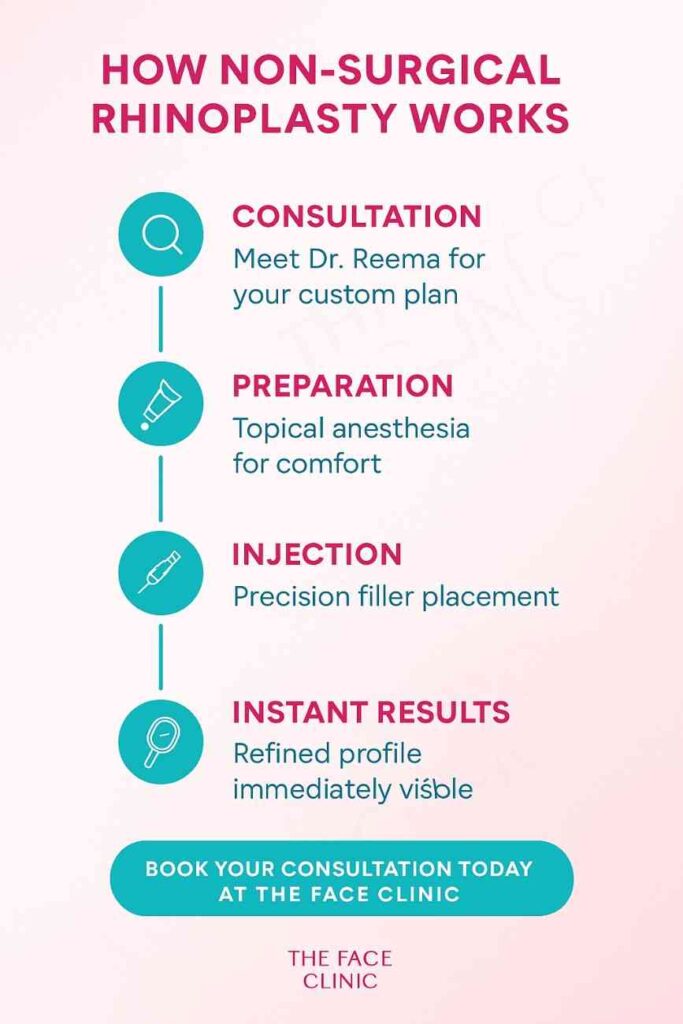
Consultation & Anatomy-Based Planning
Treatment begins with a detailed consultation to understand the patient’s concerns, medical history, previous procedures and desired outcome.
The nose is assessed in relation to the rest of the face, including bridge height, dorsal contour, tip projection, symmetry and overall facial proportions. The purpose of this assessment is not only to determine where filler may be placed, but also whether filler is the appropriate treatment at all.
Where clinically useful, AI-assisted facial analysis may be used as a supplementary tool to evaluate facial proportions and support treatment planning.
Preparation
Before treatment, the nasal area is carefully cleansed and prepared. An appropriate comfort measure, such as topical anaesthetic, may be used where required.
The proposed treatment areas and intended degree of correction are reviewed before injection.
Precise Filler Placement
Small amounts of hyaluronic acid dermal filler are placed at carefully selected anatomical points according to the treatment plan.
The aim is to improve contour, symmetry or projection while maintaining balanced facial proportions and avoiding unnecessary volume.
Because the nose has a complex vascular anatomy, conservative filler placement and detailed anatomical knowledge are especially important in this area.
Review of the Initial Result
Changes are usually visible immediately after treatment.
The nose is reassessed from different angles to evaluate contour, symmetry and facial balance. Initial swelling can temporarily influence the appearance, so the result generally becomes more refined as the treated area settles over the following days.

Liquid Nose Job for Dorsal Hump, Bridge & Tip: What's Different?
Not every nasal concern is corrected the same way, and the injection strategy for a liquid nose job depends on which part of the nose is being addressed:
- Dorsal hump: Filler is placed above and below a visible bump to smooth the transition along the bridge, creating the appearance of a straighter dorsal line without altering the underlying bone or cartilage.
- Bridge: Volume is added along the bridge to correct an uneven or under-projected profile, improving symmetry when viewed from the front and side.
- Tip: Small, precise amounts of filler can lift or refine a drooping or under-defined tip, improving projection and profile balance.
Each of these approaches uses the same hyaluronic acid fillers but requires a different injection point and volume strategy, which is why anatomy-based planning is assessed individually rather than applying a standard protocol. For a broader look at the products and techniques used across these injection points, see our dedicated guide to nose fillers in Delhi.
Benefits of Non-Surgical Rhinoplasty
For appropriately selected patients, a liquid nose job can offer several practical and aesthetic advantages:
- No surgical incisions: Nasal contour can be refined without an operation or surgical scars
- No general anaesthesia: Treatment is performed as an injectable procedure in a clinical setting
- Immediate visible change: Initial contour improvement can usually be seen directly after treatment
- Minimal downtime: Many patients are able to return to routine activities the same day
- Individualised treatment: Filler placement can be tailored to the patient’s anatomy, facial proportions and aesthetic goals
- Subtle contour refinement: Selected irregularities can be improved while maintaining balanced facial proportions
- Temporary results: Unlike surgical rhinoplasty, the changes are not permanent, which may suit patients who are not ready for permanent structural alteration
The principal advantage of non-surgical rhinoplasty is not that it replaces surgery, but that it provides a less invasive option for carefully selected cosmetic concerns that can be improved by adding contour or support. Patients focused on overall facial balance rather than the nose alone may also wish to explore our non-surgical face lift options as a complementary treatment.
For concerns requiring substantial size reduction, permanent structural change or correction of breathing problems, surgical rhinoplasty may be the more appropriate option.

Non-Surgical Rhinoplasty Risks & Safety: What You Should Know
Non-surgical rhinoplasty is a medical injectable procedure, and understanding both its expected temporary effects and its less common but potentially serious complications is an important part of informed treatment planning.
Common Temporary Effects
Temporary effects may include:
- Mild swelling or tenderness
- Redness at injection points
- Bruising
- Temporary sensitivity around the treated area
These effects usually improve over the following days, although the exact recovery period varies between patients.
Rare but Serious Complications
Because the nose has a complex vascular anatomy, dermal filler injections in this area require particular caution.
Rare but serious complications can include:
- Vascular occlusion, where blood flow to an area is compromised
- Skin injury or tissue damage, including skin necrosis
- Infection
- Very rare visual complications if filler inadvertently enters the vascular circulation supplying the eye
Experienced treatment, detailed anatomical knowledge, conservative filler placement and appropriate emergency preparedness can help reduce risk, but no injectable procedure can be described as completely risk-free.
Why the nose requires advanced expertise: The nasal region contains an important network of blood vessels. Careful patient selection, precise anatomical knowledge, appropriate technique and rapid recognition of complications are therefore particularly important when performing a liquid nose job.
Safety Protocols at The Face Clinic
At The Face Clinic:
- Non-surgical rhinoplasty is personally performed by Dr. Reema Arora
- Authentic, well-established hyaluronic acid fillers are selected according to individual anatomy and treatment requirements
- Treatment is planned after detailed medical and anatomical assessment
- Sterile clinical protocols are followed
- Emergency protocols are maintained, including access to hyaluronidase for appropriate management of hyaluronic acid filler complications
Injector expertise is only one part of safer treatment. Patient selection, anatomical knowledge, appropriate product choice, conservative technique and emergency preparedness all contribute to reducing risk.
When to Seek Urgent Medical Attention
Contact the treating clinic promptly if you develop unexpected or worsening symptoms after treatment.
Urgent assessment is particularly important if you notice:
- Increasing or severe pain that is out of proportion to expected tenderness
- Blanching, mottling, unusual paleness or progressive colour change of the skin
- Increasing swelling associated with worsening pain or skin changes
- Symptoms that are becoming progressively worse rather than improving
Any new visual disturbance, reduction or loss of vision, severe eye pain or other sudden visual symptom after nasal filler treatment should be treated as a medical emergency and assessed immediately.
Independent Medical Information
Patients who would like to read further may refer to:
- American Society of Plastic Surgeons — Liquid Rhinoplasty Patient Guidance
- PubMed — Systematic Review of Non-Surgical Rhinoplasty Outcomes and Complications
These sources are provided for general medical information and do not replace individual clinical assessment.
Non-Surgical Rhinoplasty Cost in Delhi: Pricing Guide
At The Face Clinic, the non-surgical rhinoplasty cost in Delhi depends primarily on the extent of correction required, individual nasal anatomy, filler volume and the treatment strategy recommended after clinical assessment.
Many focused liquid nose job treatments fall within an approximate liquid nose job price range of ₹25,000–₹75,000, while more extensive multi-area correction may require additional filler and consequently cost more.
Liquid Nose Job Cost by Treatment Complexity
| Liquid nose job scope | Approximate cost |
|---|---|
| Focused single-area refinement | ₹25,000–₹40,000 |
| Two-area contour correction | ₹40,000–₹55,000 |
| Full-nose non-surgical rhinoplasty | ₹55,000–₹75,000 |
For a treatment-area breakdown of injectable pricing, see our nose filler cost in Delhi guide.
What Determines the Final Liquid Nose Job Cost?
The final treatment cost may vary according to:
- The extent and complexity of the correction required
- The amount of hyaluronic acid filler needed
- Product selection
- Individual anatomy and treatment-planning requirements
A larger treatment is not automatically a better treatment. The objective is to use the amount of filler appropriate for the anatomy and desired correction rather than adding volume simply to achieve a predetermined package or price point.
Transparent, Doctor-Led Pricing
At The Face Clinic, non-surgical rhinoplasty is personally performed by Dr. Reema Arora.
The treatment plan and applicable cost are discussed before proceeding. Where included in the quoted fee, clinic components may cover treatment preparation, sterile disposables and planned follow-up according to the individual treatment plan.
Because results are temporary and maintenance requirements vary, non-surgical and surgical rhinoplasty should not be compared on price alone. Treatment choice should be based primarily on the anatomical concern, desired degree of correction, permanence of the result and whether surgery is clinically more appropriate.
Does Non-Surgical Rhinoplasty Differ for Men and Women?
Non-surgical rhinoplasty should be planned around individual anatomy, facial proportions and personal aesthetic goals rather than gender alone.
Some patients may prefer a straighter or more strongly defined dorsal profile, while others may seek softer contour transitions, improved symmetry or subtle refinement of selected nasal features. These preferences can occur in patients of any gender and should not be treated as fixed male or female treatment templates.
The aim is to create a nasal contour that remains proportionate to the rest of the face while respecting the patient’s existing features and treatment preferences.
For both men and women, the fundamental treatment principles remain the same: careful anatomical assessment, conservative filler placement, realistic expectations and avoidance of unnecessary volume.
Aftercare After Non-Surgical Rhinoplasty: The First 24–48 Hours
Following appropriate aftercare can help minimise swelling, bruising and unnecessary pressure on the treated area.
During the first 24–48 hours after a liquid nose job:
- Avoid strenuous exercise for approximately 24–48 hours, or as advised by your doctor
- Do not massage, press or manipulate the treated nose unless specifically instructed
- Avoid excessive heat exposure, including saunas and steam rooms, during the early recovery period
- Avoid alcohol on the day of treatment where possible, as it may contribute to bruising or swelling
- Try to avoid unnecessary pressure on the nose while sleeping during the first night
- Follow any individual post-treatment instructions provided by your doctor
Mild swelling, tenderness or bruising can occur after treatment and generally improves over the following days. If pain, skin colour changes or other symptoms become unexpectedly severe or progressively worsen, seek prompt medical assessment in accordance with the urgent safety guidance outlined above.
Non-Surgical Rhinoplasty FAQs
Is a Non-Surgical Nose Job Painful?
A non-surgical nose job is generally well tolerated. An appropriate comfort measure, such as topical anaesthetic, may be used where required.
Patients may feel brief pressure or discomfort during filler placement, but the procedure is usually completed within approximately 15–30 minutes, depending on the treatment plan.
Can Filler Straighten the Nose?
Patients often ask, “Can filler straighten the nose?” In selected patients, strategically placed filler can make a mildly uneven or irregular nasal profile appear straighter by improving contour and symmetry.
However, filler does not physically straighten deviated nasal bones or correct major structural crookedness. Significant deviation, post-traumatic deformity or associated breathing problems may require surgical or ENT assessment.
Can Non-Surgical Rhinoplasty Be Performed After Previous Rhinoplasty?
Selected minor contour irregularities after previous rhinoplasty may sometimes be treated with hyaluronic acid filler.
However, previous surgery can alter tissue planes and vascular anatomy, so post-rhinoplasty filler treatment requires particularly careful clinical assessment and should not be approached as a routine correction. Suitability depends on the individual anatomy, previous procedure and intended treatment area.
Why Choose The Face Clinic for Non-Surgical Rhinoplasty?
Non-surgical rhinoplasty is highly anatomy-dependent, particularly because the nose is a vascularly sensitive treatment area. At The Face Clinic, the emphasis is therefore on clinical assessment, conservative planning and doctor-performed treatment rather than filler volume alone.
Treatment is led by Dr. Reema Arora, Founder and Medical Director of The Face Clinic, who has over 20 years of experience in facial aesthetics and has previously served as Medical Head – Facial Aesthetics at Allergan India. She has also trained more than 2,000 dermatologists and plastic surgeons in injectables and non-surgical facial rejuvenation.
At The Face Clinic:
- Every non-surgical rhinoplasty is personally assessed and performed by Dr. Reema Arora
- Treatment planning is based on individual nasal anatomy, facial proportions and realistic aesthetic goals
- Planning also recognises the considerable anatomical variation seen among Indian patients; treatment is individualised rather than based on a standardised ethnic or gender template
- A conservative approach is used to avoid unnecessary filler volume
- Authentic, well-established hyaluronic acid fillers are selected according to individual treatment requirements
- Safety protocols and emergency preparedness are maintained for injectable procedures
- Patients are advised honestly when filler is unlikely to achieve the desired correction and surgical assessment may be more appropriate
The aim is not to create a standardised nose shape, but to determine whether subtle contour refinement can improve facial balance while respecting the patient’s existing anatomy, soft-tissue characteristics and individual features.
Consult Dr. Reema Arora for Non-Surgical Rhinoplasty in Delhi
A liquid nose job is most appropriate when the desired improvement can be achieved by adding carefully planned contour or support without requiring major structural change.
A personalised consultation allows Dr. Reema Arora to assess your nasal anatomy, facial proportions, medical history, previous procedures and treatment goals before determining whether non-surgical rhinoplasty is suitable for you.
If filler is not the appropriate treatment for the concern, this should be identified during assessment rather than attempting to achieve a surgical correction with injectable treatment.
Book a doctor consultation for non-surgical rhinoplasty in Delhi