
- Home
- Services
- Cheek Fillers
Have Any Question?
Don’t think much, have a query? Call us now!
Connect with us

Images are for illustrative purposes only and may not represent actual patients or outcomes. Individual results vary based on anatomy, clinical assessment, and personalised treatment planning.
Cheek Fillers in Delhi – Cost, Before & After, Results & Natural-Looking Treatment
Cheek fillers are non-surgical injectable treatments used to restore selected areas of cheek and midface volume, improve cheek definition and support facial proportions where additional volume or structural support is appropriate.
At The Face Clinic in Hauz Khas, South Delhi, cheek filler treatment is personally planned and performed by Dr Reema Arora following an assessment of facial structure, existing volume, symmetry, skin and soft-tissue characteristics, previous treatments and individual aesthetic goals.
The aim is not simply to make the cheeks larger. Treatment planning considers how the cheeks relate to the under-eye area, temples, nose, lips, chin and jawline so that any cheek enhancement remains proportionate to the rest of the face.
Cheek filler cost at The Face Clinic: ₹22,000–₹35,000 per syringe.
The amount required varies between patients. A treatment plan is recommended only after assessment rather than according to a predetermined number of syringes.
Medical content reviewed by Dr Reema Arora, MBBS, MSc Facial Aesthetics
Founder & Medical Director, The Face Clinic
Last medically reviewed: October 2026
Quick Treatment Overview
Treatment detail | Overview |
Treatment | Cheek / midface filler |
Procedure type | Non-surgical injectable treatment |
Consultation | Required before treatment |
Main goals | Restore selected volume, improve cheek projection or contour, support facial proportions |
Downtime | Usually limited; temporary swelling, tenderness or bruising may occur |
Results | Early volume or contour change may be visible immediately; the appearance continues to settle afterwards |
Longevity | Varies according to the filler used, placement, anatomy and individual response |
Clinic price | ₹22,000–₹35,000 per syringe |
Treatment performed by | Dr Reema Arora |
Location | The Face Clinic, Hauz Khas, South Delhi |
Cheek filler forms part of the broader range of dermal fillers treatment in Delhi offered at The Face Clinic.
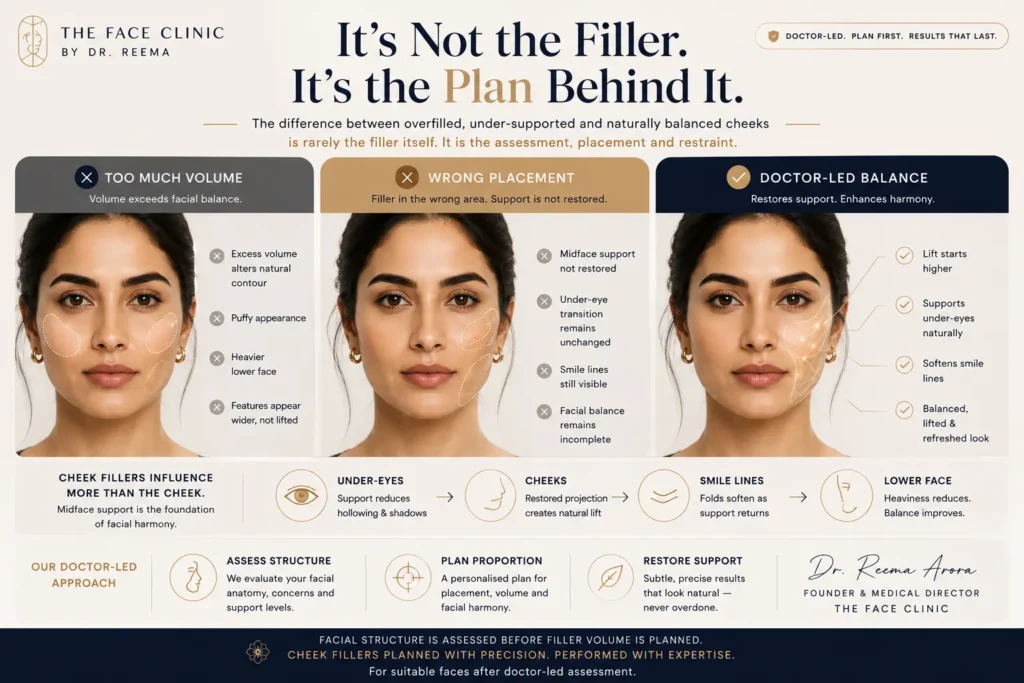
Images are for illustrative purposes only and may not represent actual patients or outcomes. Individual results vary based on anatomy, clinical assessment, and personalised treatment planning.
What Are Cheek Fillers?
Cheek fillers are injectable dermal fillers placed in selected areas of the cheek or midface to provide volume, structural support or contour where clinically appropriate.
At The Face Clinic, treatment planning focuses primarily on appropriately selected hyaluronic acid fillers for suitable patients. Different filler formulations have different physical and structural characteristics, so product choice, quantity, depth and placement are determined according to the individual face rather than by brand name alone.
A midface filler treatment may be considered for several different reasons. Some patients have age-related midface volume loss; others naturally have less cheek projection or would like greater cheek definition. In selected patients, restoring support in the midface may also improve the transition between adjacent facial areas.
The broader term cheek augmentation describes increasing or restoring cheek volume or projection. Cheek filler is one non-surgical option for achieving this in appropriately selected patients; it is not the only option and is not suitable for every concern.
What Can Cheek Fillers Help With?
Cheek filler may be considered when facial assessment identifies reduced volume, projection or structural support as an important contributor to the concern.
Depending on individual anatomy, treatment may help address:
- Age-related cheek volume loss
- Midface volume loss
- Reduced cheek projection
- Naturally flatter cheek contours
- Selected hollow or sunken appearance in the midface
- Mild asymmetry where filler is an appropriate option
- Reduced definition between the cheek and surrounding facial areas
- A desire for proportionate cheek enhancement without surgery
For some patients seeking a sunken cheeks treatment, filler may form part of the treatment plan when reduced midface volume is a significant contributor. A sunken appearance can also reflect weight loss, skeletal anatomy, skin laxity or broader facial-volume changes, so filler should not be assumed to be the correct treatment before assessment.
Similarly, naturally flat cheeks do not automatically require treatment. For someone considering a flat cheeks treatment, the relevant question is whether additional projection or volume would genuinely improve overall facial proportion.
What Cheek Filler May Not Correct
Cheek filler is not a substitute for every lifting, tightening or facial-rejuvenation treatment.
It may not adequately correct:
- Significant skin laxity or tissue descent
- Concerns caused primarily by skin texture or skin quality
- Every under-eye hollow or eye bag
- Every nasolabial fold
- Jowling caused predominantly by tissue laxity
- Major skeletal or structural concerns requiring surgical treatment
- Expectations of substantially lifting the entire face through filler alone
Adding more filler is not necessarily the solution when the underlying issue is laxity, skin quality or another anatomical feature.
A useful treatment plan therefore begins by identifying why the cheek or midface looks different before deciding whether additional volume is appropriate.
Cheek Volume Loss and Midface Ageing
Changes in the cheeks with age are not caused by one structure alone.
The appearance of the midface may change because of a combination of:
- Changes in facial fat compartments
- Alterations in skeletal support
- Changes in skin quality and elasticity
- Soft-tissue descent
- Previous weight change
- Natural facial anatomy
This distinction matters because cheek volume loss and skin laxity are not the same problem.
Where loss of volume or structural support is a meaningful contributor, carefully placed filler may help restore proportion or contour. Where laxity or skin quality is dominant, adding volume may provide limited benefit or may create unwanted facial heaviness.
For this reason, cheek filler treatment should be planned in the context of the whole face rather than simply filling whichever area appears hollow.
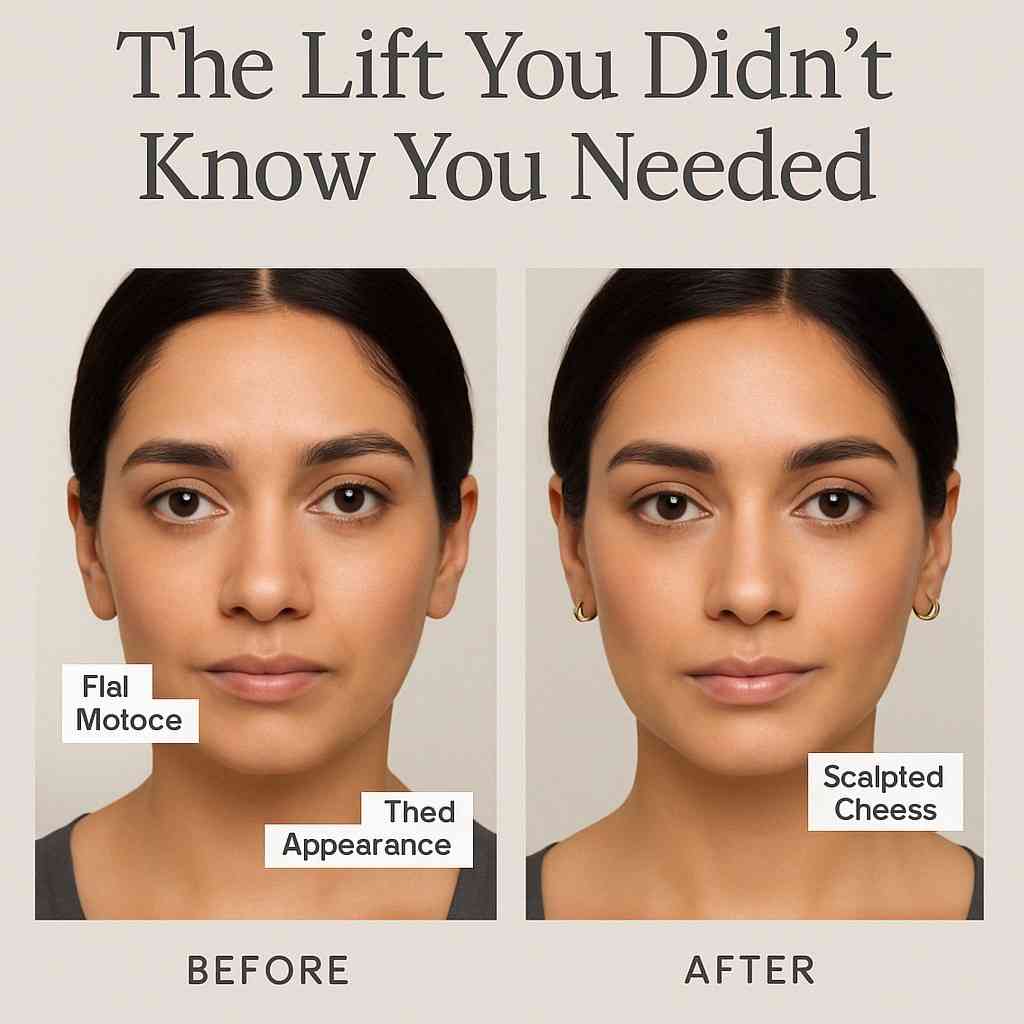
Images are for illustrative purposes only and may not represent actual patients or outcomes. Individual results vary based on anatomy, clinical assessment, and personalised treatment planning.
What Happens During a Cheek Filler Consultation?
A cheek filler consultation should determine whether filler is appropriate before deciding how much product to use.
At The Face Clinic, assessment may include:
- Your main concern and treatment goals
- Facial proportions and cheek projection
- Existing cheek and midface volume
- Skeletal support and facial structure
- Facial symmetry
- Skin and soft-tissue characteristics
- The relationship with the under-eye area, temples, chin and jawline where relevant
- Previous dermal filler or aesthetic treatment
- Relevant medical history
- Current medicines and supplements
- Allergies
- Expected change and treatment limitations
- Alternative treatment options
- Likely filler requirement
- Expected downtime and risks
- Indicative treatment cost
Treatment is not recommended simply because a patient requests a particular number of syringes or a specific filler brand.
Where cheek filler is not appropriate—or another approach is likely to address the concern more effectively—that should form part of the consultation discussion.
Dr Reema Arora's Approach to Cheek Enhancement
Cheek filler treatment at The Face Clinic is planned and personally performed by Dr Reema Arora, Founder and Medical Director of the clinic.
Dr Arora’s approach is based on facial assessment rather than treating the cheek as an isolated feature.
Treatment planning considers:
- Underlying facial structure
- Existing volume distribution
- Cheek projection
- The relationship between the anterior and lateral cheek
- Facial width and proportions
- Under-eye support where relevant
- Chin and jawline balance
- Skin and soft-tissue characteristics
- Changes associated with ageing or weight loss
- The patient’s individual treatment goal
The objective is not to create the largest or most projected cheek possible. Treatment is designed to preserve facial proportion and individual facial character while making only the degree of correction considered appropriate after assessment.
Product selection, treatment plane, technique and quantity are therefore individualised.
Read more about Dr Reema Arora and her professional background.
Who May Be Suitable for Cheek Fillers?
Cheek fillers may be considered for adults who are medically suitable and whose concern is substantially related to volume, projection or structural support.
Reasons for considering treatment may include:
- Age-related cheek or midface volume loss
- Naturally limited cheek projection
- Flattening of the cheek contour
- Selected facial asymmetry
- A hollow or tired midface appearance related to volume distribution
- A preference for a non-surgical treatment
- A desire for subtle rather than dramatic facial change
Suitability cannot be determined from age or photographs alone.
Some patients who believe they need cheek filler may instead have concerns related mainly to skin laxity, under-eye anatomy, temples, chin projection, weight-related facial change or another feature.
Treatment may also need to be deferred or avoided depending on medical history, active infection or inflammation, previous complications, medications or other clinical factors.
A medical consultation is therefore required before treatment.
Cheek Filler Before & After – What to Expect
A cheek filler before-and-after comparison is most useful when photographs are standardised and enough time has passed for early swelling to settle.
Immediately After Treatment
An initial change in volume, projection or contour may be visible straight away.
However, the immediate appearance is not necessarily the settled result. Temporary swelling, redness or tenderness may affect the appearance during the first few days.
During the First Few Days
Swelling and temporary asymmetry can occur while the treated tissues settle. Bruising is also possible.
Around 10–14 Days
By approximately two weeks, much of the early swelling has usually settled, allowing a more useful assessment of the developing result.
Individual recovery varies.
Assessing Before-and-After Photographs
Genuine cheek filler before and after photographs should be interpreted in the context of:
- Baseline anatomy
- Quantity of filler used
- Product selected
- Time elapsed after treatment
- Lighting and positioning
- Other treatments performed
- Individual variation
Results achieved in one patient should not be treated as a prediction of another patient’s outcome.
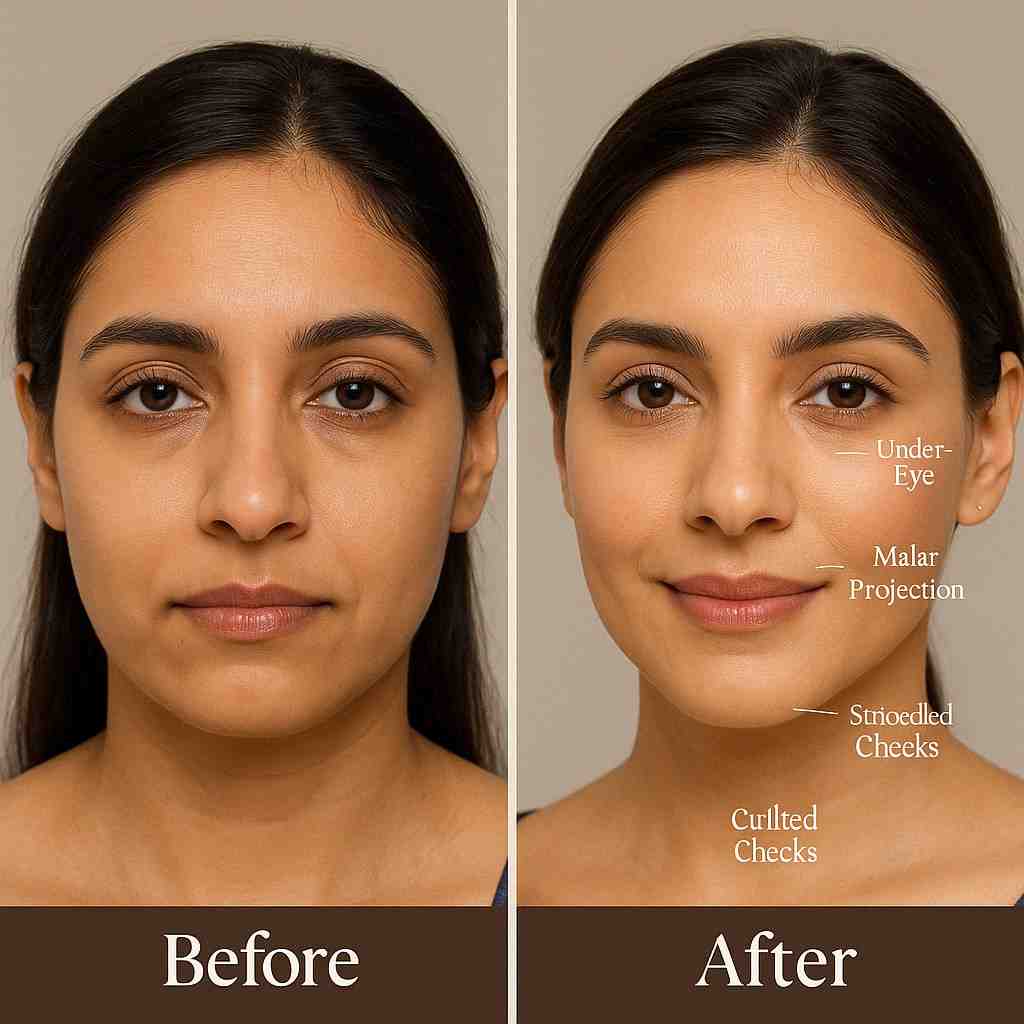
Images are for illustrative purposes only and may not represent actual patients or outcomes. Individual results vary based on anatomy, clinical assessment, and personalised treatment planning.
Cheek Filler Cost in Delhi
At The Face Clinic, cheek filler cost in Delhi is ₹22,000–₹35,000 per syringe.
Treatment | Indicative clinic price |
Cheek filler | ₹22,000–₹35,000 per syringe |
The final treatment cost depends primarily on the filler selected and the amount required for the planned correction.
The objective is not to reach a predetermined syringe count. Some faces need relatively limited correction, while others require a different amount or a staged treatment plan.
Pricing and anticipated filler requirement are discussed before treatment.
How Much Cheek Filler Do I Need?
There is no standard amount of cheek filler appropriate for every face.
The amount may depend on:
- Existing cheek projection
- Degree of cheek or midface volume loss
- Facial width and skeletal structure
- Whether the objective is restoration or additional definition
- Which areas of the cheek require treatment
- Existing filler
- Product characteristics
- Facial symmetry
- Whether treatment is being staged
Some treatment plans may involve one or two syringes in total, while other patients may require a different amount or may be better treated using another approach.
The answer to how much cheek filler do I need? should therefore come from facial assessment rather than a standard online quantity.
What Affects Cheek Filler Cost?
The main factors include:
Filler selected
Different hyaluronic acid fillers have different characteristics and price points.
Quantity required
The amount required varies according to anatomy and treatment plan.
Treatment objective
Subtle contour refinement and more extensive volume restoration are different treatment plans.
Individual anatomy
Facial structure, asymmetry and previous treatment can influence treatment planning.
Staged treatment
In selected patients, treatment may be divided across more than one appointment rather than pursuing the entire correction in one sitting.
The cost quoted after consultation should reflect the proposed treatment plan rather than a generic package.
How Long Do Cheek Fillers Last?
How long do cheek fillers last? depends on several factors, and no single duration can be guaranteed for every patient.
Longevity may vary according to:
- The specific filler formulation
- Amount used
- Treatment area and placement
- Facial anatomy
- Individual metabolism and biological response
- Previous treatment
Some hyaluronic acid fillers used in the cheek or midface may provide effects that persist for a year or longer, but duration varies between products and patients.
Longer duration should not automatically be interpreted as better treatment. Product selection should primarily match the patient’s anatomy and treatment objective.
Maintenance treatment, if desired, should be based on reassessment rather than automatically repeating the original quantity at a predetermined interval.
Cheek Filler vs Sculptra – How Do They Differ?
Cheek filler vs Sculptra is not simply a comparison between two filler brands. Hyaluronic acid filler and Sculptra/PLLA work differently and may suit different treatment objectives.
Hyaluronic Acid Cheek Filler | Sculptra / PLLA | |
Main approach | Provides injectable gel volume or structural support | Stimulates gradual collagen production |
Onset | Initial change is generally visible soon after treatment | Changes develop progressively |
Treatment style | Can provide relatively targeted volume and contour | Used for gradual biostimulatory change in selected patients |
Adjustability | HA filler can often be reduced or dissolved with hyaluronidase when clinically appropriate | Cannot be enzymatically dissolved in the same manner as HA filler |
Treatment course | May be performed as a single or staged treatment | Often planned as a treatment course |
Selection | Depends on anatomy and desired correction | Depends on anatomy, tissue characteristics and treatment objective |
Neither option is universally better.
Hyaluronic acid cheek filler may be considered where targeted volume placement or structural contouring is desired.
Sculptra may be considered in selected patients where gradual collagen stimulation better matches the treatment objective.
Read the dedicated guide to Sculptra and biostimulator treatment in Delhi for more detailed information.
Cheek Fillers vs Other Midface Treatment Options
Cheek filler is one option for addressing selected midface concerns, but the appropriate treatment depends on what is causing the appearance.
Hyaluronic Acid Filler
May provide targeted volume, support and contour in selected areas of the cheek or midface.
Collagen-Stimulating Treatments
Treatments such as PLLA/Sculptra work differently from conventional HA filler and produce gradual change through collagen stimulation.
Fat Grafting
Surgical fat transfer uses the patient’s own fat to restore volume. It involves a different procedure, recovery profile and set of considerations from injectable dermal filler.
Surgical Treatment
Where significant tissue descent, skeletal change or laxity is the dominant concern, surgical assessment may sometimes be more appropriate than adding filler.
Skin-Quality or Tightening Treatments
When the main concern is skin quality or laxity rather than volume loss, a treatment directed at those tissues may be more appropriate than increasing cheek volume.
The purpose of assessment is to identify the treatment category that matches the underlying concern rather than treating every midface change with filler.
How Are the Filler Product and Injection Technique Selected?
There is no single “best cheek filler” for every patient.
Product selection may depend on:
- Treatment objective
- Required degree of support or projection
- Facial anatomy
- Tissue characteristics
- Placement depth
- Previous treatment
- Desired degree of correction
Needle and/or cannula techniques may be selected depending on the anatomical area, intended treatment plane, product characteristics and clinical objective.
Neither technique should be described as automatically safer in every circumstance.
Treatment planning should prioritise appropriate patient selection, detailed anatomical knowledge, product choice, careful technique and the ability to recognise and manage complications.
For independent regulatory and safety information, see FDA information on dermal fillers .
Cheek Filler Risks, Side Effects and Safety Considerations
Cheek fillers are medical procedures and are not risk-free.
Temporary effects can include:
- Swelling
- Tenderness
- Redness
- Bruising
- Temporary unevenness or asymmetry
Other possible complications can include:
- Infection
- Persistent lumps or nodules
- Inflammatory reactions
- Unwanted contour or asymmetry
- Filler displacement
- Vascular occlusion
Unintentional injection into a blood vessel is an important but uncommon complication of dermal filler treatment. Depending on the vessel involved, vascular compromise can cause tissue injury and, rarely, serious visual or neurological complications.
Patient selection, knowledge of facial anatomy, appropriate product and technique selection, and prompt recognition of complications are therefore important aspects of injectable treatment.
The purpose of consultation and informed consent is to discuss relevant risks in the context of the individual patient rather than implying that filler treatment is risk-free.
When Should You Contact the Clinic After Cheek Filler?
Follow the specific aftercare instructions provided after your treatment.
Seek prompt medical advice from the treating clinic if you develop concerning or unexpected symptoms such as:
- Severe or increasing pain
- Unusual blanching, mottling or significant colour change of the skin
- New visual symptoms
- Rapidly worsening or unusual swelling
- Increasing redness, warmth or other symptoms suggesting infection
- Any symptom significantly outside the expected post-treatment course
New visual symptoms or other severe acute symptoms require urgent medical assessment rather than waiting for a routine follow-up.
Before and Aftercare
Before Cheek Filler Treatment
Tell the treating doctor about:
- Relevant medical conditions
- Previous filler or injectable treatment
- Previous adverse reactions or complications
- Allergies
- Current prescription medicines
- Anticoagulant or antiplatelet treatment
- Supplements
- Active infection or inflammation
- Recent or planned dental treatment where relevant
Do not stop prescribed medication unless advised by the clinician responsible for that medication.
Additional pre-treatment instructions may be given according to your individual medical history.
After Cheek Filler Treatment
Temporary swelling, tenderness and bruising may occur.
Aftercare may include:
- Avoiding unnecessary pressure or manipulation of the treated area
- Following the clinic’s specific instructions regarding exercise, heat exposure, skincare and other activities
- Monitoring the treated area during the early recovery period
- Contacting the clinic promptly if unexpected symptoms develop
- Attending review where recommended
Individual instructions provided by the treating doctor take precedence over general online aftercare advice.
About Dr Reema Arora
Dr Reema Arora is the Founder and Medical Director of The Face Clinic in Hauz Khas, New Delhi.
Her professional background includes:
- MBBS, St John’s Medical College, Bangalore
- MSc Facial Aesthetics, UK
- More than 20 years of experience in facial aesthetics
- Previous role as Medical Head – Facial Aesthetics at Allergan India
- Experience in injectable training and medical education
- Clinical and academic work relating to facial aesthetic treatments
Cheek filler treatment at The Face Clinic is personally planned and performed by Dr Arora using an anatomy-based approach.
The focus is on selecting an appropriate treatment for the individual face rather than following a standardised quantity, shape or treatment trend.
Frequently Asked Questions About Cheek Fillers
What are cheek fillers?
Cheek fillers are injectable treatments used to provide volume, support or contour in selected areas of the cheeks or midface. Product, quantity and placement depend on individual anatomy and treatment goals.
How much does cheek filler cost in Delhi?
At The Face Clinic, cheek filler cost in Delhi is ₹22,000–₹35,000 per syringe. Final cost depends on the product selected and quantity required.
How much cheek filler do I need?
There is no standard amount. Requirement depends on facial anatomy, baseline volume, projection, symmetry, previous treatment and the planned correction. Treatment quantity is determined after assessment rather than according to a fixed online recommendation.
How long do cheek fillers last?
Duration varies according to filler type, amount, placement, anatomy and individual response. Some HA fillers used in the cheek or midface may provide effects lasting a year or longer, but longevity cannot be predicted precisely for every patient.
When will I see cheek filler results?
An initial change may be visible immediately. Temporary swelling can affect the early appearance, and the result is generally easier to assess after much of the initial swelling has settled.
Can cheek filler be used as a treatment for sunken cheeks?
It may be appropriate when reduced midface volume is an important contributor to the sunken appearance. Weight change, skeletal structure, tissue laxity and other factors can also contribute, so suitability should be assessed before treatment.
Can cheek filler be used as a flat cheeks treatment?
Selected patients with naturally limited cheek projection may consider filler to increase contour or structural definition. Whether this would improve facial balance depends on the individual’s overall proportions and treatment goals.
What is the difference between cheek filler and Sculptra?
Hyaluronic acid cheek filler provides injectable gel volume or support, with an early visible change after treatment. Sculptra is a PLLA biostimulator that works through gradual collagen stimulation. Selection depends on anatomy and treatment objectives.
Are cheek fillers reversible?
Hyaluronic acid fillers can often be reduced or dissolved using hyaluronidase when clinically appropriate. Dissolving filler is itself a medical procedure, outcomes vary, and this should not be interpreted as making the original filler treatment risk-free.
Are cheek fillers safe?
Cheek fillers are widely used medical aesthetic procedures, but they have recognised risks. Patient selection, anatomical knowledge, product selection, injection technique and early recognition of complications are important components of risk reduction.
What are the side effects of cheek filler?
Temporary swelling, tenderness, redness and bruising are among the more common effects. Other complications can include infection, nodules, inflammatory reactions, asymmetry and vascular occlusion. Serious complications are uncommon but possible and should be discussed before treatment.
How much downtime should I expect?
Downtime is usually limited for many patients, but temporary swelling, tenderness or bruising can occur. Recovery varies between individuals.
Will cheek filler make my face look overfilled?
An overfilled appearance is influenced by factors including treatment planning, product selection, quantity and placement. At The Face Clinic, filler quantity is determined according to facial proportions and the intended correction rather than a predetermined target volume.
Who may not be suitable for cheek filler?
Suitability can be affected by medical history, active infection or inflammation, previous complications, medications, anatomy and the nature of the concern. Some patients may also be better suited to another treatment where volume loss is not the main problem.
Who performs cheek filler treatment at The Face Clinic?
Cheek filler treatment at The Face Clinic is personally planned and performed by Dr Reema Arora following a doctor-led facial assessment.
Considering Cheek Fillers in Delhi?
If you are considering cheek fillers in Delhi, the first step is to establish whether additional cheek or midface volume is actually appropriate for your face.
At The Face Clinic, Dr Reema Arora assesses facial structure, existing volume, proportions, skin and soft tissues before recommending treatment.
During consultation, you can discuss:
- Whether cheek filler is appropriate
- What degree of change may be realistic
- Alternative treatments where filler is not the best option
- The likely amount of filler required
- Potential risks and downtime
- Expected longevity
- Your individual cheek filler cost
- Whether treatment is better performed in one session or staged
The Face Clinic
Dr Reema Arora
LGF, C-36, Chaudhary Dilip Singh Marg
Hauz Khas Market, New Delhi 110016
Clinic Hours: Monday–Saturday, 10:00 AM–6:00 PM
Phone / WhatsApp: +91 99580 73900
Treatment suitability, treatment requirements and outcomes vary according to individual anatomy, medical assessment, product selection and treatment plan. Website information is educational and does not replace an individual medical consultation.
All treatments are subject to individual variation. Outcomes are determined following clinical evaluation by a qualified doctor.