Images are for illustrative purposes only and may not represent actual patients or outcomes. Individual results vary based on anatomy, clinical assessment, and personalised treatment planning.
Sculptra Treatment in Delhi: Cost, Results & Biostimulator Guide
Medically reviewed by Dr Reema Arora, MBBS, MSc Facial Aesthetics (UK)
Founder & Medical Director, The Face Clinic, Hauz Khas, New Delhi
Updated: September 2026
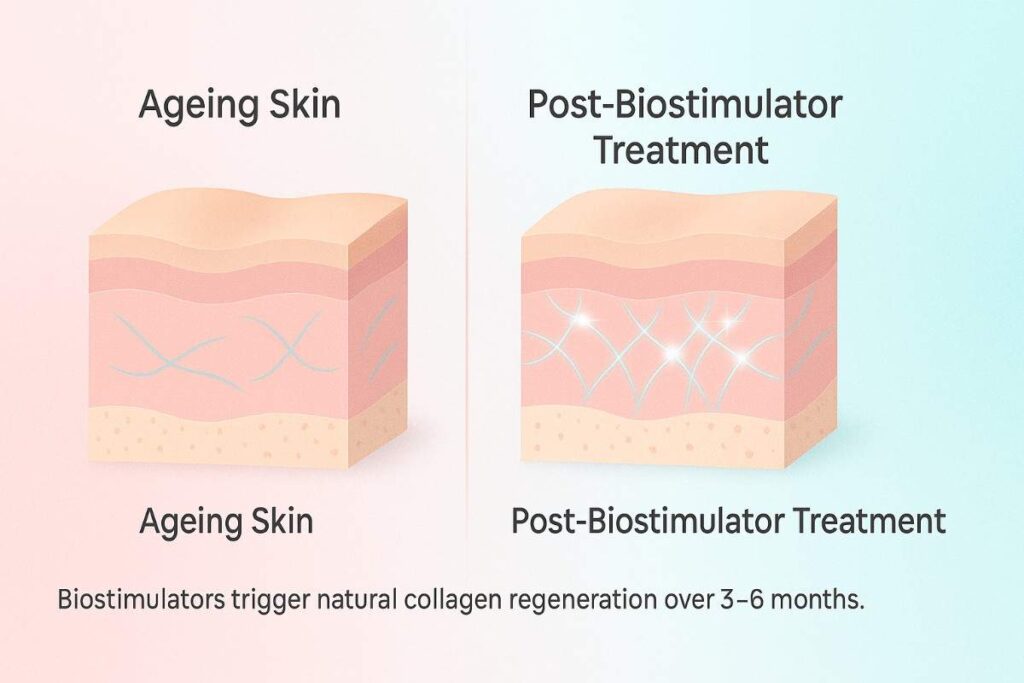
Sculptra is a poly-L-lactic acid (PLLA) collagen biostimulator used to create gradual aesthetic change by stimulating collagen rather than relying primarily on the immediate gel-like volume associated with conventional hyaluronic acid fillers.
For someone considering Sculptra treatment in Delhi, the important question is therefore not simply whether Sculptra is “better” than filler. It is whether the visible concern is actually one that may benefit from facial collagen stimulation—or whether another treatment would address the underlying anatomy more predictably.
At The Face Clinic in Hauz Khas, South Delhi, Sculptra and other injectable treatments are considered after assessing facial structure, volume distribution, tissue quality, skin laxity and the pattern of ageing change. Some concerns may lend themselves to a PLLA treatment; others may be better addressed with hyaluronic acid filler, a skin-quality treatment, tightening, combination treatment—or no injectable treatment at all.
Sculptra in India: What Changed in 2026?
This matters because much of the Sculptra information patients encounter online was written for other countries. Galderma itself notes that product availability and approved indications can vary by market, so India-specific product information and individual clinical assessment should take precedence over protocols copied from international websites.
Sculptra at a Glance
Question | Quick answer |
|---|
Treatment type | PLLA collagen biostimulator |
Main objective | Gradual collagen stimulation and improvement in tissue support in appropriately selected patients |
When results develop | Progressively over weeks to months |
Treatment plan | Individualised; commonly planned as a series rather than a fixed one-session correction |
How long may results last? | Around two years in many patients, with individual variation |
Sculptra cost at The Face Clinic | ₹45,000 per vial |
Can it be dissolved like HA filler? | No—PLLA does not have the hyaluronidase reversibility of HA filler |
Clinic location | Hauz Khas, South Delhi |
Images are for illustrative purposes only and may not represent actual patients or outcomes. Individual results vary based on anatomy, clinical assessment, and personalised treatment planning.
What Is Sculptra?
Sculptra is an injectable treatment containing poly-L-lactic acid (PLLA), a biodegradable synthetic material with a long history of medical use.
In aesthetic medicine, Sculptra is commonly described as a collagen biostimulator, collagen-stimulating injection, injectable collagen stimulator or sometimes a PLLA filler. The terminology overlaps, but the clinically important distinction is that its principal visible effect develops through collagen stimulation rather than through the immediate placement of an HA gel.
This is why Sculptra results are generally progressive rather than instantly final.
According to
official Sculptra product information , Sculptra stimulates collagen and is generally delivered as a treatment series, with effects that can persist for up to approximately two years.
The evidence, however, should not be overstated. A
systematic review of PLLA in facial aesthetics identified improvements across several outcomes and effects sustained for at least 25 months in some studies, but also found important limitations in the quality of the evidence and risk of bias in several trials.
For readers interested in the deeper biology rather than the treatment-decision overview, our separate article explains
how PLLA stimulates collagen.
What Can Sculptra and Facial Biostimulators Improve?
A biostimulator treatment may be considered when the visible concern relates partly to progressive loss of tissue support, diffuse volume change or collagen-related changes rather than one sharply defined structural deficit.
Depending on facial anatomy, individual assessment and applicable product guidance, Sculptra may merit consideration where there is:
- diffuse facial volume depletion;
- progressive loss of facial support;
- selected patterns of facial hollowing;
- declining tissue quality or firmness;
- age-related change affecting a broader facial region rather than one isolated feature;
- a preference for gradual rather than immediately obvious correction.
The important limitation is that facial collagen stimulation is not synonymous with facial lifting.
Pronounced skin laxity, significant jowling, true tissue descent or a discrete structural deficit may require a different approach. In selected patients, tightening, structural filler, another modality, surgery—or a carefully planned combination—may be more appropriate.
Who May Be Suitable for Sculptra Treatment?
Suitability is better determined by anatomy and treatment objective than by chronological age.
Sculptra treatment may merit consideration when:
- facial change is relatively diffuse rather than confined to one precise point;
- loss of tissue support or collagen quality contributes meaningfully to the appearance;
- the patient prefers or accepts gradual change;
- a staged treatment plan is acceptable;
- expectations are realistic.
Sculptra may be less appropriate as the primary treatment when the objective is immediate, highly precise projection; a small localised contour correction; predominantly superficial hydration; substantial tissue repositioning; significant loose skin; or a result that needs to be readily reversible.
Medical history, previous injectable treatment, treatment goals and product-specific suitability also need to be assessed before proceeding.
Images are for illustrative purposes only and may not represent actual patients or outcomes. Individual results vary based on anatomy, clinical assessment, and personalised treatment planning.
How Much Does Sculptra Cost in Delhi?
At The Face Clinic, Hauz Khas, South Delhi, Sculptra currently costs ₹45,000 per vial.
Pricing reviewed: September 2026.
Treatment | Current clinic price |
|---|
Sculptra / PLLA — per vial | ₹45,000 |
A per-vial price is not necessarily the same as the cost of a complete Sculptra treatment plan.
Some patients may require more than one vial or more than one session. Another patient may need a different treatment altogether. The proposed treatment plan and total applicable cost should therefore be discussed before treatment begins.
What Determines the Total Sculptra Cost?
The total Sculptra cost in Delhi may depend on:
- individual facial anatomy;
- the pattern and extent of tissue change;
- the area being considered for treatment;
- number of vials required;
- whether treatment is staged;
- number of sessions judged appropriate;
- whether another modality would address part of the concern more effectively.
This is why statements such as “full-face Sculptra always needs X vials” are not a sound substitute for clinical assessment.
The relevant figure for a patient is not an unsourced “average Delhi price,” but the cost of the actual treatment plan being proposed for that patient.
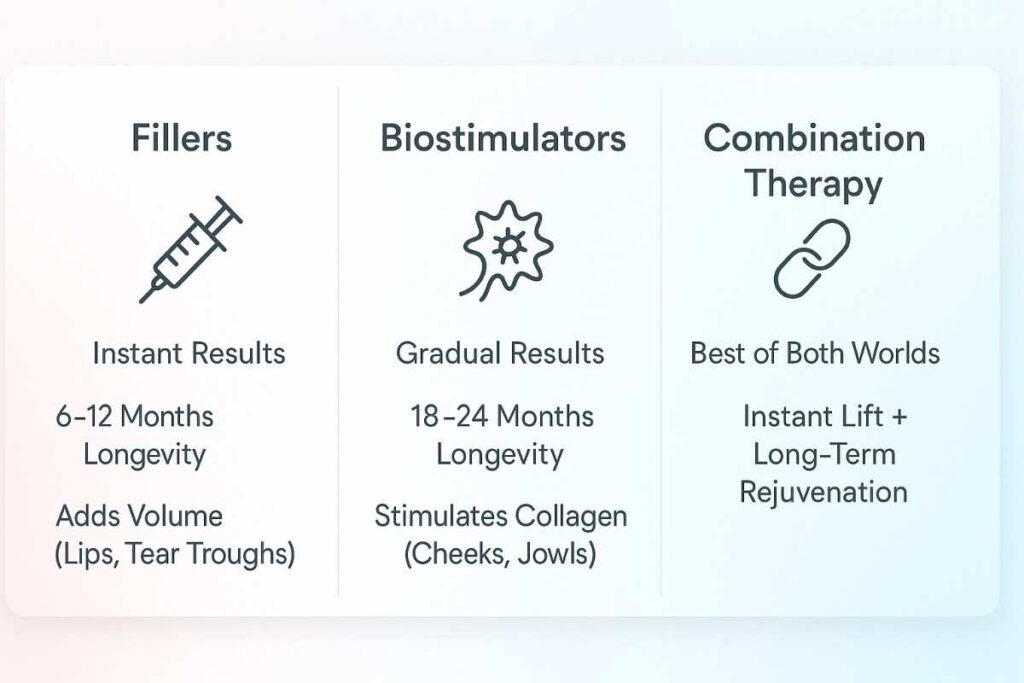
Sculptra vs Dermal Filler: What Is the Difference?
The search “Sculptra vs filler” usually means Sculptra compared with a conventional hyaluronic acid dermal filler.
They are not interchangeable.
Feature | Sculptra / PLLA | Hyaluronic Acid Filler |
|---|
Principal mechanism | Collagen biostimulation | Gel-based structural support or volume |
Visible onset | Progressive | Structural effect generally begins immediately, followed by settling |
Typical treatment objective | Gradual collagen-related support and tissue change | Targeted volume restoration, projection or contour |
Immediate shaping precision | More limited | Often better suited to precise projection or contour |
Hyaluronidase dissolution | No | HA filler can often be enzymatically dissolved when clinically indicated |
Planning | Commonly staged or series-based | May be single-stage or staged |
Result evolution | Develops over weeks to months | Immediate structural change with subsequent settling |
For example, a sharply defined chin-projection deficit may be better addressed with precisely placed HA filler than by relying on diffuse collagen stimulation. More generalised facial depletion can raise a different treatment question.
The useful question is therefore not:
Which injectable is better?
It is:
Which treatment mechanism best matches the anatomical problem?
Sculptra vs Profhilo vs Radiesse
Patients frequently compare Sculptra vs Profhilo and Sculptra vs Radiesse, but these treatments differ materially in composition and clinical behaviour.
In simple terms:
- Sculptra uses PLLA and is principally a collagen biostimulator.
- Radiesse uses calcium hydroxylapatite (CaHA) and may have structural and biostimulatory roles depending on how it is used.
- Profhilo is an HA-based bio-remodelling treatment focused more heavily on hydration, tissue quality and remodelling.
- HA dermal fillers are generally used for more targeted structural support, volume or contour.
The choice should be driven by the anatomical concern—not by which product is newer or more fashionable.
Sculptra vs Radiesse
Sculptra contains PLLA. Radiesse is a calcium hydroxylapatite filler and biostimulator based on CaHA.
Both can stimulate collagen, but their material properties and clinical uses are not identical.
Importantly, Radiesse treatment does not have one fixed role. Depending on product preparation and treatment objective, CaHA may be used for structural support or in diluted/hyperdiluted approaches with a greater emphasis on skin and tissue biostimulation.
This makes Sculptra vs Radiesse considerably more nuanced than “slow treatment versus immediate treatment.”
A recent
systematic review of PLLA and CaHA collagen biostimulators found clinically meaningful improvements with both materials while reporting differences in durability and acknowledging variation in study methods and treatment protocols. PLLA effects were reported for up to around 25 months in included studies, while CaHA effects were commonly reported over shorter periods.
The deeper PLLA-versus-CaHA biology belongs in our dedicated educational article rather than being duplicated here.
Sculptra vs Profhilo
Sculptra and Profhilo are also not equivalent treatments.
Sculptra is PLLA-based and relies principally on collagen biostimulation.
Profhilo uses hyaluronic-acid hybrid complexes created using IBSA’s
NAHYCO® Hybrid Technology and is positioned as an HA bio-remodelling approach rather than a conventional volumising filler.
The Sculptra vs Profhilo decision therefore often comes down to whether the primary treatment objective is progressive collagen-related structural support or predominantly hydration and tissue-quality bio-remodelling.
How Dr Reema Approaches the Biostimulator Decision
The clinical starting point should not be:
“Does this patient need Sculptra?”
It should be:
“Which anatomical layer is producing the visible change?”
A patient may describe the concern simply as “I look tired,” “my face has become hollow,” or “my jawline is changing.” Those descriptions can arise from very different anatomical processes.
Clinical finding | Question it raises |
|---|
Localised loss of projection or contour | Would targeted structural HA filler provide a more predictable correction? |
Diffuse loss of facial support | Would gradual PLLA biostimulation merit consideration? |
Predominantly poor hydration or superficial skin quality | Would a skin-quality or HA bio-remodelling treatment make more sense? |
Collagen-related change plus a local volume deficit | Are different treatments needed for different tissue layers? |
Predominant laxity | Should tightening be prioritised over injectable volume? |
Significant tissue descent or jowling | Is an injectable alone realistically capable of producing the desired change? |
The objective is not to select Sculptra first and make the face fit the treatment.
It is to identify what is actually contributing to the visible change and choose the least excessive treatment capable of addressing it meaningfully.
Dr Reema Arora is Founder and Medical Director of The Face Clinic, with more than 20 years of focused experience in facial aesthetics. She previously served as Medical Head – Facial Aesthetics at Allergan India and has extensive experience in injectable education and anatomy-led treatment planning.
What Happens During Sculptra Treatment?
Sculptra treatment begins with consultation rather than with a predetermined number of vials.
The assessment considers facial structure, volume pattern, tissue quality, treatment objectives, areas where collagen biostimulation may add meaningful value, expected limitations, risks and whether treatment should be staged.
Because the main effect of a PLLA treatment develops progressively, the initial treatment plan should not be regarded as an inflexible contract for every future session.
Clinical response can be reassessed as treatment evolves. Depending on that response, a later stage may proceed as initially planned, be modified or occasionally be deferred.
Galderma’s global information describes Sculptra as commonly delivered through a treatment series, typically around three sessions over several months. However, it also specifically states that approved indications and product information vary by country.
At The Face Clinic, session number and interval are therefore individualised rather than presented as a universal “2–3 sessions every 4–6 weeks” formula.
Sculptra Before and After: When Do Results Develop?
A Sculptra before and after comparison needs to be interpreted differently from the result of an immediate contour filler.
There may be temporary fullness or swelling shortly after treatment, but this should not be mistaken for the final collagen-mediated result.
Meaningful change develops progressively.
Depending on anatomy, treatment plan and individual response, patients may notice gradual changes in facial support, selected areas of depletion, tissue quality and overall facial balance.
A Practical Sculptra Results Timeline
Immediately after treatment: injection-related swelling or temporary fullness may influence appearance.
Over the following weeks: early collagen-related change may gradually become more noticeable.
Over subsequent months: the visible effect can continue to evolve as collagen remodelling develops.
This is why meaningful assessment depends on longitudinal photography and appropriate follow-up, rather than judging the face immediately after injection.
Publishing note: Insert genuine, consented The Face Clinic Sculptra before-and-after photography here if available. Use consistent lighting, angle, expression and a clearly stated follow-up interval. If an appropriate clinic case is not yet available, use an original “Sculptra Results Timeline” visual rather than stock before-and-after imagery.
Suggested image disclaimer:
Individual results vary. Photographs represent the patient shown and do not guarantee another patient’s outcome.
How Long Does Sculptra Last?
How long does Sculptra last? is one of the most important practical questions before treatment.
Galderma states that Sculptra results can last up to approximately two years, while systematic-review data have reported PLLA effects persisting for up to around 25 months in some included studies.
This should not be interpreted as a guaranteed two-year expiry date.
Duration may vary with:
- individual biological response;
- treatment indication;
- quantity and treatment plan;
- number of treatment sessions;
- ongoing facial ageing;
- other patient-specific factors.
Future treatment should therefore be considered according to how the result evolves on reassessment, rather than because a fixed 12- or 18-month maintenance date has arrived.
Sculptra Safety, Side Effects and Important Limitations
Sculptra is an injectable aesthetic treatment, so appropriate consent should include both common temporary effects and less-common complications.
Expected injection-related effects can include swelling, redness, tenderness, bruising and temporary discomfort.
Other reported complications with PLLA treatment include palpable lumps or nodules, papules, inflammatory reactions, infection and contour irregularity. A systematic review found bruising, haematoma, tenderness, nodules and oedema among reported adverse events, while also noting limitations in the overall quality of the evidence.
One important distinction from conventional HA filler is reversibility.
PLLA cannot be immediately dissolved with hyaluronidase in the way an HA filler often can. This makes appropriate patient selection, product handling, anatomical knowledge, injection technique and complication recognition particularly important.
Rare but serious vascular complications are also possible with injectable biostimulators. A 2026
review of visual loss associated with biostimulator injectables exami
ned reported cases involving non-HA products including PLLA and CaHA, reinforcing the importance of prevention and rapid recognition of vascular complications.
The appropriate message is therefore neither that Sculptra is inherently dangerous nor that it is risk-free.
It is an elective medical-aesthetic treatment whose benefits, limitations and risks should be considered for the individual patient.
Frequently Asked Questions About Sculptra
Is Sculptra a Filler or a Biostimulator?
Sculptra is best understood clinically as a PLLA collagen biostimulator. PLLA products also appear within the broader dermal-filler literature, but Sculptra behaves differently from conventional HA filler because its principal visible effect develops progressively through collagen stimulation.
Can Sculptra Be Dissolved?
Not with hyaluronidase in the way hyaluronic acid filler often can.
This absence of immediate HA-style reversibility is one reason conservative treatment planning and appropriate technique are particularly important with PLLA.
Is One Sculptra Session Enough?
There is no universal answer.
Sculptra is commonly planned as a treatment series, but the number and timing of sessions should depend on anatomy, treatment objective and clinical response rather than a fixed package applied to every patient.
Is Sculptra Suitable for Jowls or Loose Skin?
That depends on what is causing the appearance.
If reduced tissue support or collagen-related change contributes to the concern, a biostimulator may form part of the treatment discussion. Significant tissue descent or substantial skin laxity, however, should not be treated as though they were simply a collagen-deficiency problem.
Sculptra should therefore not be positioned as a substitute for every lifting or tightening procedure.
Is Sculptra Newly Available in India?
Sculptra was approved in India in 2026, and Galderma India now lists Sculptra within its Indian aesthetic portfolio.
Patients should nevertheless rely on applicable Indian product information and individual medical assessment rather than automatically adopting treatment protocols described on overseas websites.
Can Sculptra and HA Filler Be Used in the Same Treatment Plan?
Potentially, in selected patients.
A patient may have both a diffuse tissue-support concern and a localised structural deficit. Different treatments may therefore be considered for different anatomical layers.
That does not mean combination treatment is automatically better. Each component should have a clear clinical purpose.
Considering Sculptra Treatment in Delhi?
The most useful starting question is not:
“How many vials of Sculptra do I need?”
It is:
“What anatomical change are we trying to treat?”
At The Face Clinic in Hauz Khas, South Delhi, consultation with Dr Reema Arora begins by assessing facial structure, volume distribution, tissue quality, degree of laxity and the patient’s treatment goals before deciding whether Sculptra, another biostimulator, HA filler, a skin-quality treatment, tightening—or no treatment—is the more appropriate direction.
The aim is not to select the newest injectable.
It is to select the treatment that best matches the problem being treated.