How PLLA Stimulates Collagen: The Science of Biostimulation
Medically reviewed by Dr Reema Arora, MBBS, MSc Facial Aesthetics (UK)
Founder & Medical Director, The Face Clinic, Hauz Khas, New Delhi
Updated: September 2026
Facial ageing involves more than a gradual reduction in collagen. Changes in skin structure, facial fat, ligamentous support and underlying bone all influence how the face looks over time.
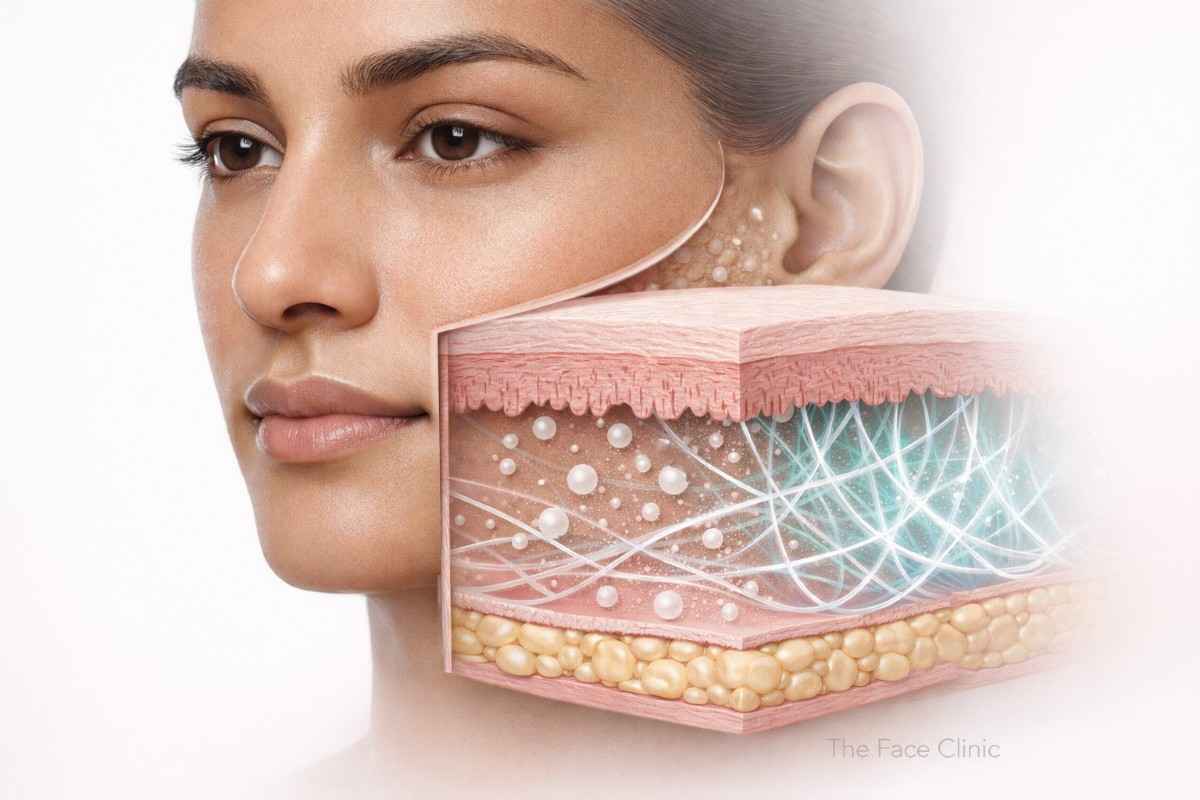
Poly-L-lactic acid (PLLA) offers a different approach to selected aspects of these changes. Unlike conventional volumising fillers, which primarily provide physical volume or support, PLLA works substantially through a biological response that encourages new collagen formation.
Sculptra is a well-known PLLA-based injectable, but understanding how it works requires looking beyond the product itself.
What happens after PLLA enters the tissue? Why do its effects develop gradually? And does stimulating collagen necessarily translate into better skin, more lifting or meaningful facial rejuvenation?
The answers lie in the biology of collagen formation—and in understanding what scientific research can and cannot establish.
Quick Answer: How Does PLLA Stimulate Collagen?
PLLA stimulates collagen through a local tissue response to its biodegradable microparticles. Cells including macrophages and fibroblasts participate in signalling processes associated with new collagen formation, known as neocollagenesis.
Over time, collagen deposition and remodelling may contribute to improved tissue support and facial appearance. However, the response varies between individuals, and increased collagen production does not guarantee lifting or complete tissue regeneration.
What Is PLLA, and Why Is It Called a Collagen Biostimulator?
Poly-L-lactic acid is a synthetic, biocompatible and biodegradable polymer with established medical applications.
In aesthetic medicine, injectable PLLA formulations contain microparticles that interact with surrounding tissue after placement. This interaction can encourage the body’s collagen-producing processes.
Collagen is a major structural component of the extracellular matrix—the network of proteins and other substances that helps provide tissues with strength and support.
With ageing, changes in collagen synthesis, breakdown and organisation contribute to alterations in skin structure.
PLLA-based treatments aim to influence selected aspects of this tissue environment through a gradual biological response, rather than relying solely on the physical presence of an injected material.
That is why PLLA is described as a collagen biostimulator.
It does not mean that the polymer becomes natural collagen, that collagen production continues indefinitely or that every ageing-related change can be reversed.
Is PLLA the Same as Sculptra?
No. PLLA is the polymer; Sculptra is a specific injectable formulation containing PLLA microparticles and other formulation components.
Sculptra has its own clinical studies, indications, safety information and product characteristics.
Other injectables containing PLLA—or related polymers such as poly-D,L-lactic acid (PDLLA)—may differ in particle properties, formulation and clinical evidence.
Consequently, findings concerning Sculptra should not automatically be applied to every polylactic-acid injectable. This distinction matters when evaluating claims about collagen stimulation, treatment duration and safety.
How Does PLLA Stimulate Collagen? Understanding the Biological Process
PLLA collagen stimulation involves several overlapping cellular and tissue responses.
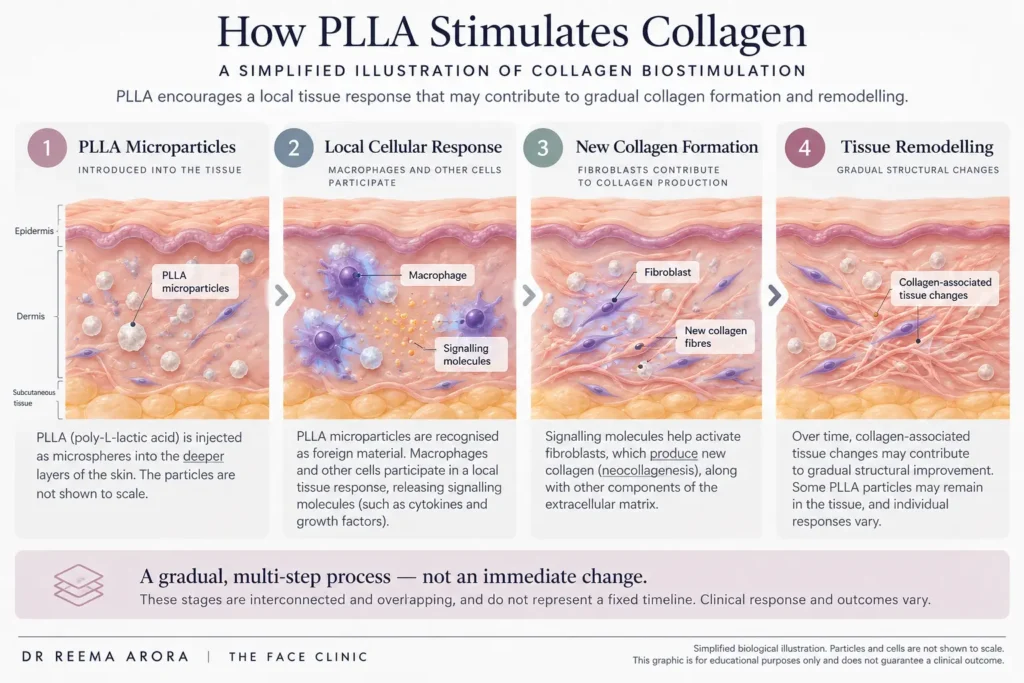
The process can be understood through four explanatory stages. These stages are not completely separate events; biological activity may overlap as the tissue responds.
Stage 1 — PLLA Microparticles Enter the Tissue
Sculptra is prepared as a suspension before injection.
Immediately after treatment, the fluid used in its preparation, together with injection-related swelling, may create temporary fullness.
As the fluid is absorbed and swelling subsides, some of this early correction can diminish.
The remaining PLLA microparticles interact with surrounding tissue, initiating the biological response associated with collagen stimulation.
This distinction matters: the appearance immediately after treatment does not indicate how much collagen will subsequently develop.
Stage 2 — Macrophages Participate in the Local Tissue Response
The body recognises implanted PLLA microparticles as foreign material and initiates a local host response.
Macrophages, immune cells involved in recognising and responding to foreign material, participate in this process. Their activity helps coordinate interactions between the particles, surrounding cells and extracellular matrix.
This is often described as a foreign-body response.
Experimental research suggests that macrophage-associated signalling may contribute to conditions supporting collagen formation. Investigated pathways include transforming growth factor beta (TGF-β), a signalling molecule involved in several connective-tissue processes.
However, the precise molecular mechanisms of PLLA collagen stimulation are not completely understood.
Findings from cell cultures and animal models cannot be assumed to occur identically in every patient. Nor should a tissue response be described as universally beneficial simply because it may contribute to a desired aesthetic effect.
Stage 3 — Fibroblasts Contribute to New Collagen Formation
Fibroblasts are connective-tissue cells responsible for producing and maintaining important components of the extracellular matrix.
During PLLA-associated tissue responses, interactions between immune cells, fibroblasts and surrounding tissue may contribute to new collagen production.
This process is called neocollagenesis.
Studies involving Sculptra’s PLLA formulation have reported increased collagen-related gene expression and collagen synthesis in experimental models. Human tissue investigations have also demonstrated increased type I collagen following treatment.
Type I collagen is an important structural protein in skin and other connective tissues.
The process is more complex than PLLA directly switching fibroblasts on through a single pathway. Several interacting cellular mechanisms may be involved, and research continues to examine their relative contributions.
Stage 4 — Collagen Remodelling Contributes to Gradual Structural Change
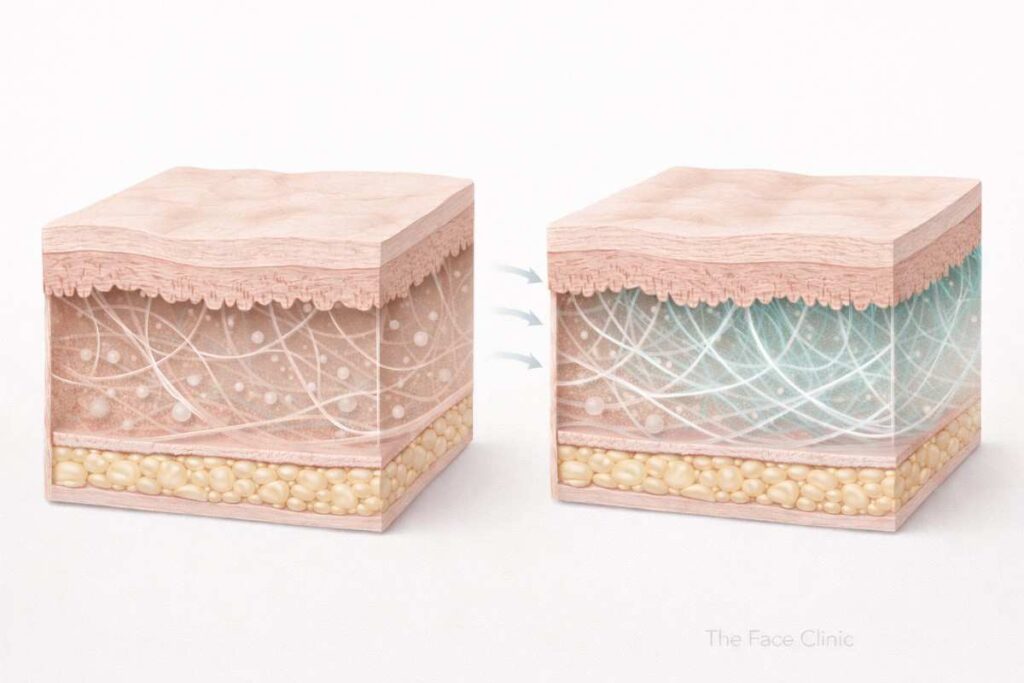
As new collagen is deposited, the extracellular matrix may undergo progressive changes in its composition and organisation.
Depending on the tissue, formulation, treatment plan and individual response, these changes can contribute to improved support and correction of selected facial concerns.
Meanwhile, the PLLA polymer undergoes gradual degradation.
However, the precise kinetics of Sculptra resorption in humans have not been established. It would therefore be inaccurate to assign an exact time at which all particles disappear.
The persistence of visible improvement should not be interpreted as proof that the original polymer is completely absent—or that youthful tissue has been fully regenerated.
The intended outcome is a controlled, clinically useful tissue response, not collagen production without limits.
Images are for illustrative purposes only and may not represent actual patients or outcomes. Individual results vary based on anatomy, clinical assessment, and personalised treatment planning.
Why Do PLLA Results Develop Gradually?
PLLA’s visible effects can develop differently from those of a conventional hyaluronic acid (HA) filler.
With HA fillers, the physical properties and placement of the gel contribute substantially to the initial correction. With PLLA, the subsequent collagen-associated tissue response plays a greater role in the developing result.
This explains why early post-injection fullness can subside before a later improvement becomes noticeable.
General period | What may be happening |
|---|
Immediately after treatment | Temporary fluid-related fullness, swelling or tenderness |
Following weeks | Continuing cellular activity and early collagen-associated tissue changes |
Subsequent months | Progressive collagen deposition and remodelling, with possible visible improvement |
Longer term | Evolution of the result according to the biological response, treatment plan and continuing facial ageing |
The sequence is approximate, not a guaranteed patient-specific timeline.
Visible improvement also cannot be used as a direct measurement of how much new collagen has formed.
The relevant clinical question is whether a gradual biological response is appropriate for the concern being treated—not simply whether PLLA can stimulate collagen.
What Does Scientific Research Actually Show About PLLA?
There is meaningful evidence supporting PLLA’s biological activity and its use in selected facial aesthetic applications.
However, three different questions must be considered: whether a biological change has been demonstrated, whether that change produces a measurable clinical improvement, and how confidently the improvement can be expected to persist.
Evidence supporting one question does not automatically answer the others.
Evidence of New Collagen Formation
Experimental research and human tissue studies have demonstrated collagen-associated changes after PLLA exposure.
A human study involving 14 subjects, discussed in a subsequent mechanistic review, reported a 65.5% increase in type I collagen at three months after treatment with PLLA-SCA, the Sculptra formulation.
This was a study-specific tissue measurement—not an estimate of total facial collagen restoration or a prediction of how much younger a patient’s face would look.
The study supports local neocollagenesis in the examined tissue. Its small sample size and selected measurements limit how broadly the finding can be applied.
Evidence for Changes in Skin and Facial Appearance
Clinical studies have investigated outcomes including dermal thickness, facial contour, wrinkle measurements and patient satisfaction.
Several studies reported improvements in relevant outcomes, including dermal thickness and facial appearance.
However, five trials were assessed as having a high risk of bias, while the remaining six raised some concerns. None was assessed as having a low risk of bias overall.
The reviewers concluded that the evidence for effectiveness and safety in facial rejuvenation was of low quality and that stronger research was required.
This does not negate the positive findings. It does mean that broad claims about predictable collagen regeneration or universal long-lasting rejuvenation would exceed what the evidence establishes.
What Did Researchers Actually Measure?
Finding | What it can support | What it cannot establish alone |
|---|
Increased type I collagen in a tissue sample | Local collagen formation | A predictable percentage of whole-face rejuvenation |
Increased dermal thickness | Structural tissue change | Correction of every cause of facial ageing |
Improved wrinkle or appearance scores | Improvement in the studied population | The same result for every patient |
Persistent improvement at follow-up | Durability under the study conditions | A guaranteed treatment duration |
A measurable biological response is not automatically equivalent to a meaningful aesthetic result for every individual.
How Strong Is the Evidence for Long-Term Improvement?
Selected clinical studies have reported PLLA-associated improvements persisting for approximately two years or longer.
The 2024 systematic review identified studies with sustained effects for at least 25 months, but the limitations of their evidence remain relevant. Duration also depends on the outcome being measured and the treatment conditions.
A broader 2025 review examined 63 studies published between January 2013 and March 2025. It discussed PLLA’s biological mechanisms, extracellular-matrix remodelling and expanding aesthetic applications.
The review provides useful scientific context, but its included studies involve different methods, populations, products and outcomes.
Overall, the research supports PLLA as a treatment with demonstrated collagen-associated effects and potential clinical benefits in selected applications. It does not establish a universally predictable degree or duration of facial rejuvenation.
Does More Collagen Always Mean Better Facial Rejuvenation?
Not necessarily.
Collagen is essential to tissue structure, but its quantity is only one part of the equation.
Facial appearance also depends on collagen organisation, skin characteristics, facial fat, ligamentous support and underlying bone structure.
A treatment may stimulate collagen without correcting the primary cause of a patient’s concern.
For example, collagen formation cannot recreate lost bone, reliably reposition descended facial fat or reproduce the mechanical correction achieved through a surgical facelift.
There is also an important distinction between three terms frequently used in aesthetic medicine:
Term | What it means |
|---|
Collagen deposition | Formation and accumulation of collagen within tissue |
Collagen remodelling | Changes in collagen synthesis, breakdown and organisation over time |
Tissue regeneration | Restoration of tissue structure and function—a broader process not demonstrated merely by finding new collagen |
The term regenerative aesthetics is increasingly used in discussions of PLLA. However, demonstrating neocollagenesis does not establish complete restoration of youthful tissue.
The more clinically relevant question is whether the collagen-associated response occurs in tissue where it can help address the patient’s actual concern.
Successful biostimulation is not simply about producing more collagen. It is about achieving an appropriate tissue response with a clinically meaningful benefit.
PLLA vs Hyaluronic Acid and Calcium Hydroxyapatite: How Do Their Mechanisms Differ?
PLLA, hyaluronic acid (HA) and calcium hydroxyapatite (CaHA) are used in injectable aesthetic medicine, but their primary mechanisms differ.
PLLA is recognised for gradual collagen biostimulation. Conventional HA fillers primarily provide physical volume and structural support. CaHA formulations can provide an immediate carrier-gel effect alongside subsequent tissue responses.
Feature | PLLA / Sculptra | HA fillers | CaHA / Radiesse |
|---|
Material | PLLA microparticles | Cross-linked HA gel | CaHA microspheres in a gel carrier |
Primary action | Gradual collagen-associated tissue change | Physical volume restoration and support | Immediate carrier-gel support and biostimulation |
Early visible effect | May include temporary fluid-related fullness | Usually apparent after placement, allowing for swelling | Depends on formulation and use |
Subsequent effects | Collagen formation and remodelling | Formulation-dependent tissue interactions | Collagen-associated tissue response |
Reversal considerations | No established HA-like enzymatic reversal method | Many HA fillers can be dissolved with hyaluronidase when indicated | No comparable routine enzymatic reversal method |
These are general mechanism differences, not a ranking of treatments.
HA fillers are not biologically inert, and PLLA and CaHA should not be considered interchangeable simply because both may stimulate collagen.
Product formulation, anatomical suitability and the intended correction all matter.
What Are the Safety Considerations and Limitations of PLLA?
PLLA is biodegradable, but injectable treatment still involves medical risks.
Common post-injection effects include redness, swelling, tenderness, bruising and local discomfort.
Delayed papules, nodules or granulomatous reactions may also occur. These reactions can differ in their timing, characteristics and underlying causes.
Some reactions may require prolonged assessment or treatment. However, the available evidence does not justify describing every nodule as permanent or untreatable.
This reinforces an important distinction: biodegradable does not mean readily or immediately reversible.
Product-Specific Precautions and Serious Complications
The U.S. Sculptra labelling identifies contraindications involving hypersensitivity to product components, certain severe-allergy histories and susceptibility to keloid or hypertrophic scarring.
It also states that Sculptra should not be injected into the lip vermilion. Periorbital injection has not been studied, and an increased risk of papules and nodules has been reported after injections in that region.
Rare but serious vascular complications can occur with facial injectables, including skin injury, visual impairment and stroke.
Changes in vision, stroke-like symptoms, skin blanching or unusual pain during or shortly after injection require immediate medical attention.
FDA Access Data
These warnings are drawn from U.S. product documentation and should not be interpreted as confirmation of identical regulatory indications in India or other jurisdictions.
PLLA treatment should therefore be considered only after appropriate clinical assessment, discussion of relevant alternatives and informed consent.
Images are for illustrative purposes only and may not represent actual patients or outcomes. Individual results vary based on anatomy, clinical assessment, and personalised treatment planning.
Clinical Perspective — What Collagen Biostimulation Can and Cannot Achieve
Understanding PLLA’s biological mechanism is valuable, but its clinical relevance depends on identifying the concern being treated.
Collagen stimulation cannot be considered independently of facial anatomy, tissue characteristics and the type of correction required.
Why Collagen Stimulation Is Not the Same as Correcting Facial Ageing
Consider three different clinical presentations.
Diffuse facial volume loss and reduced tissue support
Gradual collagen-associated improvement may be relevant in an appropriately selected patient. However, the extent and distribution of volume loss, existing tissue characteristics and desired correction still determine whether PLLA is suitable.
Fine lines, superficial texture changes or isolated skin-quality concerns
The presence of a skin concern does not automatically justify a PLLA injectable. Other approaches may be more appropriate depending on the underlying cause and the limitations of the proposed treatment.
Substantial tissue descent
Collagen stimulation cannot reproduce surgical repositioning. Although improvement in tissue characteristics may be useful in selected circumstances, PLLA should not be presented as an equivalent substitute for a surgical lift.
These examples illustrate why clinical decisions must begin with the patient’s anatomy and concern, rather than with the perceived benefits of a particular product.
At The Face Clinic, Hauz Khas, New Delhi, treatment planning under Dr Reema Arora is based on individual assessment of facial anatomy, tissue characteristics and the correction being considered.
The essential question is not simply whether PLLA can stimulate collagen, but whether that biological response is appropriate and meaningful for the individual.
Frequently Asked Questions About PLLA and Collagen Biostimulation
Does PLLA Turn Into Collagen?
No. PLLA does not chemically transform into collagen.
Its microparticles interact with surrounding tissue and encourage biological processes associated with collagen production. The newly formed collagen is produced by the body’s cells, while the polymer undergoes gradual degradation.
Does PLLA Permanently Increase Collagen?
Collagen formed in response to PLLA is subject to ongoing biological remodelling.
Visible effects may persist for an extended period, but this does not mean collagen levels remain permanently elevated or that facial ageing stops.
Individual treatment outcomes and durability vary.
Is Collagen Biostimulation the Same as Skin Regeneration?
Not exactly.
Collagen biostimulation refers to biological processes that encourage collagen formation.
Regeneration is a broader concept involving restoration of tissue structure and function. Evidence of new collagen alone does not prove that all components of aged tissue have been restored.
Can PLLA Stimulate Collagen Without Producing a Noticeable Lifting Effect?
Yes.
A measurable biological response does not guarantee a visible lifting effect.
If the primary concern involves substantial tissue descent, skeletal changes or another structural issue, collagen stimulation may not provide the degree or type of correction the patient expects.
Clinical assessment is therefore essential before choosing treatment.
The Takeaway — Understanding Collagen Biostimulation
PLLA’s role in aesthetic medicine rests on a distinctive biological principle: a biodegradable material can encourage the body’s own collagen-producing response.
Research supports collagen-associated tissue changes and improvement in selected facial indications. However, the evidence has limitations, outcomes vary, and new collagen formation is not synonymous with complete tissue regeneration.
Understanding how PLLA works is the starting point. Determining whether it offers an appropriate aesthetic benefit requires individual clinical assessment.
For readers exploring treatment considerations, suitability, results and pricing, see our separate guide to
Sculptra treatment in Delhi.
Medical References
The scientific discussion is informed by peer-reviewed mechanistic and clinical research, together with official product-specific documentation.
Medical disclaimer: This article is intended for education and does not replace individual medical advice. Product indications, availability and regulatory requirements may vary by jurisdiction. All injectable procedures involve risks, and treatment outcomes are individual.
All treatments are subject to individual variation. Outcomes are determined following clinical evaluation by a qualified doctor.