
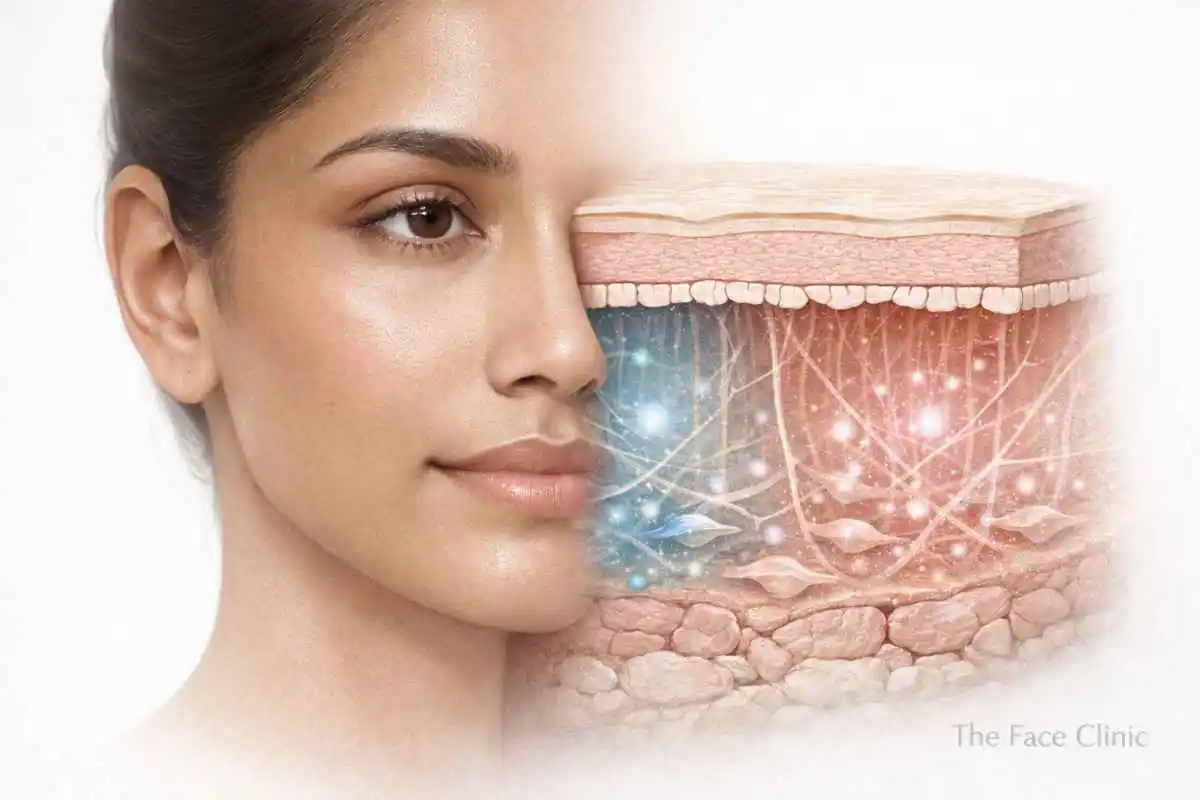
Rejuran Treatment in Delhi: Skin Booster, Results & Nucleofill Comparison
Rejuran is a polynucleotide-based injectable treatment used in aesthetic medicine for selected skin-quality concerns and facial wrinkles. Often referred to as the Rejuran Healer skin booster, it is of interest to patients seeking improvements in skin texture and the appearance of fine lines without primarily changing facial contours or restoring structural volume.
Rejuran is frequently compared with Nucleofill, another family of polynucleotide-based treatments. Although both are associated with skin-quality improvement, they differ in their formulations, product ranges and supporting clinical evidence.
Choosing between them involves more than comparing advertised benefits. Fine wrinkles, acne scars, reduced elasticity, pigmentation and structural facial ageing are different concerns that may require different treatments.
At The Face Clinic in Hauz Khas, South Delhi, Rejuran treatment and Nucleofill injections are personally administered by Dr Reema Arora, Founder and Medical Director. For patients considering Rejuran treatment in Delhi, consultation begins with an assessment of skin quality, treatment suitability and the appropriate formulation. Rejuran and Nucleofill treatment pricing starts from ₹35,000, with the final cost determined by the individual treatment plan.
This guide explains Rejuran treatment, Rejuran Healer injections, potential benefits, procedures, recovery, before-and-after expectations and costs. It also provides a detailed Rejuran vs Nucleofill comparison, including formulation differences and considerations relevant to patients in India.
Medically reviewed by Dr Reema Arora MBBS, MSc Facial Aesthetics (UK) Founder & Medical Director, The Face Clinic, New Delhi
Dr Reema Arora has over 20 years of experience in facial aesthetics and personally administers Rejuran and Nucleofill treatments at The Face Clinic. The formulation-specific statements and clinical interpretation in this guide have been reviewed by her.
View Dr Reema Arora’s professional profile.
This article is educational and does not replace individual medical assessment.
Rejuran Treatment in Delhi — Quick Facts
| Treatment | Rejuran polynucleotide injectable (Rejuran Healer skin booster) |
|---|---|
| Starting price | From ₹35,000; final cost depends on the treatment plan |
| Rejuran range | Rejuran, Rejuran I, Rejuran S and HB Plus; formulation chosen after assessment |
| Performed by | Dr Reema Arora, MBBS, MSc Facial Aesthetics (UK) |
| Clinic | The Face Clinic, LGF, C-36, Chaudhary Dilip Singh Marg, Hauz Khas Market, New Delhi 110016 |
| Clinic hours | Monday–Saturday, 10 AM–6 PM |
| Booking | Phone or WhatsApp: +91 99580 73900 |
Rejuran vs Nucleofill — At a Glance
Parameter | Rejuran | Nucleofill |
Manufacturer | PharmaResearch, South Korea | Promoitalia, Italy |
Principal material | Purified polynucleotides (PN) in the standard injectable | DNA-derived polynucleotide formulations |
Treatment focus | Selected wrinkle-related and skin-quality applications | Product-specific skin-quality and biostimulation applications |
Product range | Rejuran, Rejuran I, Rejuran S and HB Plus | Includes Nucleofill Medium, Strong, Soft Plus and Medium Plus |
Treatment approach | Formulation- and indication-specific | Formulation- and indication-specific |
Expected results | Depend on the clinical concern, product and individual response | Depend on the clinical concern, product and individual response |
Availability at The Face Clinic | Available; administered by Dr Reema Arora | Available; administered by Dr Reema Arora |
Both products belong to the broader field of polynucleotide-based aesthetic treatments. Neither should be regarded as universally more effective, safer or longer-lasting.
Their differences are best understood by comparing the specific formulations and the evidence relevant to the concern being treated.
For the full analysis, see Rejuran vs Nucleofill: What Are the Key Differences? later in this guide.
What Is Rejuran Treatment?
Rejuran is a branded injectable product family developed by South Korean manufacturer PharmaResearch.
The standard Rejuran injectable contains purified polynucleotides derived from processed salmonid DNA. Its manufacturer describes temporary improvement of facial wrinkles as the product’s intended purpose.
In aesthetic medicine, Rejuran is discussed within the broader category of injectable skin-quality treatments.
Unlike conventional volumising dermal fillers, Rejuran is not primarily selected to reshape facial contours, create projection or replace significant facial volume loss.
Its potential role depends on the formulation, the particular skin concern and the supporting clinical evidence.
What Is Rejuran Made Of?
The standard Rejuran injectable contains purified polynucleotide material, commonly abbreviated as PN.
Polynucleotides are chains of nucleotides, the molecular units that make up nucleic acids.
The material used in Rejuran is derived from processed salmonid DNA and prepared as a purified injectable formulation.
However, this does not mean that the injected material becomes human DNA or automatically integrates into a patient’s genetic material.
The relevance of PN treatment lies in its physical and biological properties and the clinical outcomes established for the particular formulation.
PharmaResearch identifies PN as the composition of its standard injectable in the official Rejuran product documentation.
How Does Rejuran Work in the Skin?
Research into polynucleotide-based treatments has explored their potential effects on tissue hydration, extracellular-matrix interactions, cellular responses and processes associated with tissue recovery.
These findings have contributed to interest in PN-based injectables within regenerative aesthetics.
However, a proposed biological mechanism is not equivalent to a demonstrated clinical result.
Laboratory findings must be distinguished from measurable improvements in patients, and studies involving one formulation should not automatically be generalised to another.
A published review, Polynucleotides in Aesthetic Medicine: A Review of Current Practices and Perceived Effectiveness, reported encouraging findings for selected aesthetic outcomes, including skin texture and wrinkle appearance.
The authors also identified variation between studies and the need for further research to establish optimal treatment applications.
Rejuran should therefore not be described as reversing skin ageing, guaranteeing collagen regeneration or repairing every type of skin damage.
Is Rejuran a PDRN Treatment or a Polynucleotide Treatment?
Rejuran is most precisely described as a polynucleotide-based injectable treatment.
PN stands for polynucleotide, while PDRN stands for polydeoxyribonucleotide.
These materials are related, but the terms should not automatically be treated as interchangeable product descriptions.
Their molecular characteristics, formulations and intended applications may differ.
The distinction is particularly important when comparing products marketed under the broader descriptions salmon DNA treatment, PDRN injection and polynucleotide skin booster.
For a broader explanation of DNA-derived skin-quality treatments, read our guide to PDRN treatment in Delhi.
This article focuses specifically on Rejuran and its comparison with Nucleofill.
Rejuran Skin Booster and Rejuran Healer Explained
The expression Rejuran skin booster is widely used to describe the skin-quality objectives associated with Rejuran treatment.
However, the terminology requires an important distinction.
Rejuran Healer is commonly used as a name for the PN-based injectable treatment. PharmaResearch also lists a separate product formally named REJURAN Skin Booster.
The latter has a different published composition, including c-PDRN, hyaluronic acid and amino acids.
The two names should therefore not be assumed to identify the same formulation.
What Is the Rejuran Healer Skin Booster?
Rejuran Healer is a commonly used treatment name associated with the standard PN-based Rejuran injectable.
It is discussed in relation to selected wrinkle-related and skin-quality concerns.
Rather than primarily changing facial structure, its intended role concerns the characteristics of the treated skin.
However, the extent of improvement depends on the specific indication, treatment protocol and individual response.
Rejuran Healer should not automatically be considered appropriate for deep acne scars, substantial laxity, pigmentation or significant facial volume loss.
What Is a Rejuran Healer Injection?
A Rejuran Healer injection involves administering the selected PN formulation using an appropriate technique determined by the treatment area and clinical indication.
The procedure may involve multiple injection points.
Temporary raised areas or other injection-site reactions may be visible immediately after treatment.
Before proceeding, the treating doctor should establish:
- The underlying skin concern.
- Whether the proposed formulation is suitable.
- Which anatomical area will be treated.
- What degree of improvement can reasonably be expected.
- Whether more than one session may be appropriate.
- What discomfort, downtime and risks should be anticipated.
At The Face Clinic, Rejuran injections are personally administered by Dr Reema Arora following clinical assessment.
Rejuran Healer, Rejuran I, Rejuran S and Rejuran HB Plus — What Is the Difference?
Rejuran is a product family, not one identical formulation used for every concern.
Formulation | Manufacturer-described characteristics | Clinical consideration |
Rejuran / Rejuran Healer | Standard PN injectable; intended for temporary improvement of facial wrinkles | Suitability depends on the wrinkle-related concern and treatment area |
Rejuran I | PN formulation with manufacturer-described applications involving the face, particularly the eye and perioral regions, and other selected areas | Anatomical assessment is especially important |
Rejuran S | PN formulation with temporary improvement of facial wrinkles listed as its intended purpose | Claims concerning scars or other indications require separate evidence |
Rejuran HB Plus | Contains sodium polynucleotide, sodium hyaluronate and lidocaine hydrochloride | The additional ingredients affect formulation-specific suitability |
PharmaResearch publishes separate documentation for Rejuran, Rejuran I, Rejuran S and Rejuran HB Plus.
Product-specific administration requirements, indications and regulatory status may differ between jurisdictions.
A formulation should not be selected solely because it belongs to the Rejuran product family.
How Does Rejuran Differ from Hyaluronic Acid Skin Boosters?
Many conventional skin boosters are based on hyaluronic acid and are considered for selected hydration and skin-smoothness concerns.
The standard Rejuran injectable uses PN as its principal material.
Certain variants, including HB Plus, also contain hyaluronic acid.
These treatments may address overlapping aspects of skin quality, but they differ in composition and supporting evidence.
A patient whose main concern is dehydration may therefore require a different approach from someone concerned about selected fine wrinkles or textural changes.
For a broader explanation of injectable skin-quality treatments, see our guide to skin booster treatments in Delhi.
The relevant question is which treatment addresses the underlying concern, rather than which injectable is currently more popular.
What Can Rejuran Treatment Help Improve?
Rejuran is considered for selected skin-quality and wrinkle-related concerns, with treatment suitability determined by the particular formulation and clinical indication.
The wider polynucleotide literature reports encouraging findings for certain measures of skin texture, wrinkles and elasticity. However, the evidence remains limited and varies across studies.
A systematic review published in the Journal of Cosmetic Dermatology included nine studies involving 219 patients. The researchers reported promising outcomes but classified the available evidence as low to moderate quality and identified a need for more rigorous studies.
Read: The Effectiveness of Polynucleotides in Esthetic Medicine: A Systematic Review.
These findings provide context for PN-based treatments generally. They do not establish identical results for every Rejuran formulation or indication.
Rejuran for Fine Lines, Skin Texture and Hydration
Patients considering Rejuran may be concerned about changes in skin appearance that occur without significant alteration of facial structure.
Depending on the formulation and clinical assessment, relevant concerns may include:
- Selected fine facial wrinkles.
- Uneven superficial texture.
- Changes in skin smoothness.
- Early concerns involving elasticity.
- Other skin-quality changes for which a PN-based injectable may be considered.
However, the underlying cause matters.
Fine wrinkles associated with skin-quality changes differ from dynamic lines produced predominantly by facial-muscle activity.
Similarly, dehydrated skin does not automatically require an injectable treatment.
Evidence supporting improvement in one parameter, such as wrinkle appearance, should not be interpreted as proof of equivalent improvement in every other parameter.
Can Rejuran Help Acne Scars and Post-Acne Skin?
Rejuran and related PN formulations are sometimes discussed in connection with selected scar-related applications.
However, post-acne concerns must be distinguished carefully.
Post-inflammatory hyperpigmentation involves pigmentation changes following inflammation.
Post-acne redness may involve persistent vascular or inflammatory changes.
Atrophic acne scars involve structural changes in the skin, which may present as rolling, boxcar or ice-pick scars.
These conditions do not necessarily respond to the same interventions.
Although certain polynucleotide products have been investigated for tissue-recovery and scar-related applications, the evidence for a specific formulation must be assessed separately.
Deep, tethered or structurally depressed scars may require treatments directed at the underlying scar architecture.
Rejuran should not be presented as a universal replacement for established acne-scar procedures.
Rejuran for Skin Elasticity and Early Signs of Ageing
Facial ageing involves changes in the skin and underlying anatomical structures.
These may include changes in elasticity, superficial wrinkles, facial fat compartments and structural support.
An injectable focused on skin quality cannot correct all these changes equally.
Rejuran may be considered for selected superficial concerns where the proposed formulation and evidence support its use.
However, it should not be expected to reproduce the structural effects of volumising fillers or procedures directed at significant tissue laxity.
The distinction is important because two patients describing their concern as skin ageing may have very different clinical requirements.
Is Rejuran Suitable for Sensitive or Inflamed Skin?
Sensitive skin is not a specific diagnosis.
Some patients experience irritation associated with skincare products. Others have active acne, rosacea, dermatitis or another inflammatory condition requiring medical management.
Although polynucleotides have been investigated for biological processes associated with tissue recovery, this does not establish injectable Rejuran as a treatment for every inflammatory skin condition.
Elective injections may need to be postponed in the presence of active infection or significant inflammation.
Treatment suitability depends on the diagnosis, medical history and selected product.
What Rejuran Cannot Reliably Correct
Rejuran should not be expected to provide substantial correction of:
- Significant facial volume loss.
- Deep structural facial folds.
- Pronounced skin laxity.
- Major facial contour deficiencies.
- Dynamic wrinkles caused predominantly by muscle activity.
- Established pigmentary disorders such as melasma.
- Deep or tethered acne scars.
Different concerns may coexist in the same patient.
A clinical assessment should determine which problem requires treatment before a product is selected.
Rejuran Injection: Procedure, Pain, Sessions and Recovery
Understanding the practical treatment experience is important when considering Rejuran injections.
Although the procedure is minimally invasive compared with surgery, it involves administration of an injectable product and requires appropriate medical assessment, informed consent and post-treatment care.
At The Face Clinic, Rejuran and Nucleofill injections are personally administered by Dr Reema Arora.
What Happens During a Rejuran Treatment?
A typical clinical pathway includes five stages.
- Consultation and skin assessment
The treating doctor examines the skin concern, anatomical area, relevant medical history and previous aesthetic treatments.
The consultation establishes whether the proposed injectable is appropriate or whether another approach deserves consideration.
- Formulation selection and informed consent
The proposed product, intended treatment objective, expected outcomes, alternatives and potential adverse effects are discussed.
- Skin preparation
The treatment area is cleaned using an appropriate antiseptic technique. Pain-management measures may be considered where clinically suitable.
- Injection administration
The selected product is administered according to the relevant formulation and treatment plan.
The technique, number of injection points and treatment extent vary according to the anatomical area and indication.
- Post-treatment assessment
The treated area is examined, recovery instructions are provided and follow-up arrangements are established where appropriate.
Are Rejuran Injections Painful?
Rejuran injections may cause discomfort.
Patients may experience stinging, pressure or tenderness during administration.
The degree of discomfort depends on individual sensitivity, treatment area, formulation and injection technique.
Appropriate pain-management measures may be considered.
Certain formulations contain additional ingredients relevant to treatment comfort. For example, Rejuran HB Plus contains lidocaine hydrochloride.
However, this does not mean that all Rejuran injections are painless.
The formulation must remain appropriate for the individual patient and intended treatment.
How Many Rejuran Sessions May Be Needed?
Rejuran is often discussed as a treatment delivered over more than one appointment.
However, no single treatment schedule should be applied to every formulation or indication.
The number and interval of sessions depend on the selected product, treatment area, baseline concern and individual response.
Some treatment plans involve an initial course followed by clinical reassessment.
Where multiple sessions are proposed, the anticipated course and associated costs should be discussed before treatment begins.
Are Small Bumps Normal After Rejuran Injections?
Small raised areas, sometimes described as injection-site papules, may occur immediately after certain intradermal injection techniques.
Temporary redness, swelling, bruising or tenderness may also be present.
These effects can settle during the early recovery period, but the extent and duration vary.
Persistent, worsening or unusual changes should be assessed by the treating clinician.
Temporary injection-site swelling should not be confused with the intended longer-term treatment outcome.
Rejuran Downtime and Aftercare
Recovery depends on the formulation, injection technique, treatment area and individual response.
Possible temporary effects include:
- Injection-site redness.
- Small raised papules.
- Localised swelling.
- Tenderness or sensitivity.
- Bruising.
Patients should receive procedure-specific aftercare instructions.
These may include guidance concerning skincare, makeup, sun exposure, exercise, treatment-area manipulation and the timing of other aesthetic procedures.
The treating clinician’s instructions should take precedence over generic online recovery schedules.
A treatment described as minimally invasive should not be assumed to produce an immediately presentable appearance in every patient.
Rejuran Side Effects, Risks and Contraindications
As with other injectable procedures, Rejuran involves potential risks.
Expected temporary reactions should be distinguished from complications.
Possible temporary effects | Symptoms requiring prompt medical assessment |
Mild redness | Increasing or disproportionate pain |
Small injection-site papules | Blanching or concerning dusky skin discolouration |
Limited bruising | Progressively worsening swelling |
Temporary tenderness | Spreading redness, fever or other signs of infection |
Mild localised swelling | Visual disturbance or sudden neurological symptoms |
Any visual disturbance or symptoms suggesting vascular compromise following facial injections require immediate emergency medical assessment.
Other possible complications include infection, hypersensitivity reactions, persistent nodules and other injection-related adverse events.
Before treatment, the doctor should assess relevant medical conditions, allergies, medications, previous treatment reactions and active skin disease.
Patients with a history of fish allergy should disclose it because Rejuran’s principal material is derived from processed salmonid DNA. The significance of that allergy requires individual and product-specific assessment.
Pregnancy and breastfeeding also warrant particular caution where adequate safety information for the specific injectable is unavailable.
Appropriate patient selection, anatomical knowledge and clinical technique help manage procedural risk, but do not eliminate the possibility of complications.
Rejuran Before and After: Results and Expectations
Patients researching Rejuran before and after are often trying to understand what visible changes may occur and how much improvement they should realistically expect.
The answer depends on the product used, treatment indication, baseline skin condition and individual response.
A treatment considered for selected fine wrinkles cannot automatically be expected to produce equivalent improvement in established acne scars, pigmentation or substantial skin laxity.
What Results Have Clinical Studies Reported?
Published polynucleotide studies have reported encouraging findings for selected aesthetic outcomes, including aspects of wrinkle appearance, skin texture and elasticity.
However, the evidence varies in study design, formulation, treatment protocol, patient population and duration of follow-up.
The systematic review cited earlier included 219 patients across nine studies and identified substantial limitations in the existing evidence.
These findings support cautious discussion of PN treatment potential, but they do not establish a predictable result for every Rejuran patient.
They also do not demonstrate that Rejuran is clinically superior to Nucleofill.
What Changes May Be Noticeable During a Treatment Course?
It is useful to distinguish immediate injection effects from subsequent treatment outcomes.
Stage | What may be observed |
Immediately after treatment | Injection-site marks, raised areas, redness or swelling |
Early recovery | Gradual settling of temporary injection-site effects |
During the prescribed course | Possible changes in selected skin-quality parameters |
At clinical follow-up | Assessment of the intended outcome and individual response |
Longer-term | Consideration of maintenance or another treatment approach |
This describes the treatment journey rather than a guaranteed improvement timeline.
The appearance of temporary swelling should not be interpreted as evidence of lasting rejuvenation.
How Long Do Rejuran Results Last?
There is no single duration that reliably applies to every Rejuran formulation or clinical indication.
Longevity may depend on the product, treatment protocol, baseline concern and individual response.
Some patients may be considered for maintenance treatment following reassessment.
However, maintenance should not be assumed necessary at a fixed interval for everyone.
Long-term evidence remains less comprehensive than the shorter-term findings available for certain polynucleotide applications.
How Should Rejuran Before-and-After Photographs Be Interpreted?
Before-and-after photographs can be useful when they accurately document the treatment performed.
Important considerations include:
- Whether the same formulation was used.
- The number of sessions.
- The interval between treatment and follow-up.
- Comparable lighting, facial expression and camera positioning.
- Whether temporary injection-related swelling had resolved.
- Whether other aesthetic procedures were performed.
A photograph showing smoother skin cannot establish that Rejuran alone produced the improvement if several interventions were used.
Likewise, one patient’s outcome cannot predict another person’s results.
Rejuran vs Nucleofill: What Are the Key Differences?
Rejuran and Nucleofill are frequently compared because both are associated with polynucleotide-based injectable treatments.
Their principal similarities concern their broad material category and their use in selected skin-quality applications.
However, the two product families differ in manufacturer, formulation, physical characteristics and documented intended uses.
The comparison should not be reduced to the idea that Rejuran is exclusively for skin repair while Nucleofill is exclusively for firmness.
Those descriptions oversimplify overlapping treatment objectives and do not establish comparative clinical superiority.
What Is Nucleofill and How Does It Work?
Nucleofill is a branded family of DNA-derived polynucleotide products associated with Italian manufacturer Promoitalia.
The range includes formulations such as Nucleofill Medium, Strong, Soft Plus and Medium Plus.
Promoitalia describes its products in relation to skin-quality and biostimulation applications, including hydration and elasticity-related objectives.
The manufacturer’s range also uses terminology involving polydeoxyribonucleotide-based preparations, demonstrating why exact product identification matters when discussing PN and PDRN.
These manufacturer descriptions establish how the products are presented and their intended applications. They should not be treated as independent proof of every advertised clinical outcome.
See the official Nucleofill product range.
Rejuran vs Nucleofill — Composition and Formulation
The standard Rejuran injectable contains PN.
Nucleofill comprises DNA-derived polynucleotide formulations that vary across the product range.
Although the materials are related, their processing, concentration, presentation and physical characteristics are not necessarily identical.
Individual products within each family may also differ.
For example, Rejuran HB Plus contains sodium hyaluronate and lidocaine in addition to sodium polynucleotide.
The Nucleofill range includes formulations intended for different treatment applications.
However, a higher stated concentration or a particular physical property does not automatically establish better clinical results.
Comparative claims should be supported by evidence involving the actual formulations and clinical indication.
Rejuran vs Nucleofill — Detailed Clinical Comparison
Clinical consideration | Rejuran | Nucleofill |
Manufacturer | PharmaResearch, South Korea | Promoitalia, Italy |
Principal material | PN in the standard injectable | DNA-derived polynucleotide formulations |
Product variants | Rejuran, I, S and HB Plus | Includes Medium, Strong, Soft Plus and Medium Plus |
Additional ingredients | Differ by formulation; HB Plus includes HA and lidocaine | Depend on the selected product |
Documented intended uses | Product-specific, including selected facial wrinkle applications | Product-specific skin-quality and biostimulation applications |
Fine wrinkles | Relevant to certain formulations and indications | Requires assessment against the particular formulation and evidence |
Skin texture | Potential treatment consideration, subject to evidence | Potential treatment consideration, subject to evidence |
Hydration | Depends on the formulation and indication | Included in manufacturer-described treatment objectives |
Elasticity | Requires formulation-specific clinical interpretation | Included in manufacturer-described treatment objectives |
Acne scars | Requires scar-specific assessment and appropriate evidence | Requires scar-specific assessment and appropriate evidence |
Under-eye concerns | Certain formulations have relevant manufacturer-described applications | Specific formulations may have relevant applications |
Substantial skin laxity | Not a replacement for structural lifting | Not a replacement for structural lifting |
Treatment course | Formulation- and patient-dependent | Formulation- and patient-dependent |
Downtime | Temporary injection-site reactions may occur | Temporary injection-site reactions may occur |
Duration of results | Not established as universally longer-lasting | Not established as universally longer-lasting |
Treatment selection | Clinical assessment | Clinical assessment |
The most important distinction is between a product’s intended purpose, its manufacturer-described benefits and outcomes demonstrated in clinical studies.
These are related, but they are not interchangeable forms of evidence.
The currently available evidence does not establish one universal clinical winner between Rejuran and Nucleofill across all aesthetic indications.
Rejuran vs Nucleofill for Acne Scars, Fine Lines and Skin Laxity
The appropriate treatment depends on the underlying problem.
Acne scars
Established acne scars differ in depth, structure and tissue involvement.
A superficial irregularity is not equivalent to a deep, tethered scar.
Neither Rejuran nor Nucleofill should automatically be presented as the preferred treatment for all acne scars.
A scar-specific assessment is required.
Fine lines
Fine lines may result from superficial skin-quality changes, repeated facial-muscle activity or a combination of factors.
Certain Rejuran formulations have documented wrinkle-related intended uses. Nucleofill products have their own formulation-specific applications.
The treatment choice should reflect the anatomical area, underlying cause and available evidence.
Skin laxity
Early changes in elasticity differ from substantial structural sagging.
Although Nucleofill is marketed in connection with biostimulation, this does not establish that it is universally preferable to Rejuran for patients concerned about laxity.
Neither product should be represented as a substitute for treatment directed at significant structural changes.
Which May Be Considered for Indian Skin?
Indian patients have diverse skin tones, anatomical characteristics and clinical concerns.
Treatment planning may involve consideration of:
- Fitzpatrick skin type.
- History of post-inflammatory hyperpigmentation.
- Active acne or inflammatory skin disease.
- Existing pigmentary concerns.
- Skin thickness and treatment area.
- Previous injectable or energy-based procedures.
- Individual response to earlier treatments.
- Degree of photoageing.
Patients with more heavily pigmented skin may be susceptible to post-inflammatory pigmentation following certain inflammatory or injurious procedures.
However, this does not mean that every Indian patient has the same risk or that either PN brand is inherently more suitable for darker skin tones.
The procedural approach, skin condition and medical history are more informative than nationality alone.
For patients in Delhi, cumulative sun exposure, skincare practices and relevant environmental factors may also inform the broader assessment.
These considerations do not establish either product as an anti-pollution treatment or a universal solution for pigmentation.
Rejuran vs Nucleofill — Results, Sessions and Downtime
Both product families may be used within planned treatment courses involving more than one appointment.
However, session numbers and intervals should not be generalised across every formulation.
The treatment course depends on the specific product, clinical indication and individual response.
Similarly, both may produce temporary injection-site effects, including redness, tenderness, swelling, bruising or raised areas.
Recovery varies according to formulation, technique and patient factors.
Neither brand can be described as consistently faster, longer-lasting or associated with less downtime without reliable comparative evidence.
How Does Dr Reema Arora Choose Between Rejuran and Nucleofill?
At The Face Clinic, both treatments are available and personally administered by Dr Reema Arora.
Treatment selection begins with the patient’s principal concern rather than the popularity of a particular brand.
The clinical assessment considers several questions.
Is the main concern skin quality or facial structure?
Fine textural changes and selected superficial wrinkles require different considerations from substantial volume loss or pronounced tissue laxity.
Is an underlying skin condition present?
Inflammatory acne, dermatitis, infection, pigmentation disorders or established scarring may require diagnosis or another treatment approach.
Which anatomical area is being considered?
The face, periocular region and neck differ in anatomy and procedural considerations.
The proposed product must be appropriate for the intended treatment.
What does the evidence support?
General PN research offers useful context, but clinical decisions should consider the actual formulation, indication and available product-specific evidence.
Would another approach be more appropriate?
Some patients may benefit from skincare, treatment of an underlying dermatological condition, a different injectable category or another procedure.
The objective is to choose an appropriate intervention rather than to select a brand name before identifying the problem.
Can Rejuran and Nucleofill Be Combined?
The fact that both treatments use related DNA-derived materials does not establish that combining them produces superior outcomes.
A staged or combination approach should have a specific clinical rationale.
Product compatibility, anatomical considerations, treatment timing and safety must be assessed individually.
Combination treatment should not be presented as routinely necessary.
Rejuran Injection Price in Delhi and India
The price of Rejuran treatment depends on the selected formulation, quantity required, anatomical area and proposed treatment course.
Patients comparing Rejuran injection prices should distinguish the advertised starting cost from the total expense of a proposed course.
The same principle applies to Nucleofill.
Rejuran and Nucleofill Treatment Cost at The Face Clinic
Rejuran and Nucleofill treatments at The Face Clinic in Hauz Khas, New Delhi, start from ₹35,000.
Both treatments are personally administered by Dr Reema Arora.
The final quotation depends on the formulation selected, treatment area, quantity required and individual clinical plan.
Where multiple sessions are recommended, the expected overall treatment expense should be discussed during consultation.
What Determines the Rejuran Injection Price?
Pricing factor | Why it matters |
Product formulation | Different products may have different specifications and costs |
Product quantity | The amount required varies by treatment plan |
Treatment area | Different areas can require different approaches |
Number of sessions | Total cost depends on the planned course |
Consultation and follow-up | Included services should be established when comparing quotations |
A price for one limited-area treatment should not automatically be compared with the cost of a full-face procedure or a complete multi-session course.
Does Rejuran Healer Pricing Differ from Other Formulations?
It may.
Different formulations have different presentations and intended applications.
The amount of product required for the proposed treatment may also vary.
Patients researching Rejuran injection price in India should therefore establish which formulation is being quoted, what quantity is included and whether the quotation covers one appointment or a full course.
At The Face Clinic, Rejuran and Nucleofill treatments start from ₹35,000, with the final plan determined following assessment.
Frequently Asked Questions About Rejuran and Nucleofill
Is Rejuran Better Than Nucleofill?
Neither product family has been established as universally superior for every skin concern.
The relevant differences depend on the particular formulation, indication and supporting clinical evidence.
At The Face Clinic, Dr Reema Arora assesses the underlying concern before recommending an appropriate treatment.
Is Rejuran Healer Different from Rejuran I?
Yes.
The standard Rejuran injectable and Rejuran I have separate manufacturer product specifications.
Rejuran I has manufacturer-described applications involving delicate facial areas, including the periocular region.
They should not be regarded as interchangeable solely because they share the same brand name.
Can Rejuran Be Used Under the Eyes?
Certain Rejuran formulations have manufacturer-described periocular applications.
However, fine lines, pigmentation, puffiness and structural hollowing are different under-eye concerns.
An anatomical and clinical assessment is required to determine whether a particular formulation is appropriate.
Can Rejuran Replace Dermal Fillers or Anti-Wrinkle Injections?
Not for every indication.
Conventional volumising fillers are commonly used to address selected structural and volume-related concerns.
Neuromodulator-based anti-wrinkle injections address muscle activity through a different mechanism.
Rejuran has a different composition and treatment purpose. It should not be expected to reproduce the effects of either treatment category.
How Much Does a Rejuran Healer Injection Cost in Delhi?
Rejuran and Nucleofill treatment pricing at The Face Clinic, Hauz Khas, starts from ₹35,000.
The final cost depends on the formulation, quantity, treatment area and proposed course.
Both treatments are personally administered by Dr Reema Arora.
What Is the Difference Between Rejuran and Plenhyage?
Rejuran and Plenhyage are distinct branded products associated with the broader polynucleotide injectable category.
Their exact formulations, manufacturer documentation, intended uses and available evidence should be compared before considering them alternatives.
Sharing a broad material category does not make them identical treatments.
Is Nucleofill Better for Mature Skin?
Chronological age alone does not establish which treatment is appropriate.
The underlying skin concern, anatomical area, individual characteristics and intended treatment objective are more relevant.
A patient with substantial laxity may require a different approach from someone of the same age with selected superficial wrinkles.
Can Rejuran and Nucleofill Be Used in the Same Treatment Plan?
A clinician may consider staged or combination treatment in selected circumstances.
However, combining related injectables does not automatically improve results.
Any proposed combination requires an appropriate clinical rationale, product-specific safety considerations and individual assessment.
Rejuran Treatment in Delhi — Dr Reema Arora at The Face Clinic
Rejuran and Nucleofill Injections in Hauz Khas, South Delhi
Rejuran and Nucleofill offer different formulation choices within the broader field of polynucleotide-based aesthetic treatments.
Understanding their composition and potential applications is useful, but identifying the underlying skin concern remains the starting point for an appropriate treatment decision.
Fine wrinkles, changes in texture, acne scars, pigmentation, structural volume loss and skin laxity are not interchangeable problems.
A patient seeking improvement in superficial skin quality may therefore require a different approach from someone concerned about significant facial ageing or established scarring.
At The Face Clinic in Hauz Khas, South Delhi, both Rejuran and Nucleofill treatments are personally administered by Dr Reema Arora, Founder and Medical Director.
With over 20 years of experience in facial aesthetics, Dr Reema brings an assessment-led approach to injectable treatment planning.
During consultation, the skin concern, medical history, anatomical considerations and realistic treatment objectives are evaluated before recommending a particular formulation.
Where appropriate, the consultation also addresses the proposed treatment course, potential adverse effects, expected recovery and alternatives.
Rejuran and Nucleofill treatment pricing starts from ₹35,000, with the final quotation determined by the individual treatment plan.
Arrange a Consultation at The Face Clinic
The Face Clinic — Dr Reema Arora Founder & Medical Director
LGF, C-36, Chaudhary Dilip Singh Marg Hauz Khas Market New Delhi – 110016
Clinic hours: Monday–Saturday, 10 AM–6 PM Phone: +91 99580 73900
Request a Rejuran or Nucleofill Consultation via WhatsApp
A consultation provides an opportunity to establish whether Rejuran, Nucleofill or a different treatment approach is appropriate for the patient’s concerns.
Treatment suitability and outcomes vary. A particular result cannot be guaranteed
Clinical References and Product Information
The following sources support the formulation descriptions and broader scientific discussion in this article.
- PharmaResearch — Rejuran
Manufacturer documentation identifying the standard PN injectable and its intended purpose.
Official Rejuran product information
- PharmaResearch — Rejuran I, Rejuran S and Rejuran HB Plus
Product-specific documentation describing their respective compositions and published intended uses.
Rejuran I · Rejuran S · Rejuran HB Plus
- PharmaResearch — REJURAN Skin Booster
Documentation distinguishing the separately named c-PDRN, hyaluronic-acid and amino-acid formulation from the standard PN injectable.
Official REJURAN Skin Booster information
- Promoitalia — Nucleofill Range
Manufacturer information describing Nucleofill formulations and product positioning.
Official Nucleofill product range
- Lee et al. — Polynucleotides in Aesthetic Medicine: A Review of Current Practices and Perceived Effectiveness
International Journal of Molecular Sciences, 2024.
A review discussing the existing clinical literature, proposed applications and limitations of evidence involving polynucleotide treatments.
- Lampridou et al. — The Effectiveness of Polynucleotides in Esthetic Medicine: A Systematic Review
Journal of Cosmetic Dermatology, 2025; published online December 2024.
A systematic review of nine studies involving 219 patients, reporting promising results while identifying limitations in evidence quality and treatment standardisation.
Manufacturer statements, general polynucleotide research and evidence for a particular injectable formulation should be interpreted separately. The information above does not establish comparative superiority or confirm regulatory authorisation for every product and indication in India.
All treatments are subject to individual variation. Outcomes are determined following clinical evaluation by a qualified doctor.