

Non-Surgical Chin Augmentation in India: What Fillers Can—and Cannot—Change
A chin that appears small or recessed does not always need more volume.
Sometimes the main concern is limited forward projection. In other faces, vertical chin proportions, asymmetry, fullness beneath the chin or the underlying position of the lower jaw may contribute more to the appearance.
Those distinctions matter because similar-looking profiles can require very different treatment considerations.
Non-surgical chin augmentation uses injectable dermal fillers to modify selected aspects of chin shape, projection and contour without an operation. In appropriately selected patients, it may improve profile balance and lower-face proportions. It cannot, however, reposition the jawbone, correct a dental bite problem or directly treat every cause of fullness beneath the chin.
For someone considering non-surgical chin augmentation in India, the most useful starting question is therefore not simply, “Can filler make my chin bigger?” It is:
What is making the chin appear small or recessed—and is adding soft-tissue volume the appropriate way to address it?
What Is Non-Surgical Chin Augmentation?
Non-surgical chin augmentation—also described as injectable chin augmentation or chin enhancement without surgery—is an aesthetic treatment in which dermal filler is used to alter selected aspects of the visible chin contour.
Hyaluronic acid (HA) fillers are commonly used for this purpose. Different formulations have different physical properties, and product selection should reflect the intended correction, tissue characteristics and individual treatment plan.
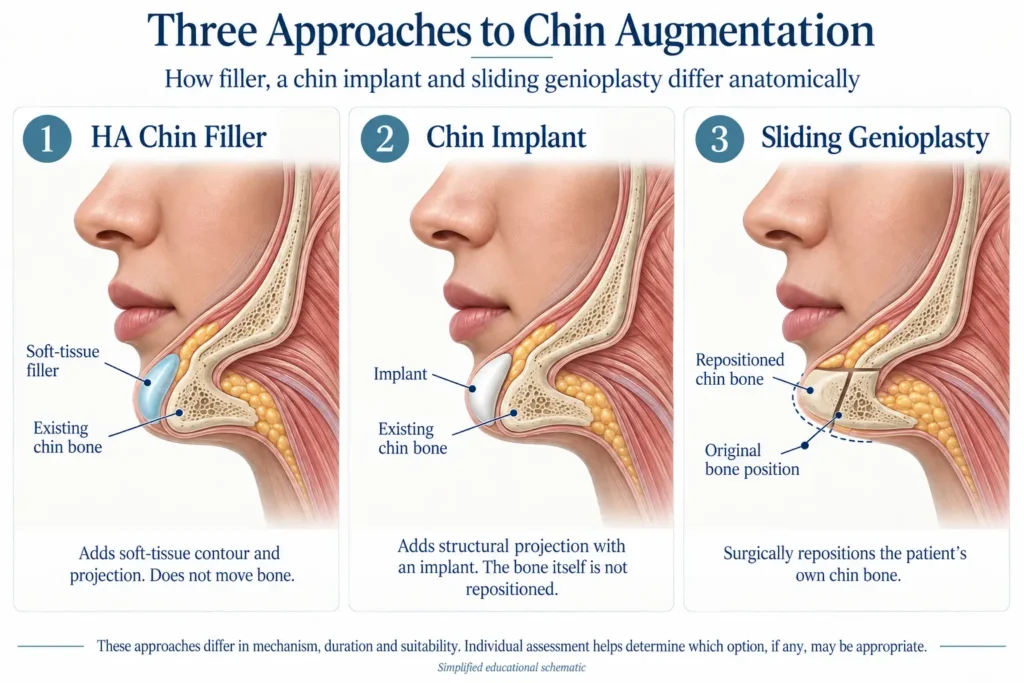
Unlike a chin implant or sliding genioplasty, chin augmentation with fillers does not surgically reposition or alter the underlying bone. Its effect comes from changing the volume and contour of the soft tissues over and around the chin.
How Does Chin Augmentation With Fillers Work?
Treatment begins with assessment of the chin in relation to the rest of the face.
Depending on the anatomy and objective, filler may be considered to:
- improve visible forward projection;
- modify selected aspects of chin shape;
- refine a limited asymmetry;
- influence the apparent vertical dimension of the chin; or
- improve the visual transition between the chin and adjoining lower face.
The objective should not simply be to make the chin larger.
A change in chin projection can influence how the lips, nose, jawline and neck are perceived in profile. For that reason, chin augmentation is better understood as a facial-proportion treatment than as an exercise in adding volume.
Why Does a Chin Look Small or Recessed? Three Anatomical Distinctions
“Weak chin,” “small chin” and “recessed chin” describe appearance. They do not necessarily describe the same underlying anatomy.
Two people may have similar-looking profiles while the reason for that appearance—and therefore the treatment discussion—is quite different.
1. The Chin Lacks Visible Forward Projection
Forward projection refers to how far the visible chin extends in profile relative to the surrounding facial structures.
When projection is relatively limited, the chin may appear to sit behind the lips, the nose may look more prominent by comparison, and the transition between the chin and neck may appear less defined.
In an appropriately selected patient, dermal filler may improve that visible projection by adding targeted soft-tissue support.
However, an under-projected chin contour is not necessarily the same as significant retrusion of the lower jaw.
Filler can alter the visible profile. It cannot move the mandible forward.
2. The Chin Looks Small Because of Its Proportions or Surrounding Tissues
Not every small-looking chin primarily lacks forward projection.
Vertical chin height, the relationship between the lower lip and chin, natural asymmetry and the tissues beneath the chin can all influence lower-face appearance.
For example, submental fullness or skin laxity may obscure an otherwise adequately projected chin. In that situation, simply adding more chin volume may not address the feature the patient actually wants to change.
Improving projection can sometimes alter the visual relationship between the chin and neck, but filler does not directly remove submental fat or tighten substantially loose skin.
Where fullness beneath the chin is the predominant concern, assessment of double chin treatment may therefore be more relevant.
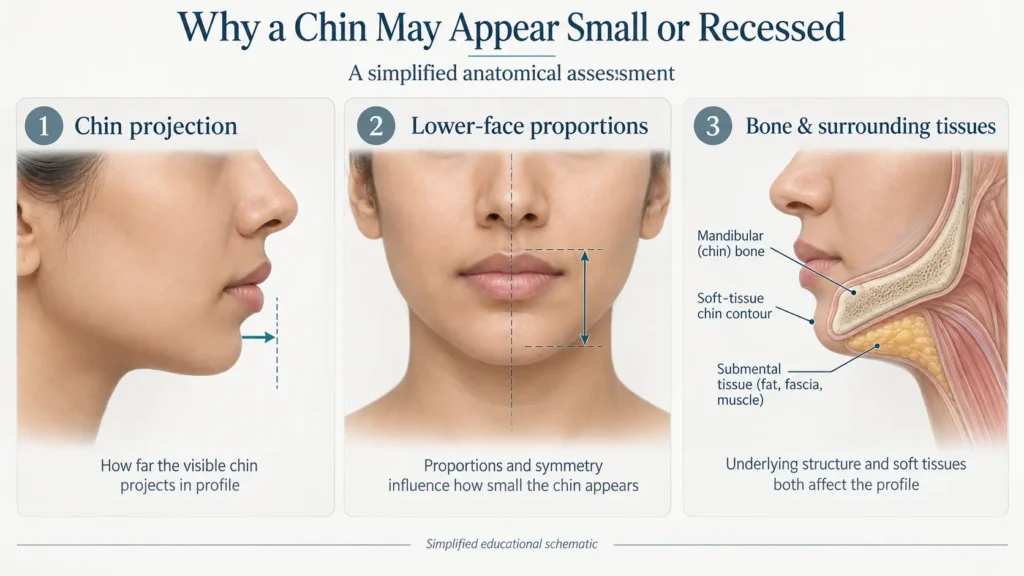
3. The Apparent Deficiency Involves the Underlying Skeletal Relationship
A recessed-looking chin may sometimes reflect the position or form of the underlying mandible rather than a localised soft-tissue contour deficiency.
In some patients, this can coexist with a dental bite discrepancy. In others, the concern relates more specifically to the bony chin itself.
Dermal filler cannot reposition the jaw or correct dental occlusion—the way the upper and lower teeth meet.
Where the apparent deficiency is substantial, or where a bite or functional concern is present, evaluation by an appropriately qualified maxillofacial, orthodontic or surgical specialist may be relevant.
It is also important to distinguish repositioning of the chin bone from correction of the jaws. Sliding genioplasty can move the bony chin segment, but it does not by itself correct a malocclusion caused by a broader jaw relationship.
The appropriate approach depends on the individual anatomical findings and treatment objective.
A chin can therefore appear small or recessed for more than one reason. The illustration below brings together three relationships considered during assessment: visible chin projection, lower-face proportions, and the position of the underlying bone and surrounding soft tissues. These factors can overlap, which is why appearance alone does not determine whether chin filler is appropriate.
What Can Chin Fillers Actually Change?
Chin fillers are most useful when the desired improvement can reasonably be achieved through soft-tissue augmentation.
Chin Projection and Side-Profile Balance
In suitable patients, filler can increase the apparent forward projection of the chin.
Even a relatively modest change may alter the visual relationship between the chin, lips and nose.
The aim should be proportionate improvement rather than maximum projection. Adding more filler does not automatically create a better or more natural-looking result.
Chin Shape and Selected Asymmetries
Injectable augmentation may help modify a relatively rounded, narrow or uneven chin contour when the underlying anatomy is suitable.
Selected differences in symmetry or apparent vertical dimensions may also be amenable to treatment.
However, filler cannot reliably correct asymmetry that primarily results from significant skeletal or jaw-position differences.
Perfect symmetry is neither a realistic nor a necessary treatment objective.
Lower-Face and Jawline Definition
The chin forms the anterior part of the lower-face contour, so its projection can influence how the adjoining jawline is perceived.
Improving an under-projected chin may therefore make the lower face appear more balanced.
Chin augmentation and jawline augmentation are not, however, interchangeable. If the concern extends along the mandibular border, jawline fillers in Delhi may need to be assessed as a separate treatment objective.
For clinic-specific information about injectable chin treatment, expected outcomes and consultation, see chin fillers in Delhi.
When Is Chin Filler Not the Right Solution?
A preference for avoiding surgery does not automatically make filler the correct alternative.
Non-surgical chin augmentation may be inappropriate or insufficient when the desired correction involves:
- significant skeletal or mandibular retrusion;
- an associated bite or functional problem;
- substantial submental fat or skin laxity;
- a degree of projection that cannot reasonably be produced with soft-tissue augmentation; or
- a preference for a permanent structural change.
There are also situations in which the most appropriate recommendation may be a different treatment, specialist referral or no treatment at all.
The relevant question is therefore not whether filler can be placed. It is whether filler can reasonably address the anatomical concern and the result the patient is seeking.
Chin Filler vs Chin Implant vs Sliding Genioplasty
Non-surgical and surgical forms of chin augmentation can all change the appearance of the chin, but they do so in fundamentally different ways.
Consideration | HA Chin Filler | Chin Implant | Sliding Genioplasty |
|---|---|---|---|
How it works | Adds soft-tissue volume and contour | Places an implant over the chin bone | Surgically repositions part of the patient’s own chin bone |
Surgery required | No | Yes | Yes |
Typical objective | Selected projection and contour refinement | Structural augmentation without moving the bone itself | Structural repositioning of the bony chin |
Duration | Temporary and product-/patient-dependent | Long-lasting; revision or removal may be possible | Structural change is generally permanent |
Recovery | Usually shorter; swelling or bruising may occur | Surgical recovery | More involved surgical recovery |
Corrects a bite problem | No | No | Not by itself |
Important considerations | Limited degree of correction, maintenance and injection-related risks | Implant- and surgery-related risks | Surgical complexity and possible neurosensory effects |
The American Society of Plastic Surgeons discusses the distinction between implants and sliding genioplasty in its overview of surgical options for a small or recessed chin.
How Do You Decide Between Fillers and Surgery?
The choice depends primarily on what needs to change.
For a patient seeking a limited, temporary change in visible chin projection, filler may be worth considering if the anatomy is suitable.
For someone seeking greater or permanent structural change, a surgical assessment may be more relevant.
And where the apparent deficiency is part of a broader lower-jaw or bite relationship, assessment may need to extend beyond the chin altogether.
A 2026 systematic review comparing surgical and non-surgical chin augmentation evaluated 56 studies involving 4,844 patients. Both categories produced favourable aesthetic outcomes in selected patients, but they had different durability and complication profiles. Importantly, the researchers also found substantial limitations and heterogeneity in the available evidence and did not identify one universally superior technique.
That supports an individualised, anatomy-led decision rather than a blanket preference for either fillers or surgery.
How Is Non-Surgical Chin Augmentation Assessed?
At The Face Clinic, chin augmentation is considered within the wider context of facial anatomy, proportions and the change the patient is hoping to achieve.
The assessment should answer four practical questions.
1. What Is Creating the Visible Concern?
The chin is considered from frontal and profile views, including:
- forward projection;
- vertical proportions;
- contour and asymmetry;
- surrounding lower-face tissues;
- the relationship with the jawline and neck; and
- whether the appearance may reflect a more substantial skeletal relationship.
Relevant medical history, previous injectable treatments and the patient’s expectations are also important.
2. What Exactly Are We Trying to Change?
Improving forward projection is not the same objective as increasing apparent chin length.
Refining a localised contour difference is not the same as treating fullness beneath the chin.
Defining the treatment objective helps avoid adding volume simply because the chin appears small.
3. Can Filler Reasonably Achieve That Change?
This is the central clinical decision.
A patient may request chin filler because the jawline appears poorly defined, but the dominant contributor may instead be submental fullness, skin laxity, mandibular contour or a combination of factors.
Treating the chin alone may therefore fail to address the original concern.
Likewise, where the degree of skeletal retrusion exceeds what soft-tissue augmentation can reasonably camouflage, further filler is not necessarily the answer.
4. What Would a Proportionate Result Look Like?
Treatment planning should respect the patient’s existing facial features rather than reproduce a standardised profile or fashionable chin shape.
The proposed correction, filler selection, limitations, foreseeable risks and expected longevity should be discussed before treatment.
A reasonable outcome can be planned. A particular aesthetic result cannot be guaranteed.
A Simple Clinical Example
Consider two people who both describe their chin as “weak.”
The first has relatively limited forward chin projection with otherwise suitable facial relationships and wants a modest profile refinement. Following assessment, filler may be appropriate to discuss.
The second has more substantial lower-jaw retrusion associated with a bite discrepancy. Adding volume to the chin may alter the contour without addressing the underlying skeletal relationship.
Their initial complaint sounds similar. Their treatment considerations are not.
The principle is simple: identify the anatomical cause before deciding whether adding volume is appropriate.
What Happens During Non-Surgical Chin Augmentation?
Treatment begins with consultation, facial assessment and agreement on the intended correction.
If injectable augmentation is considered appropriate and the patient chooses to proceed, the filler and treatment plan are selected according to the anatomy and clinical objective.
The procedure is performed in a clinical setting. Measures used to reduce discomfort may include topical or local anaesthesia depending on the product and treatment plan.
Temporary swelling, tenderness, redness or bruising can affect the initial appearance, so the result immediately after injection should not necessarily be regarded as the final settled outcome.
Many patients are able to return to routine activities relatively quickly, although visible swelling or bruising may affect individual recovery.
Follow-up may be used to evaluate how the result settles. Additional filler should not be considered automatic; any further treatment should follow reassessment of the existing contour, remaining product and original objective.
Non-Surgical Chin Augmentation Results: How Long Do Chin Fillers Last?
The result of chin augmentation varies according to the patient’s anatomy, the product used, the treatment plan and individual response.
Hyaluronic acid chin fillers are temporary, but there is no single duration that applies to every product or patient.
What Does the Clinical Evidence Show?
A 2024 randomized clinical study of hyaluronic acid chin augmentation examined a specific HA filler in Chinese adults with mild-to-moderate chin retrusion.
At six months, 81% of treated participants met the study’s definition of improvement compared with 5% of untreated controls; 61% of the initially treated group maintained that level of improvement at 12 months.
Those figures are useful evidence for the product and population studied. They should not be interpreted as a prediction that every filler or patient will have the same result or duration.
More recently, a 2026 systematic review of injectable filler-based chin augmentation included 11 studies and 876 patients. It found generally favourable short-term aesthetic outcomes and high reported satisfaction, while also noting that the evidence was heterogeneous and largely non-comparative, limiting stronger conclusions about long-term outcomes.
Will I Need Maintenance Treatment?
Not necessarily according to a predetermined timetable.
The visible effect of HA filler may gradually diminish as the material changes and is broken down. Persistence varies between individuals and products, and visible correction does not always correspond to a simple fixed “expiry date.”
Future treatment should therefore be based on reassessment rather than an automatic schedule.
Repeated augmentation without evaluating the existing contour and any residual product can result in unnecessary volume.
Is Non-Surgical Chin Augmentation Safe?
Dermal filler treatment is a medical procedure. It carries expected temporary effects as well as uncommon but potentially serious complications.
Appropriate patient selection, anatomical knowledge, product choice, sterile technique, informed consent and the ability to recognise and manage complications are all important aspects of care.
None makes treatment completely risk-free.
Common and Less Common Side Effects
Temporary effects can include swelling, bruising, redness, tenderness and discomfort.
Less common complications can include infection, persistent inflammation, nodules, asymmetry or contour irregularities. Some reactions may occur later rather than immediately after treatment.
Vascular Complications
A particularly important but uncommon complication of facial filler treatment is unintended injection into, or obstruction of, a blood vessel.
This can impair blood supply and cause tissue injury. Serious complications reported with facial dermal fillers include tissue necrosis, visual injury including blindness, and stroke.
The FDA guidance on dermal fillers describes these recognised risks and advises urgent medical attention for symptoms such as unusual pain, skin blanching or colour change, visual symptoms or signs suggestive of stroke.
Risk is not identical across every facial injection site, but the potential severity of vascular complications is why filler treatment should not be presented as risk-free.
Can Hyaluronic Acid Chin Filler Be Reversed?
HA filler can often be dissolved or reduced with hyaluronidase when clinically appropriate.
That does not mean every result or complication can be completely or predictably reversed.
The FDA also notes that removal of filler may sometimes require additional interventions and that some filler materials can be difficult or impossible to remove.
“Reversible” should therefore be understood as a property of HA filler that may provide treatment options in appropriate circumstances—not as a guarantee that all effects of treatment can simply be undone.
How Much Does Non-Surgical Chin Augmentation Cost in India?
There is no single price for every chin augmentation because treatment requirements differ between patients.
Cost may be influenced by the filler selected, amount required, anatomy, degree of correction and complexity of the treatment plan.
At The Face Clinic, the current indicative range for chin filler treatment is ₹20,000–₹70,000 per session, with an exact quotation provided after assessment. The same range is published on the clinic’s dedicated Chin Fillers service page.
An injectable treatment may have a lower upfront cost than surgery, but that is not the entire comparison. HA fillers are temporary, so longer-term cost may also include future reassessment and maintenance if desired.
For the clinic’s current pricing information, see chin filler cost in Delhi.
Frequently Asked Questions About Non-Surgical Chin Augmentation
Can chin fillers correct a severely recessed chin?
Not every recessed chin is suitable for correction with filler.
Injectable augmentation may improve selected soft-tissue contour deficiencies, but it cannot move a substantially retruded lower jaw or correct a bite problem. More pronounced skeletal concerns may require an appropriate specialist assessment.
Is chin augmentation the same as double-chin treatment?
No.
Chin augmentation primarily changes chin projection or contour. Double-chin treatment addresses concerns involving tissues beneath the chin, such as submental fat and, depending on the patient, other aspects of the chin-neck contour.
Some patients have both concerns, which is why assessment of the relative contribution of each is important.
Can chin filler make a round face look longer?
In selected patients, changes in chin projection or apparent vertical proportions can alter how the overall face is perceived.
However, filler does not change the underlying jawbone, and increasing vertical chin length is not appropriate for every face.
The aim should be an anatomically appropriate change rather than making the face conform to a predetermined shape.
Can I Try Chin Fillers Before Deciding on a Chin Implant?
Some patients may consider a temporary injectable treatment while exploring whether they like a change in chin contour.
However, filler does not exactly simulate the anatomical effect of an implant or sliding genioplasty.
Anyone later seeking surgery should inform the surgeon about previous filler treatments, including the product used and approximate treatment dates.
Can non-surgical chin augmentation look natural?
A proportionate result depends on the anatomy, the type and extent of correction, appropriate filler selection and treatment planning.
The aim should be to address a specific contour concern while respecting the individual’s existing features.
No particular cosmetic result can be guaranteed.
Choosing the Right Approach to Chin Augmentation
A chin that appears small or recessed does not necessarily require more volume.
The appearance may reflect limited projection, vertical proportions, asymmetry, surrounding soft tissues or a more substantial skeletal relationship. Each creates a different treatment consideration.
For appropriately selected patients, non-surgical chin augmentation can modify chin projection and contour without an operation. Its limitations, temporary duration and potential risks are equally important to understand.
The most useful starting point is therefore an individual clinical assessment that establishes:
what is creating the visible concern, what change is realistically achievable, and whether filler is an appropriate way to achieve it.
At The Face Clinic, Hauz Khas, South Delhi, Dr. Reema Arora provides doctor-led assessment and individualised non-surgical facial contouring.
For clinic-specific information about treatment, pricing and consultation, visit Chin Fillers Treatment in Delhi.
Individual outcomes vary. This article is intended for general patient education and does not replace an individual medical consultation.