

What Is SKINVIVE? How It Differs From Traditional Dermal Fillers
SKINVIVE by JUVÉDERM is a hyaluronic acid injectable classified as a dermal filler. However, unlike conventional fillers primarily selected to restore facial volume or modify contours, SKINVIVE has specific skin-quality treatment objectives, including improving cheek skin smoothness.
This distinction explains why SKINVIVE is frequently described as a skin booster, even though it belongs to the broader dermal filler category.
Understanding how SKINVIVE works, how it differs from volumising fillers, and what its clinical evidence demonstrates helps clarify an important question in facial aesthetics: when is the concern related primarily to skin quality, and when does it involve deeper facial structures?
Is SKINVIVE a Dermal Filler?
Yes. SKINVIVE is a dermal filler, but its intended clinical applications differ from those of traditional volumising fillers.
The confusion arises because dermal filler describes a product category, while skin booster is commonly used to describe an injectable treatment intended to improve skin-quality characteristics.
The US Food and Drug Administration (FDA) classifies SKINVIVE by JUVÉDERM as a hyaluronic acid dermal filler. Its original May 2023 approval covered intradermal injection to improve cheek skin smoothness in adults over 21.
The FDA’s original SKINVIVE approval confirms its classification and original treatment indication.
Traditional volumising fillers may be selected to restore facial fullness, provide structural support or modify facial contours.
SKINVIVE, by comparison, has been developed and investigated for specific skin-quality applications.
The difference is therefore not whether the product contains filler material. It does.
The distinction is what the selected hyaluronic acid formulation is intended to achieve.
This is why the question SKINVIVE vs filler is more accurately understood as a comparison between different treatment objectives within the broader dermal filler category.
Images are for illustrative purposes only and may not represent actual patients or outcomes. Individual results vary based on anatomy, clinical assessment, and personalised treatment planning.
What Is SKINVIVE by JUVÉDERM?
SKINVIVE is an injectable gel containing stabilised hyaluronic acid, a substance naturally present in human tissues.
Hyaluronic acid contributes to moisture retention and plays a role in the physical characteristics of the skin’s extracellular matrix.
The SKINVIVE formulation contains cross-linked hyaluronic acid. Its US presentation also contains lidocaine, a local anaesthetic included to help reduce injection-related discomfort.
Although SKINVIVE belongs to the JUVÉDERM family, it should not be considered simply a smaller quantity of a conventional cheek or chin filler.
Different hyaluronic acid formulations have different physical properties, including characteristics influencing their distribution within tissue and their ability to provide structural support.
These differences help determine their intended applications.
Some fillers are formulated primarily for volume restoration or contour modification. SKINVIVE has been developed for skin-smoothness and related skin-quality applications.
How Is SKINVIVE Described in India?
In India, the manufacturer’s product information describes SKINVIVE as an injectable implant used for filling superficial cutaneous depressions, such as fine lines, and for additional improvement of skin-quality attributes, including hydration and elasticity.
The India-specific manufacturer website also discusses applications involving the face, décolletage and hands.
These descriptions should be interpreted according to the current locally applicable product labeling.
The US FDA’s original cheek-smoothness indication, subsequent US regulatory developments and international clinical studies provide useful evidence, but they do not automatically establish identical authorised uses in every country.
This distinction is particularly relevant when comparing information from Indian, European and American sources.
How Does SKINVIVE Work Within the Skin?
SKINVIVE works through the physical properties of its hyaluronic acid formulation and its placement within the appropriate tissue.
Its mechanism differs from applying a moisturising cream or serum to the skin surface.
Hyaluronic Acid and Skin Smoothness
Hyaluronic acid can attract and retain water within surrounding tissues.
When SKINVIVE is appropriately administered, its stabilised hyaluronic acid gel is placed within selected tissue layers, where it may influence local hydration and skin-surface characteristics.
Clinical investigations have evaluated changes in skin smoothness, hydration and certain other measures of skin quality following treatment.
These changes may contribute to the treated skin appearing smoother and more hydrated.
However, improved hydration should not automatically be interpreted as evidence of substantial structural lifting or correction of every type of wrinkle.
Skin hydration, superficial texture, tissue support and facial volume are related but distinct characteristics.
Intradermal Placement and Treatment Objectives
For its original US cheek-smoothness indication, SKINVIVE is administered intradermally—within the dermis.
Small deposits of the formulation are distributed across the planned treatment region according to the relevant technique and product instructions.
The objective is to improve the appearance of the treated skin rather than create the structural projection typically sought with a volumising cheek or chin filler.
Conventional volumising fillers may be placed at different depths depending on the formulation, anatomical region and intended correction.
Injection depth alone does not determine whether a product is a dermal filler.
Its formulation, approved application and intended clinical effect must also be considered.
Different anatomical areas may require different techniques. For example, the June 2026 US neck-line indication allows intradermal and/or subdermal administration under the applicable labeling.
A technique appropriate for one indication should not automatically be applied to another.
SKINVIVE vs Traditional Dermal Fillers: What Is the Difference?
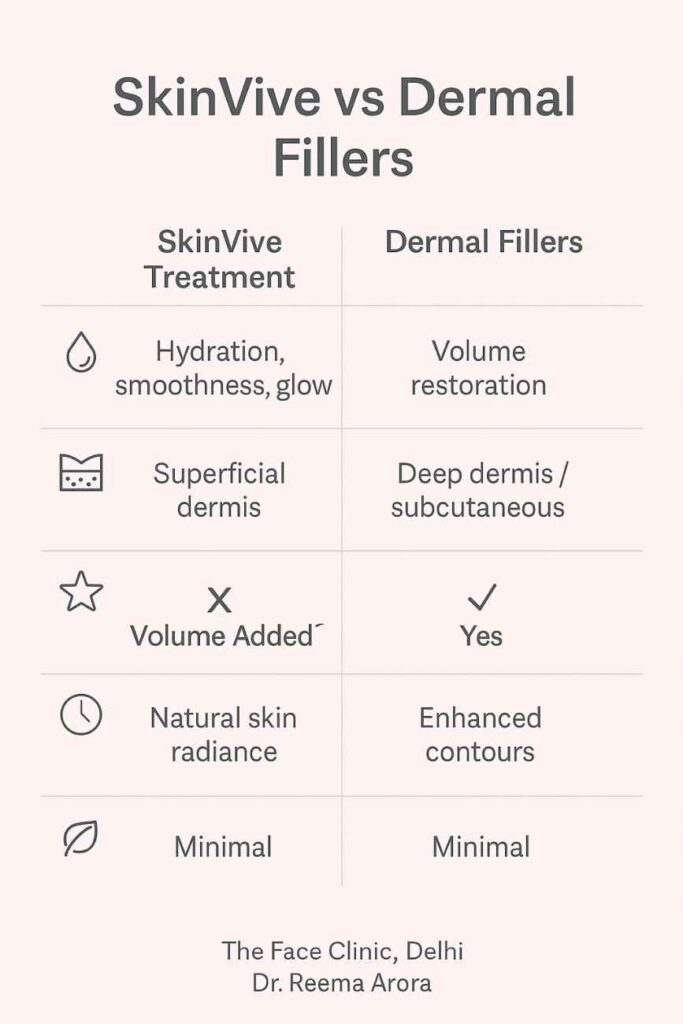
The principal difference between SKINVIVE and conventional volumising dermal fillers is the intended treatment objective.
Both belong to the hyaluronic acid filler category, but their formulations and clinical applications are not interchangeable.
SKINVIVE vs Traditional Volumising Fillers
Parameter | SKINVIVE by JUVÉDERM | Traditional volumising HA fillers |
Product classification | Hyaluronic acid dermal filler | Hyaluronic acid dermal fillers |
Primary objective | Improve skin smoothness and specified skin-quality concerns | Restore volume, provide structural support or modify contours |
Formulation | Stabilised HA formulation developed for its specific applications | Product-specific HA formulations with different structural properties |
Placement | Depends on the approved treatment indication | Depends on formulation, anatomy and intended correction |
Typical concerns | Appropriate skin-smoothness concerns and other supported skin-quality applications | Selected facial volume deficiencies, contour concerns and folds |
Intended visible change | Improvement in the appearance of treated skin | Changes in volume, projection, contour or selected facial folds |
Principal limitation | Not a substitute for substantial structural volume restoration | Volumisation is not automatically appropriate for superficial skin-quality concerns |
These categories should not be interpreted as having absolutely exclusive effects.
Volumising fillers may influence the appearance of overlying skin, while SKINVIVE can produce local tissue effects beyond a simple change in hydration.
Nevertheless, a formulation intended primarily to improve skin quality should not be expected to perform the same structural function as a filler selected for significant volume restoration.
For a broader explanation of filler formulations and anatomical applications, see our guide to dermal fillers.
SKINVIVE vs JUVÉDERM: Are They Different Products?
SKINVIVE and JUVÉDERM are not unrelated injectable brands.
SKINVIVE belongs to the JUVÉDERM family of hyaluronic acid dermal fillers.
JUVÉDERM is the broader product family, which includes formulations intended for different anatomical applications and treatment objectives.
Certain JUVÉDERM formulations are selected primarily for volume restoration, facial contouring or correction of particular folds.
SKINVIVE occupies a different position within the family because of its specific skin-smoothness and related skin-quality applications.
Consequently, the search question SKINVIVE vs JUVÉDERM is more accurately understood as:
How does SKINVIVE differ from other JUVÉDERM filler formulations?
The manufacturer’s explanation of SKINVIVE also distinguishes its skin-smoothness objective from the volumising purposes of other hyaluronic acid fillers.
Is SKINVIVE Related to JUVÉDERM VOLITE?
Yes. SKINVIVE is closely related to the JUVÉDERM VOLITE product lineage, and published research frequently refers to the VYC-12 or VYC-12L hyaluronic acid formulation.
JUVÉDERM VOLITE was used as a product name in international markets before SKINVIVE’s introduction in the United States.
For example, the 2019 clinical investigation by Niforos and colleagues identifies VYC-12 as JUVÉDERM VOLITE, while later studies of related formulations use the VYC-12L designation.
This naming history helps explain why searches for SKINVIVE may return studies using the terms JUVÉDERM VOLITE, VYC-12 or VYC-12L.
However, a shared formulation lineage does not automatically establish identical marketed presentations, approved indications or directions for use across countries.
The specific product supplied and its current local labeling should determine the clinical applications communicated to patients.
What Skin-Quality Benefits Have Been Studied?
SKINVIVE and related VYC-12 formulations have been investigated for several aspects of skin quality.
However, these outcomes have not all been evaluated using identical study designs or measurements.
A distinction is necessary between an approved clinical indication, instrument-measured findings and patient-reported improvements.
Cheek Skin Smoothness
Improvement in cheek skin smoothness is the central outcome supporting SKINVIVE’s original US approval.
The FDA’s clinical evaluation involved 209 participants and demonstrated improvement in cheek skin smoothness, with the effect lasting at least six months.
This provides a defined clinical basis for discussing SKINVIVE as a skin-smoothness treatment.
It does not establish equivalent efficacy for every type of uneven facial texture.
For example, superficial roughness, established acne scarring and changes associated with deeper volume deficiency are different clinical concerns.
Skin Hydration
Hyaluronic acid’s water-binding properties provide a rationale for investigating injectable skin hydration.
A prospective study published by Niforos and colleagues in 2019 investigated the VYC-12 formulation in 131 participants.
Of these, 31 received a touch-up treatment approximately 30 days after their initial treatment.
Skin hydration was evaluated using instrumental measurements, including the MoistureMeterD device, rather than relying exclusively on participants’ perceptions.
The study reported statistically significant improvements in skin hydration compared with baseline through nine months.
Improvement in skin roughness was demonstrated over a shorter period.
However, the investigation was a prospective, single-arm study without a separate randomised control group.
Its findings should therefore be interpreted within that methodological limitation.
The original study is available in Niforos et al., 2019 — VYC-12 skin smoothness and hydration study.
Importantly, the nine-month finding relates to the measured hydration outcome. It should not be interpreted as a guarantee of identical visible improvement in every patient.
Fine Lines and Skin Texture
Clinical investigations of VYC-12 formulations have also evaluated changes in superficial fine lines and skin-texture characteristics.
These findings help explain why the formulation is discussed in relation to skin-quality improvement rather than exclusively cheek smoothness.
However, superficial fine lines are not equivalent to deeper structural folds or wrinkles associated primarily with facial muscle movement.
The degree of improvement depends on the concern being assessed, the treatment performed and the specific clinical endpoint.
SKINVIVE should therefore not be described as a universal wrinkle-correction treatment.
Radiance and Patient-Reported Skin Satisfaction
Patients may describe changes in skin appearance using terms such as radiance, glow, freshness or healthy-looking skin.
These descriptions are relevant to patient experience but are not identical to instrument-measured hydration or investigator-assessed smoothness.
A related publication by Ogilvie and colleagues evaluated patient-reported outcomes following VYC-12 treatment in a prospective study involving 131 participants.
The investigation used the FACE-Q Satisfaction With Skin scale and assessed participants at several follow-up points.
At nine months, 76.4% of participants were reported to have improved satisfaction with their skin compared with baseline.
This is a patient-reported outcome. It does not mean that 76.4% achieved an identical degree of objectively measured improvement.
The findings are available in Ogilvie et al., 2020 — Patient-reported skin-quality outcomes.
The study was sponsored by Allergan. This is relevant when interpreting its methodology and reported outcomes, although industry sponsorship alone does not invalidate a clinical finding.
What Changes Might Be Noticeable After SKINVIVE?
An important distinction between SKINVIVE and conventional volumising fillers is the type of visible change a patient may reasonably expect.
A volumising filler may be selected to create a noticeable change in cheek projection, facial contours or structural fullness.
SKINVIVE’s skin-quality applications have different objectives.
Where treatment is appropriate, patients may notice improvements in the appearance of superficial skin texture, smoothness or hydration-related characteristics.
These changes may become apparent over the weeks following treatment.
However, the difference can be subtle.
Someone expecting a marked lifting effect or restoration of substantial cheek volume may be disappointed because these are not SKINVIVE’s principal treatment objectives.
Similarly, a person with relatively smooth, well-hydrated skin may perceive less visible change than someone with more pronounced concerns relevant to the treatment.
The appearance of normal skin texture does not necessarily indicate that an injectable procedure will produce a dramatic improvement.
A realistic expectation is improvement in a specifically identified skin-quality concern—not a guaranteed transformation in facial appearance.
This distinction is important because patients may use descriptions such as glow, rejuvenation or younger-looking skin to refer to very different underlying concerns.
Medical assessment should establish which measurable or observable change the patient is actually seeking.
What SKINVIVE Cannot Correct
Not every concern described as tired-looking or ageing skin originates within the superficial skin layers.
Some facial changes primarily involve volume distribution, tissue support, muscle activity or pigmentation.
These concerns may require different approaches.
Facial or skin concern | Clinical distinction |
Cheek skin smoothness | Established original US treatment objective |
Superficial fine lines | May be relevant under specific supporting evidence and applicable labeling |
Significant cheek hollowing | Requires assessment of underlying facial volume |
Substantial skin laxity | Not equivalent to improving superficial smoothness |
Deep expression-related wrinkles | May involve muscle activity and other structural factors |
Pigmentation or dark spots | Requires assessment of the underlying pigmentary condition |
Established acne scarring | May involve structural changes requiring scar-specific assessment |
These categories can overlap.
A person may have changes in skin quality alongside facial volume loss or tissue laxity.
Addressing one component does not necessarily correct the others.
How Does a Doctor Distinguish Skin-Quality Concerns From Volume Loss?
Skin quality and facial volume are assessed differently.
A person may have relatively well-preserved facial contours but notice changes in cheek skin texture, smoothness or hydration.
Another person may describe the face as tired-looking when the primary concern is reduced cheek projection or underlying volume loss.
The descriptions may sound similar, but their anatomical causes can be different.
Clinical assessment considers the appearance of the skin surface alongside facial contours, tissue characteristics, facial proportions and volume distribution.
It is also important to establish what the patient means by terms such as tired, flat, dull or aged.
For example, visible skin roughness with preserved cheek projection presents a different clinical question from cheek hollowing accompanied by relatively smooth overlying skin.
The first concern may direct attention towards skin-quality characteristics. The second requires assessment of deeper facial structure.
Some individuals have both.
The relevant clinical question is not simply whether a person should receive a skin booster or a filler.
It is which anatomical or skin-related change is contributing most to the concern, and whether an injectable treatment is appropriate for addressing it.
This distinction is particularly useful when evaluating SKINVIVE against conventional volumising dermal fillers.
How Long Can SKINVIVE Results Last?
The duration of SKINVIVE results depends on the outcome being measured, the study population, the treatment protocol and individual variation.
Skin smoothness and skin hydration do not necessarily improve for identical periods.
For the original US cheek-smoothness indication, the FDA reported that improvement lasted at least six months in the supporting clinical evaluation.
Separately, the 2019 prospective VYC-12 study reported improvement in skin roughness for up to six months and statistically significant instrument-measured hydration improvements through nine months.
These findings relate to different clinical investigations and outcome measurements.
The nine-month hydration finding should not be interpreted as a guarantee that every patient will have visibly smoother or more radiant skin for nine months.
The VYC-12 study also permitted touch-up treatment in selected participants, which is relevant when interpreting the duration of observed outcomes.
Individual responses may vary according to baseline skin characteristics, treatment parameters and biological factors.
SKINVIVE is not a permanent implant.
Further treatment, where clinically appropriate, should be considered according to the individual’s response and reassessment rather than assuming that every patient requires reinjection at a fixed interval.
What Does the Clinical Evidence Show?
The evidence supporting SKINVIVE includes clinical investigations of cheek smoothness, hydration, fine lines and selected skin-quality outcomes.
There have also been subsequent regulatory developments involving additional anatomical applications.
Understanding the study design and intended endpoint is important when interpreting these findings.
Original US Evidence for Cheek Skin Smoothness
In May 2023, the FDA approved SKINVIVE by JUVÉDERM for intradermal injection to improve cheek skin smoothness in adults over 21.
The supporting clinical evaluation demonstrated improvement in the specified cheek-smoothness outcome.
This approval supports a defined treatment objective rather than an unrestricted claim that SKINVIVE corrects every aspect of facial ageing.
Additional Research on Skin Quality
The VYC-12 research programme includes prospective investigations of skin texture, hydration and patient satisfaction.
The 2019 Niforos study evaluated multiple skin-quality characteristics in a single-arm design.
A separate randomised, evaluator-blinded study published by Alexiades and colleagues in 2023 compared VYC-12L treatment with a no-treatment control group.
That study evaluated cheek skin smoothness, fine lines and instrument-measured hydration.
The randomised investigation included 131 participants allocated to treatment and 71 allocated to the control group.
It reported improvement in the specified skin-quality endpoints, providing controlled comparative evidence for these outcomes.
The study is available in Alexiades et al., 2023 — Randomised clinical study of VYC-12L for skin-quality improvement.
These investigations support discussing specific skin-quality effects, but they do not establish equivalent efficacy for every anatomical region or every possible treatment objective.
Industry involvement in the research should also be considered when critically evaluating the evidence.
The June 2026 US Neck-Line Indication
On June 11, 2026, the FDA approved an expansion of SKINVIVE’s US indications.
The updated indication includes intradermal and/or subdermal injection to reduce neck lines for improvement of neck appearance in adults over 21.
The supporting clinical investigation demonstrated improvement in a defined neck-line severity measure compared with a no-treatment control group.
The FDA’s June 2026 SKINVIVE indication expansion documents the updated US indication.
The accompanying SKINVIVE clinical safety and effectiveness data provide further information about the supporting investigation.
This approval demonstrates that additional applications have been investigated and authorised in the United States.
It does not mean that every skin-quality application is approved in every country.
US regulatory approvals and clinical studies should therefore be interpreted alongside the current product labeling applicable in India.
What the Evidence Does Not Establish
Clinical studies answer specific research questions.
An improvement in cheek smoothness does not automatically establish identical improvement in pigmentation, tissue laxity or structural facial support.
Similarly, a hydration-related finding should not be presented as proof of permanent skin regeneration.
Results demonstrated in one anatomical region cannot automatically be extended to all other regions.
The study populations, baseline characteristics, treatment protocols and follow-up periods also influence how confidently the results can be applied to an individual patient.
Although smaller mechanistic investigations have explored biological changes associated with related formulations, they should not be used to promise substantial collagen regeneration or permanent rejuvenation without appropriate supporting clinical evidence.
The value of SKINVIVE is best understood through the specific outcomes demonstrated by the relevant research.
For information about treatment assessment, practical considerations and current clinic pricing, readers can explore our dedicated SKINVIVE treatment in Delhi page.
What Are the Risks and Limitations of SKINVIVE?
SKINVIVE is an injectable medical treatment.
Although hyaluronic acid fillers are widely used in aesthetic medicine, their administration involves potential adverse effects and procedural risks.
The fact that hyaluronic acid occurs naturally in human tissues does not make every injectable formulation risk-free.
Common Injection-Related Reactions
Possible reactions include redness, swelling, tenderness, bruising, itching and temporary changes at the injection sites.
Some individuals may experience firmness, palpable lumps, discolouration or local discomfort.
Many routine injection-site reactions resolve without lasting consequences, but their intensity and duration vary.
Persistent, worsening or unusual symptoms require medical evaluation.
Less Common but Serious Complications
Dermal filler injections may occasionally be associated with infection, inflammatory reactions, nodules and vascular complications.
Unintentional injection into a blood vessel can interfere with tissue blood supply.
Although uncommon, serious complications associated with dermal filler injections may include tissue necrosis, visual impairment, blindness or stroke.
These are recognised risks of dermal fillers generally. They should not be interpreted as complications occurring at the same frequency—or necessarily observed at all—in every SKINVIVE clinical study.
The FDA’s guidance on dermal filler risks explains the potential consequences of unintended intravascular injection and the importance of appropriate medical care.
Severe or unusual pain, whitening or dusky discolouration of the skin, or any visual disturbance during or after injection requires immediate medical assessment.
Sudden visual changes or symptoms suggestive of stroke warrant emergency medical care.
Contraindications and Medical Assessment
The original US FDA product information identifies contraindications including a history of anaphylaxis, multiple severe allergies, known sensitivity to gram-positive bacterial proteins and allergy to lidocaine.
The manufacturer’s US safety information also identifies previous allergic reactions to hyaluronic acid fillers as a contraindication.
Relevant medical history, previous reactions to injectable products, current medications and active infection or inflammation at the proposed treatment site should be assessed before treatment.
Patients should also inform their doctor about pregnancy or breastfeeding, relevant immune conditions and any planned procedures involving the same anatomical region.
The current locally applicable product labeling should be consulted for the complete contraindications, warnings and precautions.
Treatment planning should include an informed discussion of the expected benefits, reasonable alternatives, limitations and potential complications.
Qualified medical assessment and appropriate injection technique can help manage procedural risk, but no injectable treatment should be described as completely risk-free.
Frequently Asked Questions About SKINVIVE and Fillers
Is SKINVIVE a Filler or a Skin Booster?
SKINVIVE is classified as a hyaluronic acid dermal filler. It is also commonly described as a skin booster because its treatment objectives include improvement of specific skin-quality characteristics.
The two terms are not mutually exclusive. One describes the product category, while the other describes a commonly used treatment concept.
Is SKINVIVE the Same as Other JUVÉDERM Fillers?
SKINVIVE belongs to the JUVÉDERM family, but it is not interchangeable with every other formulation.
Different JUVÉDERM products have distinct physical properties, intended applications and applicable regulatory indications.
SKINVIVE’s original US indication focuses on cheek skin smoothness, whereas certain other formulations are selected primarily for volume restoration or contour modification.
Can SKINVIVE Replace Cheek Fillers Used for Volume Restoration?
SKINVIVE is not intended to substitute for substantial structural volume restoration when that is the underlying clinical requirement.
A person concerned about cheek skin smoothness may require a different approach from someone experiencing significant midface volume loss.
The appropriate treatment objective should be established through facial assessment.
Can SKINVIVE Improve Skin Hydration Without Changing Facial Contours?
SKINVIVE and related VYC-12 formulations have demonstrated hydration-related improvements in clinical investigations.
Its original cheek-smoothness indication is not primarily intended to produce the structural contour changes associated with conventional volumising fillers.
However, no injectable procedure should be described as producing absolutely no local tissue effect.
The intended outcome, product quantity, anatomical placement and individual response all matter.
Understanding Where SKINVIVE Fits in Facial Aesthetics
SKINVIVE illustrates an important distinction in facial aesthetics: not all dermal fillers are intended to achieve the same clinical result.
Although SKINVIVE belongs to the hyaluronic acid filler category, its formulation and specific applications distinguish it from products primarily intended for structural facial volume restoration.
Understanding this difference helps separate changes in skin quality from those involving deeper facial anatomy.
A concern described as tired-looking skin may reflect changes in hydration, texture, volume distribution or tissue support. Several factors may also be present together.
Selecting a treatment should therefore begin with understanding the underlying concern rather than assuming that every visible change requires the same injectable product.
At The Face Clinic in Hauz Khas, New Delhi, Dr. Reema Arora’s approach to facial aesthetics emphasises anatomical assessment and individualised treatment planning. Distinguishing changes in the skin from changes in the underlying facial structure is central to establishing an appropriate treatment objective.
For readers exploring another injectable approach to skin quality, our SKINVIVE vs Profhilo comparison explains the differences between their formulations, treatment objectives and relevant clinical considerations.
The essential principle is straightforward: the concern being treated should determine the clinical approach—not simply the popularity of an injectable product.
Medical review: Dr. Reema Arora, Founder & Medical Director, The Face Clinic, Hauz Khas, New Delhi.
All treatments are subject to individual variation. Outcomes are determined following clinical evaluation by a qualified doctor.


