
Thread Lift Cost in India: Why the Right Face and Right Doctor Matter More Than Price
Thread lift cost can vary widely, but price alone does not tell you whether the treatment is right for your face. Two patients can pay for a thread lift and walk away with very different outcomes — and very different value for the money spent. One may see a subtle, natural-looking lift that settles well; another may experience temporary tightness, minimal visible improvement, or a result that does not justify the cost.
The real question is not only “How much does thread lift cost?” The better question is: “Is thread lift the right treatment for my face — and is the plan designed to give a safe, natural-looking, visible result?”
Doctor’s Summary
Thread lift cost in India varies because the treatment is not simply priced by thread count. The real value depends on whether your face is suitable for threads and whether the procedure is planned safely.
- What affects thread lift price: treatment area, number and type of threads, facial heaviness, skin quality, vector planning, sterile technique, doctor expertise, and follow-up.
- When thread lift may be worth the cost: mild to moderate sagging, early jowls, reasonable skin quality, and realistic expectations of a subtle, natural-looking lift.
- When thread lift may not be worth it: severe laxity, significant lower-face heaviness, volume loss, poor skin quality, or expectations of surgical facelift-level correction.
- Best next step: before comparing packages or per-thread pricing, start with a doctor-led thread lift assessment in India to decide whether threads, HIFU, fillers, skin boosters, or a combination plan gives better value.
The Biggest Misunderstanding About Thread Lift Cost
The biggest misunderstanding about thread lift cost is assuming that every clinic is offering the same treatment at a different price. In reality, two quotes often reflect very different levels of facial assessment, planning, thread type and quality, technique, safety, and follow-up.
Patients are not always comparing the same procedure
A lower quote may involve fewer threads, limited treatment areas, reduced support, or less detailed planning. A higher quote may include more comprehensive facial assessment, doctor-led vector planning, appropriate thread type and quality, sterile protocols, and review appointments. However, price alone does not guarantee a better result. Value depends on whether the treatment plan is right for the patient’s face.
Cost should be judged by suitability, not only thread count
One of the biggest cost mistakes is paying for thread lift when the face is not suitable for threads. If the concern is severe laxity, facial heaviness, volume loss, or poor skin quality, simply adding more threads may not create a better lift. In thread lift treatment, the correct diagnosis often matters more than the number of threads.
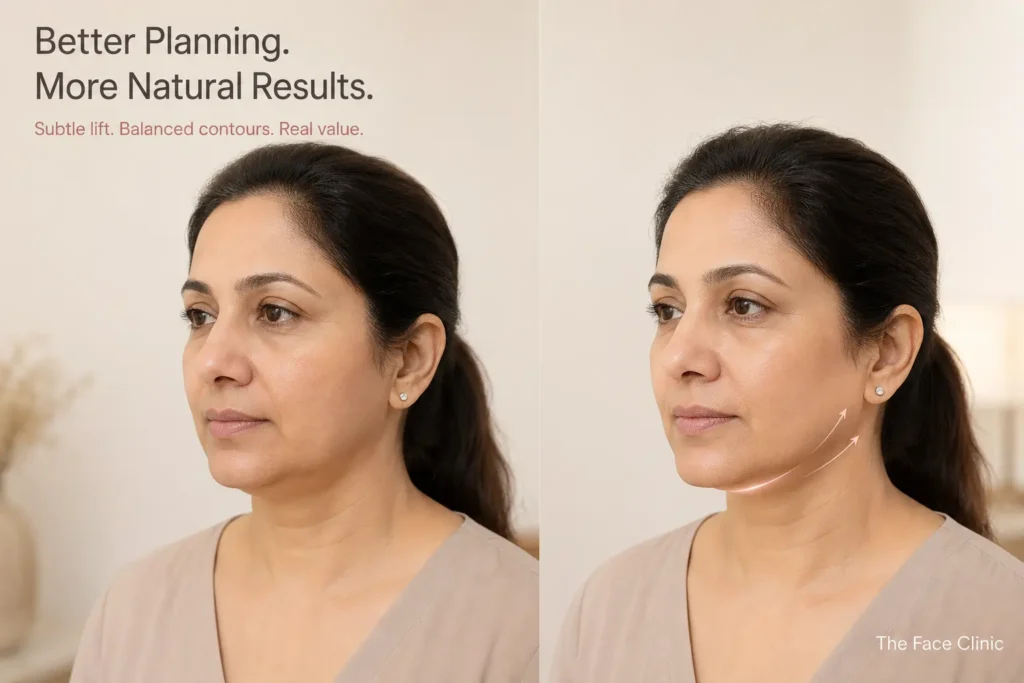
Images are for illustrative purposes only and may not represent actual patients or outcomes. Individual results vary based on anatomy, clinical assessment, and personalised treatment planning.
The Thread Lift Value Equation
The smartest way to judge thread lift cost or thread lift price is not by the lowest quote or the highest number of threads. It is by whether the treatment is planned well enough to create a safe, natural-looking, worthwhile result for your face.
The value equation
Thread Lift Value = Candidate Selection + Vector Planning + Thread Quality + Area Coverage + Doctor Expertise + Aftercare
This equation matters because two patients may both receive a “thread lift,” but the quality, safety, and visible value of the result can be very different.
Candidate selection
Thread lift usually offers better value in carefully selected patients with mild to moderate sagging, early jowls, reasonable skin quality, and realistic expectations. If the face is too heavy, the skin is too loose, or the patient expects a surgical facelift result, threads alone may not offer good value.
Vector planning
Threads should not simply be inserted where sagging is visible. They should be planned according to tissue movement, facial heaviness, and the direction of lift required. Poor vector planning can make even good-quality threads underperform.
Thread quality and area coverage
PDO, PLLA, and PCL threads may differ in design, longevity profile, tissue response, and intended purpose. Cost also changes with the area treated. A lower-face thread lift, jawline lift, cheek lift, brow lift, and neck thread lift cannot all be priced as the same treatment.
Doctor expertise and aftercare
The value lies not only in inserting threads, but in knowing when not to insert them. A good plan includes doctor-led judgement, sterile technique, clear aftercare, review appointments, and early support if concerns arise.
Patients should therefore understand that a thread lift is generally a subtle, temporary, non-surgical procedure — not a replacement for surgical facelift results. External medical resources such as the Cleveland Clinic also advise patients to discuss whether thread lift is the right procedure for their goals.
Why Per-Thread Pricing Can Be Misleading
Per-thread pricing can offer transparency, but it should not be the only way to judge thread lift cost or value. A thread lift is not simply “number of threads × price per thread.” The real value depends on whether suitable threads are placed in the correct areas, along the right vectors, for a face that is actually suitable for thread lift. Thread count tells you quantity; planning tells you value.
More threads do not always mean better lift
More threads cannot compensate for poor vector planning, wrong candidate selection, or unrealistic expectations. If tissue heaviness or skin laxity is significant, adding more threads may increase cost without improving the quality of the result.
Fewer threads may reduce cost but also reduce support
A cheaper package may look attractive initially, but limited coverage or insufficient support can lead to weak or short-lived improvement. In some cases, the patient may later need additional sessions or a different treatment approach.
The better question patients should ask
The better question is: How many threads are needed, in which vectors, for which areas, and for what realistic endpoint? This is a smarter way to judge thread lift cost than thread count alone.
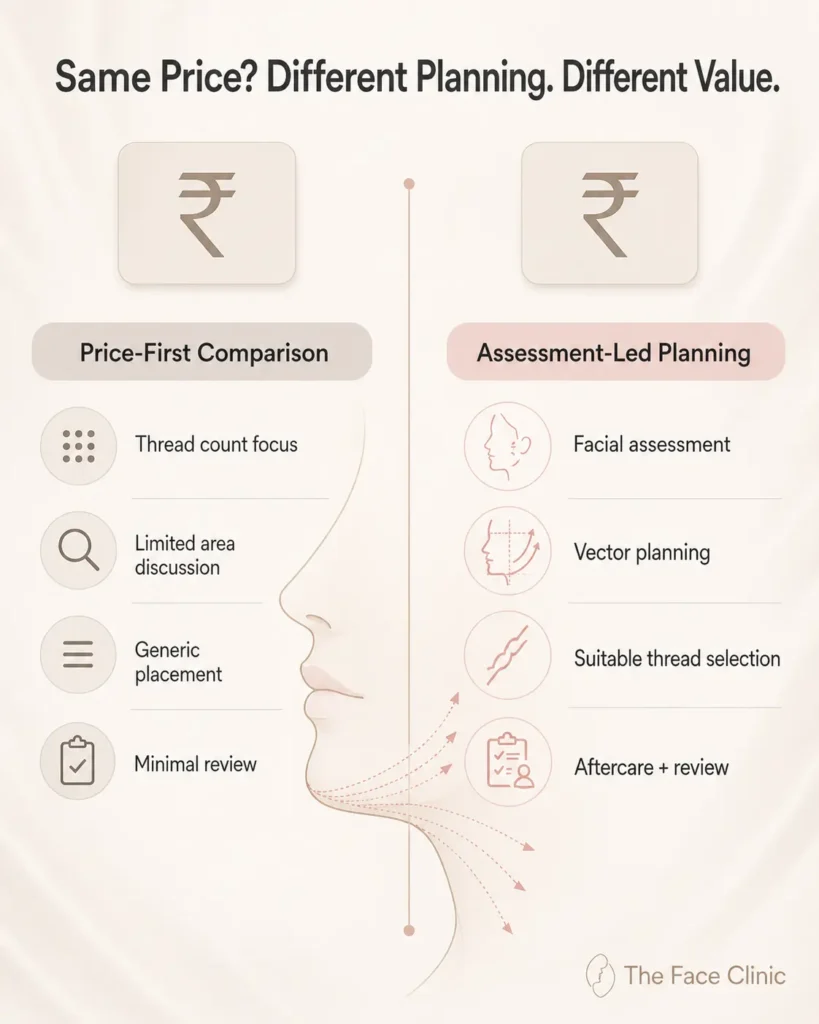
Images are for illustrative purposes only and may not represent actual patients or outcomes. Individual results vary based on anatomy, clinical assessment, and personalised treatment planning.
Why Thread Lift Cost Varies So Much in India
Thread lift cost in India can vary widely because not every thread lift involves the same area, complexity, treatment design, or follow-up. A cheek lift, jawline thread lift, lower-face lift, brow lift, and neck thread lift involve different levels of anatomical complexity and should not be judged by the same price yardstick.
Treatment area and complexity
Smaller areas may need fewer threads and simpler planning, while lower-face, jawline, or neck laxity often requires closer assessment of tissue heaviness, skin quality, and the direction of lift.
Doctor-led planning vs package-led pricing
Some clinics may price thread lift as a fixed package or per-thread procedure. In a doctor-led setting, the fee is usually guided by facial assessment, suitability, thread type, area coverage, vector planning, and post-procedure review. For patients who are suitable candidates, a doctor-led thread lift treatment in Delhi can help reposition early facial sagging while maintaining a natural, non-operated appearance.
Safety and follow-up are part of value
Thread lift cost should also be understood in the context of sterile setup, medical supervision, aftercare instructions, review appointments, and access to review if concerns arise.
What Is the Approximate Thread Lift Cost in India?
Thread lift cost in India may vary depending on the treatment area, number and type of threads used, facial complexity, doctor expertise, safety protocols, and follow-up. Smaller areas may cost less, while lower-face, jawline, cheek, brow, or neck thread lift plans may require more detailed planning and a higher investment. The exact cost should ideally be quoted only after assessing facial laxity, tissue heaviness, skin quality, and whether threads are genuinely the right treatment.
5 Cost Traps to Avoid Before Thread Lift Treatment
A thread lift can be valuable in the right face, but thread lift cost becomes misleading when patients compare only price, packages, or thread count. Before paying for thread lift treatment, avoid these common cost traps.
Cost Trap 1: Choosing the lowest package price
A low-cost quote is not automatically unsafe, but patients should ask what is included. Does the fee cover facial assessment, appropriate thread type and quality, adequate area coverage, sterile setup, aftercare instructions, and follow-up? A lower price may be reasonable for a smaller area, but not if planning or safety is compromised.
Cost Trap 2: Thinking more threads always means better lift
More threads do not guarantee a better result if the vectors are wrong or the face is not suitable. Thread lift value depends on direction, support, placement, and realistic goals — not thread count alone.
Cost Trap 3: Treating thread lift like a cheaper facelift
Thread lift is not a surgical facelift. It can create subtle repositioning in selected patients, but it cannot replace surgery in severe laxity, significant tissue heaviness, or advanced sagging.
Cost Trap 4: Ignoring skin quality
If the skin is thin, crepey, or has poor collagen support, threads alone may not deliver the desired outcome. Paying only for lift while ignoring skin quality may reduce the visible value of the result.
Cost Trap 5: Paying twice because the first treatment was wrong
A poorly selected or poorly planned thread lift may lead to disappointment, additional treatment, review, adjustment, or later surgical consultation. Medical literature on thread lift complications has reported issues such as dimpling, irregularity, extrusion, bruising, pain, infection, and migration. The goal is not to fear thread lift, but to choose it only when the diagnosis, plan, and expectations are right.
When Thread Lift Is Worth the Cost
Thread lift can be worth considering when the face, concern, and expectations are correctly assessed, and the goal is subtle, natural improvement rather than dramatic surgical change. The best value usually comes when threads are used for the right indication, in the right tissue, with realistic expectations.
Good candidate situations
Thread lift may be suitable for patients with mild to moderate facial sagging, early jowls, mild lower-face laxity, or selected cheek descent. It is usually more appropriate when skin quality is reasonable, the tissues are not too heavy, and the patient wants a natural-looking, non-surgical lift rather than an obvious or overcorrected look. Good candidates also understand that aftercare matters and are willing to follow post-procedure restrictions, sleep-position advice, exercise guidance, and review appointments.
The right expectation
Thread lift should be viewed as a treatment for subtle repositioning, not a dramatic transformation. If your main concern is early jowling or mild tissue descent, a consultation for thread lift treatment for facial sagging can help determine whether threads are suitable or whether another approach would give better value. The most worthwhile result is not the most lifted face — it is the most natural, balanced improvement for the right face.
When Thread Lift May Not Be Worth the Cost
Thread lift can be a valuable treatment in the right face, but it is not the best investment for every ageing concern. In some cases, paying for threads may not give the patient the improvement they are expecting, especially when the real issue is not mild tissue descent. Sometimes the most ethical thread lift advice is not to do a thread lift.
Severe laxity or significant lower-face heaviness
Thread lift may not provide enough improvement when skin laxity is advanced or when the lower face has significant tissue heaviness. In these cases, threads may create some short-term support, but not enough meaningful correction to justify the cost.
Volume loss mistaken for sagging
Sometimes what appears to be sagging is actually loss of facial support. If the cheeks, temples, or mid-face are hollow, threads alone may not restore the structure needed for a balanced result. Fillers or biostimulators may be more appropriate.
Poor skin quality
If the skin is very thin, crepey, weak, or collagen-poor, threads may not deliver the visible lift patients expect. Regenerative or skin-quality treatments may be needed before, or alongside, thread lift.
Surgical expectations
Patients expecting facelift-level correction may be disappointed with thread lift. Thread lift can reposition selected tissues subtly, but it cannot remove excess skin or replace surgical lifting in advanced laxity.
When another treatment may offer better value
Thread lift is valuable only when it matches the real concern. If the main issue is skin laxity without true tissue descent, HIFU treatment for skin tightening may offer better value. If the face has hollowing or volume loss, dermal fillers for facial volume loss may be more appropriate. If the skin is thin, crepey, dehydrated, or has poor collagen support, skin boosters, PDRN, or other regenerative skin-quality treatments may be needed before, or alongside, thread lift to improve the visible value of the result. And if facial laxity is severe, surgical consultation may be more realistic than spending repeatedly on non-surgical correction.
This is why the most important part of thread lift cost is not the number of threads — it is correct diagnosis.
The Smart Patient Checklist Before Paying for Thread Lift
Before paying for a thread lift, the most important step is not comparing packages — it is asking the right questions. This checklist can help you judge whether the treatment is being planned as a carefully assessed, doctor-led aesthetic procedure or simply sold as a thread-count package.
Questions to ask before saying yes
- Has my face, skin quality, and tissue heaviness been assessed properly?
- Am I actually a good candidate for thread lift treatment?
- Has the doctor explained why threads are suitable for me?
- Do I understand what thread lift can and cannot improve?
- Am I being charged only per thread, or for a complete treatment plan?
- Do I know what type of threads will be used?
- Has the lifting vector or treatment area been explained?
- Have the risks and recovery instructions been discussed?
- Is there a follow-up plan?
- Have alternatives like HIFU, fillers, skin boosters, or surgery been discussed if needed?
What a good consultation should feel like
A good thread lift consultation should feel structured, honest, and specific to your face. You should understand why threads are being recommended, what result is realistic, what recovery involves, and what alternatives may offer better value if threads are not ideal.
The right consultation should leave you clearer, not pressured.
Final Takeaway — Do Not Ask Only “How Much Does Thread Lift Cost?”
Thread lift cost should not be judged only by the lowest price, the number of threads, or a package deal. These details matter, but they do not tell the full story. The more important question is whether thread lift is appropriate for your face, whether the plan is safe, whether the expected result is realistic, and whether the doctor is willing to recommend a better alternative when threads are not the right choice.
A well-planned thread lift is not about chasing the strongest pull or the cheapest quote. It is about choosing the right treatment for the right face, with the right expectations. For some patients, threads can offer subtle, natural-looking repositioning. For others, another approach may offer better value. The right decision should feel clear, measured, and specific to your face.
Thread lift cost is not just the price of threads. It is the price of correct diagnosis, correct face selection, correct vector planning, safe execution, and knowing whether thread lift treatment is truly right for your ageing pattern.
Considering Thread Lift Treatment? Start With a Doctor-Led Assessment
At The Face Clinic, thread lift treatment is recommended only after assessing facial anatomy, tissue heaviness, skin quality, ageing pattern, and realistic expectations. The goal is not to sell threads to every patient, but to identify whether thread lift is genuinely the right option for your face.
If you are comparing thread lift cost in India, the safest first step is a structured consultation with Dr Reema Arora. You will understand whether threads, HIFU, fillers, skin-quality treatments, or a combination plan would offer the most natural-looking value for your face.
FAQs About Thread Lift Cost and Value
Why do thread lift quotes vary so much in India?
Thread lift cost in India can vary because clinics may price treatment by package, per thread, treatment area, or complexity. The final quote may depend on facial assessment, thread type, number of threads, area coverage, vector planning, doctor expertise, sterile setup, aftercare, and follow-up.
Should I choose thread lift based on the lowest price or per-thread pricing?
Not necessarily. A lower thread lift price is not automatically unsafe, especially for a smaller or simpler treatment area, and per-thread pricing can offer transparency. However, neither should be the only way to judge value.
Thread lift cost should be assessed by the quality of facial evaluation, suitable thread selection, area coverage, vector planning, sterile technique, aftercare, and review. Too few threads may reduce support, while too many threads cannot compensate for poor planning. The right question is not “How cheap?” or “How many threads?” — it is whether the plan is suitable, safe, and realistic for your face.
When is thread lift worth the cost?
Thread lift may be worth the cost for selected patients with mild to moderate sagging, early jowls, mild lower-face laxity, reasonable skin quality, and realistic expectations. It is usually most valuable when the goal is subtle, natural-looking repositioning.
When may thread lift not be worth paying for?
Thread lift may not be the best value if there is severe laxity, significant lower-face heaviness, major volume loss, very thin or crepey skin, or expectations of facelift-level correction. In such cases, HIFU, fillers, skin-quality treatments, or surgical consultation may be more appropriate.
What should I ask before paying for thread lift treatment?
Ask whether you are a good candidate, what type of threads will be used, which areas are being treated, what result is realistic, what risks exist, what recovery involves, and whether follow-up is included. Also ask whether another treatment may offer better value.
Medically reviewed by:
Dr Reema Arora, MBBS, MSc Facial Aesthetics, UK
Founder & Director, The Face Clinic, Hauz Khas, South Delhi
Former Medical Head – Facial Aesthetics, Allergan India
20+ years in non-surgical facial aesthetics and injectable training
Dr Reema Arora, MBBS, MSc Facial Aesthetics, UK
Founder & Director, The Face Clinic, Hauz Khas, South Delhi
Former Medical Head – Facial Aesthetics, Allergan India
20+ years in non-surgical facial aesthetics and injectable training
This article is for educational purposes only and does not replace a personalised medical consultation. Thread lift suitability, risks, recovery, and cost vary from patient to patient.
All treatments are subject to individual variation. Outcomes are determined following clinical evaluation by a qualified doctor.