
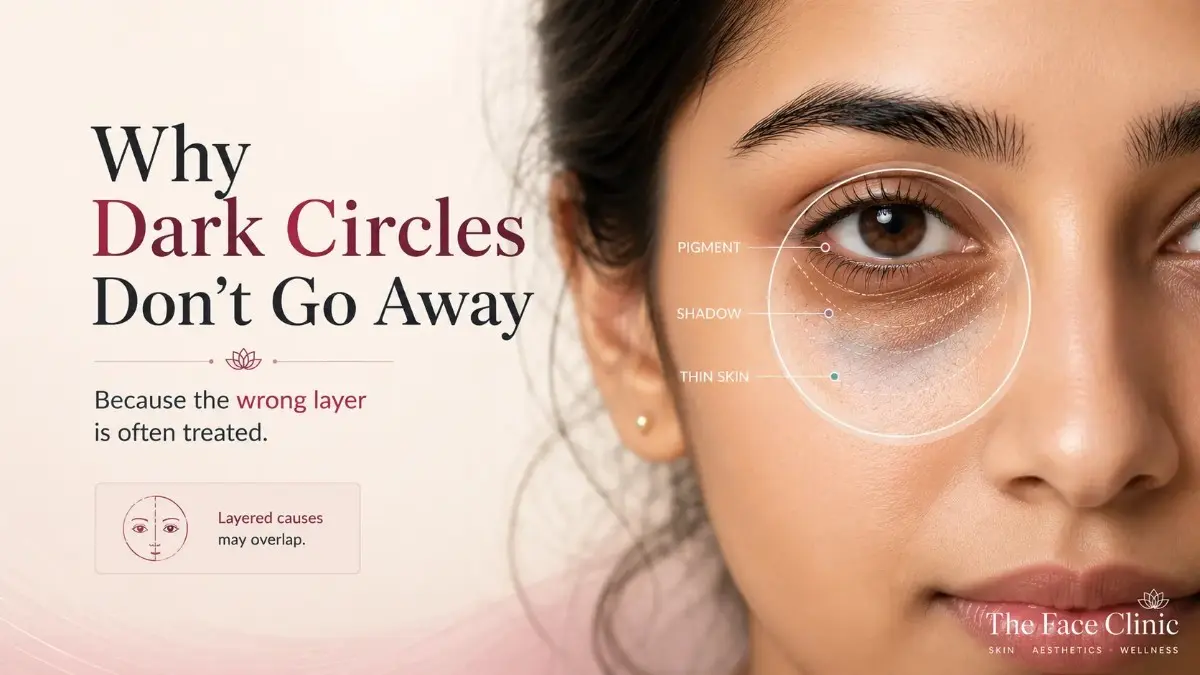
Why Dark Circles Don’t Go Away: The 5-Layer Misdiagnosis Guide
Why Your Dark Circles May Not Be “Stubborn” — They May Be Misread
Core Insight — Dark Circles Are a Pattern-Recognition Problem
This Guide Is Especially Useful If Your Dark Circles Are Not Going Away
This guide is particularly relevant if your under-eye darkness has persisted despite better sleep, skincare, or repeated attempts to improve it.
eye creams have not helped much, even after consistent use;
your under-eyes look different in the mirror, selfies, photographs, and harsh lighting;
dark circles look worse in photos than they do face-to-face;
laser improved some of the colour, but the tired or hollow appearance remained;
filler made the under-eye area look puffy, heavy, or unnatural;
your dark circles change noticeably with lighting, camera angle, facial expression, or time of day;
puffiness seems to make the darkness more obvious;
- you are unsure whether what you are seeing is colour, shadow, thin skin, visible vessels, swelling, or a combination of these.
What This Guide Can — and Cannot — Tell You
Why “Dark Circles” Is Not a Diagnosis
“Dark circles” describes how the under-eye area looks; it does not explain why it looks that way.
Two people may both notice dark circles under the eyes, yet the underlying pattern can be very different. In one person, pigment may dominate. In another, the darkness may largely be a shadow created by hollowness. Puffiness, thin skin, visible vessels, facial structure, or several overlapping factors may create a similar tired-looking appearance.
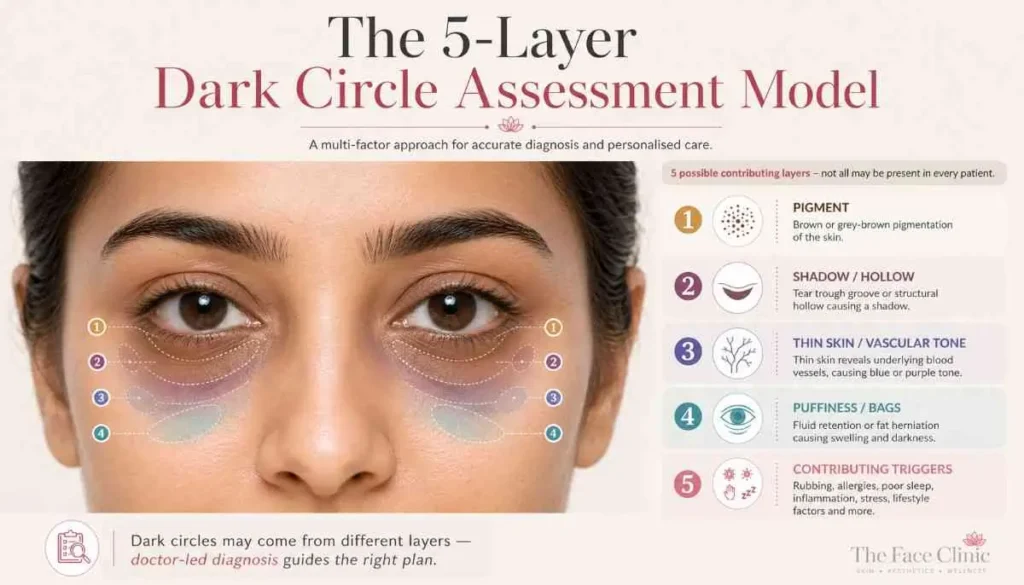
The 5-Layer Dark Circle Assessment Model
- Colour
- Shadow
- Skin quality
- Puffiness
- Triggers
Layer 1 — Colour: Brown, Blue, Purple, Grey or Mixed
Layer 2 — Shadow: Tear-Trough Hollows and Facial Structure
Layer 3 — Skin Quality: Thin, Crepey or Translucent Under-Eye Skin
Layer 4 — Puffiness: Fluid, Allergies and Eye Bags That Create Shadows
Layer 5 — Triggers: Rubbing, Sun, Sleep, Allergies, Genetics and Inflammation
Doctor’s Summary — Most Persistent Dark Circles Are Mixed Patterns
The 3-Minute Dark Circle Observation Check
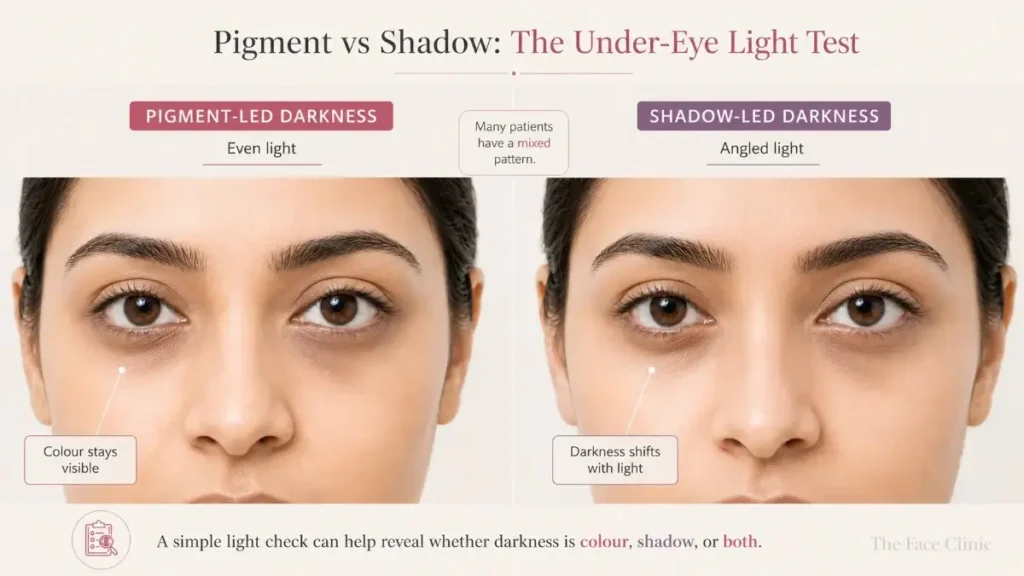
The Light Test
The Colour Test
The Morning–Evening Test
The No-Tug Skin Observation
- fine crepiness;
- dryness;
- visible vessels;
- uneven texture;
- puffiness;
- differences in how light reflects from the skin.
The Treatment History Test
Why Common Dark Circle Treatments May Not Work
Why Eye Creams May Not Be Enough
Why Lasers May Not Work for Some Dark Circles
Why Under-Eye Filler May Not Work for Some Dark Circles
Why Peels or Pigment Treatments May Disappoint
- structural shadow;
- tear-trough hollowness;
- puffiness;
- visible vascular colour;
- thin-skin translucency;
- recurring rubbing, allergy or inflammation.
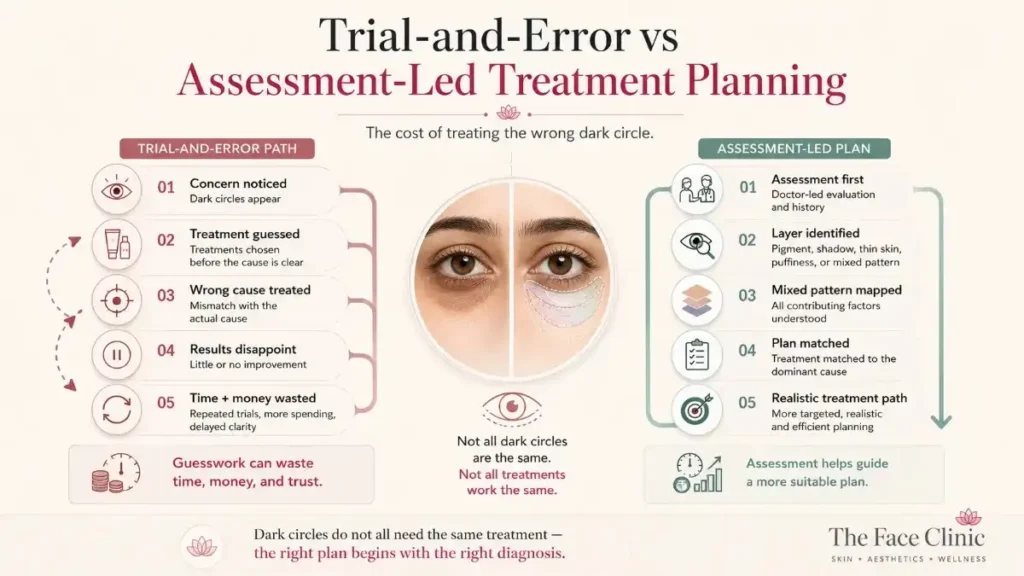
The Hidden Cost of Treating the Wrong Layer
- repeated treatments that address only part of the problem;
- unnecessary irritation or swelling;
- time spent changing approaches without understanding the pattern;
- disappointment when one visible feature improves but the tired look remains;
- loss of confidence in treatments that were never designed to correct every contributing layer.
What Your Dark Circle Pattern May Be Telling You
WHAT YOU NOTICE | WHAT MAY BE CONTRIBUTING | WHY PREVIOUS ATTEMPTS MAY HAVE MISSED IT |
|---|---|---|
Brown or grey-brown darkness | Pigmentation may be contributing | Structural treatment alone would not necessarily change colour within the skin |
Grey groove or darkness that changes with lighting | Hollowness or structural shadow may be contributing | Creams or pigment-focused approaches cannot remove a shadow created by depth |
Blue-purple appearance | Thin skin or vascular visibility may contribute | The visible colour may be mistaken for pigmentation alone |
Puffiness with a darker area beneath it | Swelling, fluid tendency or lower-eyelid bags may be creating shadow | Treating the colour alone may leave the contour-related darkness unchanged |
Several of these features together | A mixed pattern | One intervention may improve one layer while another remains visible |
Common Misdiagnoses That Keep Dark Circles Persistent
Misdiagnosis 1 — Assuming Every Dark Circle Is Pigmentation
Misdiagnosis 2 — Treating a Shadow Like a Colour Problem
Misdiagnosis 3 — Mistaking Puffiness for Hollowness
Misdiagnosis 4 — Expecting One Treatment to Correct Every Layer
- pigmentation;
- thin skin;
- a structural shadow;
- puffiness;
- recurring triggers such as rubbing or allergy.
Misdiagnosis 5 — Ignoring the Triggers That Keep Recreating the Problem
When Persistent Dark Circles Need Medical Assessment
- sudden or unexplained;
- clearly one-sided;
- associated with significant or persistent swelling;
- accompanied by pain, redness or tenderness;
- linked with active dermatitis, eczema or infection;
- occurring with marked allergy or inflammation;
- new and progressively worsening;
- very different from your usual under-eye pattern.
What a Professional Under-Eye Assessment Should Clarify
Is the Darkness Mainly Colour, Shadow, Puffiness — or Mixed?
Are There Factors the Five-Layer Model Cannot Establish at Home?
- skin thickness and quality;
- pigmentation tendency;
- allergy or inflammation history;
- persistent or fluctuating swelling;
- previous under-eye procedures;
- facial anatomy;
- ageing-related changes;
- whether a new or unusual symptom needs medical evaluation.
What Can Realistically Change — and What May Remain?
Frequently Asked Questions About Dark Circles That Don’t Go Away
Why Are My Dark Circles Not Going Away Even After Sleep?
How Do I Know If My Dark Circles Are Pigmentation or Shadow?
Can Eye Creams Remove Dark Circles If the Cause Is Hollowness?
Why Do My Dark Circles Look Worse in Some Lighting?
Can Puffiness Make Dark Circles Look Worse?
Why Can Dark Circles Persist Even After Several Different Treatments?
Can Dark Circles Have More Than One Cause at the Same Time?
Final Takeaway — Treat the Pattern, Not Just the Colour
- Does the colour remain relatively constant?
- Does the darkness change with lighting?
- Is there visible hollowness or structural shadow?
- Does puffiness fluctuate?
- Is the skin thin or translucent?
- Are rubbing, allergies or other triggers repeatedly worsening the area?
- Could several of these factors be present together?
All treatments are subject to individual variation. Outcomes are determined following clinical evaluation by a qualified doctor.


