Chin Fillers
- Home
- Services
- Chin Fillers
Don’t think much, have a query? Call us now!
EXCELLENT Based on 313 reviews
 Posted on Google
 anjana kaushalI had a wonderful experience at The Face Clinic. Dr. Reema is incredibly kind, polite, and professional. She listens to all your concerns very patiently and carefully, making you feel comfortable and well cared for throughout the consultation. The quality of services provided by the clinic is top-notch. The entire team ensures that patients are comfortable Overall, if I ever need any dermatology services in the future, I will definitely visit this clinic again. It has become my go-to place, and I highly recommend it to anyone looking for expert and compassionate skincare treatment.Posted on Google
 Ritu BhardwajA very experienced doctor.

Medically reviewed by: Dr Reema Arora, MBBS, MSc Facial Aesthetics (UK)
Medical review date: October 2026
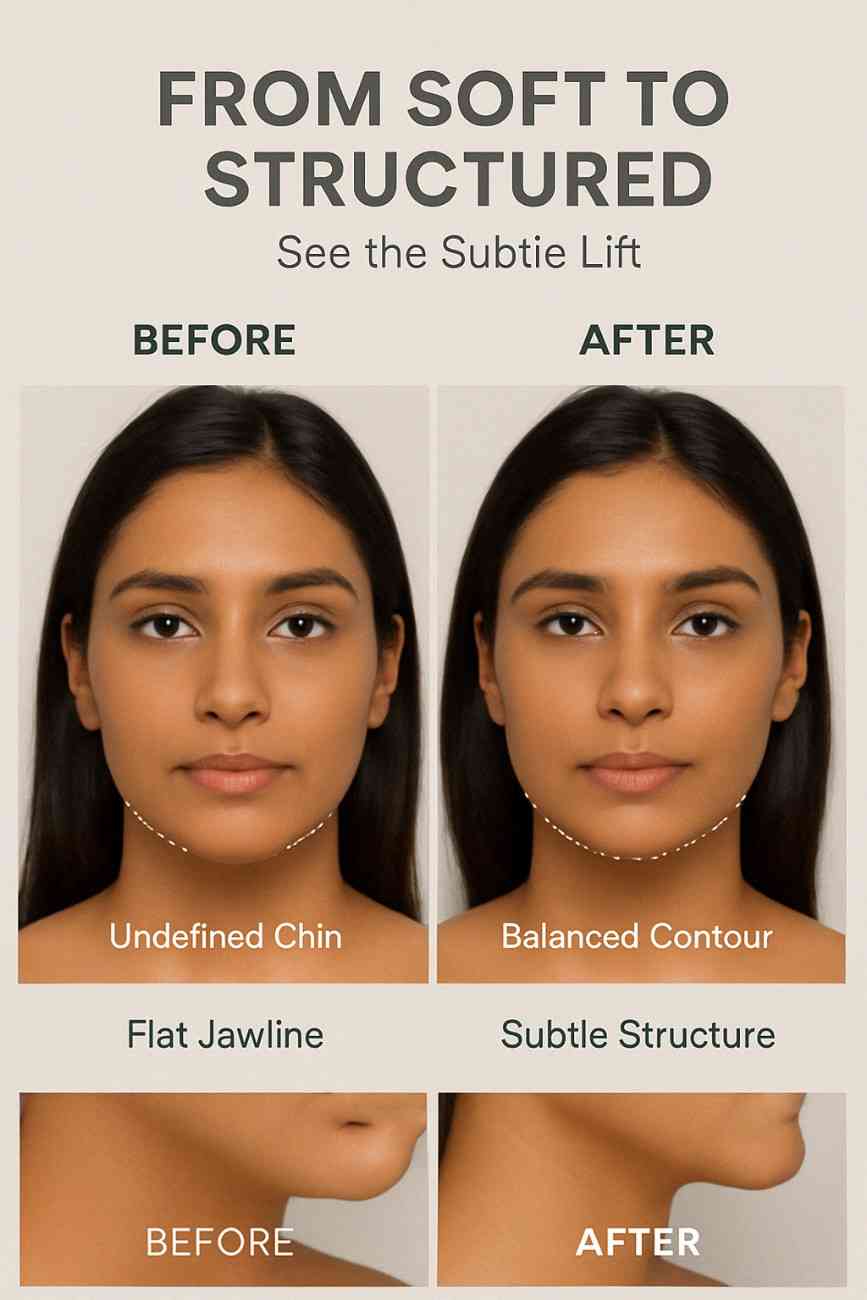
A chin that appears recessed, lacks projection or seems out of proportion with the rest of the face can influence the appearance of the entire facial profile. However, improving chin definition is not simply a matter of adding volume. The underlying concern may involve chin shape, projection, surrounding soft tissues or skeletal structure.
At The Face Clinic, Hauz Khas, South Delhi, Dr Reema Arora offers doctor-led chin filler treatment for suitable patients seeking to improve chin projection, refine contours or address selected soft-tissue asymmetries.
Patients considering chin filler in Delhi may be concerned about a weak, recessed or small chin, or wish to understand whether non-surgical chin augmentation can improve their facial proportions.
Treatment planning considers the chin in relation to the nose, lips and jawline. The objective is proportionate profile balancing, rather than simply increasing chin size.
Treatment detail | What to expect |
Treatment | Injectable dermal filler for selected chin-contour concerns |
Main purpose | Improve chin projection, shape and lower-face proportions |
Indicative cost at The Face Clinic | ₹20,000–₹70,000 |
Initial results | Usually visible immediately; swelling may affect the early appearance |
Typical longevity | Often approximately 12–18 months for selected HA fillers; individual variation applies |
Recovery | Temporary swelling, tenderness or bruising may occur |
Treating doctor | Dr Reema Arora |
Clinic location | Hauz Khas, South Delhi |
The quoted range is indicative, not a fixed per-syringe price. Final cost, suitability, results, recovery and longevity depend on individual assessment and treatment planning.
Chin fillers are injectable materials used to add volume or support to selected areas of the chin. They offer a non-surgical approach to modifying visible chin projection, contour or shape.
Unlike a chin implant or surgical genioplasty, non surgical chin augmentation with dermal filler does not reposition the underlying bone.
In suitable patients, chin filler may help:
The degree of improvement depends on the patient’s original anatomy, treatment objective, filler formulation and amount of correction considered appropriate.
Chin filler does not directly remove submental fat, correct significant skeletal retrusion, reposition the jaw or reliably treat substantial skin laxity.
Hyaluronic acid (HA) is naturally present in the body. Injectable HA fillers are specially formulated gels that can provide volume and structural support in selected facial tissues.
Different formulations have different physical properties. A filler considered for structural chin projection may differ from one selected for softer facial contours or highly mobile areas.
Filler selection should consider the patient’s anatomy, tissue characteristics, intended correction, medical history, manufacturer’s instructions and applicable regulatory indications.
At The Face Clinic, the proposed product, quantity, expected benefits, limitations and potential complications are discussed during individual treatment planning.
Hyaluronic acid fillers and collagen-stimulating injectable materials are not interchangeable. Their characteristics, duration and options for managing unwanted outcomes may differ.
For a broader understanding of injectable treatments, see our Dermal Fillers Treatment in Delhi guide.
Injectable dermal fillers are medical products, and their regulatory status, intended indications and manufacturer instructions should be considered before treatment.
In India, the applicable medical-device framework is administered by the Central Drugs Standard Control Organisation (CDSCO), including the Medical Devices Rules, 2017.
Regulatory authorisation is product-specific. An authorisation for one dermal filler or treatment indication should not automatically be assumed to apply to other formulations or anatomical areas.
Some dermal fillers have received US Food and Drug Administration (FDA) approval for chin augmentation in specified patient groups. However, US FDA approval does not automatically establish Indian regulatory authorisation or an equivalent approved indication in India.
Product selection at The Face Clinic takes account of clinical suitability, manufacturer documentation, applicable indications and relevant regulatory requirements.
Patients may ask about the proposed filler, manufacturer, intended use and available product information before consenting to treatment.
Regulatory authorisation does not eliminate procedural risks or guarantee a particular aesthetic outcome.
Independent regulatory information:
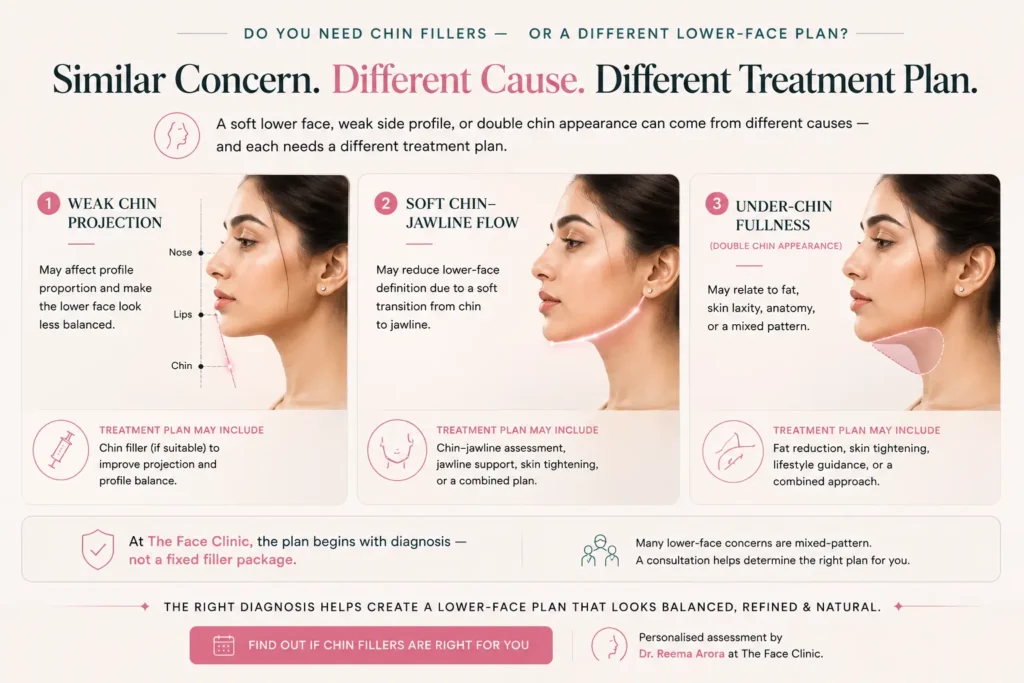
A chin may appear weak, small, recessed or poorly defined for different anatomical reasons.
Identifying the underlying cause is important because adding filler is not necessarily the most appropriate solution for every patient.
The appearance of the chin depends on several relationships, including forward projection, vertical proportions, surrounding soft tissues and the position of the underlying bone.
A chin may appear recessed because of limited forward projection. It may look relatively short because of its vertical dimensions or less defined because of tissue fullness beneath the chin.
A prominent mental crease or visible chin dimpling may involve muscle activity or other soft-tissue characteristics rather than inadequate chin projection.
Main concern | Possible contributing factor | Potential role of filler |
Recessed-looking chin | Limited visible forward projection | May improve projection in selected patients |
Small or short chin | Vertical proportions or skeletal structure | May provide limited contour or length refinement |
Mild chin asymmetry | Soft-tissue or skeletal differences | May improve selected soft-tissue irregularities |
Poor chin definition | Submental fullness or adjacent contours | Filler alone may not address the cause |
Chin dimpling or deep crease | Mentalis activity or tissue characteristics | Requires separate assessment |
The purpose of consultation is to identify what contributes to the patient’s concern before deciding whether injectable correction is appropriate.
Weak chin treatment begins with an assessment of whether the apparent lack of projection comes from the chin itself, the surrounding facial proportions or a broader skeletal relationship.
For selected patients, chin filler may improve visible projection and contour without surgery.
However, recessed chin treatment requires particular care because substantial skeletal discrepancies cannot be corrected simply by adding filler.
Similarly, small chin treatment depends on whether the concern involves limited forward projection, vertical chin dimensions, soft-tissue volume or the underlying bone structure.
Injectable correction may be appropriate for selected mild to moderate contour concerns. The amount of change achievable is limited by anatomy and tissue response.
Where a recessed chin is associated with an abnormal bite, significant jaw-position discrepancy or functional concern, dental, orthodontic or maxillofacial assessment may be more appropriate.
Chin fillers may help refine selected areas of the chin or improve minor soft-tissue contour differences.
For example, a treatment plan may consider changes to a relatively rounded, narrow or uneven chin where injectable correction is anatomically appropriate.
The objective is not perfect symmetry or maximum projection. The intended result should be proportionate to the surrounding facial features.
Significant differences in underlying bone structure cannot reliably be corrected using dermal filler alone.
Chin dimpling and a pronounced mental crease may reflect mentalis muscle activity, skin characteristics or the underlying soft-tissue structure.
These concerns are not necessarily caused by insufficient chin projection.
An assessment may identify another treatment approach or determine that more than one anatomical factor contributes to the appearance.
Structural chin augmentation should not automatically be used to address every chin line or dimple.
Chin fillers for men and women are planned according to individual anatomy, facial proportions and patient preferences.
Some patients seek greater projection or definition. Others prefer limited changes that preserve their existing facial characteristics.
Treatment should not be based on a predetermined masculine or feminine chin shape.
Chin filler may be unsuitable, require modification or need to be deferred when there is:
Elective filler procedures are generally deferred during pregnancy and breastfeeding because adequate safety evidence is lacking.
Suitability is determined through medical-history review, clinical assessment and informed discussion.
Understanding chin filler vs jawline filler is important because the treatments address different anatomical areas.
Chin filler primarily aims to modify selected aspects of chin projection, shape and contour. Jawline filler is used to address selected definition or contour concerns along the lower jaw.
A patient may have a reasonably defined jawline but insufficient chin projection. Another may have adequate chin projection but wish to address contour differences along the mandibular border.
Treatment | Principal concern | Potential improvement |
Chin filler | Under-projection or selected chin-shape concerns | Chin projection, shape and visible profile |
Jawline filler | Reduced lower-jaw definition | Selected mandibular contours |
Double chin treatment | Submental fullness or tissue laxity | Improvement according to the underlying cause |
The treatments are not interchangeable.
Chin filler does not dissolve fat beneath the chin. Similarly, jawline filler does not automatically correct inadequate chin projection.
Combination treatment may be considered where separate anatomical concerns are present, but it is not routinely necessary.
Where the concern involves the lower-jaw contour, explore Jawline Fillers in Delhi.
For fullness beneath the chin, see Double Chin Treatment in Delhi.
Chin filler results depend on the patient’s original anatomy, filler formulation, treatment quantity, individual tissue response and intended correction.
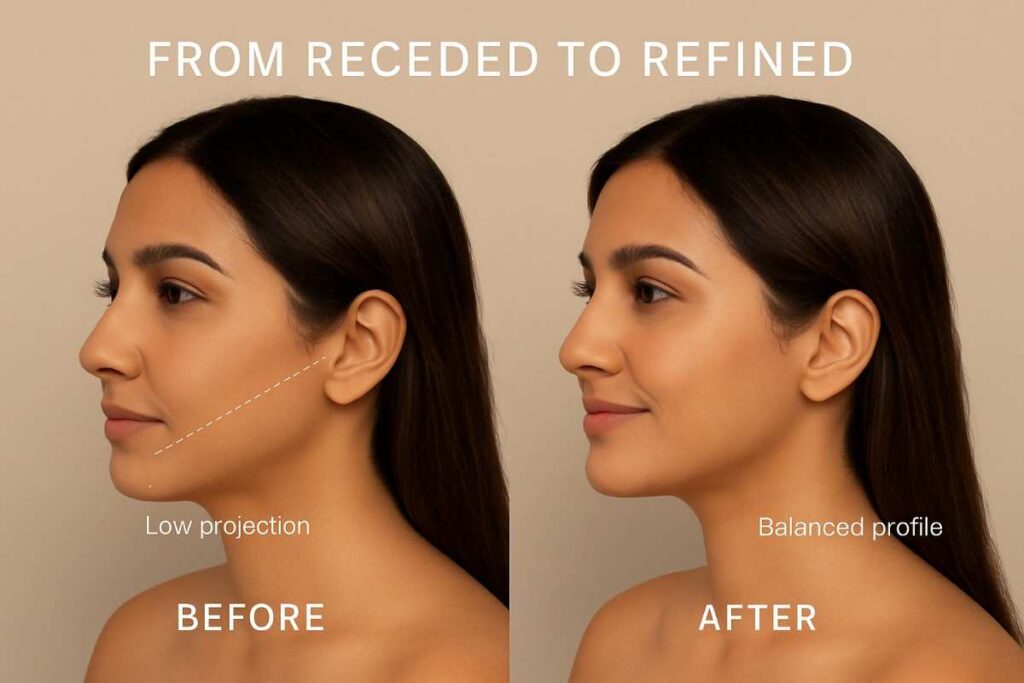
In suitable patients, treatment may improve visible chin projection, refine shape or create a more proportionate lower-face profile.
A change may be visible immediately after injection. However, swelling can affect the initial appearance, and the settled result should be assessed after the early tissue response has resolved.
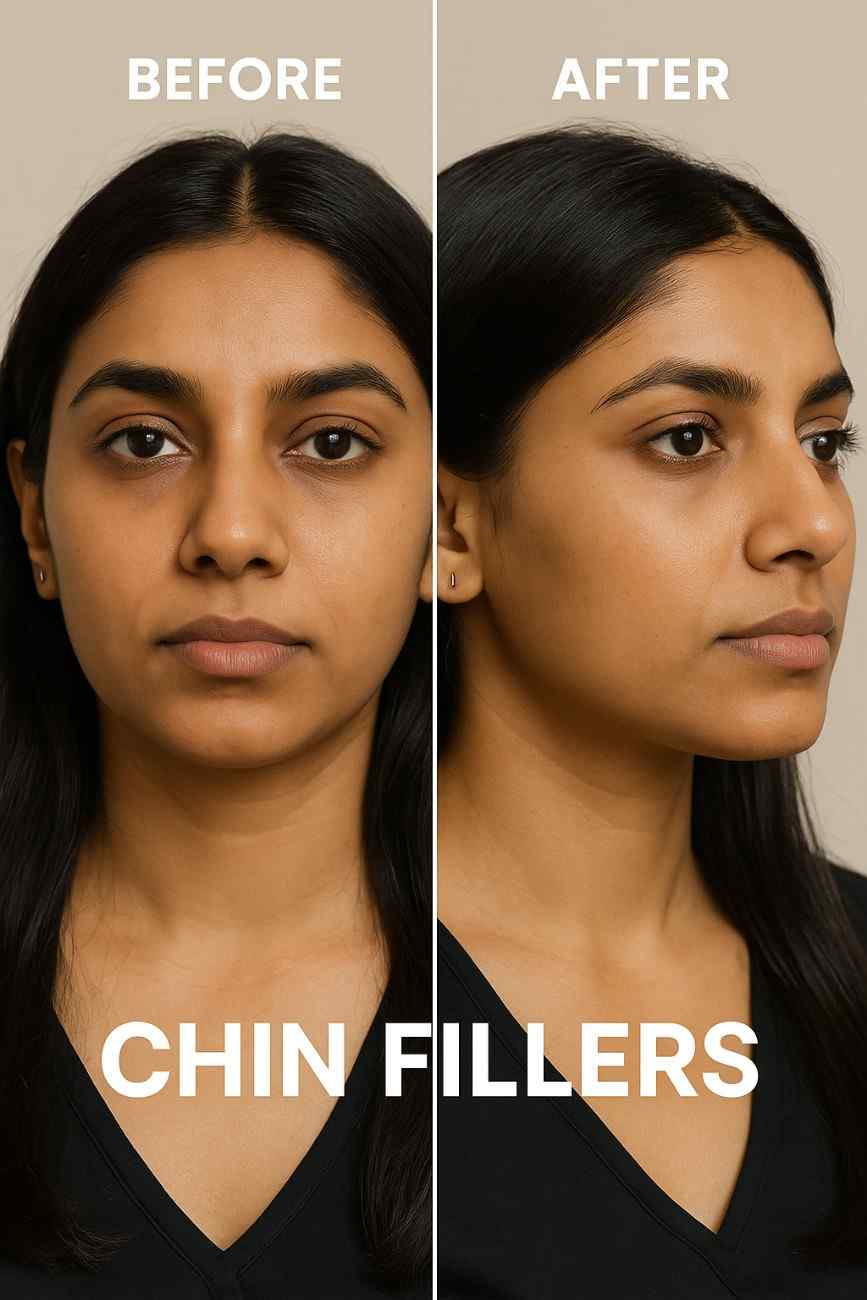
Patients reviewing chin filler before after photographs should consider the degree of correction, starting anatomy and circumstances in which the images were taken.
A proportionate result does not necessarily involve a noticeably longer, sharper or more prominent chin.
For some patients, a modest change to projection may influence the visible relationship between the nose, lips and chin. Others may require a different approach because of anatomical limitations.
Actual patient photographs, where displayed with appropriate consent, should ideally use comparable camera angles, facial positioning, expressions and lighting.
The interval between treatment and the after photograph should also be stated.
Photographs taken immediately after treatment may reflect temporary swelling.
Another patient’s result does not reliably predict an individual outcome.
Patients commonly ask, “How long does chin filler last?”
Chin filler results are temporary.
For some hyaluronic acid formulations, visible improvement may last approximately 12–18 months, although this is an indicative range rather than a guarantee.
Longevity depends on:
The duration of visible improvement is not necessarily the same as the length of time residual filler may remain detectable within tissues.
Maintenance should therefore be based on reassessment rather than a fixed injection schedule.
Further treatment may not be appropriate simply because a standard time interval has passed.
At The Face Clinic, Hauz Khas, South Delhi, the published indicative chin filler cost in Delhi is ₹20,000–₹70,000 per treatment session.
The final chin filler price depends on the selected formulation, treatment quantity, individual anatomy and complexity of the proposed correction.
Patients comparing chin filler cost should distinguish between a per-millilitre quotation, a per-syringe price and the overall cost of an individual treatment plan.
An exact quotation is provided following consultation and facial assessment.
Cost factor | Why it matters |
Filler formulation | Different products have different properties, indications and costs |
Quantity required | The proposed amount depends on anatomy and treatment objectives |
Degree of correction | Limited contour refinement and more involved projection concerns may require different plans |
Treatment complexity | Asymmetry or anatomical limitations may influence planning |
Additional treatment areas | Jawline or other facial procedures are considered and priced separately |
The ₹20,000–₹70,000 range is an indicative treatment price, not a standard price per millilitre or syringe.
Patients should be informed of the proposed product, planned quantity, total treatment quotation and any separately chargeable consultation, additional treatment or follow-up services before proceeding.
The cost of jawline filler, if considered separately, should not be assumed to be included in the chin filler quotation.
There is no universal filler quantity suitable for every patient.
The amount depends on the existing chin anatomy, intended projection or contour change, selected product and degree of correction considered appropriate.
More filler does not automatically produce a better or more balanced result.
Excessive volume can create unwanted chin dimensions or an exaggerated appearance, particularly when the underlying concern has not been correctly identified.
The quantity and total cost should be discussed before treatment.
Non-surgical chin augmentation at The Face Clinic begins with an individual facial assessment rather than a predetermined filler quantity or standardised chin shape.
Dr Reema Arora assesses the chin in relation to the lips, nose, jawline, lower face and side profile.
The consultation includes discussion of the patient’s concerns, relevant medical history, previous aesthetic procedures, medications and expectations.
This helps determine whether filler is suitable, whether another treatment may be more appropriate and what degree of correction might reasonably be achieved.
Where chin filler is considered appropriate, the proposed formulation and quantity are selected according to anatomy, intended correction, product characteristics and applicable instructions for use.
Before treatment, the consultation covers anticipated benefits, limitations, potential complications, alternatives, indicative longevity, recovery, follow-up arrangements and total cost.
Patients have an opportunity to ask questions and make an informed decision.
Treatment proceeds only after appropriate medical assessment and informed consent.
Choosing not to undergo treatment remains a valid option.
Following appropriate preparation, the selected filler is administered according to the individual treatment plan.
Comfort measures may be used where appropriate.
Temporary pressure, stinging or discomfort may occur during the procedure.
The injection approach, product and quantity depend on clinical assessment rather than a fixed treatment template.
Immediately after treatment: A change in projection or contour may be visible, although temporary swelling can influence the initial appearance.
During the first few days: Swelling, tenderness or bruising may occur. Their severity and duration vary.
Over the following weeks: The treated area can be reassessed after the initial tissue response settles. A follow-up appointment may be recommended where clinically appropriate.
There is no single recovery timeline applicable to every patient or filler product.
Persistent or worsening symptoms should not automatically be assumed to represent normal settling.
Individualised aftercare instructions are provided following treatment.
Temporary swelling, bruising or tenderness may occur. Patients should follow the treating doctor’s recommendations regarding pressure, physical activity, heat exposure and other post-treatment precautions.
Follow-up is arranged according to the procedure and clinical needs.
Any decision regarding further correction should take account of the settled appearance and individual tissue response.
Chin filler treatment is a medical procedure and carries risks, even when performed by an experienced clinician.
The chin has an important and variable vascular supply. Appropriate anatomical knowledge, patient and product selection, injection technique and access to complication-management pathways are important considerations.
Patients should understand the potential benefits, limitations and risks before providing informed consent.
Common temporary chin filler side effects may include:
These effects often improve during recovery, although their severity and duration vary.
Less common complications include infection, persistent lumps or nodules, inflammatory reactions, unwanted contour changes, asymmetry and filler migration.
A rare but serious complication is vascular occlusion, which can occur when filler enters a blood vessel or compromises blood flow.
This may cause tissue injury or necrosis. Vision loss and stroke have also been reported following facial filler injections.
Although uncommon, such complications can be serious and may require urgent medical intervention.
For independent patient-safety information, read the US FDA guidance on dermal fillers and possible complications.
Unusual, severe or worsening pain, or white, grey, blue or dusky skin discolouration following filler treatment requires immediate clinical assessment.
Contact the treating clinic urgently. If prompt assessment is unavailable, seek emergency medical care.
Sudden vision changes, facial weakness, difficulty speaking, sudden severe headache or other stroke-like symptoms require immediate emergency medical services.
Do not wait for a routine follow-up appointment if a serious complication is suspected.
Before treatment, inform the doctor about relevant medical conditions, allergies, previous filler procedures, prescription medicines, supplements and any recent infection or inflammation.
Do not independently stop prescribed aspirin, anticoagulants or other medication.
Any proposed medication change should be discussed with the prescribing clinician and treating doctor.
Some hyaluronic acid fillers can be reduced or dissolved using hyaluronidase when clinically appropriate.
However, this does not make treatment risk-free or guarantee complete reversal of every unwanted result.
Responses to hyaluronidase vary, and additional intervention may be required. Dissolving filler does not necessarily reverse tissue injury that has already occurred.
Non-hyaluronic acid fillers may not be removable in the same way.
Patients should understand the proposed product and available management options before treatment.
Patients comparing chin filler vs implant treatment should understand that injectable and surgical approaches change facial anatomy in different ways.
Chin fillers modify selected soft-tissue contours without repositioning bone.
Chin implants are surgically placed to change chin projection or contour, while sliding genioplasty involves repositioning part of the patient’s own chin bone.
Consideration | Chin filler | Surgical chin augmentation |
Approach | Injectable soft-tissue treatment | Implant placement or bone repositioning |
Main objective | Selected projection and contour refinement | Structural augmentation or repositioning |
Duration | Temporary | Generally longer-term structural change |
Recovery | Usually shorter, with individual variation | Typically requires more recovery |
Reversibility | Some HA fillers can be dissolved, with limitations | Revision or removal may require surgery |
Risks | Includes injection-related and vascular complications | Includes surgical, implant-related and anaesthesia-related risks |
Chin filler may be appropriate for selected patients seeking a limited, temporary change in projection or contour.
Surgical evaluation may be more relevant when substantial structural correction or a longer-term anatomical change is desired.
Where the concern involves a broader jaw-position or bite discrepancy, a specialist evaluation may be required.
For further educational information, see Cleveland Clinic’s overview of genioplasty and chin augmentation.
For a detailed comparison of fillers, chin implants, sliding genioplasty and anatomical decision-making, read our Non-Surgical Chin Augmentation in India: Fillers vs Surgery guide.
Chin enhancement requires more than choosing a filler or deciding how much volume to inject.
Appropriate treatment planning involves assessing facial anatomy, understanding the cause of the patient’s concern, recognising the limits of injectable correction and discussing the potential benefits and risks.
Dr Reema Arora is the Founder and Medical Director of The Face Clinic, Hauz Khas, New Delhi.
She holds an MBBS from St John’s Medical College and an MSc in Facial Aesthetics (UK), and has over 20 years of experience in facial aesthetics.
She previously served as Medical Head – Facial Aesthetics at Allergan India and has experience as a national and international trainer in botulinum toxin and dermal filler treatments.
At The Face Clinic, treatment planning begins by determining whether the concern primarily involves chin projection, shape, surrounding facial proportions or an anatomical issue that filler cannot adequately correct.
A chin that appears small does not automatically require greater filler volume.
The recommendation may involve limited chin refinement, consideration of another facial area, specialist assessment, an alternative treatment or no injectable intervention.
The aim is an appropriate, proportionate improvement where clinically suitable while respecting the patient’s individual facial characteristics.
Read more about Dr Reema Arora’s qualifications and professional background.
Chin augmentation is a broader term for procedures that change chin shape, size or projection. Chin filler is a non-surgical form of augmentation using injectable material. Surgical augmentation may involve an implant or repositioning of the chin bone.
At The Face Clinic, Hauz Khas, the indicative price is ₹20,000–₹70,000 per treatment session. The final quotation depends on the selected product, quantity required, individual anatomy and treatment plan.
Chin filler may improve the visible projection of a mildly or moderately recessed chin in selected patients. It cannot reposition the jaw or correct significant skeletal discrepancies. Suitability is determined through clinical assessment.
Discomfort varies. Patients may experience temporary pressure, stinging or tenderness during treatment. Appropriate comfort measures may be used. Unusual or worsening pain after treatment requires urgent medical assessment.
Many patients resume routine activities shortly after treatment. However, temporary swelling, tenderness or bruising may be visible. Certain activities may need to be restricted according to individual aftercare advice.
Selected patients may benefit from assessment of both areas where separate concerns involve chin projection and jawline contour. Combination treatment is not automatically necessary.
No. Dermal fillers differ in composition, characteristics, regulatory status and intended anatomical indications.
Authorisation for one filler or treatment area does not automatically establish approval for chin augmentation.
Product selection should consider applicable Indian regulatory requirements, manufacturer instructions and individual clinical suitability.
Consider relevant medical qualifications, experience with facial anatomy and injectable treatment, product transparency, the informed-consent process, availability of complication management and follow-up arrangements.
The consultation should explain treatment options, expected benefits, limitations, risks and total costs before proceeding.
If you are considering chin fillers in Delhi for a weak or recessed chin, limited chin projection or selected contour concerns, an individual medical consultation can help determine whether treatment is appropriate.
At The Face Clinic, Dr Reema Arora assesses facial proportions, discusses realistic treatment objectives and explains the potential benefits, limitations, risks and indicative cost.
The objective is not simply to add volume, but to determine whether chin enhancement is suitable for your anatomy and expectations.
The Face Clinic — Dr Reema Arora
Address: C-36, LGF, Chaudhary Dilip Singh Marg, Hauz Khas Market, New Delhi – 110016
Hours: Monday–Saturday, 10:00 AM–6:00 PM
Phone: +91 99580 73900
Medical disclaimer: Chin filler treatment requires individual medical assessment. Suitability, outcomes, longevity, recovery and complications vary. No particular aesthetic result can be guaranteed.
All treatments are subject to individual variation. Outcomes are determined following clinical evaluation by a qualified doctor.
Special Offer
Get a Consultation With Our Experts*
*T&C Apply
Everything you need to feel healthy and beautiful