
Have Any Question?
Don’t think much, have a query? Call us now!
Connect with us
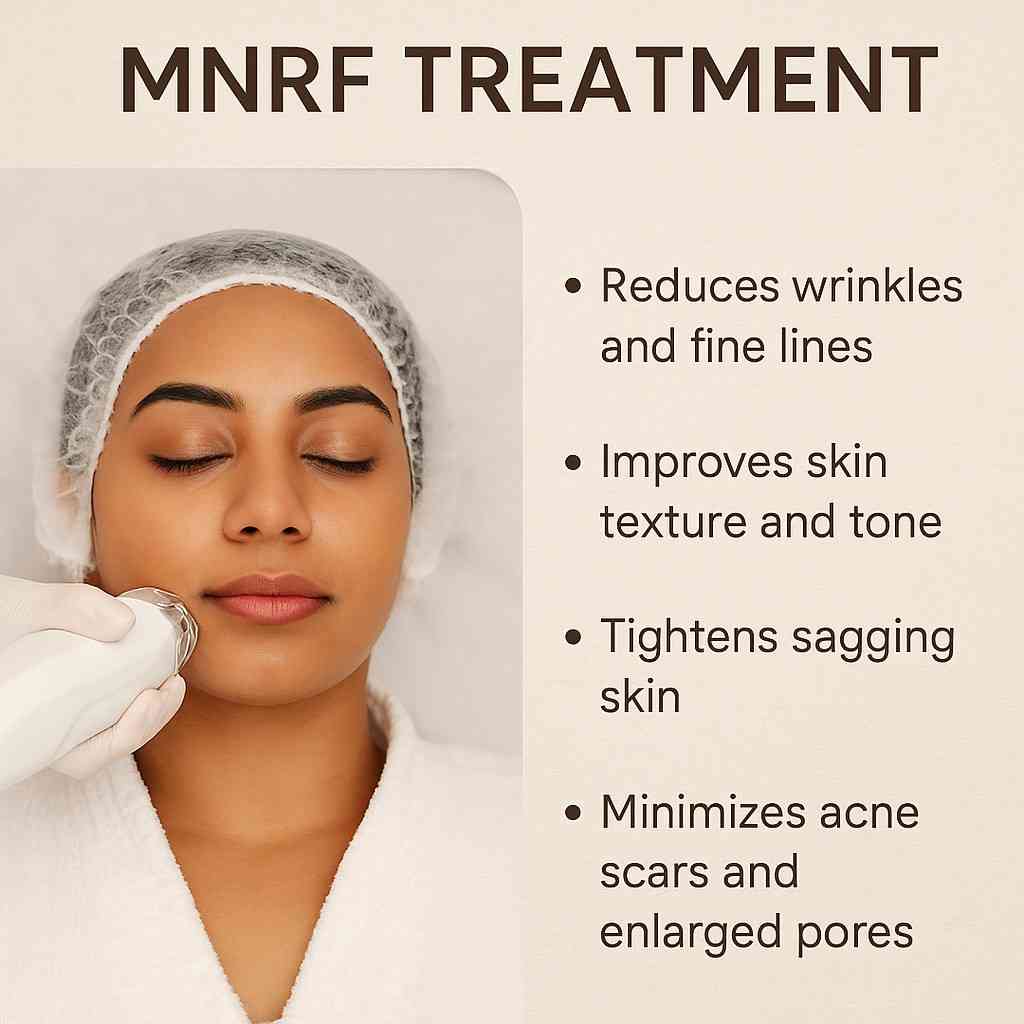
MNRF Treatment in Delhi: RF Microneedling for Acne Scars, Pores & Skin Tightening
MNRF treatment combines microneedling with controlled radiofrequency energy to stimulate collagen and address selected concerns such as acne scars, enlarged or open pores, uneven skin texture and mild skin laxity. Also known as RF microneedling or radiofrequency microneedling, treatment depth and energy are customised to the concern, treatment area and individual skin characteristics.
MNRF / RF Microneedling at a Glance
| Best suited for | Acne scars, enlarged pores, uneven texture and mild skin laxity |
| Downtime | Usually 1–3 days |
| Sessions often recommended | Typically 2–5, depending on the concern and treatment plan |
| When results develop | Gradually as collagen remodelling progresses |
| Treatment cost | From ₹12,000 per session |
| Where | The Face Clinic, Hauz Khas, South Delhi |
Book an MNRF Consultation
Treatment planning is personalised by Dr Reema Arora, with over 20 years of experience in aesthetic medicine, based on the concern, skin characteristics, treatment area, and the depth and intensity of treatment required.
What Is MNRF / RF Microneedling?
MNRF stands for Microneedling Radiofrequency. It combines controlled microneedling with radiofrequency energy delivered at selected depths beneath the skin. Fine microneedles create precise micro-injuries while RF energy is delivered into targeted tissue, stimulating the skin’s repair response and supporting collagen and elastin remodelling over time.
MNRF is commonly referred to as RF microneedling or radiofrequency microneedling; the term microneedling radiofrequency describes the same combination of controlled needling and RF energy.
This ability to customise treatment parameters allows MNRF to be considered for different indications, including selected acne scars, enlarged pores, uneven skin texture and mild skin laxity. A brief clinical assessment determines suitability and expected improvement for each patient — see Who Is MNRF Suitable For below.

MNRF vs Ordinary Microneedling
MNRF and ordinary microneedling both use controlled microneedling to stimulate the skin’s repair response. MNRF / RF microneedling additionally delivers controlled radiofrequency energy through the needles at selected depths beneath the skin, which is what allows both needle depth and energy parameters to be tailored to the treatment indication.
| Feature | Ordinary Microneedling | MNRF / RF Microneedling |
|---|---|---|
| How it works | Controlled microneedling creates micro-injuries that stimulate a repair response | Combines controlled microneedling with radiofrequency energy |
| RF energy delivery | No | Yes, delivered through the needles at selected depths |
| Treatment parameters | Needle depth selected according to the indication and treatment area | Needle depth and RF parameters selected according to the indication and treatment area |
| Commonly considered for | Uneven texture, selected acne scars and collagen induction | Selected acne scars, pores/texture and mild skin laxity where RF energy may add clinical value |
| Treatment selection depends on | Concern, skin characteristics and clinical assessment | Concern, skin characteristics and clinical assessment |
Neither treatment is automatically better for every patient — the right option depends on the depth of the concern, individual skin characteristics and treatment goal. For a detailed overview of collagen-induction treatment without radiofrequency energy, see our guide to Microneedling Treatment.
What Can MNRF / RF Microneedling Treat?
MNRF treatment is customised for different skin concerns by adjusting the depth of microneedling and the radiofrequency energy delivered. Depending on the indication and individual skin characteristics, RF microneedling may be considered for selected acne scars, enlarged pores, uneven skin texture and mild skin laxity.
RF Microneedling for Acne Scars
RF microneedling for acne scars combines controlled microneedling with radiofrequency energy delivered at selected depths beneath the skin. The treatment stimulates collagen remodelling within areas of textural irregularity and may help soften the appearance of selected atrophic acne scars over time.
Scar type, depth and distribution matter here. Rolling, boxcar and other atrophic scars respond differently, so treatment depth and energy are selected according to the individual scar pattern. In some cases, MNRF forms part of a broader Acne Scar Treatment plan rather than being used as a standalone procedure.
MNRF for Open Pores & Skin Texture
MNRF for open pores may help improve the appearance of enlarged pores and uneven skin texture by supporting controlled collagen remodelling within the treated skin. The aim is gradual improvement in smoothness, texture and overall skin quality rather than an immediate or artificial surface change.
Because enlarged pores and uneven texture can have different underlying causes, clinical assessment helps determine whether RF microneedling, ordinary microneedling or another approach is better suited to the concern.
MNRF for Skin Tightening
MNRF for skin tightening may be considered for early to mild skin laxity or loss of firmness. By delivering radiofrequency energy at controlled depths, the treatment supports collagen and elastin remodelling within the treated tissue — in selected areas of the face, jawline or neck.
MNRF is not a substitute for surgical lifting in patients with significant skin laxity. For more pronounced laxity, our Skin Tightening Treatments page outlines the full range of non-surgical options, including where HIFU may be more appropriate.
Areas Commonly Treated with MNRF
- Cheeks and mid-face — commonly for acne scars, enlarged pores and uneven texture
- Jawline and lower face — where mild skin laxity or loss of firmness is a concern
- Neck and décolletage — for selected textural changes and mild laxity
- T-zone and other pore-prone areas — where enlarged pores or uneven texture are being addressed
Treatment depth and RF parameters are selected according to the anatomical area, individual skin characteristics and treatment objective.
Who Is MNRF Treatment Suitable For?
MNRF treatment may be considered for people seeking improvement in:
- selected acne scars and uneven skin texture
- enlarged or open pores
- early to mild skin laxity
- loss of firmness or overall skin quality
- concerns where deeper collagen remodelling may be appropriate
Not every textural concern requires radiofrequency energy — in some cases, ordinary microneedling or another treatment approach is more appropriate after clinical assessment.
MNRF may need to be postponed, or may not be appropriate, in the presence of: active skin infection, significant irritation or open wounds in the treatment area; certain active inflammatory skin conditions; or medical conditions, medications or healing concerns that may affect treatment suitability. These factors are reviewed during consultation before treatment is recommended.
A note on individual results and suitability: MNRF’s outcomes depend on the concern being treated, skin characteristics, medical history and treatment parameters — no two treatment plans are identical. This is the general principle behind every recommendation on this page; where a specific concern needs a different consideration, it’s called out in that section.
MNRF Procedure: What Happens During Treatment?
Before Treatment
Before MNRF is performed, the treatment concern and skin are assessed to determine whether RF microneedling is appropriate. At The Face Clinic, assessment by Dr Reema Arora considers skin characteristics, pigmentation tendency, scar pattern, degree of laxity, treatment area, relevant medical history and treatment goals.
The treatment area is cleansed and prepared, and topical anaesthesia is generally applied with adequate time to take effect before treatment begins.
During MNRF Treatment
Fine microneedles enter the skin at selected depths and deliver controlled radiofrequency energy into the targeted tissue. The active treatment commonly takes approximately 45–60 minutes, depending on the area and treatment plan; the overall appointment may run longer once consultation, skin preparation and numbing time are included.
Pain & Anaesthesia
Sensitivity varies between individuals and treatment areas. Topical anaesthesia is generally used to improve comfort before the procedure. During RF energy delivery, patients may experience pressure, warmth, prickling or brief discomfort, managed according to clinical protocol and individual tolerance.
After Treatment
Immediately after MNRF, the treated skin may appear red and mildly swollen, with temporary sensitivity or pinpoint marks. Appropriate post-procedure skincare is applied before the patient leaves the clinic, along with personalised aftercare instructions. Redness and swelling generally settle over the following few days, though recovery varies with treatment depth, area treated and individual response.
MNRF Downtime & Recovery
Downtime after MNRF is generally limited to 1–3 days, although the exact recovery experience varies with treatment depth, RF settings and individual skin sensitivity.
When can I wash my face? Gentle cleansing typically resumes after approximately 24 hours, using a mild, non-active cleanser.
When can I apply makeup? Best avoided for approximately 24–48 hours, or until significant redness has settled.
When can I restart retinoids, acids, vitamin C or other actives? Commonly withheld for 5–7 days, or longer where advised.
When can I return to work? Many patients resume routine activities within 1–2 days.
What about sun exposure? Consistent sun protection is particularly important during recovery — direct or excessive sun exposure should be avoided to reduce irritation and the risk of post-inflammatory pigmentation.
Personalised aftercare advice provided after the procedure takes precedence over these general timelines.
MNRF Results & Timeline: What to Expect
MNRF results develop gradually because the treatment relies on the skin’s own collagen-remodelling response.
- Around 2–4 weeks: early changes in skin texture or subtle firmness may begin to appear
- Around 6–12 weeks: further improvement in texture, pore appearance, firmness or selected acne scars becomes more apparent
- Over 3–6 months: collagen remodelling continues, with progressive changes over subsequent months
- Longer term: durability of results and any need for maintenance depend on the original concern, treatment course and ageing process
These timelines are guides — acne scars, pores, texture and laxity don’t necessarily respond at the same rate.
How Long Can MNRF Results Last?
Because RF microneedling works through a gradual repair response, changes develop progressively rather than creating filler-like volume or an immediate lifting effect. Some patients consider maintenance treatment after completing their initial course, timed individually rather than at a fixed interval.
MNRF may also form part of a broader treatment plan when another treatment — for example Dermal Fillers or a Pico Laser Treatment — is better suited to an additional concern.
How Many MNRF Sessions Are Needed?
| Concern | Indicative Sessions | Typical Interval |
|---|---|---|
| Selected mild-to-moderate acne scars | Approximately 3–5 | Every 4–6 weeks |
| Enlarged pores & uneven skin texture | Approximately 2–4 | Every 4–6 weeks |
| Mild skin laxity of face, jawline or neck | Commonly around 3 | Every 4–6 weeks |
| General skin-quality improvement | Approximately 2–3 | Every 4–6 weeks |
The final number of sessions and interval are confirmed after clinical assessment and may be adjusted as your skin’s response is reviewed through the course.
MNRF Risks, Side Effects & Safety
MNRF / RF microneedling is a minimally invasive, energy-based procedure. Temporary redness, mild swelling, warmth, sensitivity, pinpoint marks, dryness or irritation can occur and generally improve as the skin recovers. Less commonly, complications such as prolonged inflammation, burns, persistent pigmentation changes, infection or scarring may occur — risk cannot be eliminated completely, which is why patient selection, sterile technique and correct parameter selection matter.
In October 2025, the U.S. FDA issued a safety communication after receiving reports of serious complications associated with certain uses of RF microneedling devices, including burns, scarring, fat loss, disfigurement and nerve damage; some cases required medical or surgical intervention. The FDA advises patients considering RF microneedling to discuss potential benefits and risks with a licensed healthcare provider experienced with these devices — which is precisely why MNRF at The Face Clinic is planned and performed under Dr Reema Arora’s direct clinical oversight, not administered as a standardised, technician-led protocol.
Is MNRF Suitable for Indian Skin?
MNRF can be considered across a range of skin tones, but treatment is individualised according to the patient’s skin characteristics rather than applied as a one-size-fits-all “low” or “high” setting. In patients with a greater tendency toward post-inflammatory hyperpigmentation, additional care is taken when selecting treatment parameters and planning aftercare — informed by pigmentation history, previous reactions to procedures, and the treatment area.
Independent clinical literature supports this individualised approach: a systematic review of RF microneedling in Fitzpatrick skin types III–VI concluded that RF and RF microneedling carry a low risk of scarring or hyperpigmentation in skin of color, and have been used successfully mainly for wrinkles, acne scarring and skin rejuvenation (Syder et al., Dermatologic Surgery, 2023).
MNRF Treatment Cost in Delhi
At The Face Clinic, MNRF treatment typically ranges from ₹12,000 to ₹25,000 per session, with final pricing confirmed after clinical assessment. Cost depends on:
- Treatment area — face, neck, jawline or combined areas
- Type and severity of concern — acne scars, pores, texture or laxity
- Number of sessions recommended as part of the plan
- Treatment depth and RF settings required for the individual concern
What Your MNRF Treatment Quote Includes
- Doctor-led consultation and skin assessment
- Treatment planning according to the concern and treatment area
- Topical anaesthesia/numbing, where appropriate
- Single-use sterile microneedling tips for each session
- Treatment with appropriate medical oversight
- Post-treatment care and recovery guidance
- Follow-up review when clinically indicated
Why Doctor-Led MNRF Treatment Matters
RF microneedling is not simply a device-based procedure. There is no single MNRF setting that suits every patient, treatment area or concern — needle depth and RF parameters are selected according to the tissue being treated and the clinical objective, which is why treatment planning for acne scars typically differs from that used for enlarged pores or mild skin laxity.
At The Face Clinic, Dr Reema Arora’s assessment weighs scar pattern, pore and texture changes, degree of skin laxity, treatment area, pigmentation tendency and treatment goals before recommending MNRF — and, where MNRF is unlikely to provide sufficient improvement for a given concern, an alternative or combination approach is discussed rather than simply escalating treatment intensity.
Supporting evidence for RF microneedling as monotherapy in acne scarring specifically shows this individualisation matters: a 2025 systematic review of 16 studies involving 481 patients concluded that fractional radiofrequency microneedling is likely an effective treatment for acne scarring when used as a monotherapy, while noting that further randomised controlled trials are needed to establish optimal treatment parameters (Niaz et al., Clinical, Cosmetic and Investigational Dermatology, 2025) — underscoring why parameter selection by an experienced clinician, rather than a fixed protocol, drives outcomes.
Frequently Asked Questions About MNRF / RF Microneedling
Is MNRF the Same as RF Microneedling?
Yes. MNRF stands for Microneedling Radiofrequency and is commonly referred to as RF microneedling or radiofrequency microneedling — the terminology varies, but it’s the same combination of controlled needling and RF energy delivered at selected depths.
Can All Acne Scars Be Treated With MNRF?
No single treatment suits every type of acne scar. MNRF may be considered for selected atrophic scars, but suitability depends on scar type, depth and distribution. Some scars respond better to another procedure or a combination approach — see our Acne Scar Treatment guide for the full range of options.
Does MNRF Permanently Remove Open Pores?
No. In suitable patients, RF microneedling may help improve the appearance of enlarged pores and uneven texture through gradual collagen remodelling, but the degree and durability of improvement vary by individual.
Can MNRF Be Combined With Other Treatments?
Sometimes. MNRF may form part of a broader plan alongside lasers, injectables or other energy-based procedures when clinically indicated — combination treatment is individualised, not routine.
Related Treatments & Clinical Resources
Depending on whether the main concern is acne scarring, uneven texture, pigmentation or skin laxity, another treatment may be considered instead of, or alongside, MNRF.
Related Treatments at The Face Clinic:
- Microneedling Treatment — collagen-induction treatment without radiofrequency energy
- Acne Scar Treatment — options selected according to scar type and severity
- Skin Tightening Treatments — non-surgical options for laxity and firmness
- HIFU Treatment — a different energy-based approach for selected tightening concerns
- Pico Laser Treatment — a different laser technology for selected pigmentation and texture concerns
Clinical References:
- Syder NC, Chen A, Elbuluk N. Radiofrequency and Radiofrequency Microneedling in Skin of Color: A Review of Usage, Safety, and Efficacy. Dermatologic Surgery, 2023.
- Niaz G, et al. Fractional Radiofrequency Microneedling as a Monotherapy in Acne Scar Management: A Systematic Review of Current Evidence. Clinical, Cosmetic and Investigational Dermatology, 2025.
Published evidence should be interpreted in the context of the specific device, treatment parameters, indication and individual patient characteristics.
Considering MNRF Treatment?
A consultation allows your skin concern, individual characteristics and treatment goals to be assessed before deciding whether MNRF / RF microneedling is right for you. Where MNRF is recommended, the proposed treatment area, course, expected recovery, potential risks and realistic goals are discussed before proceeding.
Special Offer
Get a Consultation With Our Experts*
*T&C Apply