Why Does the Lower Face Look Wide or Square?
A wide, broad or square-looking lower face is not a diagnosis in itself. Two people can have a similar facial shape for entirely different reasons: one may have a naturally broad jaw structure, another may have prominent jaw muscles, while facial fat, skin laxity or changes in structural support may be more important in someone else.
Often, more than one factor is involved.
That distinction matters because facial width should not automatically be treated as a single problem. A treatment that acts on muscle cannot narrow the underlying jaw bone; similarly, an approach intended for facial fat or skin laxity will not correct genuine muscle bulk.
So the useful question is not simply:
“How can I make my face look narrower?”
It is:
“What is actually making my lower face look wide?”
Understanding the structure responsible is the starting point for a proportionate, anatomy-led assessment.
What Determines the Shape of the Lower Face?
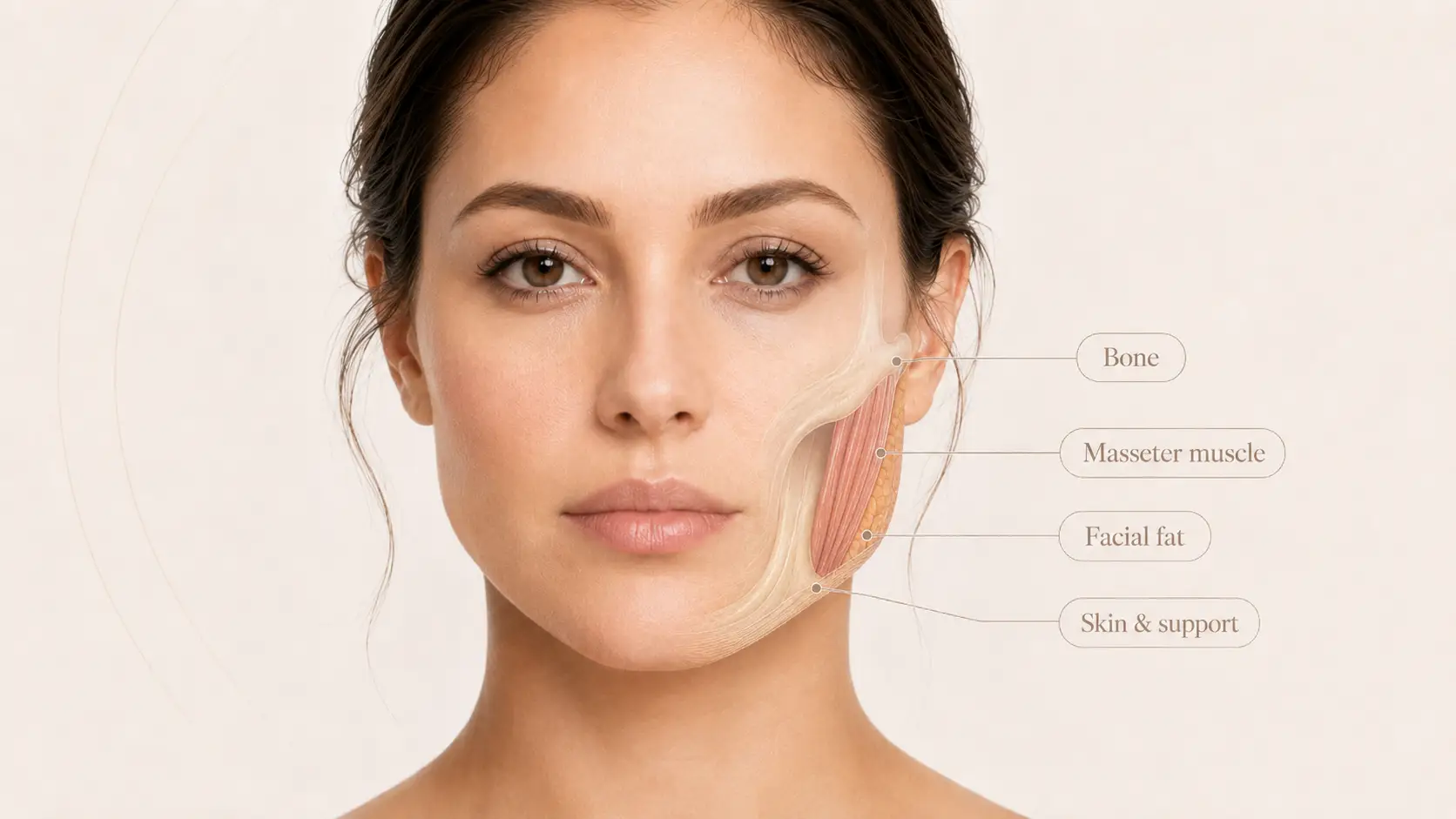
The appearance of the lower face is created by several anatomical layers working together:
- the underlying facial skeleton and jaw
- the muscles responsible for chewing and jaw movement
- the amount and distribution of facial fat
- skin, ligaments and other supporting tissues
- the relationship of the chin and jaw to the rest of the face
These structures vary naturally between individuals. Genetics, age, facial proportions, changes in weight and muscle activity can all influence the appearance of the lower third of the face.
Describing a face as “square” or “wide” therefore tells us what it looks like—but not necessarily why it looks that way.
Bone Structure and Natural Jaw Width
For some people, a broad lower face is primarily skeletal.
The mandible, or lower jaw bone, forms much of the structural width of the lower face. A naturally prominent mandibular angle can create a strong or square jaw, while the projection and width of the chin influence how that jaw appears in relation to the cheeks and the rest of the face.
These are normal anatomical variations, not abnormalities.
Bone structure also explains why two people with similarly developed jaw muscles can still have very different facial shapes. Someone with a broader skeletal base may naturally look more angular, while another person with a narrower mandible may have a more tapered lower face.
This distinction is particularly important when considering non-surgical options:
muscle-directed treatment cannot change the underlying width of the jaw bone.
Facial proportions also evolve with age. Changes occur across bone, ligaments, muscles, fat and skin, and these layers do not necessarily age at the same rate. A detailed medical review of the anatomy of facial ageing describes this interaction across the structural layers of the face.
Can Jaw Muscles Make the Lower Face Look Wider?
Yes—when the masseter muscles are particularly prominent.
The masseters are powerful chewing muscles positioned along the sides of the lower jaw. They help close the jaw and, because of their location over the outer surface of the mandible, their size can influence the visible width and contour of the lower face. The underlying masseter muscle anatomy is well established in anatomical literature.
In some people, the masseter muscles are naturally more developed. In others, prominence may become more noticeable over time or may be different between the two sides.
A prominent masseter can contribute to a lower face that appears:
- broader around the jaw angles
- more square when viewed from the front
- heavier through the lower third
- asymmetrical between the two sides
During clinical assessment, one useful observation is how the area changes when the teeth are firmly clenched. A masseter that becomes distinctly more prominent during contraction suggests that muscle bulk may be contributing to the visible width.
But clenching is only one clue. Bone structure, soft tissue, symmetry and overall facial proportions still need to be considered together.
Can Jaw Clenching or Bruxism Affect the Masseter Muscles?
Bruxism involves grinding, clenching or gnashing the teeth and can occur while awake or during sleep. It may be associated with jaw muscle tiredness or soreness, headaches and dental wear. The US National Institute of Dental and Craniofacial Research provides a useful medical overview of bruxism (teeth grinding and clenching).
Repeated jaw activity can place considerable workload on the chewing muscles, but it is important not to assume that every prominent masseter is caused by bruxism—or that everyone who clenches develops visibly enlarged jaw muscles.
Published literature on masseter muscle hypertrophy also notes that the cause is not always identifiable and that clenching, dental factors and other possibilities must be interpreted in context.
Jaw pain, significant tooth wear, persistent headaches, difficulty opening the mouth or other functional symptoms deserve appropriate medical or dental assessment rather than being treated solely as an aesthetic concern.
Likewise, a new, rapidly changing, painful or unexplained one-sided swelling around the jaw should be medically or dentally assessed, rather than assumed to be normal muscle prominence or a cosmetic facial-shape issue. Conditions involving the salivary glands, dental structures and other tissues can sometimes resemble masseter enlargement.
Facial Fat and Lower-Face Fullness
Muscle and bone are not the only contributors to a broad-looking lower face.
Facial fat is distributed through different anatomical regions rather than as one uniform layer. Individual differences in soft-tissue distribution can influence how full or defined the lower cheeks, jawline, jowl area and region beneath the chin appear.
A person may therefore have a relatively narrow underlying jaw but still perceive the lower face as broad because of soft-tissue fullness.
Weight changes can alter facial fullness in some people, but not every part of the face responds equally. Localised lower-face fullness should therefore not automatically be interpreted simply as excess body weight.
The distinction between soft-tissue fullness and structural width matters because they represent different anatomical problems.
Can Skin Laxity Make the Lower Face Appear Heavier?
Yes.
As facial tissues change over time, changes in skin elasticity, facial fat compartments, ligaments and deeper structural support can alter the contour of the lower face.
This may create:
- early jowling
- reduced separation between the face and neck
- less definition along the jawline
- visual heaviness around the lower cheeks
- an apparently broader lower third
Facial ageing is therefore not simply a matter of “loose skin.” Medical reviews describe changes progressing across the facial skeleton, fat, muscle and skin, including the lower third of the face.
This helps explain why a lower face that gradually becomes heavier with age may require a very different assessment from a naturally square jaw that has looked similar since early adulthood.
A Clinician-Led Way to Assess Lower-Face Width
A photograph can show that a face appears broad, but it does not necessarily identify the structure creating that appearance.
In clinical assessment, four questions are particularly useful:
1. What Does the Face Look Like at Rest?
A fixed, strong jaw angle may point towards skeletal structure.
Softer fullness around the jaw or beneath the chin may suggest a greater soft-tissue contribution.
Visible jowling or loss of jawline definition may instead reflect changes in skin and structural support.
2. What Changes During Movement?
The face should also be assessed dynamically.
If the outer jaw becomes substantially more prominent during firm clenching, masseter muscle bulk may be contributing to the width.
Movement can therefore reveal information that a static photograph cannot.
3. Is the Width Symmetrical and Proportionate?
Lower-face width should be interpreted in relation to:
- the cheekbones
- chin projection and width
- jaw angles
- overall facial length
- symmetry between the two sides
A feature that looks prominent in isolation may be harmonious when considered within the proportions of the whole face.
4. Has the Facial Shape Always Been This Way?
Time provides another clue.
A broad lower face that has been present since early adulthood is more likely to have a significant structural or constitutional component.
A lower face that has become heavier over time may instead reflect changes in soft tissue, facial support, body weight, muscle activity—or a combination.
What Different Findings May Suggest
What is observed | May suggest — but does not diagnose |
|---|---|
A naturally strong, relatively fixed jaw angle | Greater skeletal contribution |
Jaw angles become substantially more prominent during clenching | Greater masseter muscle contribution |
Soft fullness around the jaw or beneath the chin | Greater soft-tissue/fat contribution |
Jowling or reduced jawline definition developing over time | Skin and structural-support changes |
Noticeable asymmetry | Muscle, skeletal or another local factor requiring assessment |
Several findings together | A combination of anatomical contributors |
This is why assessment should ideally consider the face at rest, in movement, from different angles and in the context of how it has changed over time.
The goal is not to attach a treatment to a facial shape. It is to identify which anatomical layer is actually creating the feature of concern.
Why the Same Treatment Does Not Suit Every Wide or Square Face
Correct assessment matters more than choosing a procedure first.
If lower-face width is primarily caused by:
Bone: reducing muscle activity will not narrow the skeletal width of the mandible.
Muscle: approaches directed at facial fat or skin will not address genuine muscle prominence.
Fat or soft-tissue fullness: changing muscle activity will not remove the tissue creating that fullness.
Skin laxity or structural ageing: simply trying to make the face “smaller” may fail to address the actual loss of support or definition.
A combination: more than one anatomical layer may be contributing, and treating every visible feature is not necessarily required.
A useful sequence is therefore:
identify the structure → understand its contribution → decide whether treatment is appropriate.
This is also why a treatment plan should not begin solely with a trend, an online before-and-after photograph or a request for a particular injection.
The anatomy comes first.
When Enlarged Masseter Muscles Are the Main Contributor
If assessment shows that excessive masseter bulk genuinely accounts for a significant part of the lower-face width, a muscle-directed approach may sometimes be considered.
That is a much narrower indication than simply having a square-looking face.
Someone whose facial width is primarily skeletal, related to soft-tissue fullness or associated with laxity may not achieve the expected change from treating the masseter muscles.
For readers whose concern is specifically muscle-driven, our dedicated guide to Masseter Botox for jawline slimming explains suitability, expected changes, limitations, safety considerations and treatment planning in detail.
The purpose of making this distinction is not to suggest that one facial shape is preferable to another. It is to avoid treating the wrong anatomical structure.
When Is a Professional Facial Assessment Useful?
A professional assessment can be useful when it is unclear whether perceived lower-face width is related mainly to muscle, bone, soft tissue, age-related change—or several factors together.
A structured assessment may consider:
- facial shape at rest
- facial proportions from different angles
- mandibular and chin structure
- masseter prominence during movement
- symmetry between the two sides
- soft-tissue distribution
- jawline and neck relationship
- skin quality and laxity
- relevant functional symptoms such as jaw tension or grinding
- whether the desired change would remain proportionate to the rest of the face
Importantly, assessment does not automatically mean treatment is necessary.
A broad, angular or square lower face may simply reflect an individual’s natural skeletal anatomy and facial identity.
The objective of aesthetic assessment should therefore be to understand the face first—not to automatically narrow every strong or square jaw.
Frequently Asked Questions
Why does my lower face look wider than my upper face?
The lower face may appear relatively wider because of the natural width of the jaw bone, prominent jaw muscles, facial fat distribution, chin proportions or changes in skin and structural support. More than one factor can exist at the same time.
Can strong jaw muscles make the face look square?
Yes. Prominent masseter muscles sit over the outer part of the lower jaw and can increase visible width around the jaw angles. However, a square face can also be predominantly skeletal, so muscle bulk should not be assumed from facial shape alone.
Can jaw clenching change facial shape?
Repeated clenching increases activity in the chewing muscles and may coexist with prominent masseters in some people. However, not everyone who clenches develops visible muscle enlargement, and not every enlarged masseter is caused by clenching.
How can you tell whether facial width comes from muscle or bone?
Muscle prominence may become more noticeable during firm clenching, whereas skeletal width is relatively fixed. In practice, facial structure, movement, muscle palpation, symmetry and overall proportions are considered together rather than relying on a single sign.
Can losing weight make a square face narrower?
It depends on what is creating the width. Weight loss may reduce facial soft-tissue fullness in some people, but it will not narrow the jaw bone and may make relatively little difference when skeletal structure or muscle bulk is the dominant contributor.
Can ageing make the lower face look wider?
Age-related changes in skin, facial fat, ligaments and skeletal support can reduce jawline definition and create greater visual heaviness in the lower face. This differs from a naturally broad skeletal jaw or prominent masseter muscles.
The Most Important Principle: Understand the Cause Before Treating the Shape
A wide or square lower face can be created by bone, muscle, facial fat, skin and structural support—often in combination.
That is why the appearance itself should never determine the treatment.
The more useful clinical question is:
Which anatomical layer is creating the feature that concerns you?
Once that is understood, treatment decisions—if treatment is appropriate at all—can be more precise, conservative and proportionate to the individual face.
If you would like an anatomy-led assessment of your facial proportions, you can book a consultation with Dr Reema Arora at The Face Clinic, Hauz Khas, New Delhi.
Individual facial anatomy and treatment suitability vary. This article is intended for general educational information and does not replace an individual medical or dental assessment.
AUTHOR / MEDICAL REVIEW
Dr Reema Arora, MBBS, MSc Facial Aesthetics (UK)
Founder & Medical Director, The Face Clinic
Hauz Khas, New Delhi
Founder & Medical Director, The Face Clinic
Hauz Khas, New Delhi
Published: [August 31, 2026]
Medically reviewed: [August 31, 2026]
Last updated: [August 31, 2026]
Medically reviewed: [August 31, 2026]
Last updated: [August 31, 2026]
All treatments are subject to individual variation. Outcomes are determined following clinical evaluation by a qualified doctor.