
Masseter Botox in Delhi: Jaw Slimming, Results, Cost & Safety
Masseter Botox is a targeted treatment used to reduce excessive activity and bulk in the masseter muscles—the powerful chewing muscles positioned along the sides of the lower jaw.
When these muscles are prominent or enlarged, they can contribute to a broad, square or heavy-looking lower face. Carefully planned treatment with botulinum toxin may gradually reduce their prominence, creating a softer or more tapered lower-face contour without changing the underlying jaw bone.
The important question is not simply whether the face looks square, but whether masseter muscle bulk is actually contributing to that width.
A broad lower face can also reflect jaw-bone structure, facial fat, chin proportions, skin laxity or a combination of factors. If the cause is unclear, our guide to why the lower face looks wide or square explains these anatomical differences in greater detail.
At The Face Clinic, Hauz Khas, New Delhi, Masseter Botox treatment is planned by Dr Reema Arora following assessment of masseter size and activity, facial proportions, symmetry, lower-face support and the degree of change that would remain natural for the individual face.
The objective is not to make every jaw smaller. It is to determine whether reducing masseter prominence would create a balanced change while preserving facial character and normal function.
Masseter Botox at a Glance
Question | What to Know |
|---|---|
What does it treat? | Prominent or enlarged masseter muscles contributing to lower-face width |
Main aesthetic goal | Gradual reduction in muscle-related jaw width |
Does it change the jaw bone? | No |
Does it remove facial fat? | No |
Can it tighten loose skin? | No |
Typical BOTOX® dose used at our clinic | Approximately 30–50 units per side, individualised according to muscle size, strength, symmetry and treatment goals |
When does facial slimming become visible? | Gradually over several weeks |
How long can results last? | Commonly several months, with individual variation |
Indicative cost at The Face Clinic | ₹25,000–₹45,000 for treatment of both sides |
Downtime | Usually limited, although temporary tenderness, bruising or chewing fatigue may occur |
Dose, product, treatment response and duration vary between individuals. BOTOX® units are product-specific and should not be assumed to be equivalent to units of other botulinum toxin formulations.
What Is Masseter Botox?
The masseter is one of the principal muscles responsible for closing the jaw and chewing.
In some people, these muscles are naturally strong or prominent. In others, repeated muscle activity, clenching or individual anatomical factors may contribute to greater masseter development.
When muscle bulk accounts for a meaningful part of lower-face width, botulinum toxin type A can be injected into selected areas of the masseter to reduce neuromuscular activity.
Over time, this may lead to:
- reduced strength of excessive contraction;
- gradual reduction in masseter prominence;
- a softer appearance through the jaw angles;
- less muscular width through the lower third of the face.
The facial change is therefore progressive rather than immediate.
Masseter treatment does not reshape the mandible itself. It changes the contribution made by the muscle overlying the jaw.
That distinction is fundamental to appropriate patient selection.
Masseter Botox vs Masseter Reduction
“Masseter Botox” is the term commonly used by patients when referring to botulinum toxin treatment of enlarged or prominent masseter muscles.
“Masseter reduction” describes the intended reduction in muscle activity and prominence rather than a separate procedure.
BOTOX® is a specific formulation of onabotulinumtoxinA. Other botulinum toxin products have their own formulations and potency units, so doses should not be assumed to be interchangeable between brands.
Is Masseter Treatment Right for Every Wide or Square Jaw?
No.
A wide or square-looking lower face can also result from:
- naturally broad jaw-bone structure;
- facial or submental fat;
- chin proportions;
- skin laxity or jowling;
- asymmetry;
- several anatomical factors occurring together.
Masseter treatment is most useful when muscle bulk is a meaningful contributor to the visible width.
During assessment, one useful clue is how prominently the masseter becomes visible or palpable when the teeth are firmly clenched. But this is only one part of the examination. Facial proportions, skeletal structure, soft tissue and symmetry also need to be considered.
Treatment should therefore follow identification of the anatomical contributor—not simply the appearance of a square jaw.
Who May Be a Good Candidate for Masseter Botox?
Treatment may be appropriate for adults who:
- have visibly prominent or enlarged masseter muscles;
- have a broad or square lower face in which muscle contributes significantly to the width;
- notice substantial masseter prominence when clenching;
- want gradual, non-surgical reduction in muscle-related lower-face width;
- have realistic expectations about how much their facial shape can change;
- understand that treatment is temporary and may require reassessment over time.
Both women and men may be suitable candidates.
Treatment planning should be based on anatomy rather than gender or a predetermined facial ideal. Muscle size, facial proportions, chin projection, baseline lower-face volume, skin support and symmetry all influence whether masseter reduction is likely to improve the face.
When Masseter Botox May Not Be the Right Treatment
The expected benefit may be limited when lower-face width is caused predominantly by:
- broad mandibular bone structure;
- facial or submental fat;
- significant jowling or skin laxity;
- chin proportions rather than masseter prominence;
- another medical or dental condition.
Aggressive masseter reduction may also be unsuitable in an already narrow, depleted or significantly lax lower face.
A technically successful injection can still produce an unsatisfactory aesthetic result if the wrong anatomical structure has been selected for treatment.
What Can Masseter Reduction Change?
When prominent masseter muscles are genuinely contributing to facial width, treatment may create:
- a less square appearance through the jaw angles;
- a softer lower-face contour;
- reduction in muscular heaviness;
- improved balance between the lower and mid-face;
- improvement in asymmetry where unequal masseter bulk is contributing.
The goal should not be maximal narrowing.
A smaller masseter is not automatically a better lower face.
Reducing a strong masseter may improve proportion in one person but make hollowness or existing laxity more apparent in another. The treatment endpoint should therefore be based on facial balance and function rather than achieving the smallest possible jaw.
What Masseter Botox Cannot Do
Masseter treatment does not:
- narrow the underlying jaw bone;
- remove facial or submental fat;
- lift established jowls;
- tighten significantly loose skin;
- increase chin projection;
- create structural jawline projection.
This is why “face slimming” should not be treated as one single anatomical problem.
Masseter Reduction vs Jawline Filler: Different Problems, Different Treatments
Masseter Botox and jawline filler are sometimes grouped together as facial-contouring treatments, but they work very differently.
Concern | Masseter Botox | Jawline Filler |
|---|---|---|
Prominent jaw muscle | May reduce muscle prominence | Does not reduce muscle |
Broad lower face caused by muscle | May help | Additional volume may increase width |
Weak or poorly projected jawline | Does not create skeletal projection | May improve structure and definition |
Facial fat | Does not remove fat | Does not remove fat |
Significant skin laxity | Does not correct the underlying laxity | Limited role if laxity is the dominant problem |
Someone with a broad muscular lower face may benefit from reducing masseter prominence.
Someone with a narrower but poorly defined jaw may instead benefit from structural treatment such as jawline fillers in Delhi.
This is why lower-face contouring should begin with diagnosis rather than automatically combining procedures.
When Will Jaw-Slimming Results Become Visible?
The effect is gradual.
Changes in muscle activity begin before the full visible reduction in muscle volume becomes apparent.
For many patients:
- changes in muscle activity begin during the first few weeks;
- visible slimming becomes progressively more apparent over approximately 4–12 weeks;
- the final contour is better assessed once the muscle has had sufficient time to reduce in prominence.
The exact response varies according to:
- starting masseter size;
- muscle strength;
- product and dose;
- asymmetry;
- previous treatment;
- individual biological response.
Current clinical evidence supports botulinum toxin type A as an effective short-term treatment for masseter muscle hypertrophy in appropriately selected patients. However, research has not established a single universal dose or treatment protocol that is appropriate for every patient.
How Long Do Masseter Botox Results Last?
Masseter Botox is temporary.
Muscle activity gradually returns as the effect of botulinum toxin wears off. The visible contour change may evolve somewhat differently because reduction and subsequent recovery of muscle volume occur gradually.
Results commonly persist for several months, although duration varies according to:
- baseline muscle strength;
- dose and product used;
- previous treatment;
- individual muscle activity;
- metabolism and biological response.
Repeat treatment may be appropriate for some patients, but it should not automatically be scheduled simply because a fixed number of months has passed.
Facial proportions, masseter volume, chewing function and soft-tissue support should be reassessed before subsequent treatment.
How Many Units Are Used for Masseter Botox?
Masseter treatment requires substantially more toxin than small upper-face muscles because the masseter is a large and powerful chewing muscle.
When BOTOX® (onabotulinumtoxinA) is used at The Face Clinic, treatment commonly involves approximately 30–50 units per side.
The exact dose may differ according to:
- masseter size and thickness;
- muscle strength;
- asymmetry between the two sides;
- previous treatment;
- desired degree of reduction;
- facial proportions and lower-face support.
The two sides do not necessarily require identical dosing.
A patient with significant asymmetry may have different muscle bulk or strength on each side, and the treatment plan can be adjusted accordingly.
There is no single dose that is appropriate for every patient.
Importantly, these figures apply specifically to BOTOX® units. Potency units for different botulinum toxin products are product-specific and should not be directly converted from one formulation to another.
For unit ranges across other facial areas, see our Botox units by area guide.
How the Masseter Is Assessed and Treated
Good Masseter Botox treatment begins before the injection.
Assessment may include:
- lower-face shape at rest;
- masseter prominence during clenching;
- muscle size and strength;
- symmetry between the two sides;
- mandibular and chin proportions;
- skin laxity and jowling;
- facial soft-tissue volume;
- previous injectable treatment;
- relevant jaw symptoms where present.
The central question is:
How much of the visible lower-face width is actually being created by the masseter muscle?
Once suitability has been established, the masseter is examined and treatment is planned according to its individual anatomy.
Injection placement, depth and dose are selected to reduce excessive muscle activity while respecting adjacent muscles and normal chewing function.
The procedure itself is usually brief and is performed in the clinic. Most patients return to routine daily activities the same day, although individual aftercare instructions should be followed.
Why Conservative Masseter Treatment Matters
The masseters are functional chewing muscles.
More toxin does not automatically produce a better result.
Excessive or poorly planned reduction may contribute to:
- unwanted facial narrowing;
- lower-face hollowing;
- greater visibility of pre-existing laxity or jowling;
- temporary chewing fatigue or weakness;
- asymmetry;
- altered smile dynamics if nearby muscles are affected.
This becomes particularly important in naturally slim faces, older patients and people who already have reduced soft-tissue support.
The objective should be controlled reduction of excessive muscle prominence while maintaining facial balance and comfortable function.
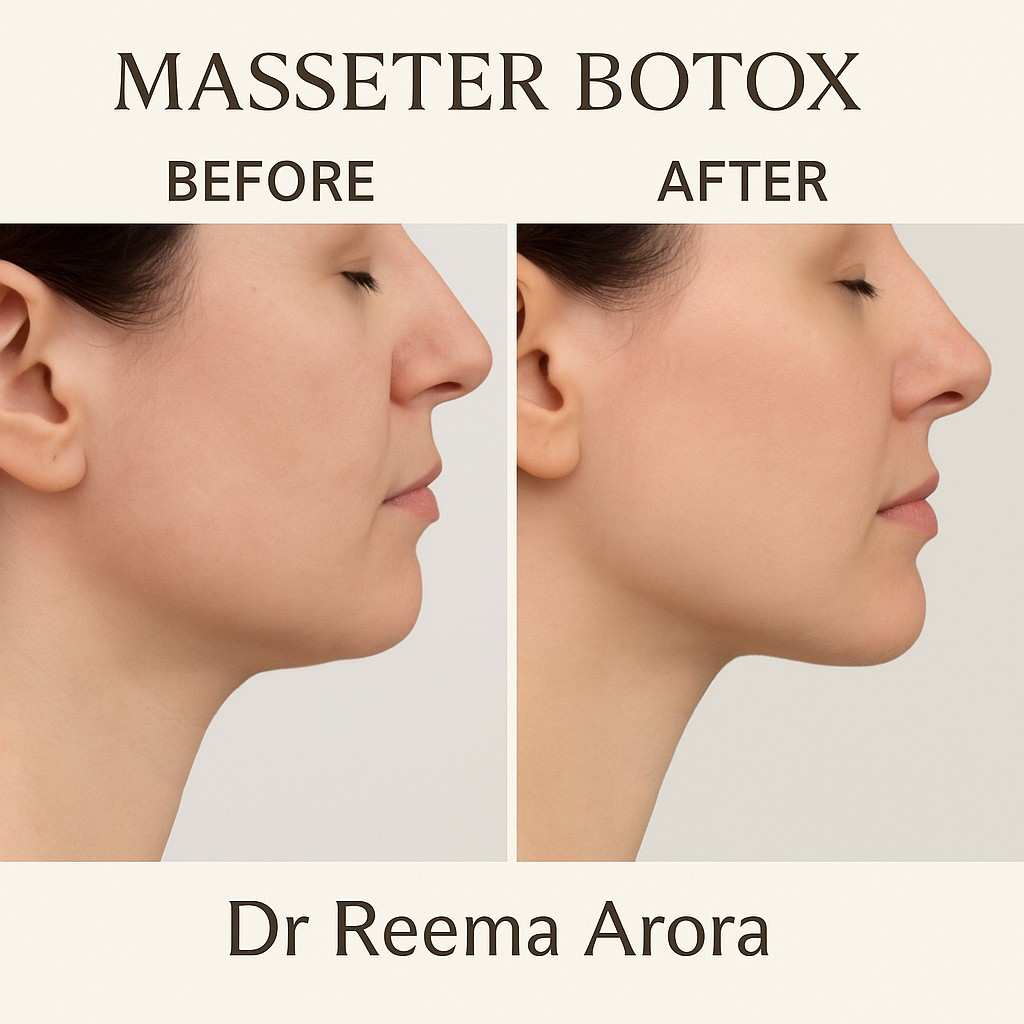
Images are for illustrative purposes only and may not represent actual patients or outcomes. Individual results vary based on anatomy, clinical assessment, and personalised treatment planning.
Safety, Side Effects and When Treatment May Not Be Appropriate
Botulinum toxin treatment is a medical procedure and is not completely risk-free.
Temporary effects may include:
- tenderness at injection sites;
- mild bruising or swelling;
- temporary chewing fatigue;
- a feeling of reduced jaw strength;
- headache.
Less common or anatomy-, dose- or technique-dependent effects may include:
- smile asymmetry;
- uneven facial contour;
- excessive reduction in muscle volume;
- unwanted lower-face hollowing;
- increased visibility of existing jowling;
- weakness in nearby muscles.
Treatment suitability should also consider medical history, active infection at the proposed injection site, known hypersensitivity to relevant product components, certain neuromuscular conditions, medications and other individual factors. Pregnancy or breastfeeding should be discussed during medical assessment.
The prescribing information for BOTOX® Cosmetic also carries warnings concerning potential spread of toxin effect beyond the injected area.
What About Repeated or Long-Term Treatment?
Repeated masseter treatment is used in clinical practice, but it should not be approached as an automatic maintenance programme.
Suitability may change as:
- the masseter becomes smaller;
- facial proportions evolve;
- skin and soft-tissue support change with age;
- functional symptoms change;
- treatment goals change.
The longer-term effects of repeated treatment on the masticatory muscles and mandibular structures continue to be studied. Current systematic-review evidence does not establish a clear pattern of clinically significant mandibular bone change, but the available evidence remains limited.
This is another reason to reassess the indication, dose and treatment interval rather than automatically repeating the same treatment indefinitely.
Regulatory note: approved indications differ by botulinum toxin product and jurisdiction. In current U.S. BOTOX® Cosmetic prescribing information, masseter contouring and bruxism are not among the listed cosmetic indications. Appropriate informed consent should therefore include discussion of the product being used, intended treatment, expected benefits, limitations and relevant regulatory status.
Can Masseter Botox Help Jaw Clenching or Bruxism?
Botulinum toxin has also been studied for bruxism, jaw clenching and muscle-related discomfort.
By reducing excessive activity in the treated muscles, it may reduce muscle activity, bite force or pain in selected patients.
However, bruxism is not simply an enlarged masseter muscle, and treatment should not be presented as a universal cure.
Current research suggests potential benefit in some outcomes, but the quality and consistency of the evidence remain variable.
Patients with significant tooth wear, persistent jaw pain, restricted mouth opening, locking, recurrent headaches or other temporomandibular symptoms may require appropriate dental, oral-maxillofacial or other medical assessment.
Aesthetic jaw slimming and management of functional jaw symptoms may overlap—but they are not the same clinical indication.
Masseter Botox Cost & Price in Delhi
At The Face Clinic, the indicative Masseter Botox price in Delhi is:
₹25,000–₹45,000 for treatment of both sides.
The final treatment cost may vary according to:
- masseter size and strength;
- BOTOX® units required;
- asymmetry;
- clinical complexity;
- individual treatment goals.
When BOTOX® is used, treatment commonly involves approximately 30–50 units per side, although the actual dose is determined only after clinical assessment.
We recommend quoting Masseter Botox as a bilateral treatment cost rather than a fixed per-side price, because aesthetic treatment planning usually considers the lower face as a whole. The two sides may require different doses when muscle size or activity is asymmetric.
An individual quotation is confirmed after assessment.
For per-unit pricing of forehead, frown-line and crow’s-feet treatment, see our guide to BOTOX® pricing by treatment area.
Any consultation, review, GST or other applicable charges should be confirmed when the individual treatment plan is discussed.
How Is Masseter Botox Different From Anti-Wrinkle Botox?
Both treatments may use botulinum toxin, but the anatomy and objective are different.
Anti-wrinkle treatment generally modifies selected facial-expression muscles associated with areas such as frown lines, forehead lines or crow’s feet.
Masseter treatment targets a much larger chewing muscle and aims to reduce excessive muscle activity and, when appropriate, its contribution to lower-face width.
The treatment should therefore not be regarded simply as “more Botox.”
For an overview of its wider aesthetic applications, see Botox treatment in Delhi.
Why Experience and Facial Assessment Matter
Successful masseter treatment depends on understanding how the entire lower face is constructed—not simply finding the masseter and injecting it.
Two people may both describe their face as square but have very different anatomy.
One may have substantial muscle bulk.
Another may have broad skeletal structure.
Another may have relatively modest masseters but significant lower-face fullness, chin imbalance or laxity.
Reducing muscle without recognising these differences can produce a technically adequate treatment but an aesthetically inappropriate outcome.
At The Face Clinic, treatment is personally planned by Dr Reema Arora, MBBS, MSc Facial Aesthetics (UK), Founder and Medical Director, with over 20 years of focused experience in facial aesthetics and previous experience as Medical Head – Facial Aesthetics at Allergan India.
Treatment planning prioritises anatomy, proportion, conservative correction and preservation of normal function rather than maximal reduction.
Frequently Asked Questions About Masseter Botox
Does Masseter Botox make the face slimmer?
It can make the lower face appear slimmer when prominent masseter muscles are a significant cause of facial width. It will have limited effect when width is caused mainly by the jaw bone, facial fat or skin laxity.
How do I know whether my masseter muscles are enlarged?
A prominent masseter often becomes more noticeable during firm clenching, but this is only one clue. Muscle size, jaw structure, symmetry, soft tissues and overall facial proportions should be assessed together.
How soon will I see jaw-slimming results?
Visible slimming develops gradually rather than immediately. For many patients, changes become progressively more noticeable over approximately 4–12 weeks.
How many units are needed for Masseter Botox?
When BOTOX® is used at The Face Clinic, treatment commonly involves approximately 30–50 units per side. The actual dose depends on muscle bulk, strength, asymmetry, previous treatment and the desired degree of reduction.
How much does Masseter Botox cost in Delhi?
At The Face Clinic, indicative Masseter Botox treatment cost is approximately ₹25,000–₹45,000 for both sides. The final quotation is confirmed after assessment and depends partly on the BOTOX® dose required.
Will Masseter Botox affect chewing?
Some patients may experience temporary chewing fatigue or reduced bite strength, particularly early after treatment. Appropriate patient selection and conservative treatment planning are important for preserving comfortable normal function.
Can Masseter Botox make jowls or sagging more noticeable?
It can in some patients. Reducing masseter volume changes the contour and support of the lower face. Where significant laxity or low soft-tissue volume already exists, excessive reduction can make jowling or hollowing more apparent.
Can Masseter Botox help teeth grinding or bruxism?
Botulinum toxin may reduce excessive jaw-muscle activity and some associated symptoms in selected patients. However, bruxism has multiple possible contributors and current evidence does not support presenting Masseter Botox as a universal cure. Dental or other assessment may also be required.
Medical Evidence and References
A 2026 systematic review and meta-analysis of botulinum toxin for masseter muscle hypertrophy evaluated five randomised placebo-controlled trials involving 536 participants. Botulinum toxin type A was associated with short-term improvement in masseter prominence, muscle thickness and patient-reported outcomes, although the authors concluded that current evidence is insufficient to establish a universal formulation-adjusted dose-response relationship or optimal treatment protocol.
For functional symptoms, a 2025 overview of systematic reviews on botulinum toxin for bruxism found potential improvements in outcomes such as pain, bruxism events and bite force in many included reviews, but also found substantial methodological limitations. This supports a cautious, individualised approach rather than presenting botulinum toxin as a definitive treatment for all forms of bruxism.
A 2024 systematic review of botulinum toxin treatment and mandibular bone effects found no clear overall pattern linking injections into the masticatory muscles with clinically meaningful bone resorption, while also concluding that the available evidence and clinical significance remain uncertain.
For product-specific prescribing information, warnings, precautions and approved indications, refer to the BOTOX® Cosmetic prescribing information on DailyMed.
Considering Masseter Botox in Delhi?
Masseter Botox can be an effective option when prominent jaw muscles genuinely contribute to lower-face width.
But a square jaw should not automatically lead to masseter treatment.
A consultation should establish:
- whether the masseter is genuinely enlarged;
- how much it contributes to visible facial width;
- whether skeletal structure or soft tissue is also important;
- the relationship between the jaw and chin;
- baseline facial volume and skin support;
- muscle symmetry and function;
- whether reducing the muscle would improve overall facial proportion.
If treatment is appropriate, the goal is a measured reduction in excessive muscle prominence while preserving facial balance, identity and normal function.
Book a consultation with Dr Reema Arora at The Face Clinic, Hauz Khas, New Delhi, for an individual assessment.
Individual anatomy, medical suitability, product, dose, treatment response and results vary. This article provides general educational information and does not replace individual medical or dental assessment.
AUTHOR / MEDICAL REVIEW
Dr Reema Arora, MBBS, MSc Facial Aesthetics (UK)
Founder & Medical Director
The Face Clinic, Hauz Khas, New Delhi
Founder & Medical Director
The Face Clinic, Hauz Khas, New Delhi
Last medically reviewed: September 2026
Pricing last updated: September 2026
Pricing last updated: September 2026
All treatments are subject to individual variation. Outcomes are determined following clinical evaluation by a qualified doctor.