
Facial Harmonization in Delhi: A Doctor's Guide to a Face That Looks Balanced, Not "Done"
Written & medically reviewed by Dr. Reema Arora, MBBS — Aesthetic Physician, The Face Clinic, Hauz Khas, South Delhi
Search “facial harmonization” often enough and you’ll notice something curious.
Almost every page promises balance, symmetry, and natural-looking results. Yet very few explain the question that matters most:
How does an experienced doctor decide what actually needs treatment—and, just as importantly, what should be left completely alone?
That distinction is where facial harmonization begins.
Most people arrive convinced that one feature is the problem—the lips, the jawline, the nose, or the under-eyes. In reality, the feature attracting attention is often perfectly normal. It simply appears out of proportion because another area of the face has quietly changed over time.
Facial harmonization is not about making individual features more noticeable.
It is about making the entire face feel more naturally balanced.
That means understanding anatomy before aesthetics, proportion before product, and restraint before intervention.
This guide explains how experienced aesthetic physicians build that process—from structural assessment and treatment sequencing to deciding when the best treatment is, quite simply, not to treat at all.
Why "Facial Harmonization" Isn't Really About Any Single Feature
Here’s a pattern seen often in consultations: a patient points to their lips, their under-eyes, or their jawline and says “this is the problem.” Half the time, that feature isn’t the actual problem — it’s just the one drawing attention because something else nearby is out of proportion with it.
A chin that sits slightly further back than it should can make lips look larger than they are. A jaw that’s lost definition can make a perfectly fine nose look more prominent in profile. Facial harmonization is the discipline of finding that “something else” before reaching for a syringe — treating the relationship between features rather than chasing the one feature someone happens to notice in the mirror.
Clinical Insight
One of the most common surprises during consultation is that patients requesting lip fillers often leave with an entirely different recommendation.
A slightly retrusive chin or reduced lower-face support may be making the lips appear more prominent than they truly are.
Correcting the underlying proportion frequently produces a more balanced appearance than adding further volume to the lips themselves.
The Principle Behind Facial Harmonization
One of the biggest misconceptions in aesthetic medicine is that every concern should be treated where it appears.
In reality, faces function as integrated systems, not collections of isolated features. Every change to one area subtly alters how neighbouring features are perceived. A stronger chin can make the nose appear more balanced. Improved mid-face support can soften the appearance of the lower face. Better skin quality can reduce the need for additional volume altogether.
For this reason, successful facial harmonization rarely begins by asking, “Which treatment should we perform?” It begins by asking, “What is creating the imbalance in the first place?”
Sometimes the answer is a different treatment than the patient expected.
Sometimes it is a staged approach.
And sometimes the most appropriate recommendation is not to treat at all.
The objective is never to make individual features stand out.
It is to restore balance in a way that allows the face to look naturally refreshed—without drawing attention to the treatment itself.
The Question a Facial Harmonization Consultation Should Start With
Not “what do you want to fix,” but: which feature is quietly pulling attention away from the rest of your face? That single reframing is usually what separates a harmonization plan from a one-area filler top-up.
Facial Harmonization Treatment vs. a Single Filler Visit: What’s Actually Different
These get used interchangeably online, but they’re not the same service.
Facial Harmonization (Planned) | A Single Filler/Botox Visit | |
Starting point | Full-face structural assessment before any product is discussed | Patient requests one area, treatment usually starts same-day |
Sequencing | Treatments staged over weeks or months, reviewed between stages | One-time, single session |
Reference point | Facial proportions and how features relate to each other | The one area the patient came in for |
Risk pattern | Lower risk of an “overfilled” look — volume is distributed with intent | Higher risk of repeat treatment in the same spot without wider context |
Best suited to | Practitioners with strong anatomical training and facial-proportion experience | Can be delivered competently by less specialised providers, with more variable outcomes |
Where the “Overdone” Look Actually Comes From
It’s rarely the treatment’s fault. It’s almost always a sequencing problem — filler added to one area, repeatedly, without ever stepping back to check how the rest of the face responded. A harmonization plan builds in that step-back deliberately.
A Pattern We Frequently See
One recurring pattern seen during consultation is patients gradually treating the same area repeatedly over several years while neighbouring areas continue to age naturally.
Each treatment may have been technically appropriate when performed. However, because the face continues to age as a connected structure, the overall balance can slowly change over time.
Facial harmonization seeks to interrupt that cycle by periodically stepping back, reassessing the face as a whole, and deciding whether the original treatment plan still reflects the patient’s current anatomy rather than simply repeating what was done previously.
Looking Like Yourself Matters More Than Looking Different
One of the biggest misconceptions about facial aesthetics is that successful treatment should make people notice what has changed.
In reality, most patients are hoping for something far more subtle.
They want to look less tired, less heavy, or simply more like themselves than they have in recent years. They want friends, family, or colleagues to say, “You look well,” rather than ask, “Have you had something done?”
That distinction is important because facial harmonization is not designed to make individual features stand out. It is designed to restore balance between them.
When treatment becomes the first thing people notice, harmony has often been replaced by excess. The most natural outcomes are usually those where the face appears refreshed, while the treatment itself remains almost impossible to identify.
Inside a Facial Harmonization Consultation: How the Plan Gets Built
Reading the Face Before Touching It
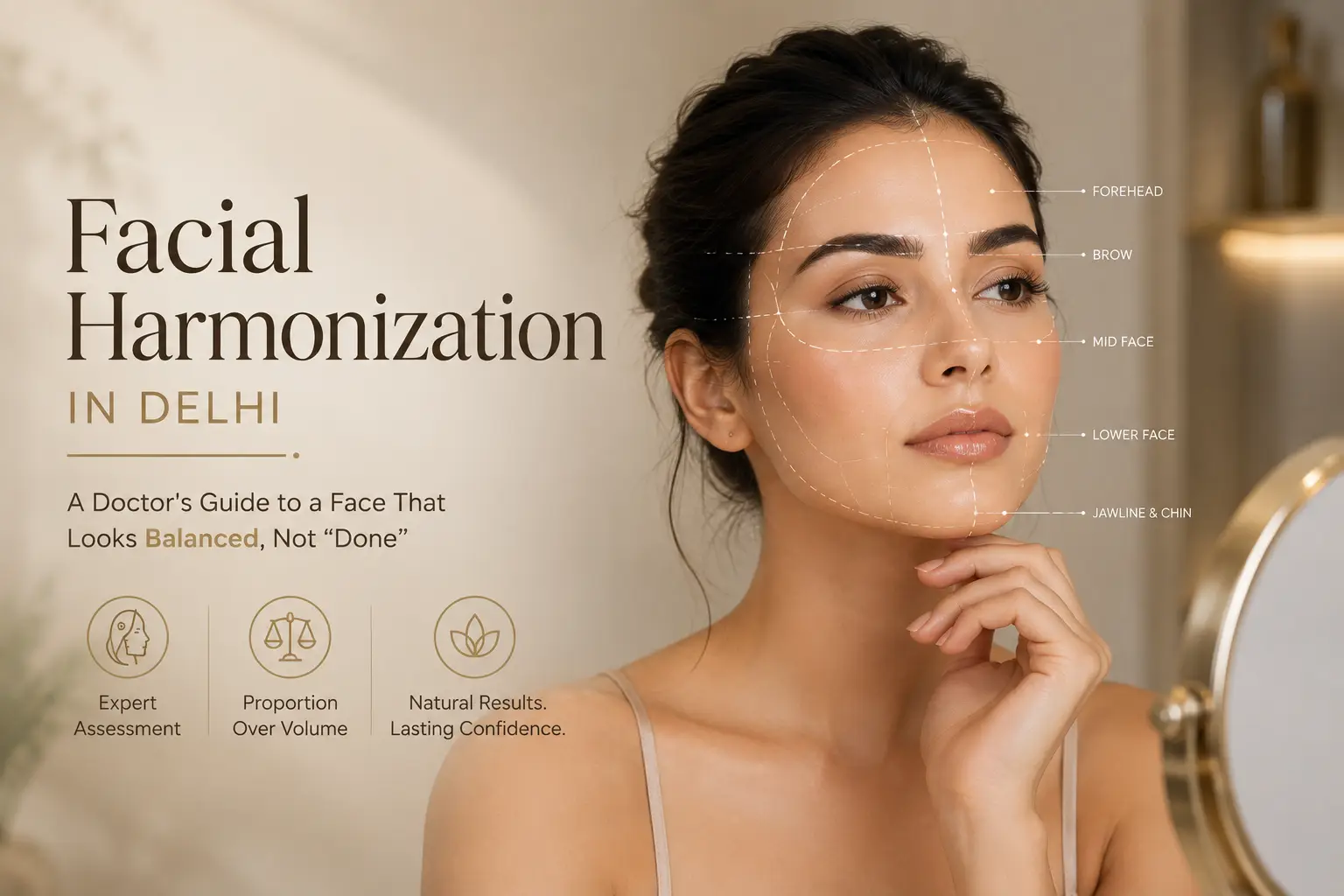
Before any product is discussed, an aesthetic physician looks at vertical proportion (hairline to brow, brow to nose base, nose base to chin) and horizontal width (using the eyes as a natural measuring unit), along with jaw angle, chin projection, and cheek volume. This isn’t about forcing a face into a mathematical ideal—it’s a working reference to separate genuine imbalance from features that are simply part of someone’s natural bone structure and shouldn’t be touched at all.
A comprehensive consultation is rarely about deciding what treatment to perform first. More often, it is about understanding which treatments are unnecessary, which can safely wait, and which are likely to have the greatest influence on overall facial balance. Experienced aesthetic physicians spend as much time explaining why certain treatments are not recommended as they do recommending the right ones. That clinical judgement helps avoid unnecessary intervention, preserves natural facial identity, and ensures every recommendation supports the face as a whole rather than an isolated feature.
In some consultations, the most valuable outcome is not a treatment plan, but the reassurance that no treatment is needed at that stage.
Clinical Insight
Many patients worry that facial harmonization means treating the entire face.
In reality, the opposite is often true.
A careful structural assessment frequently identifies one or two key areas that influence overall facial balance far more than treating multiple regions unnecessarily.
Factoring In How Skin Is Actually Ageing
Two patients can have near-identical bone structure and still need entirely different plans, because bone density loss, fat-pad shifting, and skin elasticity all progress at different rates in different people. Skin quality is assessed separately from structure for exactly this reason.
Where AI-Assisted Facial Mapping Fits In
At clinics equipped for it, digital facial mapping flags proportion or symmetry differences that aren’t obvious on visual inspection alone — turning “I think your jawline looks slightly asymmetric” into a measured, documented observation both doctor and patient can refer back to.
Sequencing: Why Doing Everything in One Visit Is a Red Flag
A conservative first stage, a review after the swelling settles, then a second stage if needed — this is standard practice in well-run harmonization plans. A clinic offering to “sort everything today” in a single sitting is optimising for convenience, not for how your face will actually look in six months.
Clinical Insight
Patients often ask whether everything can be completed in a single visit.
In practice, some of the most natural-looking outcomes come from doing less initially, allowing tissues to settle, and reassessing the face before deciding whether additional treatment is genuinely needed.
Matching Facial Harmonization Treatments to Common Concerns
If your concern is… | The treatment usually considered |
Forehead lines, frown lines, crow’s feet | |
A square jaw from clenching or grinding | Masseter Botox |
Uneven or heavy-looking brows | |
Cheeks that look flat in photographs | |
A chin that sits further back than your profile suggests it should | |
A jawline that’s lost its edge, or early jowling | |
Lips that look thin or uneven at rest | |
Shadowing or hollowing under the eyes | |
A nasal bump or asymmetry you’d rather not have surgery for | |
Deep lines running from nose to mouth corners | Nasolabial Fold Fillers |
A lower face that looks like it’s “sliding” downward | |
Skin that’s lost its snap-back firmness | |
A neck that’s started showing its own ageing lines | |
Fullness under the chin that exercise won’t touch | |
Skin that looks dull no matter how well you sleep | |
General skin quality and cellular regeneration |
Most real-world facial harmonization plans combine two to four of these — jawline plus chin plus a skin booster is a frequent pairing for patients wanting more lower-face definition alongside better skin texture, for instance.
Two of these treatments are also backed by dedicated clinical literature. A 2026 systematic review published in the Aesthetic Surgery Journal found HIFU produced measurable improvements in skin laxity, particularly in the lower face and neck. Separately, clinical research on botulinum toxin injected into the masseter muscle has documented measurable reductions in muscle tone and grinding-related tension — useful context for anyone considering masseter Botox purely for jawline slimming.
What Actually Happens During a Facial Harmonization Appointment
Before You Sit in the Chair
Medical history, current medications, and a discussion of how subtle or noticeable you want the change to be — this shapes the plan as much as the facial assessment does.
During the Procedure Itself
Most injectable sessions run 30–60 minutes with topical or local anaesthesia. Thread lifts and HIFU sessions can run slightly longer.
The First 72 Hours
Mild swelling, redness, or tenderness is expected and typically settles within a day or two for injectables. Thread lifts and HIFU may need a little longer to fully settle.
The Review Appointment Most Clinics Skip
Two to four weeks later, once swelling has fully resolved, results are reviewed against the original plan. This is where a doctor decides whether to stop, hold, or move to the next stage — and it’s often the single biggest difference between a natural-looking outcome and an overdone one.
Safety in Facial Harmonization: What Actually Reduces Risk
Safety in facial harmonization begins long before the first injection. It starts with recognising individual anatomy, understanding how different facial structures influence treatment choices, identifying situations where expectations are unrealistic, and knowing when treatment should be postponed—or avoided altogether. Technical skill is essential, but clinical judgement is what determines whether treatment should proceed in the first place.
Anatomical Knowledge Matters More Than the Product Brand
Knowing the location of major blood vessels and nerves — particularly around the nose, temples, and under-eye area — is fundamental to safe facial aesthetics. Equally important is recognising anatomical variation, previous treatments, and situations where a planned procedure carries unnecessary risk. While product quality certainly matters, patient selection, anatomical understanding, and sound clinical judgement remain the strongest safeguards against complications. This aligns with the U.S. FDA’s own consumer guidance on dermal filler safety, which emphasises choosing a licensed, experienced provider over focusing on the product brand alone.
More Filler Is Not the Same as More Harmony
Over-correction, rather than the treatment itself, is one of the most common causes of an unnatural appearance. A practitioner who recommends less treatment than expected—or advises waiting before adding more—is often protecting both safety and long-term aesthetic outcomes.
Technical proficiency is essential, but the hallmark of an experienced aesthetic physician is knowing when treatment should be modified, staged, deferred, or not performed at all.
Clinical Insight
One recurring pattern seen in consultations is patients gradually treating the same area repeatedly over several years while neighbouring areas continue to age naturally.
Although each treatment may have been technically successful, the overall facial balance slowly changes.
Periodic reassessment of the face as a whole helps prevent this gradual drift.
Facial Harmonization Cost in Delhi: What Actually Drives the Number
There’s no single fixed price for facial harmonization because it’s a plan, not a product. As a rough, non-binding indication, non-surgical facial harmonization plans in Delhi commonly fall between ₹25,000 for a single-area combination (say, Botox plus one filler) and ₹1,50,000 or more for a multi-area plan spanning jawline, chin, cheeks, and a skin-quality treatment.
What actually moves that number:
- Which treatments are combined, and how many areas are involved
- The volume of filler your specific anatomy requires
- Whether the plan runs across a single visit or several staged sessions
- The product quality used — this affects both cost and safety, so it’s worth asking about directly
- The experience level of the practitioner planning your case
A written, itemised quote after your assessment is the only way to compare clinics meaningfully — two people both asking for “facial harmonization” can walk out with very different treatment lists.
Is Facial Harmonization Right for You?
Signs You’re a Reasonable Candidate
- You’ve noticed your face reads as tired or heavy in a way you can’t pin to one specific feature
- You want a change people notice in you, not a change people notice as “work”
- You’re generally healthy with realistic expectations about what non-surgical treatment achieves
- You’re comfortable with a staged plan rather than expecting one visit to solve everything
Reasons to Pause Before Booking
- You’re expecting to look like a different person entirely
- You’re pregnant, breastfeeding, unwell, or on blood-thinning medication (your doctor will screen for this anyway)
- Your concern is genuinely single-area — in which case a targeted treatment may serve you better than a full harmonization plan
- You haven’t had a structural assessment yet and are choosing treatments off a price list instead
Choosing the Right Facial Harmonization Doctor in Delhi
The treatment names matter far less than who is planning your case. Before booking, it’s worth asking any clinic: who assesses my face — a doctor, or whoever’s available that day?and will I get a staged plan, or is today’s visit the only one being discussed?
How This Plays Out at The Face Clinic
At The Face Clinic in Hauz Khas, South Delhi, every facial harmonization case is personally assessed by Dr. Reema Arora, MBBS, an aesthetic physician with 20+ years of clinical practice and former Medical Head – Facial Aesthetics at Allergan India, where she trained over 2,000 dermatologists and plastic surgeons in injectable technique. Plans are built on structural and skin assessment — supported by AI-assisted facial mapping — and staged progressively rather than delivered as a fixed package in one sitting.
Facial Harmonization Near Hauz Khas and South Delhi
The Face Clinic sees patients travelling in regularly from Hauz Khas, Greater Kailash (GK 1 & 2), Defence Colony, Green Park, Vasant Vihar, Saket, Panchsheel Park, Jor Bagh, Chanakya Puri, Golf Links, and Sunder Nagar across South Delhi — as well as from New Delhi, Gurugram, Noida, Faridabad, Ghaziabad, and other parts of India.
If you’re specifically searching for facial harmonization near Hauz Khas or South Delhi, starting with a doctor-led structural assessment — at this clinic or elsewhere — is the right first move before any product gets discussed.
Facial Harmonization: Frequently Asked Questions
What exactly is facial harmonization?
It’s a personalised, usually non-surgical treatment plan aimed at balancing how facial features relate to each other — not a single procedure aimed at one feature.
Is facial harmonization the same as a facelift?
No. A facelift is surgical and addresses sagging skin and tissue directly. Facial harmonization is generally non-surgical and works through injectables, skin-quality treatments, and non-surgical lifting — though some surgical practices use the term more broadly to include procedures like rhinoplasty or genioplasty.
How long do results last?
It depends on what’s used. Botox typically lasts 3–4 months, dermal fillers 6–18 months depending on area and product, and skin boosters or biostimulators can show benefit for 6–12 months across a course of sessions.
Does it hurt?
Most sessions involve mild, brief discomfort managed with numbing cream or local anaesthesia. Lips and under-eyes tend to be more sensitive than cheeks or the jawline.
How many sessions are typically needed?
Some patients see meaningful change in one or two visits; others prefer a staged plan across three to six months with reviews in between.
Is there an ideal age to start?
No fixed age applies. Some patients in their late twenties address proportion concerns like a weak chin; others in their forties to sixties focus on volume loss and skin laxity. A consultation clarifies what’s relevant for your face specifically.
Can it be reversed if I don’t like the result?
Hyaluronic acid fillers can generally be dissolved, which is part of why most patients start with reversible, non-surgical options. Botox also wears off naturally over a few months.
Will I end up looking overdone?
Only if the plan is rushed. An overdone look comes from too much product without a proportion-based plan behind it — not from facial harmonization as an approach. A staged, conservative process is specifically designed to avoid this.
What does facial harmonization cost in Delhi?
Non-surgical plans commonly range from roughly ₹25,000 for a single-area combination to ₹1,50,000 or more for a multi-area plan, depending on the treatments combined, product volume, and number of sessions — confirmed only with a written quote after assessment.
After years of treating facial ageing, one lesson has remained remarkably consistent.
Patients rarely regret having less treatment than they expected.
They are far more likely to regret treatment that was unnecessary.
Natural-looking results are rarely the product of a single appointment. They are built through thoughtful planning, conservative staging, periodic reassessment, and knowing when to stop.
Ultimately, that is what facial harmonization is designed to achieve.
Facial harmonization should never leave people wondering what you’ve had done.
Ideally, it leaves them wondering why you simply look healthier, fresher, or more like yourself.
That outcome rarely comes from treating the first concern someone points to. It comes from understanding how every feature relates to the next—and building a treatment plan that respects those relationships rather than changing them unnecessarily.
The best consultation doesn’t simply answer:
“What treatment do I need?”
It answers a far more important question:
“Do I need treatment at all—and if so, where will it make the greatest difference?”
Because the highest compliment after facial harmonization isn’t, “You look different.”
It’s, “You look incredibly well.”
Considering Facial Harmonization?
If you’re exploring facial harmonization, begin with a comprehensive doctor-led assessment rather than a predetermined treatment package.
At The Face Clinic, every treatment plan is developed after a detailed evaluation of facial structure, skin quality, ageing patterns, and your aesthetic goals—ensuring recommendations are tailored to your anatomy rather than a standard protocol.
Book a consultation with Dr. Reema Arora to receive a personalised assessment and a treatment plan designed around balance, proportion, and natural-looking results.
Medically reviewed by Dr. Reema Arora, MBBS, Aesthetic Physician with 20+ years of clinical experience in non-surgical facial aesthetics, and former Medical Head – Facial Aesthetics, Allergan India.
Disclaimer: This article is for general informational purposes only and does not constitute individual medical advice. Facial harmonization outcomes, suitability, and pricing vary by individual anatomy, skin condition, and treatment plan. Please consult a qualified aesthetic physician for an in-person assessment before undergoing any treatment.