
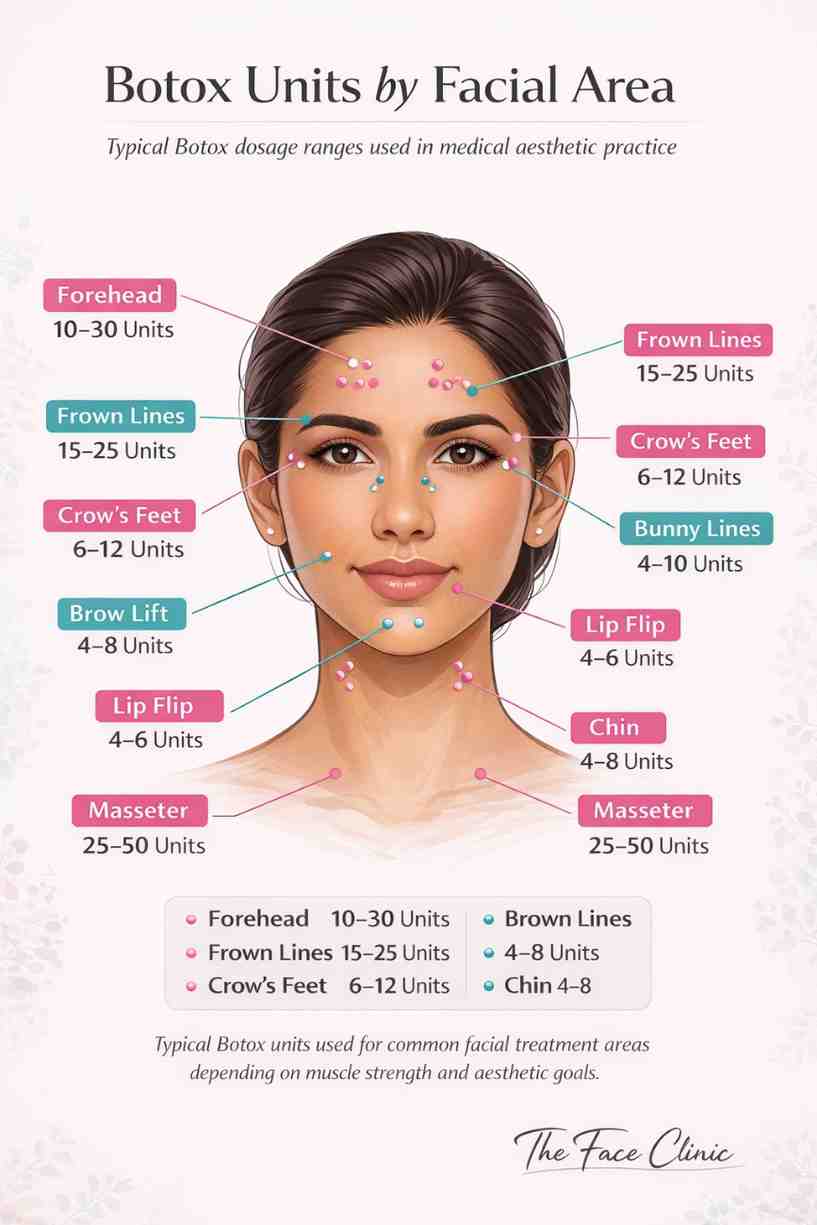
Botox Units by Area: Forehead, Crow’s Feet, Masseter & Full Face
A doctor-led guide to Botox units charts, labelled reference doses and individualised facial treatment planning
How many Botox units are used for the forehead, frown lines, crow’s feet or masseter muscles?
There is no single dose suitable for every face. The answer depends on the product, treatment area, muscle activity, facial anatomy and the clinical indication.
However, understanding Botox units by area can help patients interpret commonly discussed treatment figures and ask informed questions during a medical consultation.
Botox Units by Area: Quick Answer
For BOTOX® Cosmetic (onabotulinumtoxinA), the cited U.S. prescribing information provides these reference doses:
- Frown lines (glabella): 20 units.
- Crow’s feet: 24 units across both sides.
- Forehead and frown lines together: 40 units.
- Forehead, frown lines and crow’s feet together: 64 units.
- Selected neck bands (platysma): 26, 31 or 36 units, according to the labelled pattern.
Masseter jaw slimming and some smaller facial applications are outside the aesthetic indications of the cited U.S. BOTOX® Cosmetic label. Their dosing should not be assumed from these approved upper-face protocols.
Important educational note: These figures are product-specific references, not individual prescriptions. They describe U.S. labelling and do not establish identical approval or dosing recommendations in India. Treatment requires assessment by a qualified medical practitioner.
At The Face Clinic in Hauz Khas, New Delhi, Dr Reema Arora considers facial movement, muscle balance, medical history and individual treatment objectives when evaluating whether botulinum toxin is appropriate.
Botox Units Chart by Facial Area
The following Botox units chart brings the principal numerical references together in one place.
It deliberately distinguishes between doses specified in the cited U.S. product label and clinical applications for which that label does not establish a standard cosmetic dose.
Treatment area | BOTOX® unit reference | Regulatory and clinical context |
Frown lines / 11 lines | 20 units | U.S. labelled dose for glabellar lines |
Crow’s feet | 24 units, both sides combined | U.S. labelled dose for bilateral lateral canthal lines |
Forehead lines | 20 forehead units, combined with 20 glabellar units | U.S. labelled combined protocol: 40 units total |
Full upper face | 64 units total | U.S. labelled combination of forehead, glabella and bilateral crow’s feet |
Neck / platysma bands | 26, 31 or 36 units | U.S. labelled protocols for specified band patterns |
Masseter jaw slimming | Approximately 30–50 units per side in selected patients at The Face Clinic | Clinic-specific illustrative range; off-label relative to cited U.S. cosmetic label |
Subtle brow lift | No standard dose established in cited U.S. cosmetic label | Off-label aesthetic application |
Bunny lines | No standard dose established in cited U.S. cosmetic label | Off-label aesthetic application |
Lip flip | No standard dose established in cited U.S. cosmetic label | Off-label aesthetic application |
Gummy smile | No standard dose established in cited U.S. cosmetic label | Off-label aesthetic application |
Chin dimpling | No standard dose established in cited U.S. cosmetic label | Off-label aesthetic application |
The masseter range reflects clinic-specific clinical experience in selected patients and does not represent an approved standard dose, guaranteed treatment requirement or independently validated universal protocol.
How to interpret this chart: The presence of a number does not mean it is appropriate for every patient. Equally, the absence of a standard labelled dose does not mean that a treatment has no published clinical literature. Product-specific evidence, individual suitability, safety considerations and applicable regulations must all be considered.
Primary regulatory reference: BOTOX® Cosmetic — Official U.S. Prescribing Information (DailyMed).
What Is a Botox Unit, and How Is It Measured?
A Botox unit measures the biological potency of the BOTOX® formulation using a product-specific testing method.
It is not the same as a millilitre of liquid, a fixed quantity of medicine common to all toxin products, or a measure of how severe a wrinkle appears.
BOTOX® contains onabotulinumtoxinA, which temporarily inhibits nerve signalling to selected muscles. This reduces muscle contraction and may soften dynamic expression lines associated with movements such as frowning, raising the eyebrows and squinting.
Three principles are important:
- Units and volume are different: Millilitres describe fluid volume; Botox units describe product-specific biological potency.
- More units are not necessarily better: Greater muscle weakening does not automatically produce a more desirable or natural-looking result.
- The product matters: A numerical dose for BOTOX® should not be transferred directly to another botulinum toxin formulation.
Are Botox, Dysport and Xeomin Units Interchangeable?
No.
BOTOX®, Dysport® and Xeomin® are distinct botulinum toxin formulations. Their potency units are specific to their products and assay methods.
Consequently, patients should not use online conversion ratios to compare their doses or determine how much of another product they require.
A clinician must consider the chosen formulation, its prescribing information and the intended treatment.
The official BOTOX® Cosmetic label expressly states that its potency units cannot be directly compared with or converted into the units of other botulinum toxin products.
How Many Botox Units Are Used for Forehead Lines?
Forehead Botox units are among the most frequently discussed aspects of cosmetic botulinum toxin treatment.
Horizontal forehead lines largely arise through repeated contraction of the frontalis muscle, which elevates the eyebrows.
In the cited U.S. BOTOX® Cosmetic prescribing information, 20 units are specified for forehead lines together with 20 units for glabellar lines, producing a 40-unit combined protocol.
The distinction matters because the forehead and frown-line muscles work together in controlling eyebrow position.
Why Forehead Botox Dosing Needs Individual Assessment
The frontalis muscle is involved in keeping the eyebrows elevated.
A patient may have visible horizontal forehead lines while also relying on frontalis activity to compensate for low-set brows or upper-eyelid heaviness.
Reducing this activity without adequately assessing brow position can produce an undesirable change in appearance or function.
A clinical assessment therefore considers forehead anatomy, brow position, muscle movement, asymmetry, upper-eyelid characteristics and previous treatment response.
Clinical perspective: Visible forehead wrinkles are not, by themselves, a sufficient basis for selecting a dose. The relationship between the forehead, eyebrows and glabellar muscles is equally important.
For information about suitability, consultation and the procedure itself, visit Botox Treatment in Delhi.
How Many Botox Units Are Used for Frown Lines (11 Lines)?
Frown lines, also known as glabellar lines or 11 lines, form between the eyebrows through activity involving the corrugator and procerus muscles.
The cited U.S. BOTOX® Cosmetic label specifies 20 units for glabellar lines.
However, the appearance of these lines varies.
Some become prominent only during expression, while others remain visible when the face is relaxed.
Botulinum toxin acts primarily on the muscular component of a dynamic wrinkle. It may not completely eliminate an established static crease.
Clinical assessment considers muscle activity, eyebrow position, baseline asymmetry, skin changes and the interaction between the glabellar and forehead muscles.
How Many Botox Units Are Used for Crow’s Feet?
Crow’s feet are lines around the outer corners of the eyes associated with movement of the orbicularis oculi muscles.
For BOTOX® Cosmetic, the cited U.S. label specifies 24 units in total for bilateral lateral canthal lines.
This refers to treatment of both sides, not 24 units per side.
Assessment considers the pattern of smiling and squinting, existing asymmetry, surrounding eyelid function and whether the lines are predominantly dynamic or also visible at rest.
The aim of treatment planning is to determine whether selectively reducing muscle activity could improve the concern while preserving appropriate facial function.
For general patient information about treatment expectations and aftercare, refer to the American Academy of Dermatology’s botulinum toxin FAQs.
How Many Botox Units Are Needed for the Full Face?
There is no universal full-face Botox dosage.
The phrase full-face Botox is used inconsistently.
Some patients use it to describe forehead, frown lines and crow’s feet together. Others include the jawline, chin, mouth or neck.
These are different anatomical regions, not one standard treatment protocol.
Upper-Face Botox Units
For the combined U.S. labelled treatment of forehead lines, glabellar lines and bilateral crow’s feet, the reference total is 64 BOTOX® Cosmetic units.
This comprises:
- Forehead: 20 units.
- Glabella: 20 units.
- Bilateral crow’s feet: 24 units.
The total describes a particular labelled upper-face combination. It is not a universal recommendation for everyone considering Botox.
Does Full-Face Botox Always Require More Units?
No.
The appropriate approach depends on which muscles, if any, require treatment.
A patient with predominantly forehead movement may have different needs from someone seeking treatment for several expression-line regions.
Furthermore, not every visible facial change is caused by muscle contraction.
Volume loss, skin laxity, pigmentation and textural changes may require different approaches.
For a broader understanding of the options, see Anti-Wrinkle Treatment in Delhi.
How Many Botox Units Are Used for Masseter Jaw Slimming?
Masseter Botox involves the muscles responsible for much of the force of chewing.
In some patients, prominent masseter muscles contribute to a broad or square appearance of the lower face.
Reducing masseter activity with botulinum toxin may gradually change muscle prominence and lower-face contour in appropriately selected individuals.
At The Face Clinic, Dr Reema Arora may consider approximately 30–50 BOTOX® units per side in selected patients, depending on clinical findings. This clinic-specific range is not a standard prescription or a dose that can be transferred between patients.
Aesthetic masseter slimming is outside the indications of the cited U.S. BOTOX® Cosmetic label.
Why Masseter Botox Units Differ From Forehead Units
The masseter is a large chewing muscle with a different anatomical role from the muscles producing upper-face expression lines.
Assessment considers:
- Masseter size and activity.
- Whether muscle bulk is genuinely contributing to jaw width.
- Facial bone structure and soft-tissue proportions.
- Existing asymmetry and lower-face support.
- Chewing function and relevant jaw or dental symptoms.
- Potential functional and aesthetic consequences of muscle weakening.
A wide jaw is not necessarily caused by enlarged masseter muscles.
Reducing masseter activity may be unsuitable when bone structure, facial fat or other factors are primarily responsible for the patient’s concern.
Potential adverse effects include chewing weakness or fatigue, unwanted changes in facial contour, smile asymmetry and other functional or aesthetic disturbances.
A 2024 clinical review specifically examined adverse events associated with botulinum toxin treatment for masseter hypertrophy, reinforcing the importance of patient selection and risk assessment.
Clinical distinction: Using botulinum toxin for aesthetic masseter reduction is not the same as establishing a treatment plan for bruxism or other jaw disorders, which require their own diagnostic assessment.
For detailed information on suitability, contour changes, treatment limitations and cost, read Masseter Botox in Delhi: Jaw Slimming, Results and Cost.
Botox Units for Brow Lift, Lip Flip, Bunny Lines, Gummy Smile and Chin
Some cosmetic applications involve relatively small facial muscles or muscle groups that perform closely related functions.
These include a subtle non-surgical brow lift, bunny lines over the nose, lip flip, gummy smile treatment and chin dimpling.
These applications are not among the aesthetic indications in the cited U.S. BOTOX® Cosmetic label. Consequently, that label does not establish standard doses for them.
Why Smaller Facial Areas Require Particular Care
A smaller muscle does not necessarily mean a simpler treatment.
Muscles surrounding the mouth influence smiling, speech, drinking and lip closure. Unwanted relaxation may therefore affect ordinary facial functions.
Similarly, muscles controlling brow position act together rather than independently.
The dose, if treatment is appropriate, should reflect an individual assessment and the relevant evidence, not simply a commonly circulated internet range.
Published clinical examples of off-label treatment cannot automatically be interpreted as approved or universally applicable dosing recommendations.
Botox Units for Neck Bands and Platysma Treatment
Visible vertical neck bands may be associated with activity of the platysma muscle.
The cited U.S. BOTOX® Cosmetic label includes treatment of moderate to severe platysma bands associated with muscle activity in adults.
For its specified anatomical band patterns, the labelled total doses are 26, 31 or 36 units.
These numbers do not describe a universal neck-lift dose.
Botulinum toxin cannot directly remove excess skin, restore lost facial volume or correct every cause of neck laxity.
The neck is also a functionally sensitive region, making an understanding of relevant anatomy, swallowing function, medical history and possible adverse effects particularly important.
Patients seeking treatment for skin looseness rather than muscle-related bands require a different assessment.
Why Botox Unit Requirements Vary Between Patients
A Botox units chart explains reference figures, but it cannot capture the anatomical and functional differences between individuals.
Muscle Activity and Facial Expression
Muscle size, activity, strength and movement patterns can vary considerably.
A deeper visible line does not automatically mean a larger dose is required. Skin changes and established static wrinkles may also contribute.
Facial Anatomy and Brow Position
Forehead height, eyebrow position, eyelid characteristics, muscle distribution and baseline asymmetry can influence upper-face treatment planning.
In particular, preserving appropriate brow movement may be important in patients with upper-eyelid heaviness.
Differences Between Men and Women
Some individuals, including some men, may have greater muscle bulk or activity in particular facial regions.
However, there is no appropriate universal rule that all men require a fixed percentage more Botox than women.
Clinical findings are more important than applying a general gender-based multiplier.
Previous Treatments, Medical History and Product Selection
Previous responses, unwanted effects, relevant illnesses, medicines and contraindications may influence treatment decisions.
The selected product and its regulatory indications must also be considered.
The appropriate Botox dose follows a clinical assessment; it should not be selected from an online chart alone.
Are Botox Unit Charts Medical Prescriptions?
No.
An online Botox units chart is an educational reference, not an individualised prescription.
Product labelling describes specific indications and dosing protocols for defined populations and jurisdictions. Other aesthetic applications may be considered off-label.
Off-label treatment requires an appropriate clinical rationale, evaluation of benefits and risks, informed consent and compliance with the applicable regulatory and professional framework.
The fact that a dose has appeared in a clinical publication does not establish that it is suitable for a particular patient.
How Do Botox Units Affect Treatment Cost?
Botox treatment cost can be influenced by the amount of product used, but the price per unit is only one component of the overall treatment charge.
At The Face Clinic, the published indicative BOTOX® price is ₹400–₹500 per unit, with the final treatment cost determined after assessment. Consultation, review, GST and other applicable charges are additional, as specified on the cost page.
A lower price per unit does not necessarily represent better value, especially if the products or proposed treatments are different.
For detailed treatment-area prices and pricing considerations, refer to Botox Treatment Cost in Delhi: Price Per Unit and Treatment Areas.
Botox Safety, Side Effects and Treatment Duration
Botulinum toxin treatment is a medical procedure and is not appropriate for everyone.
BOTOX® Cosmetic is contraindicated in patients with known hypersensitivity to a botulinum toxin preparation or its components and in those with infection at the proposed injection site.
Patients should disclose relevant medical conditions, medications, previous toxin treatments, swallowing or breathing problems, neuromuscular disorders, and pregnancy or breastfeeding status before treatment.
Possible adverse effects include local tenderness, bruising, swelling and headache. Depending on the treatment area, unintended muscle weakness, asymmetry, eyelid or eyebrow drooping, or functional changes may occur.
The official BOTOX® Cosmetic prescribing information also contains a boxed warning about distant spread of toxin effect. Serious symptoms can include difficulty speaking, swallowing or breathing.
New swallowing, speech or breathing difficulties following treatment require immediate medical attention.
How Long Do Botox Results Last?
For many facial expression-line treatments, the visible effect lasts approximately three to four months, although individual responses vary.
Effects develop over days rather than immediately, with further change often occurring during the first one to two weeks.
Duration can vary by area, product, individual response and treatment history. Masseter-contouring changes may follow a different timeline from upper-face wrinkle treatment.
Review and repeat-treatment decisions should follow medical assessment and product-specific prescribing guidance.
For additional patient information, see the American Academy of Dermatology’s botulinum toxin treatment FAQs.
Dr Reema Arora’s Clinical Perspective: Treating Muscle Activity, Not Just Wrinkle Depth
One of the most important clinical distinctions in facial aesthetics is the relationship between the visible concern and the underlying muscle activity.
Consider a patient with prominent horizontal forehead lines.
These lines may arise from frequent frontalis contraction. However, the patient may also be using the frontalis muscle to compensate for low-set eyebrows or upper-eyelid heaviness.
Assessing only the depth of the forehead lines could overlook this functional relationship.
Similarly, a broad lower face may reflect prominent masseter muscles, jaw-bone anatomy, facial volume or a combination of these factors.
Botulinum toxin is not necessarily appropriate for every broad jaw or visible wrinkle.
The clinical question is therefore not merely how many Botox units an area can receive, but whether modifying that muscle’s activity is suitable for the patient and what functional consequences may follow.
At The Face Clinic, Dr Reema Arora’s doctor-led approach emphasises anatomical assessment, individual treatment objectives and preservation of appropriate facial balance.
Treatment may be recommended, modified or deferred depending on the clinical findings.
Frequently Asked Questions About Botox Units
Is 20 Units of Botox Enough?
Twenty units is the reference dose for glabellar lines in the cited U.S. BOTOX® Cosmetic label. It is not a standard dose for the full face or every treatment area. Individual suitability requires assessment.
What Is the Average Botox Dosage for the Full Face?
There is no universal full-face dosage. The U.S. labelled combined treatment of forehead, glabella and bilateral crow’s feet totals 64 BOTOX® Cosmetic units, but other treatment combinations are different and require individual assessment.
How Many Botox Units Are Used for Masseter Slimming?
At The Face Clinic, approximately 30–50 BOTOX® units per side may be considered in selected patients. This is a clinic-specific illustrative range for an off-label aesthetic application relative to the cited U.S. cosmetic label, not a universal prescription.
Do Men Usually Need More Botox Units?
Not always. Muscle size and activity vary between individuals. Treatment should not be selected using a fixed percentage increase based on sex alone.
Are Botox and Dysport Units the Same?
No. Their potency units are formulation-specific and should not be directly converted using an online ratio.
Can I Decide My Botox Dose From an Online Chart?
No. An online chart is useful for education but cannot account for facial anatomy, medical history, contraindications, muscle function or clinical suitability.
Does a Higher Botox Dose Give Better Results?
Not necessarily. Excessive muscle weakening may produce unwanted functional or aesthetic effects. The objective is an appropriate clinical outcome, not the highest possible unit count.
Can More Botox Be Added After Treatment?
Further treatment may be considered only after clinical review, with attention to the original response, potential adverse effects and product-specific guidance. An automatic touch-up should not be assumed.
Understanding Botox Units Is the Beginning, Not the Treatment Plan
A Botox units chart can help explain how product-specific doses differ between anatomical regions.
It cannot determine whether botulinum toxin is the right treatment for your individual concern.
At The Face Clinic in Hauz Khas, South Delhi, Dr Reema Arora provides doctor-led facial aesthetic consultations focused on suitability, anatomical assessment, potential benefits, limitations and informed decisions.
The Face Clinic — Dr Reema Arora
Founder & Medical Director
LGF, C-36, Chaudhary Dilip Singh Marg
Hauz Khas Market, New Delhi – 110016
Clinic hours: Monday–Saturday, 10 AM–6 PM
Phone: +91 99580 73900
Appointments: Contact The Face Clinic through the verified appointment channel.
A consultation is an opportunity to understand whether treatment is appropriate, rather than simply selecting a number of units.
Medical Review and References
Medical reviewer: Dr Reema Arora
MBBS, MSc Facial Aesthetics (UK)
Founder & Medical Director, The Face Clinic, New Delhi
Former Medical Head – Allergan India
20+ years of experience in facial aesthetics
Last medically reviewed: 12 October 2026
Medical References
- BOTOX® Cosmetic — U.S. Prescribing Information, DailyMed. Revised October 2024. Reference for U.S. labelled indications, doses, contraindications, warnings and non-interchangeability of units.
- American Academy of Dermatology — Botulinum Toxin Therapy: FAQs. Patient education concerning the procedure, treatment effects and expectations.
- Nishikawa A, Aikawa Y, Kono T. Treatment of Masseter Muscle Hypertrophy With Botulinum Toxin Type A Injection: A Review of Adverse Events. Journal of Cosmetic Dermatology. 2024. Peer-reviewed observational evidence addressing complications associated with masseter treatment.
- Efficacy of Botulinum Toxin for Masseter Muscle Hypertrophy: A Systematic Review and Meta-analysis. Journal of Plastic, Reconstructive & Aesthetic Surgery. 2026. Review of randomised evidence concerning masseter hypertrophy and treatment effects.
Medical information disclaimer: This article provides general patient education and is not a prescription, an injection guide or a substitute for medical assessment. Published dose figures may refer to particular products, indications and regulatory jurisdictions. Individual results and treatment suitability vary.