
Under Eye Fillers
- Home
- Services
- Under Eye Fillers
Don’t think much, have a query? Call us now!
Medically reviewed by Dr. Reema Arora, MBBS, MSc Facial Aesthetics · Last updated: 20 October 2026
Under-eye fillers are hyaluronic acid-based dermal fillers used to add carefully controlled volume where under-eye hollowing or tear trough depression is present. In suitable patients, this can soften the hollow beneath the eyes and improve the contour between the lower eyelid and upper cheek.
Unlike treatments aimed at skin pigmentation, under-eye fillers address structural hollowing and volume loss. They may reduce the shadow created by a tear trough, but they do not change the colour of the skin itself.
The tear trough is the natural groove at the junction of the lower eyelid and upper cheek, beginning beneath the inner part of the eye. It may become more noticeable because of facial anatomy, ageing or loss of support in the surrounding tissues. To learn more about tear trough anatomy and hollowing, see the clinic’s dedicated guide.
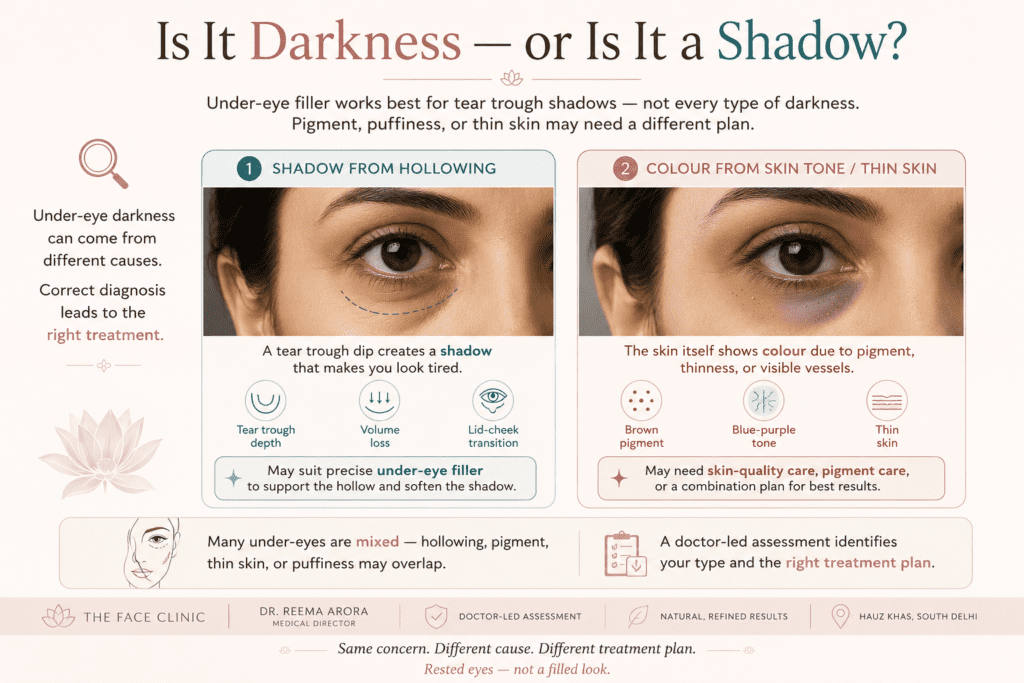
A deeper tear trough can cast a shadow that resembles a dark circle even when pigmentation is not the main cause. In carefully selected patients, filler may be used to soften this hollow and create a smoother surrounding contour.

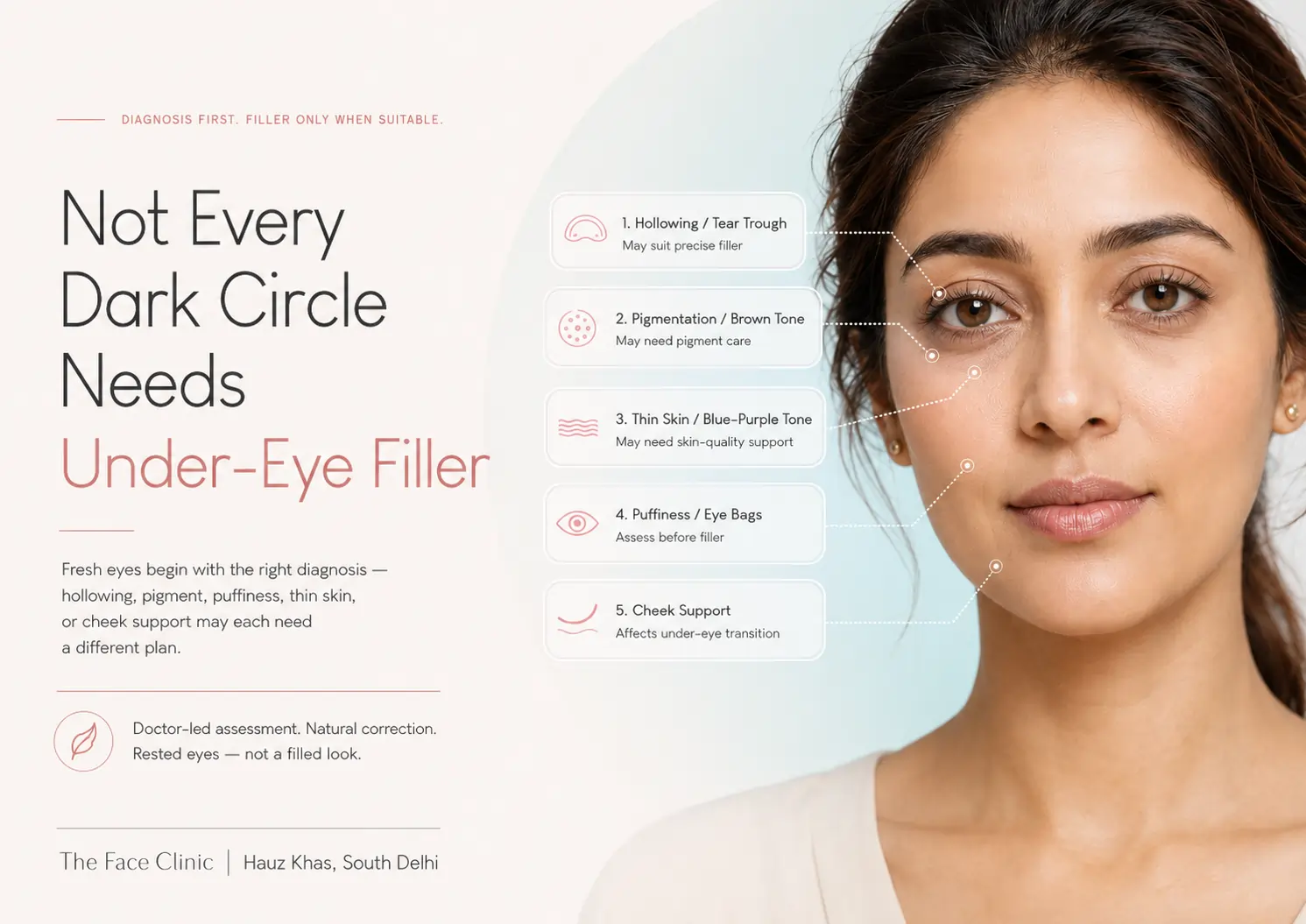
Darkness or tiredness beneath the eyes does not always have the same cause. Hollowing, pigmentation, thin or crepey skin, prominent eye bags and fluid retention are different concerns, although more than one may be present at the same time.
Identifying the main contributor helps determine whether under-eye filler is likely to help or whether another treatment pathway may be more appropriate.
| Main Concern | What You May Notice | Is Under-Eye Filler Appropriate? |
|---|---|---|
| Under-eye hollows / tear troughs | A groove or depression beneath the eye that creates shadowing or a sunken appearance | May be suitable when structural hollowing or volume loss is the primary concern |
| Pigmentation | Brown or darker skin beneath the eyes without significant hollowing | Filler does not correct skin pigment; a dedicated Dark Circle Treatment in Delhi assessment may be more appropriate |
| Thin, crepey or translucent skin | Fine lines, visible vessels or delicate skin quality beneath the eyes | Filler may not address the main concern; a skin-quality approach such as Polynucleotide Under-Eye Treatment may be considered where clinically suitable |
| Prominent eye bags / fat prolapse | Bulging or fullness beneath the lower eyelid | Filler may not be appropriate and can worsen heaviness or puffiness in some anatomies; specialist assessment is important |
| Persistent puffiness / fluid retention / malar oedema | Swelling that may fluctuate or extend towards the upper cheek | Filler is often not the preferred first option; the cause of swelling should be assessed before treatment |
| Mixed under-eye concerns | A combination of hollowing, pigmentation, thin skin, bags or puffiness | A personalised or staged treatment plan may be needed rather than filler alone |
Pigmentation ≠ hollowing ≠ thin/crepey skin ≠ eye bags — and more than one of these concerns may coexist.
This distinction is important because similar-looking under-eye concerns can require very different treatment approaches.
When structural hollowing or volume loss is the main concern, under-eye fillers may help improve:
The quality of the result depends on appropriate patient selection, individual anatomy and careful treatment planning.
Under-eye hollows can develop because of a combination of genetic anatomy, ageing and changes in the tissues that support the lower eyelid and upper cheek. These structural changes can deepen the tear trough and create shadowing beneath the eyes, making the area appear darker or more tired.
Common factors that can contribute to under-eye hollowing include:
Structural hollowing can create a dark shadow even when pigmentation is not the main problem. Dark circles caused predominantly by pigmentation, vascular visibility or other non-structural factors require a different assessment and are not corrected simply by adding volume.
For a more detailed explanation of the different factors that can contribute to persistent under-eye darkness, read Why Dark Circles Don’t Go Away.
Read more: why under-eye hollows make you look tired
Before recommending under-eye filler, the area should be assessed as part of the lower eyelid, cheek and midface as a whole. The aim is to determine whether structural hollowing is the main concern and whether filler is likely to improve it appropriately.
Pattern and depth of hollowing: The location, depth and extent of the tear trough are assessed to understand whether the visible depression is related mainly to genetic anatomy, age-related volume change or a combination of factors.
Lower-eyelid and midface support: The relationship between the lower eyelid and cheek is important. Loss of midface support can make an under-eye hollow appear deeper, and in selected patients the supporting cheek or midface may need to be considered as part of the overall treatment plan.
Skin quality and thickness: Thin, crepey or translucent skin can influence both the appearance of the under-eye area and whether filler is likely to improve the main concern. Skin-quality problems may require a different or complementary treatment approach.
Eye bags, puffiness and fluid retention: Prominent fat pads, persistent swelling or malar oedema can affect suitability for filler. In some anatomies, adding volume directly beneath the eyes may worsen heaviness or puffiness rather than improve the appearance.
Pigmentation and vascular visibility: Brown pigmentation or visible vessels can contribute to under-eye darkness independently of hollowing. Because filler does not correct skin colour, these features are assessed separately before deciding on treatment.
Previous under-eye or midface treatment: Previous filler, surgery or other procedures around the lower eyelid and midface are also considered where relevant, as they may influence anatomy, treatment planning and suitability for further correction.
The final treatment plan is based on the combination of anatomy, skin quality, midface support and the dominant cause of the under-eye concern, rather than treating every dark circle or hollow in the same way.
When under-eye filler is considered appropriate, treatment is planned conservatively according to individual anatomy and the degree of correction required.
The doctor selects the appropriate hyaluronic acid filler and treatment strategy according to the pattern of hollowing, surrounding support, skin quality and overall facial proportions.
There is no single under-eye filler that is automatically “best” for every patient. Product choice is only one part of the treatment plan; tissue characteristics, swelling tendency, structural support and placement strategy are also important.
The objective is controlled correction rather than simply adding volume beneath the eyes. This individualised approach reflects the clinic’s overall Dermal Fillers Treatment in Delhi philosophy — product selection and placement strategy are matched to anatomy rather than a fixed protocol.
The treatment area is prepared carefully before the procedure. A topical numbing cream may be used where appropriate to improve comfort during treatment.
Filler is placed only in the areas that require correction. Depending on individual anatomy, treatment may involve the tear trough itself, supporting areas of the midface, or a combination of both rather than direct filling of every visible hollow.
The amount and placement are tailored conservatively to create a smoother transition between the lower eyelid and cheek while preserving natural facial proportions.
The treated area is reviewed after the procedure, and appropriate aftercare instructions are provided. Mild swelling, tenderness or bruising can occur temporarily.
Many patients can resume routine activities soon after treatment, although visible swelling or bruising may persist for several days in some cases. Recovery and final settling vary according to individual anatomy, treatment extent and response.

Under eye filler prices across India vary with the city, the clinic, the doctor’s experience and the hyaluronic acid product used. A lower quoted price can sometimes mean less filler, a different product, or no assessment included. At The Face Clinic, Hauz Khas, South Delhi, under-eye filler treatment typically costs ₹22,000–₹35,000, and the fee is confirmed after a doctor-led anatomical assessment.
Under-eye fillers can be an appropriate treatment for selected patients with structural hollowing or tear trough volume loss, but the area requires particularly careful assessment because of its delicate anatomy, thin tissues and tendency towards swelling in some patients.
At The Face Clinic, Hauz Khas, South Delhi, treatment is personally performed by Dr. Reema Arora using a conservative, anatomy-led approach. Appropriate patient selection, careful treatment planning and the ability to recognise and manage complications are important parts of under-eye filler safety.
Temporary effects after treatment may include:
These effects are usually self-limiting, although their degree and duration vary between patients.
Persistent or delayed swelling, inflammation, lumps or nodules can occasionally occur and should be medically assessed if they develop.
The under-eye area can be particularly sensitive to filler volume and placement. Potential concerns include:
These considerations are another reason why not every hollow or dark circle should automatically be treated with filler.
Although uncommon, serious vascular complications can occur if filler enters or compromises a blood vessel. These may cause skin or tissue injury and, in exceptional cases, visual impairment — including blindness — or stroke.
Knowledge of facial anatomy, appropriate patient selection, conservative treatment planning, early recognition of complications and appropriate emergency management are therefore essential aspects of safe filler practice.
Seek urgent medical attention after filler treatment if you develop sudden visual changes, unusual or severe increasing pain, or marked whitening, blanching or discolouration of the skin.
Because under-eye treatment commonly uses hyaluronic acid filler, the product can often be dissolved with hyaluronidase when clinically indicated.
This may be useful when correction or removal of HA filler is required, but it does not make filler treatment risk-free or guarantee reversal of every possible complication. Hyaluronidase should therefore be considered part of appropriate clinical management where indicated rather than a substitute for careful patient selection and treatment planning.
Under-eye filler may require additional caution, an alternative treatment approach or temporary deferral when there is:
Elective dermal filler treatment is also generally deferred during pregnancy and breastfeeding because safety has not been established.
The decision to treat should ultimately depend on whether filler is appropriate for the individual anatomy and underlying concern, rather than simply on the presence of a dark circle or visible hollow.
Under-eye filler is one of the most technique-sensitive injectable treatments. At The Face Clinic, every under-eye treatment is personally performed by Dr. Reema Arora, former Medical Head – Facial Aesthetics at Allergan India, who has trained more than 2,000 dermatologists and plastic surgeons in fillers and injectables. Her approach is conservative and anatomy-led: treatment is recommended only when structural hollowing is the main concern, and complication management is part of every treatment plan.
Under-eye filler can soften tear trough hollows, structural shadowing and the sunken appearance caused by volume loss. Initial correction is usually visible immediately after treatment, although temporary swelling can affect the appearance during the first few days.
As swelling settles, the treated contour becomes easier to assess. For many patients, the result appears more settled over approximately 1–2 weeks, although individual recovery varies.
Under-eye filler results are not permanent. Many patients may see visible correction for around 9–12 months, although longevity varies according to individual anatomy, metabolism, the hyaluronic acid filler used, the degree of correction and how the area changes over time. In some patients, improvement may persist for longer.
Repeat treatment should be considered after clinical reassessment rather than according to a fixed schedule.
Recovery after under-eye filler is usually relatively short, but temporary swelling or bruising can occur. Aftercare may vary according to the treatment performed, so the personalised instructions provided after your procedure should take priority over general advice.
During the early recovery period, you may notice:
Many patients can resume routine activities soon after treatment, although visible swelling or bruising may make some patients prefer additional social downtime.
Depending on your individual treatment, you may be advised during the first 24–48 hours to avoid:
Always follow the specific aftercare advice provided by your treating doctor.
Day 0–2: Swelling, bruising or mild tenderness may be most noticeable.
Day 3–7: Temporary swelling usually begins to settle and the treated contour may appear more natural.
Around Day 7–14: The result is often easier to assess once most early swelling has reduced.
Recovery varies between patients. Persistent, worsening or unusual symptoms should be discussed with your treating doctor.
Many patients may see visible correction for around 9–12 months, although results vary and may persist for longer in some patients. Longevity depends on individual anatomy, metabolism, the hyaluronic acid filler used, the degree of correction and how the treated area changes over time.
Under-eye filler can be appropriate for carefully selected patients, but it is not a risk-free procedure. Temporary swelling, bruising and tenderness can occur. Under-eye-specific concerns include persistent puffiness, irregularity, overcorrection and superficial filler visibility. Rare but serious vascular complications can also occur, which is why careful assessment, appropriate treatment planning and medical management of complications are important.
Under-eye fillers can improve shadow-related dark circles caused by tear trough hollowing or structural volume loss. They do not remove skin pigmentation. If pigmentation, thin skin, visible vessels, eye bags or another factor is the main cause of darkness, filler may not be the most appropriate treatment.
Under-eye filler may be suitable when the main concern is:
Patients with significant eye bags, persistent puffiness, fluid-prone anatomy, predominantly pigmentary darkness or other concerns may require an alternative or combined treatment approach.
Yes, this can occur in some anatomies. Patients with prominent eye bags, malar oedema, lymphatic congestion or a tendency towards fluid retention may develop additional heaviness or puffiness if filler is not appropriate for the underlying concern. This is why eye bags and under-eye hollows should not be treated as the same problem.
The two treatments address different problems. Under-eye filler is primarily used when structural hollowing, tear trough depression or volume loss is creating a shadow or sunken appearance. PDRN/polynucleotide-based treatment is more focused on skin-quality concerns such as thin, crepey or delicate under-eye skin. Some patients have both structural and skin-quality concerns and may need a staged or combined treatment plan after assessment.
Under eye filler prices in India vary by city, clinic, doctor experience and the filler used. At The Face Clinic in Hauz Khas, South Delhi, treatment typically costs ₹22,000–₹35,000, confirmed after clinical assessment.
Depending on the underlying concern, these pages may also be useful:
For additional evidence-based information on dermal filler safety, tear trough anatomy, outcomes and treatment selection:
These resources are provided for patient education and do not replace personalised medical assessment. International regulatory information should not be interpreted as product-specific approval for every filler or indication used in India.
If you are considering under-eye filler, the first step is to determine whether structural hollowing is actually the main cause of your concern.
At The Face Clinic, Hauz Khas, South Delhi, consultations and under-eye filler treatments are personally performed by Dr. Reema Arora. Assessment considers tear trough anatomy, eye bags or puffiness, skin quality, pigmentation, midface support, previous treatments and overall facial proportions before filler is recommended.
The objective is not to fill every visible dark circle or hollow, but to recommend treatment only when structural correction is likely to provide an appropriate and balanced result.
All treatments are subject to individual variation. Outcomes are determined following clinical evaluation by a qualified doctor.