
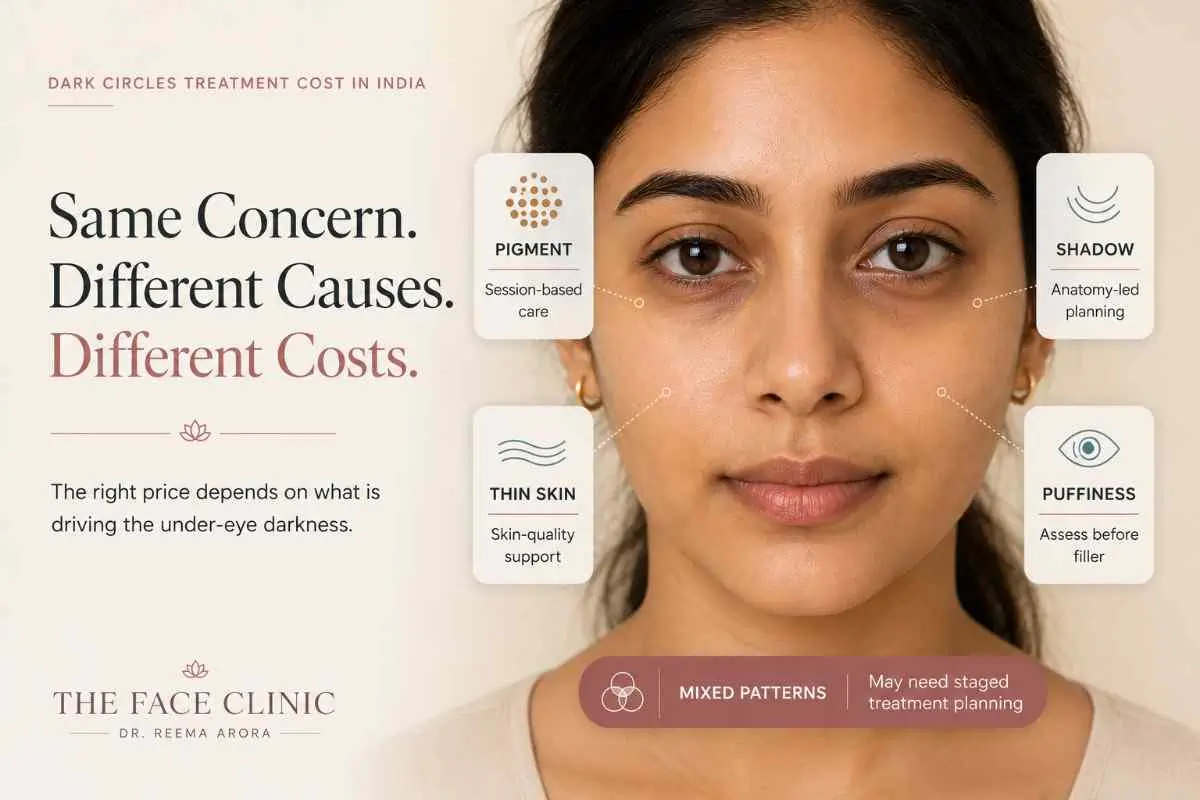
Dark Circle Treatment Cost in India: What You Should Actually Pay For
Dark circle treatment cost in India can vary considerably depending on what is actually causing the under-eye darkness. As an indicative guide, selected skincare approaches may cost around ₹1,500–₹8,000+, while peels and laser-based treatments may range from approximately ₹4,000–₹25,000+ per session. PRP, PDRN and other selected skin-quality treatments may fall within approximately ₹10,000–₹45,000+ per session, while under-eye filler or tear-trough treatment may cost approximately ₹20,000–₹70,000+ across India, depending on the product, amount required and treatment plan (at The Face Clinic: ₹22,000–₹35,000 for direct under-eye correction).
These figures are not directly interchangeable. Dark circles may be predominantly pigmentary, structural, vascular, skin-quality related or mixed, and each pattern may require a different treatment pathway. A patient with brown pigmentation, for example, should not compare treatment costs in the same way as someone whose darkness is mainly caused by tear trough hollowing or structural shadow.
Comparing price alone can therefore be misleading. A lower-cost treatment may offer poor value if it does not address the dominant concern, while a higher price may be reasonable when it reflects appropriate diagnosis, practitioner expertise, suitable products or technology, careful under-eye planning and realistic treatment requirements.
This guide explains what influences the cost of dark circle treatment in India, how different treatment categories compare, and what to consider before deciding whether a quoted price represents appropriate value.
Doctor's Summary: What Determines Dark Circle Treatment Cost?
Different causes of dark circles lead to different treatment pathways—and therefore different prices. A meaningful cost comparison should consider more than the advertised price of an individual procedure.
Before comparing treatment costs, consider:
what is primarily causing the under-eye darkness; which treatment category is being recommended and why; whether the quoted price is for one session, a product or a treatment course; how many sessions may realistically be required; which product, device or technique is being used; and whether the proposed treatment is appropriate for the delicate under-eye area.
Cost should follow diagnosis—not the other way around.
Doctor-Led Note
At The Face Clinic, treatment and cost planning begin with assessment rather than a predetermined procedure. The aim is to identify the dominant contributing factors, assess the under-eye anatomy and skin quality, and determine whether treatment is best approached with a single modality or a staged plan before discussing expected costs and realistic outcomes.
Dark Circle Treatment Cost in India: Typical Price Ranges
There is no single price for dark circle treatment because the options below represent different types of treatment and different pricing models. Skincare may involve product or course costs, while procedures such as peels, lasers, PRP and PDRN are commonly priced per session and may require a course. Under-eye fillers follow a different model, with cost influenced by the product, quantity required and treatment plan.
The table below provides a practical starting point for comparing dark circle treatment prices in India. These are broad indicative ranges rather than fixed quotations.
TREATMENT CATEGORY | APPROXIMATE COST RANGE IN INDIA | USUALLY CONSIDERED FOR |
|---|---|---|
Skincare / prescription creams | ₹1,500–₹8,000+ depending on product and course | Mild pigmentation, maintenance and barrier support |
Chemical peels | ₹4,000–₹10,000 per session | Selected pigmentation, dullness and superficial pigmentary concerns |
Laser / pigment correction | ₹5,000–₹25,000+ per session | Selected pigmentary or vascular-appearing concerns after appropriate assessment |
PRP | ₹10,000–₹30,000+ per session | Selected skin-quality concerns, early under-eye ageing and collagen support |
PDRN / selected skin-quality injectables | ₹15,000–₹45,000+ per session | Thin, crepey, dehydrated or poor-quality under-eye skin in suitable patients |
Under-eye fillers | Approximately ₹20,000–₹70,000+ across India depending on product, amount and plan (at The Face Clinic: ₹22,000–₹35,000 for direct under-eye correction) | Tear trough hollowing, structural shadow and volume-related darkness in appropriately selected patients |
Combination / staged plans | Variable according to treatment sequence | Mixed-pattern dark circles where more than one contributing factor needs to be addressed |
Doctor consultation / assessment | Variable | Diagnosis, suitability assessment, treatment planning and cost estimation |
Pricing note: These are broad India-level estimates. Actual dark circle treatment cost may vary according to the diagnosis, city, practitioner expertise, clinic, product or device used, treatment complexity, number of sessions required, and whether a staged or combination plan is appropriate. They should not be interpreted as fixed quotations or as a substitute for individual assessment.
The lowest number in the table is not automatically the best value. A ₹5,000 peel, for example, may be entirely reasonable for selected pigmentation but will not correct a structural tear trough shadow. Conversely, under-eye filler may be appropriate when hollowing is an important contributor, but it is not a universal treatment for dark circles and may be unsuitable where puffiness, fluid tendency or another factor predominates.
The most meaningful comparison is therefore the likely overall treatment pathway, not simply the advertised starting price.
Why Dark Circle Treatment Does Not Have One Fixed Price
Two patients may both describe their concern as “dark circles” while having very different underlying patterns. One may predominantly have brown pigmentation, another may have shadow caused by under-eye hollowing, while others may have thin skin, vascular visibility, puffiness, allergy-related factors or several contributors occurring together.
Medical literature describes the multifactorial causes of periorbital hyperpigmentation, including pigmentary, vascular and structural influences. This helps explain why skincare, peels, lasers, PRP, PDRN or other skin-quality treatments, under-eye fillers and combination plans cannot be treated as interchangeable simply because they may all be discussed in relation to “dark circles.”
Patients often search using different terms — dark circles treatment cost, cost of dark circle treatment, or dark circle treatment price in India — but the underlying answer depends on the same variable: what is actually causing the darkness.
A common financial mistake is to compare procedure prices before establishing what the procedure is expected to correct. Repeated pigment-focused treatment, for example, is unlikely to represent good value where structural shadow is the dominant problem. Equally, treating hollowing without first recognising significant puffiness or other anatomical factors may lead to an inappropriate treatment pathway.
For readers who want to understand the assessment and treatment-planning process rather than cost alone, our dark circle treatment in Delhi page explains the doctor-led treatment approach in more detail.
Where dark circles have persisted despite skincare or previous procedures, the issue may also involve an incomplete diagnosis, mixed causation or a treatment that addressed only one part of the problem. Our guide to why dark circles don’t go away explores these possibilities in greater detail.
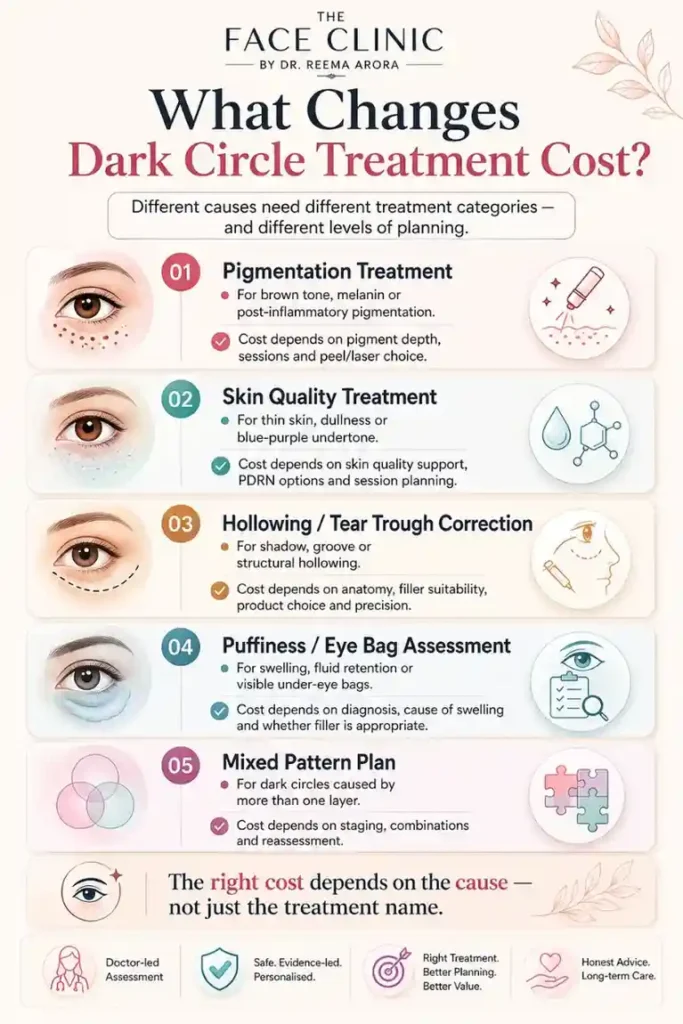
The Dark Circle Cost Map: What You Are Actually Paying For
A dark circle treatment quote is most useful when you understand what the price actually includes. Two clinics may quote different amounts without offering equivalent treatment plans: the difference may reflect the diagnosis, treatment category, number of sessions, product or device used, practitioner expertise, treatment complexity, follow-up—or simply what is and is not included in the fee.
A more meaningful comparison therefore looks beyond the headline number and considers the factors that may influence both the treatment plan and the overall cost.
WHAT MAY INFLUENCE THE COST | HOW IT CAN AFFECT THE TREATMENT PLAN OR PRICE | WHAT TO ASK BEFORE PAYING |
|---|---|---|
Main contributing factor(s) | Pigmentation, structural shadow, thin skin, puffiness and mixed-pattern dark circles may require very different treatment pathways and therefore different levels of expenditure. | What are the main factors contributing to my dark circles? |
Treatment category | Skincare, peels, lasers, PRP, PDRN or other skin-quality treatments, and fillers involve different products, technologies, treatment protocols and pricing models. | Why is this treatment category being recommended for my concern? |
Number of sessions | Some treatments are course-based and require repeat sessions, while others may involve fewer treatments but a higher cost per treatment. A single-session price may therefore be very different from the likely total expenditure. | Is this a one-session treatment or a course, and what is the likely overall cost? |
Under-eye complexity | Thin skin, puffiness, fluid tendency, anatomical variation or previous under-eye treatments may change treatment suitability, the approach recommended or whether staged treatment is required, which can alter total cost. | Am I suitable for this treatment, and are there factors that could change the plan or overall cost? |
Product / device / formulation | Different products, formulations and devices have different costs, protocols, indications and consumable requirements. | What product, formulation or device is being used, and why has it been selected? |
Practitioner expertise | The under-eye area is anatomy-sensitive. Assessment, treatment selection and technique—including device settings or injection planning where relevant—can influence safety and outcome. | Who will assess and perform the treatment, and what experience do they have with the under-eye area? |
What the quote includes / follow-up | Consultation, planned review, aftercare and management of concerns may or may not be included in the quoted fee. | What is included in the price, and is follow-up available if review is needed? |
The meaningful comparison is therefore the overall treatment pathway, not simply the advertised starting price. A useful quote should make it clear what is being treated, why that treatment has been selected, how many sessions or stages may be required, what product or technology is involved, who is providing the treatment and what follow-up is included.
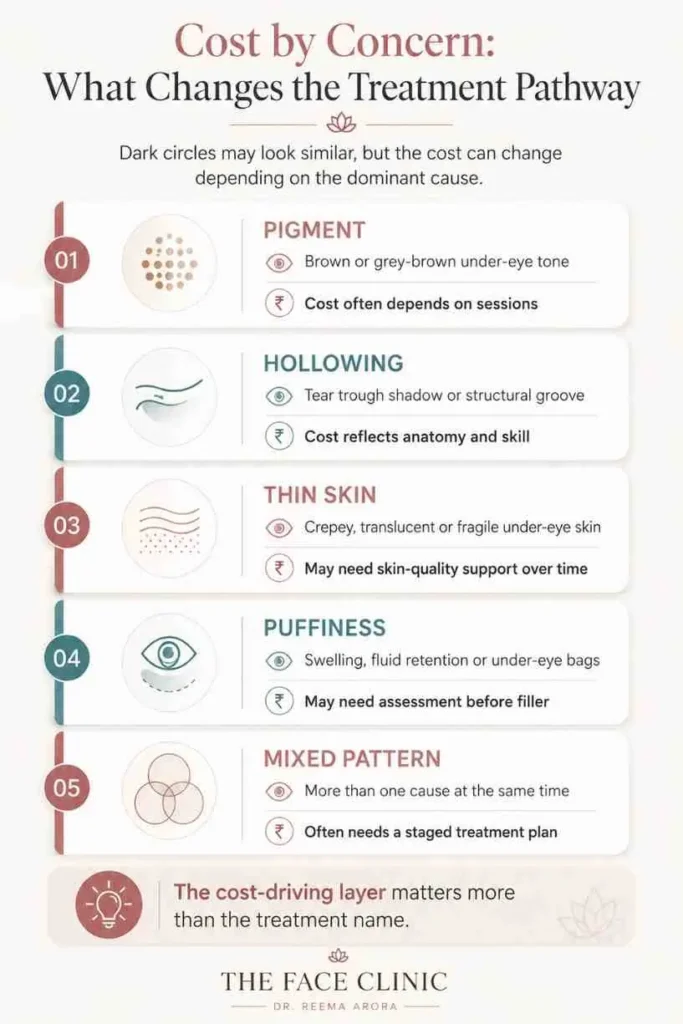
Cost by Concern: Pigment, Hollowing, Thin Skin, Puffiness or Mixed Dark Circles
The dominant under-eye concern changes both the treatment category and the likely pricing pattern. This is why the under eye dark circle treatment cost can look so different from one patient to another, even when both cases are simply described as “dark circles.” Pigmentation, structural hollowing, thin skin, puffiness and mixed dark circles should therefore not be budgeted in the same way.
Dermatology references describe multiple possible causes of dark circles, including pigmentation, thin translucent skin, puffiness and structural shadowing. Identifying the main contributing factors helps explain why two patients with similar-looking dark circles may receive very different treatment plans and cost estimates.
Pigmentation-Related Dark Circles
When brown or grey-brown pigmentation is the dominant concern, the treatment plan may include skincare, prescription products, selected chemical peels or pigment-focused procedures depending on the assessment.
These pathways may appear less expensive per treatment than injectable options, but total expenditure can increase when consistent skincare, repeat sessions or maintenance are required. Costs may also accumulate when repeat treatments are undertaken without addressing relevant triggers or recurrence factors.
The important comparison is therefore not only the starting price, but the likely duration of treatment, number of sessions and need for ongoing maintenance.
Hollow or Tear Trough Shadow
Structural hollowing follows a different cost pathway because creams and superficial pigment treatments cannot correct a shadow caused primarily by volume loss or anatomy.
In appropriately selected patients, structural treatment such as under-eye filler may therefore sit in a different pricing category. Cost can vary according to the product used, amount required, practitioner expertise and complexity of the treatment plan.
Because filler is not appropriate for every patient with under-eye darkness, deeper questions about structural hollowing and treatment suitability are better considered separately. Our guide to tear trough hollowing and when filler may help explains this structural concern in more detail.
Thin Skin or Blue-Purple Tone
When the under-eye area appears thin, translucent, crepey or blue-purple, the cost pattern may differ because the treatment objective is often gradual improvement in skin quality rather than pigment correction or structural volume replacement.
PDRN, selected skin-quality injectables or other collagen-support approaches may be planned as a course rather than a single treatment. The relevant financial comparison is therefore the price per session, recommended number of sessions and likely total course cost.
For treatment-specific information rather than cost comparison, our guide to PDRN eye treatment for under-eye skin quality explains where polynucleotide treatment may—and may not—fit into an under-eye treatment plan.
Puffy Under-Eyes or Eye Bags
Puffiness can create or exaggerate under-eye shadow, but the appropriate expenditure may not begin with an aesthetic procedure.
Puffy eyes and under-eye bags can have anatomical, lifestyle, inflammatory or medical contributors that may need assessment before treatment is considered. Cleveland Clinic notes that puffy eyes and under-eye bags can also relate to factors such as fat-pad prominence, bone structure and skin laxity.
Where significant eye bags or fat prolapse are present, repeated non-surgical treatments may offer poor value if the dominant concern requires a different approach or surgical opinion. In these situations, assessment can help prevent spending on procedures that are unlikely to address the main problem.
Mixed-Pattern Dark Circles
Many patients have more than one contributing factor—for example, pigmentation with hollowing, thin skin with vascular visibility, or puffiness combined with structural shadow.
These cases may require a staged treatment plan rather than one aggressive procedure. The total dark circle treatment cost can therefore be higher, but staged planning may provide better value when each treatment addresses a defined part of the problem and is performed in the appropriate sequence.
The financial advantage of staging is not that it is necessarily cheaper at the outset. It is that it may reduce repeated spending on treatments that address only one component of a mixed concern.
Identifying which concern is driving the treatment cost also helps explain why choosing the lowest-priced procedure can sometimes become more expensive over time.
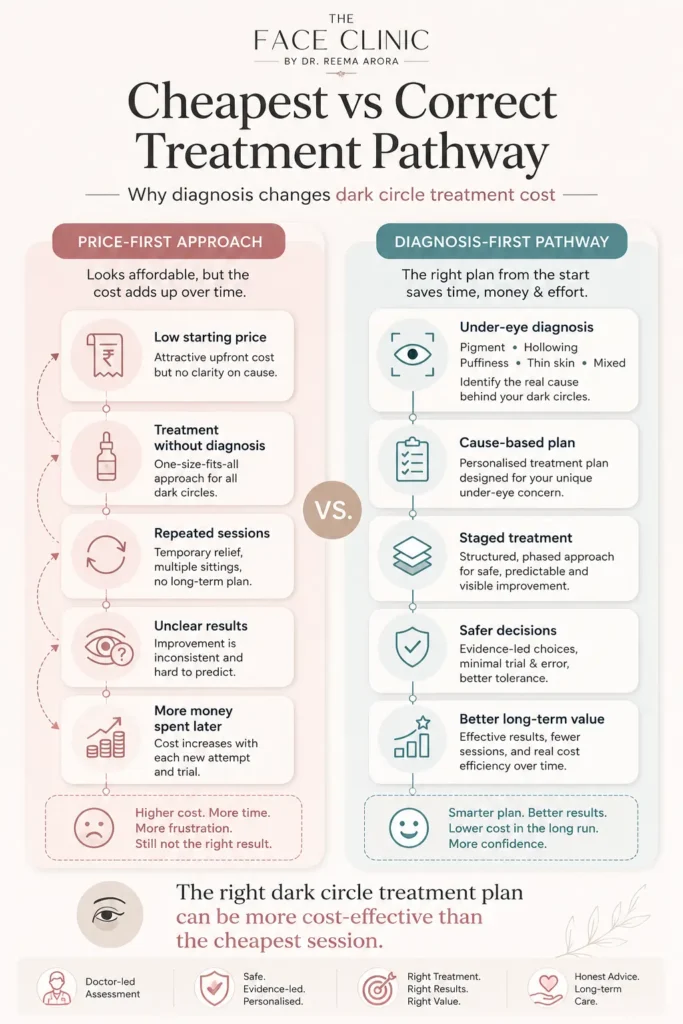
Why the Cheapest Treatment May Become Expensive
The cheapest dark circle treatment is not always the most economical choice. A lower upfront price can become more expensive over time if the treatment does not match the concern actually driving the under-eye darkness and the patient then pays repeatedly for limited or mismatched improvement.
For example, a peel may help selected pigmentation but cannot correct structural hollowing. Under-eye filler may soften a tear trough shadow in an appropriately selected patient but will not remove true brown pigmentation. Likewise, a pigment-focused laser may improve selected pigmentary concerns but cannot correct a structural groove caused primarily by anatomy or volume loss.
The financial problem is therefore not simply that a treatment is inexpensive. It is that repeated low-cost interventions can create a higher cumulative spend when they are being used for the wrong indication. Several individually affordable treatments may ultimately cost more than a properly planned pathway that matches the treatment category to the dominant concern.
The more useful question is not “Which option costs least?” but “Which option is appropriate for the concern I actually have?” A lower price represents good value when the treatment is appropriate, the expected benefit is realistic and the overall treatment pathway makes clinical sense.
Why Structural Treatment Is Priced Differently — And Why It Is Not for Everyone
Under-eye fillers sit in a different pricing category from skincare, peels or many pigment-focused treatments because they involve an injectable medical product together with anatomy-led assessment, product selection, treatment planning, precise placement and follow-up.
A higher filler quote does not mean filler is the correct treatment for every type of dark circle. Filler is mainly relevant where structural hollowing or tear trough shadow is an important contributor. If pigmentation, puffiness, skin-quality changes or another concern is dominant, spending more on filler does not necessarily represent better value.
The relevant comparison is therefore not simply whether filler is more expensive, but whether structural hollowing is genuinely the concern being treated and whether the quoted price reflects an appropriate product, amount and treatment plan.
Readers considering filler specifically can review our under-eye fillers in Delhi page for procedure-specific suitability, planning, risks and treatment considerations.
When a Staged Plan May Be More Cost-Effective Than One Procedure
A staged plan may sometimes be more cost-effective when dark circles have more than one significant contributing factor. In mixed-pattern cases, a single procedure may improve only one part of the visible concern, while other contributors remain unchanged.
Staging allows the treatment plan to be divided into defined steps rather than committing immediately to several procedures at once. For example, when pigmentation, skin quality, puffiness and structural shadow overlap, assessment may determine which issue should be addressed first and whether later stages are still necessary after the initial response is reviewed.
This approach changes how treatment cost should be judged. Instead of comparing only the price of the first procedure, patients should ask:
what each proposed stage is intended to address; which stages are essential and which are conditional; how many sessions may be required; what the likely total planned expenditure could be if all recommended stages are needed; and whether later stages will be reassessed based on response.
The value of staging is not that it is necessarily cheaper at the outset. It is that it may reduce unnecessary treatment, allow the plan to be adjusted as the under-eye area responds, and avoid paying for several procedures before it is clear that each one is required.
Not every patient needs a staged plan. When one dominant concern can be treated appropriately with a simpler approach, adding unnecessary stages only increases cost. A staged pathway should therefore be used because the clinical pattern justifies it—not because a larger treatment plan is automatically better.
For mixed-pattern dark circles, the financial value of staging comes from giving each treatment step a defined purpose and reassessing whether the next step is still necessary, rather than trying to treat every possible contributor at once.
Dark Circle Treatment Cost in India: What Affects Pricing Locally?
Dark circle treatment cost in India can vary even within the same broad treatment category. For instance, dark circle treatment cost in Delhi may differ from other Indian cities due to variations in clinic overheads, technology availability and practitioner experience. Differences in quoted prices may reflect the location or city, practitioner expertise, treatment complexity, clinic fee structure, exact product or device used, number of sessions required, and whether consultation, review or follow-up is included.
Pricing also depends on how the treatment itself is structured. A quote may represent a single session, a treatment course, a specific product quantity or a broader treatment plan. Two prices that appear very different may therefore not be directly comparable unless the treatment scope and pricing basis are clear.
When comparing India-level costs, it is more useful to ask what the quoted amount actually covers and what the likely overall expenditure may be. A lower session price does not necessarily mean a lower total cost if additional sessions, products or clinically indicated treatment stages are likely to be required.
How to Compare Dark Circle Treatment Prices Safely
Dark circle treatment prices are easiest to compare when the quotes relate to equivalent treatment plans. The headline number matters, but so do the diagnosis, treatment scope, likely number of sessions, product or device involved, practitioner expertise and follow-up.
Before Comparing Two Dark Circle Treatment Quotes, Check:
Are both plans treating the same concern? A quote for pigmentation treatment should not be compared directly with one for structural hollowing, skin-quality treatment or a mixed-pattern plan.
What does the quoted price represent? Check whether it is per session, per product, for a treatment course or for a wider staged plan.
How many sessions are realistically expected? A lower per-session price can result in a higher total cost if substantially more sessions are required.
What exact treatment, product, formulation or device is included? The treatment being compared should be clear rather than described only by a broad marketing name.
Who will assess and perform the treatment? For medical or procedural under-eye treatment, consider the practitioner’s relevant qualifications, experience and familiarity with the under-eye area.
What consultation, review and follow-up are included? Two treatment prices may represent different levels of assessment and aftercare.
What are the important limitations, risks and alternatives? A useful consultation should explain not only what treatment may help, but also where improvement may be limited or where another approach may be more appropriate.
The purpose of comparing quotes is therefore to establish whether you are comparing equivalent treatment plans, not simply different headline prices.
When Paying More May Be Worth It — And When It May Not Be
A higher dark circle treatment quote is not automatically better value. Additional cost may be reasonable when it corresponds to a meaningful difference in the assessment, treatment complexity, practitioner expertise, product or device requirements, treatment planning or follow-up.
Paying More May Be Worth It When
A higher fee may be reasonable when the treatment is technically complex or anatomy-sensitive and requires greater assessment, planning or procedural expertise. Selected under-eye injectable procedures are one example, but the same principle can apply where laser-based or other technically complex treatment requires careful assessment and technique.
Practitioner expertise may also influence professional fees, particularly when previous treatment, unusual anatomy or mixed contributing factors make assessment or treatment planning more complex.
The exact product, formulation, device and consumables used can also affect price. A higher quote may be reasonable where a particular product or technology is appropriate for the concern—but it should be selected because it fits the treatment plan, not simply because it is more expensive.
Meaningful follow-up can also add value, particularly where treatment response needs to be reviewed before any additional procedure or clinically indicated stage is considered.
Paying More May Not Be Worth It When
A higher fee is harder to justify when the underlying concern has not been adequately assessed or when the proposed treatment is not clearly linked to what is causing the under-eye appearance.
It may also represent poor value when:
a fixed package is recommended without establishing whether every component is appropriate; the additional cost is explained mainly through branding or “premium” terminology rather than a meaningful clinical difference; dramatic or unrealistic results are promised; unnecessary procedures are added without a clear purpose; or the quote does not make clear what treatment, product, number of sessions or follow-up is actually included.
The relevant question is therefore not simply whether one clinic charges more. It is what the additional cost is buying. A higher quote may represent better value when the additional cost corresponds to a meaningful difference in treatment suitability, technical complexity, practitioner expertise, product or device requirements, or follow-up.
Dark Circle Treatment Cost at The Face Clinic
At The Face Clinic, dark circle and under-eye treatment costs are discussed after a doctor-led assessment rather than through a one-size-fits-all package. The final quote depends on the concern being treated, the treatment category selected, the likely number of sessions or stages, and any product, device or follow-up requirements relevant to the plan.
To understand which treatment pathway and approximate cost range may apply to your under-eye concern, you can book a doctor-led assessment at The Face Clinic.

Frequently Asked Questions About Dark Circle Treatment Cost
What Is the Dark Circle Treatment Cost in India?
Dark circle treatment cost in India varies by treatment category. As a broad guide, skincare may cost around ₹1,500–₹8,000+, chemical peels around ₹4,000–₹10,000 per session, laser treatment around ₹5,000–₹25,000+ per session, PRP for dark circles cost around ₹10,000–₹30,000+ per session, PDRN or selected skin-quality injectables around ₹15,000–₹45,000+ per session, and under-eye filler treatment may cost approximately ₹20,000–₹70,000+ across India, depending on the product, amount required and treatment plan (at The Face Clinic: ₹22,000–₹35,000 for direct under-eye correction). These are indicative India-level ranges rather than fixed quotations. The total cost depends on the concern being treated, treatment selected, number of sessions and whether a staged or combination plan is required.
Why Does Dark Circle Treatment Cost Vary So Much?
Dark circle treatment cost varies because different underlying concerns require different treatment categories, and those treatments differ in product or device requirements, practitioner input, treatment complexity and number of sessions.
A patient being treated primarily for pigmentation will therefore have a different cost pathway from someone whose main concern is structural hollowing, skin quality, puffiness or a mixed pattern.
How Many Sessions Are Needed, and How Does That Affect the Total Cost?
The number of sessions depends on the treatment and the concern being addressed. Some treatments may involve a course of several sessions, while others may require fewer treatments but have a higher cost per treatment.
For this reason, compare the likely total treatment cost, not only the advertised price of one appointment. Where a staged plan is proposed, it is also useful to ask which stages are essential and which will be reconsidered after reviewing the response.
What Does Dark Circle Removal Treatment Cost in India?
“Dark circle removal” is a common search term, and dark circle removal cost can vary just as widely, but there is no single procedure that removes every type of dark circle. Treatment cost depends on whether the main concern involves pigmentation, structural shadow, skin quality, puffiness or more than one contributing factor.
The dark circle removal treatment cost may therefore involve skincare, peels, laser-based treatment, skin-quality procedures, injectables or combination plans, each with a different pricing structure. The relevant price is the cost of treating the identified concern rather than the price of a procedure marketed broadly for “dark circle removal.”
Is Filler Worth the Cost for Dark Circles?
Filler is only worth considering when structural hollowing or tear trough shadow is a major cause of the darkness; it does not treat pigmentation. Across India, under-eye filler typically costs around ₹20,000–₹70,000+ depending on product and plan. For clinic-specific pricing, suitability and risks, see our under eye fillers in Delhi page.
How Much Does Laser Treatment for Dark Circles Cost?
Laser treatment for dark circles may cost approximately ₹5,000–₹25,000+ per session in India, depending on the device used, treatment indication, treatment protocol and number of sessions required.
The total cost may therefore be substantially different from the price of one session. Laser should be selected according to the type of concern and individual treatment requirements rather than compared with other dark-circle treatments on price alone.
Is Cheaper Dark Circle Treatment Safe?
A cheaper dark circle treatment is not automatically unsafe, just as a higher price does not automatically mean better care. More important questions are whether the treatment is appropriate, what product or device is being used, who is providing the treatment, and what assessment and follow-up are included.
A low price becomes poor value when important parts of the treatment plan are unclear or when repeated treatment is undertaken without adequately addressing the underlying concern.
All treatments are subject to individual variation. Outcomes are determined following clinical evaluation by a qualified doctor.